

ServiceNow Implementation Services
Implement ServiceNow with the right foundation from the beginning. Aegis Softtech provides ServiceNow implementation services, including assessment, solution design, configuration, integrations, data migration, testing, user enablement, go-live, and hypercare across enterprise ServiceNow environments.
- Now Create + Agile/Scrum : Structured delivery with iterative sprints
- OOTB-First : Native capabilities before unnecessary customization
- CSDM-Centric : Service and data architecture built into the foundation
- Enterprise-Ready : Architecture, integrations, security, data, and automation

Hire Certified Consultants


Review our official certifications and industry recognitions. Each logo represents the authentic partnerships, credentials, and professional accolades that validate our consulting services.




Our ServiceNow Implementation Services
Our ServiceNow implementation services cover the work required to take an implementation from initial assessment and architecture through configuration, integration, testing, deployment, and user enablement.

ServiceNow Assessment & Implementation Planning
Start with a clear understanding of what the platform needs to support. We conduct process and technical discovery, assess requirements and dependencies, define the implementation scope, and turn agreed requirements into a prioritized backlog and implementation plan.
Key areas:

ServiceNow Solution Design & Architecture
Establish how your ServiceNow platform implementation will enable your processes, data, security, integrations, and long-term platform requirements before development begins. Solution design includes the architecture, foundational data, integration needs, security considerations, governance, and implementation specifications required for a successful ServiceNow platform implementation.
Key areas:
For platform strategy, architecture, and roadmap requirements, explore our ServiceNow Consulting Services.

ServiceNow Configuration & Workflow Implementation
Configure workflows, forms, routing, approvals, service catalogs, SLAs, workspaces, business rules, and other platform capabilities based on agreed-upon requirements.
Key areas:

ServiceNow Integrations During Implementation
Plan and build the connections required between ServiceNow and your enterprise systems. We define integration architecture, data flows, authentication, dependencies, error handling, and testing based on the systems and workflows involved.
Key areas:

Data Migration During ServiceNow Implementation
Prepare and move the data required for your implementation using Extract, Transform, and Load (ETL) pipelines, Import Sets, Transform Maps, Robust Transform Engine (RTE), and IntegrationHub ETL. The work may involve activities such as legacy data extraction, cleansing, relationship mapping, historical documents and attachments, reconciliation, data cleansing, test loading, and production cutover.
Key areas:
For legacy data, instance, or platform migration requirements, explore our ServiceNow Migration Services.

ServiceNow Implementation Testing & User Acceptance
Testing is inherent in the delivery process, rather than left for last. This includes unit testing done during the development stage, Automated Test Framework (ATF) suites, integration testing, User Acceptance Testing (UAT) and defect remediation before cutover to production. Our ATF implementations have reduced manual regression-testing cycles by 60%.
Topics:

Training & User Enablement
Ensure that users and admins are ready for the new ServiceNow environment before the go-live. Delivery may be done through end-user & administrator training guides, role-based enablement, walkthroughs, etc. Organizational Change Management is implemented before the go-live to support adoption.

Go-Live & Hypercare
Complete production deployment and cutover, followed by 2 to 4 weeks of go-live hypercare and operational transition.
For ongoing administration, monitoring, maintenance, optimisation, and support after implementation, explore our ServiceNow Managed Services.
Bring us your requirements. We’ll help you define the scope and get your implementation moving.

ServiceNow Implementation Across Key Products
Aegis Softtech's implementation experience spans IT Operations, Employee/Customer Workflow, Security & Risk, Portfolio Management, Automation, Integrations, and Custom Platform Applications.
ServiceNow ITSM Implementation
Design and implement all lifecycle IT service processes from Incident, Problem, Change, Release, Request, Knowledge and SLA Management. Implement Service Operations Workspaces, dynamic routing, an approval process, a service catalogue, a fulfilment process, and operational reporting.
ServiceNow ITOM Implementation
Deploy Discovery, Service Mapping, Event Management, Health Log Analytics, and Cloud Operations in hybrid environments. Deploy MID Server clusters, service dependency mapping, monitoring integration, event correlation, alert clustering, and workflow automation.
ServiceNow ITAM Implementation
Implementation of Hardware Asset Management (HAM) and Software Asset Management (SAM) throughout the asset life cycle, starting from normalization up to contract repositories, license compliance, stockroom policies, procurement processes, and inventory reconciliation.
ServiceNow CMDB Implementation
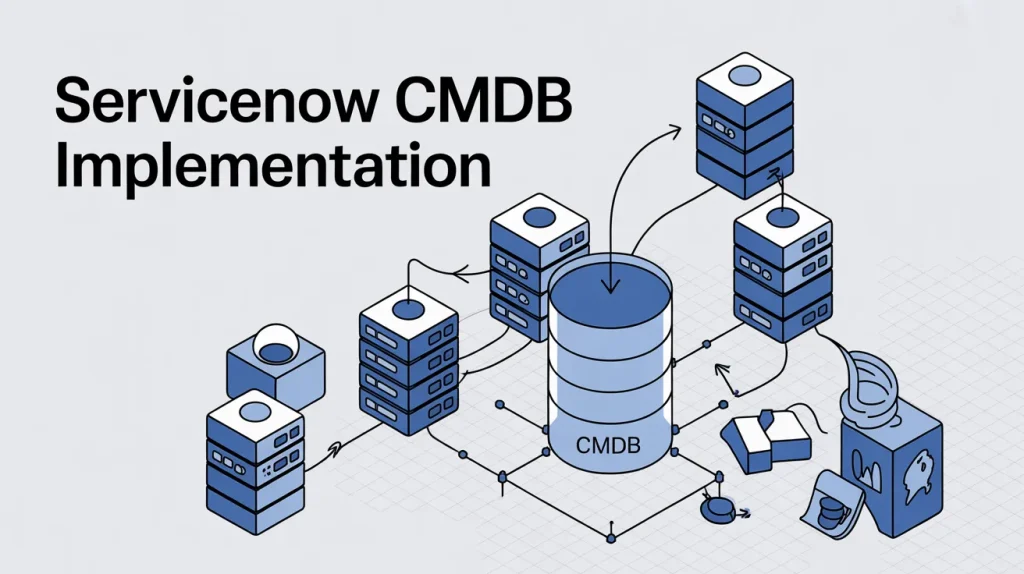
Implementation of Enterprise CMDB with CI Class Hierarchies, Relationship Dependencies, IRE, Multi-source CMDB, and Data Health dashboards.
ServiceNow CSDM Implementation
Match the business applications, technical services, service offerings, and infrastructure using ServiceNow Common Service Data Model. Define service hierarchies, naming policies, ownership models, and service lifecycles. This will help with service-aware operations and impact analysis.
ServiceNow HRSD Implementation
Deploy HR case and knowledge management capabilities, Employee Center Pro, and Enterprise Lifecycle Events to support onboarding, transfers, and offboarding processes. Create HR COE data structures that are secure and integrate ServiceNow with HCM platforms like Workday, SAP SuccessFactors, and Oracle HCM.
ServiceNow CSM Implementation
Deploy Case Management, Omni-Channel, Customer Portals, Account & Contacts hierarchies, Service Contracts and Entitlements by integrating customer workflows with internal IT, Field Service and Engineering teams.
Service Portal & Employee Center Implementation
Design mobile-responsive Service Portal and Employee Center experiences with unified taxonomies, dynamic content, enterprise search, request catalogs, and personalized experiences. Bring IT, HR, facilities, and other employee services into a common self-service experience.
ServiceNow SecOps Implementation
Implement Security Incident Response, Vulnerability Response, and Threat Intelligence with integrations to tools such as Tenable, Qualys, CrowdStrike, and Splunk. Capabilities include risk-based vulnerability prioritization, CMDB-based scoring, remediation workflows, threat enrichment, and automated security playbooks.
ServiceNow GRC / IRM Implementation
Implement Policy & Compliance, Risk Management, Audit Management, and Third-Party/Vendor Risk Management using compliance frameworks, continuous-control testing, risk scoring, and audit dashboards.
ServiceNow SPM Implementation
Demand Management, Project Portfolio Management, Agile Development, Resource Management, Financial Cost Planning, and Portfolio Reporting will be implemented for structured project intake, demand management, resource planning, and portfolio visibility.
ServiceNow App Engine Implementation
Set up App Engine Studio, low-code development frameworks, custom data models, flow designer workflows, role-based security, deployment pipelines, and citizen-development governance.
ServiceNow Automation Implementation
Create enterprise workflow automation through Flow Designer, Process Automation Designer, Decision Tables, Virtual Agent, Predictive Intelligence, and automated fulfillment.
ServiceNow IntegrationHub Implementation
Implement out-of-the-box (OOTB) Spokes, REST/SOAP IntegrationHub Actions for custom development, Data Stream actions, secure MID server integration, and authentication, transformation, and error handling pattern implementation.
Custom ServiceNow Application Implementation
Build scoped applications for requirements that an existing ServiceNow product cannot meet. Capabilities include custom data models, Script Includes, client scripts, REST APIs, UI Builder, Workspaces, security controls, and workflow logic.
For custom applications, workflows, integrations, and other platform development needs, explore our ServiceNow Development Services.
Measurable Outcomes From Our ServiceNow Implementations
| Implementation | Proven Result |
|---|---|
| Enterprise IT Modernization | ITSM, ITOM, and CMDB implementation supporting 50,000+ users, with 42% lower MTTR and 75% lower event noise |
| Global HR & Workplace Transformation | HRSD and Employee Center Pro implementation with 50% lower onboarding turnaround time |
| Asset & License Management | HAM/SAM implementation yielding millions of dollars in reclaimed software licenses |
| SecOps & GRC | Automated vulnerability and compliance processes on 200,000+ assets, decreasing vulnerability-remediation timelines from months to days |
ServiceNow Implementation Case Studies

GOVERNMENT · SERVICENOW ITSM
ServiceNow Cuts Service Resolution Time by 40% for a European Government Agency
We replaced disconnected legacy systems with a unified ServiceNow platform — automating incident and request management, deploying a multilingual self-service portal, and building in GDPR-compliant audit trails — taking the client from delayed, error-prone service requests to faster, transparent, citizen-facing operations.
Europe • Public Transportation Agency • 280 Users • Consultant : Vivek Ladani
MANUFACTURING · SERVICENOW ITSM + HRSD
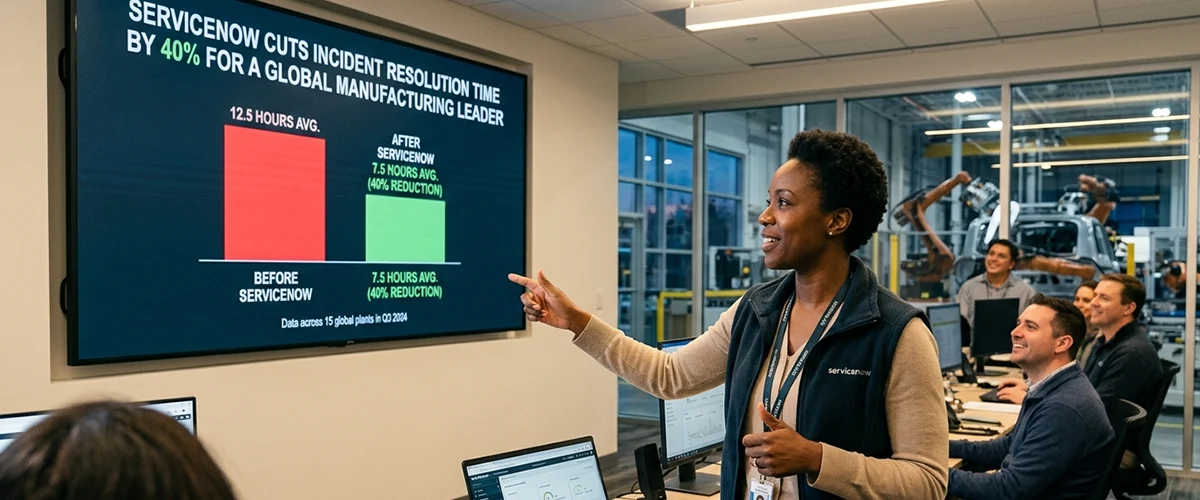
ServiceNow Streamlines IT and HR Services for 2,400+ Manufacturing Employees
We automated incident, problem, and change management with ServiceNow ITSM, built self-service portals, and designed automated onboarding workflows integrated with Active Directory and SAP—taking the client from outdated, manual IT processes to faster resolution, quicker onboarding, and real-time visibility across 2,400+ employees on three continents.
Result: 40% faster incident resolution | 25% higher customer satisfaction | 20% cost reduction
Global • Industrial Machinery Manufacturer • 463 Users • Consultant : Vivek Ladani
Trusted by Enterprises Across Industries
Leading businesses choose Aegis Softtech for the expertise, reliability, and technical depth needed to solve complex technology challenges and support critical business initiatives.













Complex ServiceNow Implementations We Handle
Complex environments may require ServiceNow implementation solutions tailored to technical debt, multiple instances, large data volumes, restricted networks, or specific security requirements.
Heavily Customized ServiceNow Environments
Refactor legacy technical debt, streamline complex business rules, and bring heavily customized environments towards native ServiceNow standards.
Multi-Instance Consolidation & Large-Scale Data Migration
Consolidate siloed global instances or migrate massive legacy datasets, keeping relationships between records intact. We have extensive migration experience, having migrated tens of millions of records, leveraging automated data reconciliations, data sanitisation, and parallelised load testing.
Segmented, Air-Gapped and Large-Scale Discovery
Setup MID Server topologies across strict firewalls, DMZs, segmented, and air-gapped environments. Our experience includes highly segmented networks in banking and healthcare, each comprising 250,000+ active CIs.
Complex Domain Separation
Create secure, partitioned domain-separated architectures for shared services and Managed Service Provider (MSP) environments.
Tell us what’s making your implementation complex, and we’ll help you determine the best way to handle it.

Our ServiceNow Implementation Methodology
We follow ServiceNow’s Now Create methodology, supported by Agile/Scrum delivery. Our delivery model includes preparation activities within the planning stage, so the team is ready to begin execution with the required architecture, foundation data, sprint plan, and test approach in place.
Initiate
Define the scope of work, align on the business vision, set up a governance structure, configure development tools, and conduct the formal kickoff.
Key deliverables:
Key roles:
Project Manager|Engagement Manager|Platform Architect
Plan
Perform process and technical discovery workshops, map current and future states, CSDM alignment, and prioritized product backlog creation.
Key deliverables:
Key roles:
Business Process Consultant|Technical Architect|Product Owner
Preparation
Build instances, develop the basic data models and developer pipelines, and prepare the sprint and test plans.
Key deliverables:
Key roles:
Lead ServiceNow Developer / Platform Architect|Project Manager
Execute
Create configurations, integrations, flows, and scripts through Agile sprints with unit tests and continuous sprint demonstrations.
Key deliverables:
Key roles:
Certified System Administrators / Developers|Technical Architect|Business Process Consultant
Deliver
Ensure end-to-end integration testing and UAT are completed, defects are corrected, user training is provided, and the production cutover is accomplished.
Key deliverables:
Key roles:
QA / Test Lead|OCM / Training Specialist|Lead Developer / Project Manager
Close
Provide hypercare, transfer ownership of the platform to the operations team, capture lessons learned, and complete project closure.
Key deliverables:
Key roles:
Project Manager|Engagement Manager|Operations / Managed Services Team
Our Approach to Customization in ServiceNow Implementation
At Aegis Softtech, we follow an OOTB-first approach, giving preference to the native features available on the ServiceNow platform before moving on to custom scripting and functionalities.
For any customization that may be needed, we make use of ServiceNow platform capabilities like scoped applications, App Engine, Flow Designer, UI Builder, and IntegrationHub to keep the ServiceNow platform implementation maintainable and easier to evolve. Our implementation approach targets less than 15% customizations.

ServiceNow Integrations for Your Implementation
Our Integration expertise includes enterprise applications ranging from ERP and DevOps to IT operations, security, identity, and collaboration.
| Integration Area | Systems |
|---|---|
| ERP & Core Systems | SAP ECC/S4HANA|Oracle EBS|Workday|Microsoft Dynamics |
| DevOps & Agile | Jira|Azure DevOps|GitHub|GitLab|Jenkins |
| IT Operations & Monitoring | Dynatrace|Datadog|Splunk|SolarWinds |
| Security | CrowdStrike|Tenable|Qualys |
| Identity & Access | Microsoft Entra ID|Okta|CyberArk |
| Collaboration | Microsoft Teams|Slack|Zoom |
ServiceNow Implementation Timelines
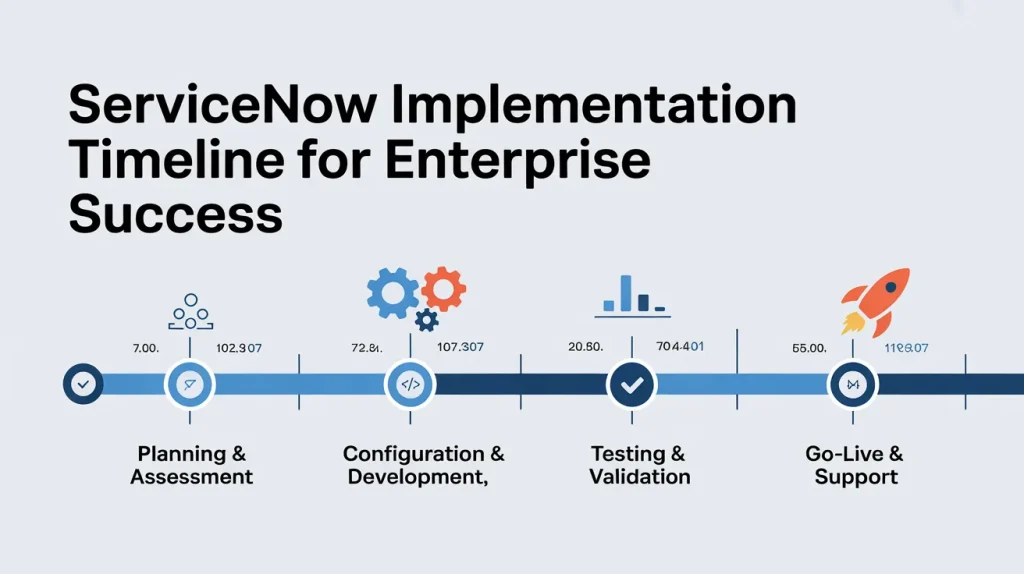
The amount of time needed for a ServiceNow implementation is affected by various factors, which include data requirements, integration complexity, architecture, process changes, and overall scope.
| Implementation | Typical Timeline | Scope |
|---|---|---|
| Basic ITSM | 6-8 weeks | OOTB Incident, Problem, Change, Request, Knowledge and baseline Portal with minimal customization or integrations |
| Mid-Size ITSM | 10-14 weeks | ITSM, Service Catalog, approvals, SLAs, routing, basic CMDB and standard integrations |
| ITSM + CMDB | 12-16 weeks | ITSM with CMDB, IRE, Multisource setup, data-health capabilities and foundational data |
| ITSM + Multiple Integrations | 14-18 weeks | ITSM with 3–5 complex bidirectional integrations |
| Enterprise ITSM | 16-22 weeks | Global deployment, advanced workflows, CSDM alignment and legacy-data migration |
| ITSM + ITOM | 18-26 weeks | ITSM with MID Server clustering, Discovery, Service Mapping and Event Management |
| Enterprise Multi-Module | 28-40+ weeks | Phased implementation across multiple ServiceNow products |
What Can Affect Your ServiceNow Implementation Timeline?

Changing requirements
Use MoSCoW prioritization and route new requirements through the backlog or change process.

Poor data quality
Begin data discovery, extraction, and validation early using ETL staging for validation.

Integration access delays
Confirm API access, service accounts, credentials, and MID Server/firewall requirements before development.

Slow approvals from stakeholders
Set up RACI and governance right from the start, with regular approval check points.

Bottlenecks in the UAT phase
Build ATF suites during development so functionality is tested before reaching UAT.

User resistance
Introduce OCM, role-specific training, walk-throughs, and champion empowerment before cutover.
ServiceNow Implementation Across Industries


Healthcare & Life Sciences
Support service delivery, medical-device asset management, clinical workflows, and protected-data requirements.

Manufacturing, Supply Chain & Retail
Support IT operations, supply-chain incident routing, supplier processes, asset management, and B2B customer service.

Technology & SaaS
Support Agile/SPM portfolio management, multi-cloud Discovery, IT operations, and DevOps/Jira integrations.

Telecommunications & Utilities
Support high-volume event management, distributed network Discovery, field service, and customer service environments.
Every implementation has a different scope and technical requirements. Tell us about your needs, and we’ll help you understand the timeline involved.

ServiceNow Implementation for Mid-Market and Enterprise Organizations

Mid-Market Organizations
For organizations with approximately 500 to 2,500 people, implementation initiatives can center on ITSM, self-service portals, user provisioning automation, and the replacement of legacy or spreadsheet-based processes.

Enterprise & Global Organizations
For organizations with approximately 2,500 to 100,000 employees, implementation initiatives can include multi-instance architectures, multi-country HRSD & CSM, ERP/CRM integration, and complex hybrid-cloud ITOM & CMDB environments.
Meet Our ServiceNow Implementation Experts
A ServiceNow implementation specialist can support different parts of the project, from solution architecture and platform configuration to integrations, security, data, development, and testing.
Certified ServiceNow Expertise
- Architecture: CMA • CTA
- ServiceNow Certified Implementation Specialist (CIS): ITSM • ITOM • HAM • SAM • HRSD • CSM • SIR • VR • Risk & Compliance • SPM
- Core & Development: CAD • CSA
- Industry Credential: ITIL 4 Managing Professional
ServiceNow Architecture & Security Capabilities
Our ServiceNow architecture capabilities include governance of the platform, data modeling, ACL modeling, encryption in transit and at rest, Edge Encryption, and controlled data segregation for enterprise ServiceNow environments.





FAQ About ServiceNow Implementation Services
A ServiceNow implementation can include requirements gathering, solution design, platform configuration, integrations, data migration, testing, user enablement, production deployment, and post-go-live hypercare. The exact scope depends on the ServiceNow products and business processes being implemented.
The implementation time varies with the project's scope, the number of ServiceNow products involved, data volume, customisation, and complexity. It could range from 6-8 weeks for an ITSM implementation to 28-40+ weeks for a multi-module implementation in phases.
The implementation cost for ServiceNow varies based on the products being implemented, the project scope, integration needs, data migration needs, customization needs, implementation timeline, and the technical complexity of the implementation. A detailed assessment is usually needed before the implementation effort, and the cost can be estimated accurately.
Yes. The large-scale implementation process can be split into release waves based on the products, workflows, business units, or priorities. Such an approach may help manage a complex enterprise implementation process.
Yes. ServiceNow can be integrated with existing ERP, DevOps, monitoring, security, identity, and collaboration systems. Aegis Softtech's integration experience includes SAP, Oracle, Workday, Jira, Azure DevOps, Splunk, Microsoft Entra ID, Okta, Teams, Slack, and other enterprise platforms.
Not all requirements need custom development. An OOTB-first approach uses native ServiceNow capabilities wherever they meet the business requirement and introduces customization only where there is a clear need. Aegis Softtech's documented implementation approach targets less than 15% customization.
As part of the project, a ServiceNow implementation specialist can collaborate with project managers, product owners, architects, developers, QA, and change management experts.
Prepare your current processes, business requirements, information about the existing system, data sources, system integration dependencies, security requirements, and user groups. Having these ready can help the first step go more smoothly.
Risks can be minimized by controlling scope, validating data early, confirming integration prerequisites, assigning clear stakeholder responsibilities, testing throughout development, and preparing users before cutover.
A good ServiceNow implementation partner should understand your requirements, have experience with the services that you require, and have a clear delivery process in place. While selecting ServiceNow implementation firms, also evaluate their integration capabilities with projects similar to yours.