
The data warehouse vs data lake vs data lakehouse decision depends on what data you have and how you plan to use it. A data warehouse is ideal for providing organized, reliable reporting to the company. A data lake is an adaptable method to store huge quantities of varied and unstructured data. A data lakehouse integrates the flexibility of a lake with the administration and analytics capabilities of a warehouse — giving teams one architecture for both.
This article compares all three, so you can select a suitable architecture.
Data Warehouse vs Data Lake vs Data Lakehouse: A Quick Comparison
While all three architectures centralize data for analysis, they differ significantly in how they store, organize, govern, and process it.
| Factor | Data Warehouse | Data Lake | Data Lakehouse |
| Primary purpose | BI and structured analytics | Large-scale raw data storage | Unified BI, analytics and AI |
| Data types | Mainly structured | Structured, semi-structured and unstructured | Structured, semi-structured and unstructured |
| Data state | Cleaned and processed | Mostly raw | Raw and curated |
| Schema approach | Primarily schema-on-write | Primarily schema-on-read | Supports flexible and governed schemas |
| Storage | Optimized analytical storage | Typically cloud object storage | Typically cloud object storage plus a management layer |
| Governance | Strong | Requires additional controls | Stronger governance than a basic lake |
| BI reporting | Excellent | Requires additional processing/tools | Strong |
| AI/ML workloads | Possible, but not its traditional strength | Strong for data science workloads | Strong |
| Cost profile | Depends heavily on platform and compute | Storage is generally economical | Economical storage with additional processing/management costs |
Data Warehouse vs Data Lake vs Data Lakehouse: Detailed Comparison
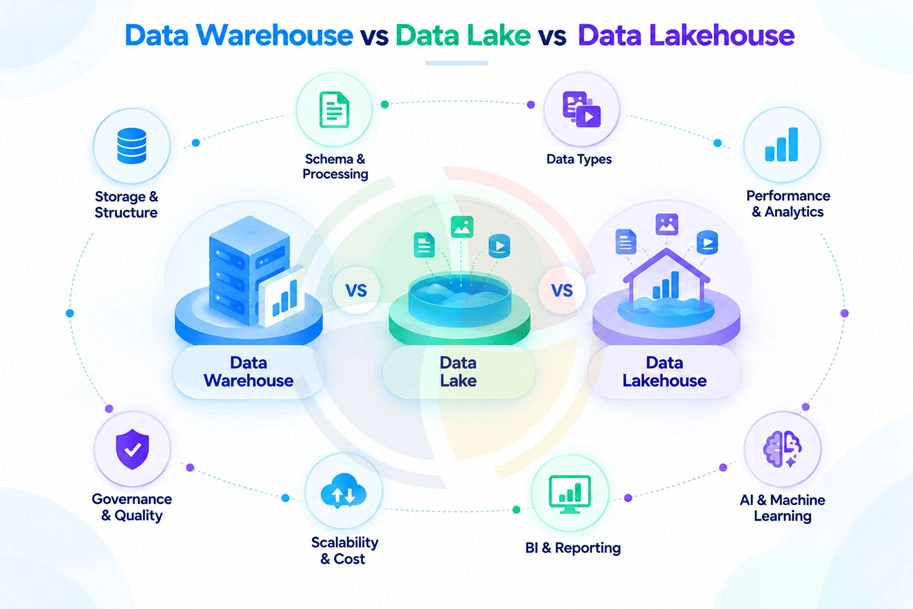
Let’s look at how each architecture actually handles data, where it performs best, and what changes when your analytics requirements grow.
1. Data Storage and Structure
- Data warehouse: A data warehouse usually contains cleaned, transformed and organized data. Information is modeled into consistent structures so that it can be queried efficiently by analysts and BI applications. Data warehouse developers can help design these structures and build the data models and processes needed for reliable analytics.
- Data lake: A data lake is a storage repository that can store data in its native format — including database records, JSON, logs, documents, images, sensor data, and other structured and unstructured data sources. This allows flexibility, especially if the eventual use of the data is unknown.
- Data lakehouse: A lakehouse marries the flexible storage capabilities of a data lake with a metadata and management layer — one that makes the data easier to organize, govern, and query. So it can hold both raw and curated datasets.
2. Schema and Data Processing
- Data warehouse: Traditionally built using a schema-on-write approach. The data is verified and mapped to an established framework before or as it is loaded into enterprise-ready warehouse models. Cloud warehouses today also allow for more flexible ways to ingest.
- Data Lake: Lakes tend to be schema-on-read. Data is first kept and then analysed whenever an application, data engineer, or data analyst needs it. This speeds up ingestion — but it puts more accountability on you for managing the data downstream.
- Data lakehouse: Lakehouses allow for more adaptable ingestion but bring with them benefits such as schema enforcement and schema evolution for managed tables. This enables teams to keep raw data and create trustworthy data sets for production analytics.
For organizations deciding how their warehouse environment should support these workloads, data warehouse services can help translate business requirements into an appropriate architecture.
3. Data Types
- Data warehouse: Ideal for organised company information, like orders, payments, client files, stock, revenue, and financial details. Many warehouse platforms allow for semi-structured data also.
- Data lake: Capable of supporting almost any format. It’s especially helpful if your organization has a huge amount of log files, hyperlinks, IoT files, documents, images or other data that don’t automatically fit into relational databases.
- Data lakehouse: Enables the diverse data types of a lake while allowing some datasets to operate more like controlled analytical tables. This makes the design appealing when BI and AI teams are required to access similar underlying information.
4. Query Performance and Analytics
- Data warehouse: Warehouses are specifically optimised for SQL analytics, dashboards, past analysis, and frequently asked business enquiries — a good choice where predictable BI performance is the primary need.
- Data lake: A basic lake is mainly an archive layer — not an entire analytical system. Many teams link computing and query engines together to modify or analyse their data. Raw data that is poorly organised is hard to efficiently query.
- Data Lakehouse: Lakehouses augment lake storage with technologies such as metadata handling, table formats, indexing or optimisation methods, and logical query engines. These capabilities make BI-style analytics useful while still supporting data science as well as engineering.
5. Data Governance and Quality
- Data warehouse: Warehouses traditionally provide strong control over schemas, business rules, permissions, quality, and consistency. That makes them particularly useful when multiple departments need trusted KPIs and standardized reporting.
- Data lake: Governance must be intentionally designed. Without catalogs, metadata, ownership, quality controls, and lifecycle policies, a lake can accumulate poorly understood datasets and become difficult to use—a problem often described as a “data swamp.”
- Data lakehouse: Lakehouses address many traditional lake governance limitations by introducing metadata layers, schema controls, access management, data quality mechanisms, and transactional capabilities. However, governance still requires clear organizational processes and ownership.
Aegis Softtech’s data engineering services cover data governance, metadata management, pipelines, data quality, cloud architecture, and processing—components that become important regardless of which storage architecture is selected.
6. Scalability and Cost
- Data warehouse: Cloud data warehouses make scalability a breeze than conventional on-site systems. Cost is based on the number of queries, compute usage, storage space, concurrency, data transfer, and the pricing framework of the platform.
- Data lake: Cloud object storage makes it cheap to hold huge data sets in lakes — but cheap storage is not equivalent to cheap analytics. The total cost is a function of the processing engines, pipelines, catalogues, management tools, and engineering labour.
- Data lakehouse: Lakehouses utilise expandable object storage — and often separate compute from storage. They may minimise some of the redundant data transfer between lake and warehouse configurations, but cost is still driven by query engines, oversight, optimisation, and platform services.
7. Business Intelligence and Reporting
- Data warehouse: Usually the most straightforward fit for governed BI. Clean business models provide analysts and tools such as Power BI or Tableau with consistent datasets for dashboards and recurring reports.
- Data lake: Raw lake data normally needs additional transformation and semantic modeling before business users can reliably consume it. A standalone lake is therefore rarely the simplest choice for conventional BI.
- Data lakehouse: A data lakehouse can support BI alongside engineering and data science workloads by exposing governed tables and SQL interfaces over lake-based data.
8. AI, Machine Learning and Advanced Analytics
- Data warehouse: AI and ML can be supported by warehouses, and native AI capabilities are becoming more prevalent in today’s platforms — however, storage-focused architectures may be less practical for models requiring huge quantities of organized or unorganized information.
- Data lake: Data scientists can store detailed data and run experiments on huge and varied data sets. This makes lakes beneficial for model training, feature design, experimental analytics — and big-data tasks.
- Data lakehouse: Lakehouses are intended to bring AI/ML and conventional analytics closer to one another. Data scientists are able to work with detailed information, while BI teams use regulated datasets — without necessarily keeping entirely distinct storage settings.
Data Warehouse vs Data Lake vs Data Lakehouse: Which One Should You Choose?
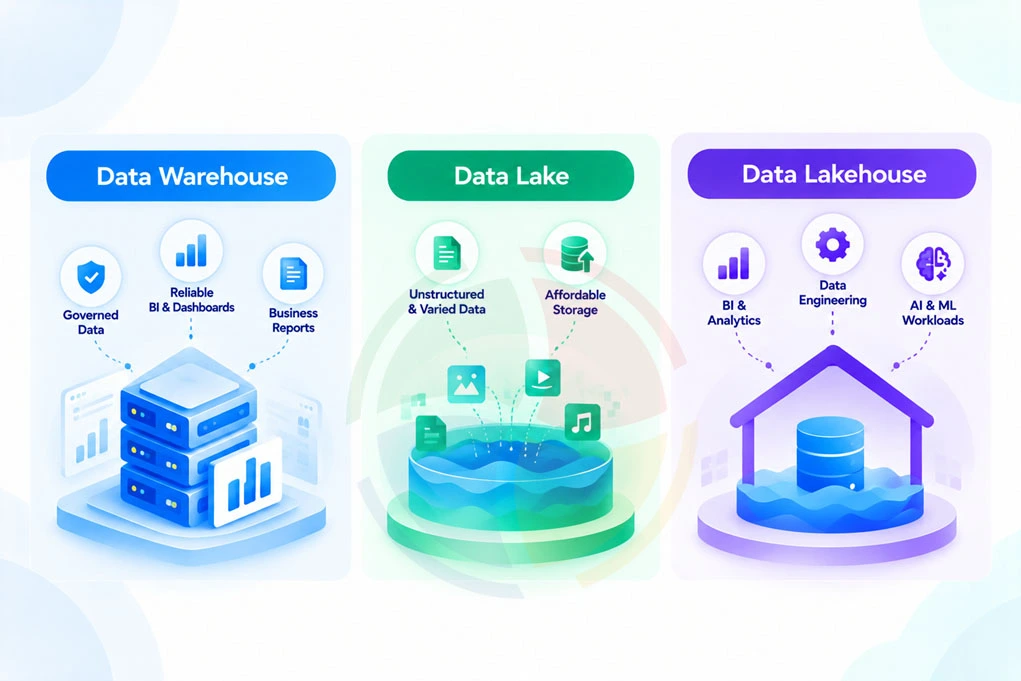
If you need governed, organized data, reliable BI, dashboards, and business reports, get a data warehouse.
Use a data lake when you require affordable, scalable storage of huge quantities of unstructured and varied data.
If you’re looking for an integrated design that combines scalable storage with BI, data engineering, and AI and ML workloads — a data lakehouse is the way to go.
Aegis Softtech’s data warehouse consulting services can evaluate your current responsibilities, structure, governance, productivity, and expenses — before charting an appropriate upgrade strategy.
Frequently Asked Questions
1. Do I need to migrate all my existing data to adopt a lakehouse?
No. You can adopt a lakehouse incrementally. A lakehouse can be deployed in conjunction with a present warehouse or lake, so companies can upgrade specific responsibilities first — a planned strategy that may minimize the risk of migration and avoid the replacement of systems that are working properly.
2. Is Snowflake a data warehouse or a data lakehouse?
Snowflake began mainly as a cloud data warehouse, but it has grown considerably into more advanced data-platform and lakehouse-style capabilities. With architecture labels becoming increasingly similar, businesses should assess platform-specific features against their regular tasks — rather than relying on the labels alone.
3. Is Databricks a data lake or a data lakehouse?
Databricks is often marketed as a data lakehouse platform. Its design brings together cloud object storage and open table technologies — with SQL analytics, data engineering, governance, data science, ML, and AI capabilities layered on top.
4. Do small businesses need a data lake or lakehouse?
Architecture depends on workloads and team capabilities, not company size alone. If your main goal is to combine organized company information to build dashboards and reports, a managed cloud warehouse could make things easier. Lakes and lakehouses become more relevant as you add a wider range of data, AI needs, technical operations, or storage capacity — and not before.
5. How do you know when your current data architecture needs modernization?
Rising cloud costs, duplicated datasets, slow pipelines, metrics that don’t match between teams, data quality nobody trusts, new sources that are a fight to govern, data moving between systems more than it should. One of these alone might mean nothing. Several at once usually means the architecture is the actual problem, not whatever got blamed for it this quarter.