
Considering the sheer amount of unstructured data being generated on an everyday basis, organizations ought to be drowning in it. However, this volume still does not guarantee them insights because just collecting it is no longer enough.
Are you stuck in a similar situation, too?
Thriving today transcends simple data accumulation and instead involves orchestrating your data streams for a cohesive understanding. While orchestration might be complex, it can be simplified with data warehousing.
But what is data warehousing exactly?
It is a powerful process wherein a single, optimized repository rapidly analyses data for agile decision-making. Hence, a business of any given size and nature can swiftly respond to market changes.
Intrigued? Our blog covers some of its key aspects that can propel your business forward as a market leader.
Let’s get started!
What is Data Warehousing?
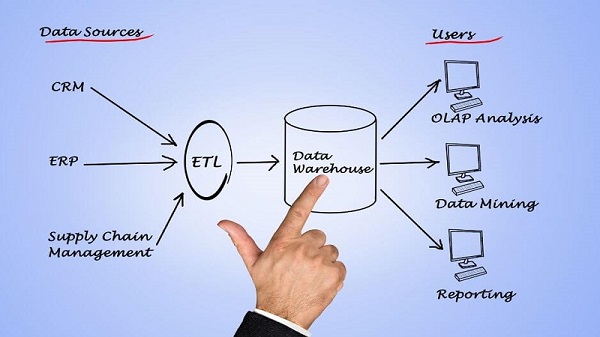
Data warehousing is a process where data from multiple sources is collected and managed into a single, centralized repository for actionable business insights. Getting all business data in one place in real time will help you simplify subsequent phases of analyzing and reporting at distinct aggregate levels.
It’s the core of the business intelligence system to drive faster and smarter business decisions. A data warehouse (DWH) stores and processes gigantic amounts of data from various available sources within a business. ETL solutions, statistical analysis, and data mining are the key types of offerings in data warehousing.
What is Data Warehousing Used for?
Data analytics, business intelligence, and big data are the top industries where data warehousing is useful.
Large enterprises and SMEs (small and medium-sized enterprises) use data warehouses to access, analyze, and process data efficiently for predictive analytics and AI-driven insights.
Let’s dive a little deeper into what data warehousing is used for.
1. Business Intelligence
DWHs are the backbone of all leading business intelligence systems, especially with their central repository for analyzing and reporting data.
2. Data Analysis
Trends and patterns can be analyzed deeply with DWHs through both real-time and historical data.
3. Data Mining
Data mining uses a combination of statistics, database systems, and machine learning to discover patterns, anomalies, and insights from large datasets. Businesses can explore big data to forecast future trends through data mining.
4. Decision Making
DWHs consolidate and clean data to ensure different departments can make decisions for business functions.
5. Refined Data Quality
Its ETL (extract, transform, load) process keeps the data quality high and refined.
What is Data Warehousing Architecture?
The architecture of a data warehouse consists of four core components, besides some additional ones.
The right data warehousing process and its underlying architecture are fundamental to effective data warehouse solutions, enabling you to make the most of your data.
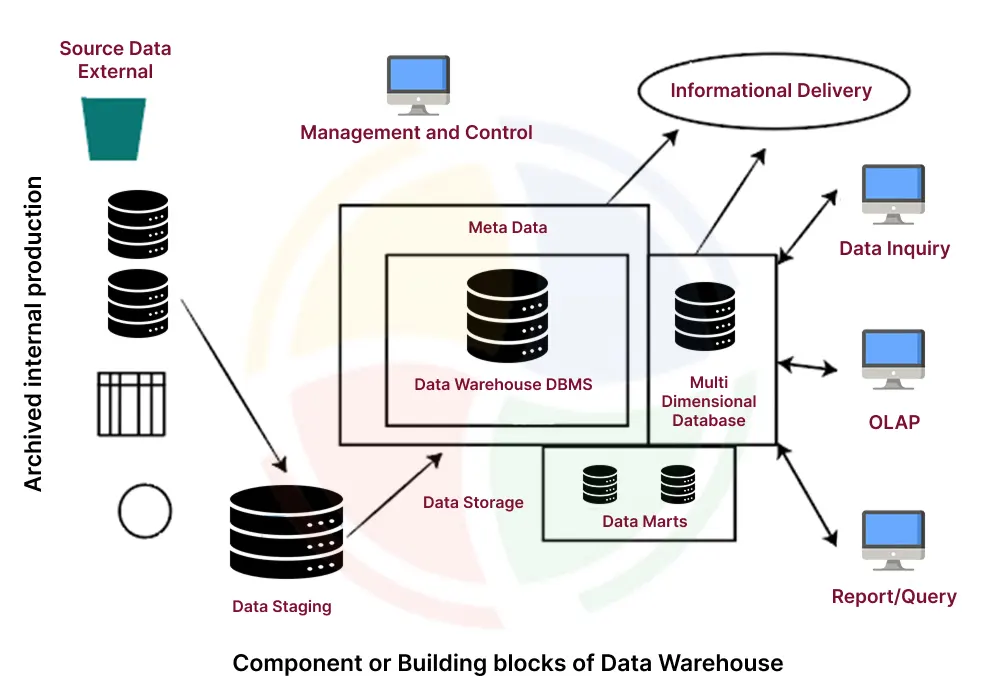
Here is a list of the main components of a DWH architecture:
1. Central Database
The main component is a database where all the enterprise data accumulates to make it more reporting-friendly. You can pick from a list of different types of DBs, including data warehouse applications, cloud-based DBs, traditional relational DBs, and analytics DBs.
2. Metadata
Metadata outlines its DB while constructing a framework. It is data about your data to draw a clearer picture of using, constructing, handling, and preserving a warehouse. The two types of metadata to know about are business (easily understandable information) and technical (mostly for managers and developers).
3. Data Integration/ETL Tools
ETL and integration tools help extract information from various sources and then transform it into a smooth format for the DWH. The ETL approach ensures that even non-engineers can seamlessly understand and use this information.
4. Reporting Layer
The reporting layer gives end-users access to the business intelligence interface. It works like a dashboard wherein they can extract information, visualize data, or even create reports.
5. Access Tools
Interacting with the data stockpiled in a company’s DWH can only be done using different no-code data access tools. While this is not true for all business units, many cannot work with their DB without DB administrators. The most popular no-code access tools are application development, OLAP, query and reporting, and data mining.
What are the Features of Data Warehousing?
Data warehousing is a strategic process, but it is not merely about storing massive amounts of information. It structures that data for analytical superiority to change the course of your organization.
The core features of data warehousing highlight its ability to extract deeper business insights for truly informed decisions.
The global data warehouse as a service (DWaaS) market size is set to go from USD 8.13 billion in 2025 to around USD 37.84 billion by 2034.
Some of its crucial features are:
1. Centralized Repositor
The centralized repository collects abundant enterprise data coming from various sources. Your organization will get a more rounded view of the data for business decisions that align with the desired outcomes.
2. Stores Historical Data
Storing historical data easily analyzes key data trends over a period of time. This plays an imperative role in highlighting patterns and anomalies for improved business performance.
3. Process for Data Transformation
Its data transformation process encompasses cleaning, formatting, and filtering to render the accumulated information more consistent and usable. The better the data quality, the fewer data inconsistencies.
4. Robust Data Security
Data warehousing ensures complete security for your data with features like access controls, backups, and encryption. All protection measures are in place to block any unauthorized access.
5. Data Integration
Data is integrated from various sources into a unified view to eliminate data silos and minimize data inconsistencies.
What are the Types Of Data Warehousing Models?
Every data warehousing model plays an integral role in different data management operations. The most common types of data warehousing models are:
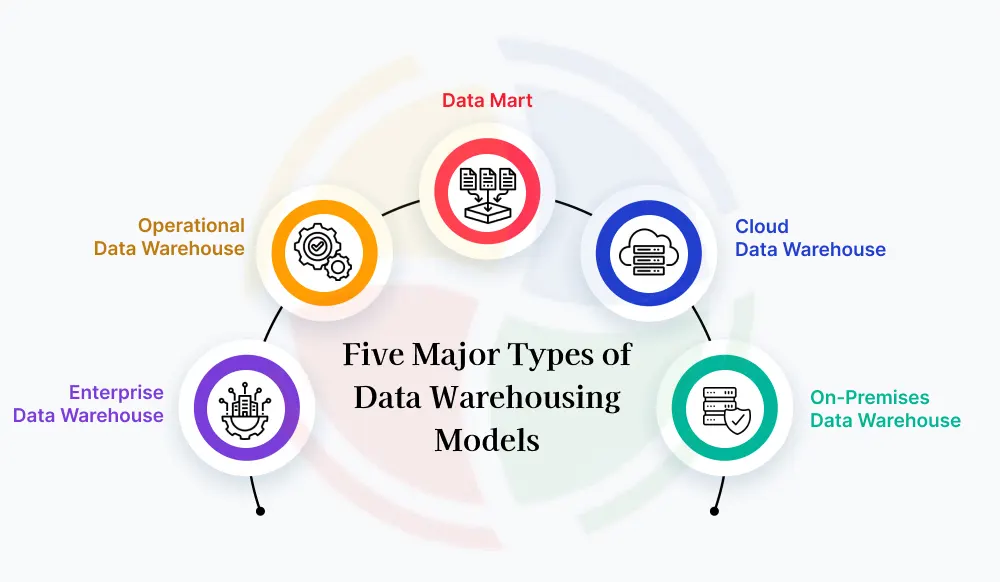
1. Enterprise Data Warehouse (EDW)
EDW is a centralized database that works for your entire organization with a single source of data truth. You get cross-organizational information by running complex queries from multiple sources. It is often built on a multi-dimensional data model like a star schema.
2. Data Mart
Often termed as a smaller version of a DWH, it is tasked with supporting the specific needs of all your business departments. They improve query performance by collecting information relevant to particular functions.
3. Operational Data Store (ODS)
Operational data stores support your organization’s operational needs by storing and managing data from transactional systems in real time. They usually come into play when an OLTP system or a DWH does not fulfill a company’s reporting needs.
4. Cloud Data Warehouses
Cloud data warehouses use the flexible and scalable nature of cloud computing to provide on-demand resources. Common cloud DWHs are Google BigQuery, Snowflake, and Amazon Redshift.
5. On-Premises Data Warehouses
These are traditional DWHs that you can deploy and manage within your infrastructure. You will have complete control over the security and performance level of the data.
What is the Data Warehousing Process?
The data warehousing process is quite extensive and involves a few imperative steps. Each of these phases or steps takes the data closer to being useful for your organization.
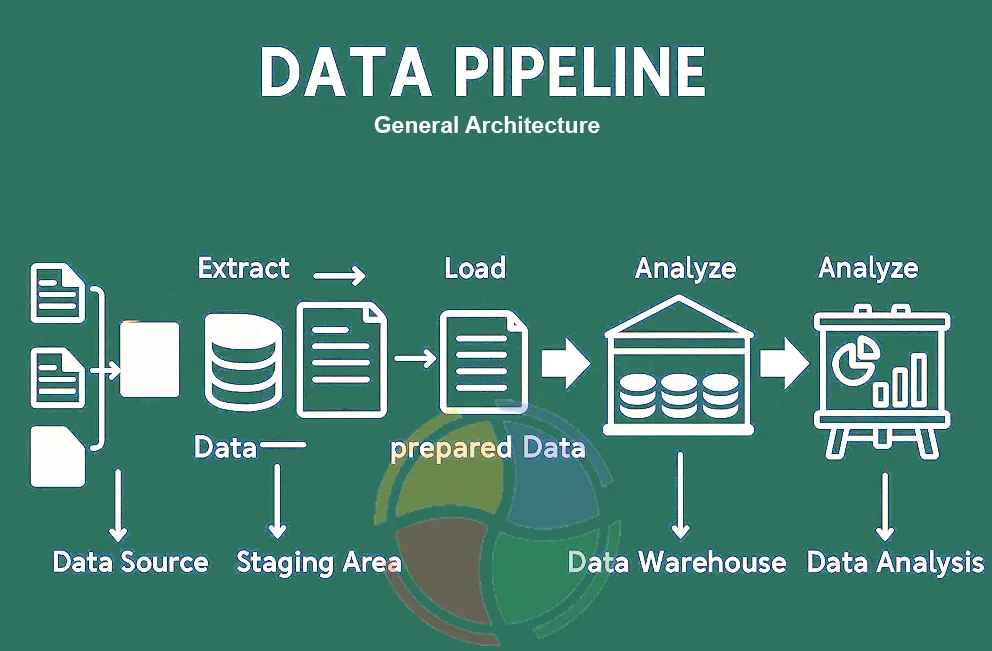
1. Data Extraction
The first step is data extraction. Data is sourced from multiple organizational sources like ERP systems, external data sources, and operational databases (DBs).
2. Data Transformation
The next step is integrating the data into a DWH requires its format to be consistent. It is often done through steps like cleansing, enriching, and standardizing.
3. Data Loading
The third step includes using a snowflake or a star schema to load the data into a warehouse for proper structure.
4. Data Modeling
After this, you can use different data structures to model the data for maximum support. It is done according to your organization’s specific reporting and analytical needs.
5. Data Maintenance
Once the data is modeled, data accuracy is checked to ensure its alignment with the changing organizational requirements.
6. Data Access & Analytics
Finally, you can use this data for different reporting and analytical tasks.
What are the Benefits of Data Warehousing?
Most organizations today face an explosive influx of data from diverse sources. Since these are often isolated in operational silos, analysis and strategic decision-making become challenging.
Data warehousing proves to be an advantageous process for transforming raw data into actionable intelligence. To fully harness these advantages and navigate implementation complexities, you can also leverage specialized data warehouse consulting services.
Let’s look at a few of its benefits:
1. Easy Integration
Data from transactional databases, log files, and other sources is collected and stored for easy analysis. Your organization can integrate multi-dimensional data for a comprehensive view of important findings.
2. Time Efficient
You can access all your data in mere minutes with a data warehouse. Since all of it is consolidated into a single, consolidated repository, it also provides a single source of truth for a reliable view.
3. Better Business Intelligence
You can use a data warehouse to access all your data in mere minutes. Since all is consolidated into a single repository, it also provides a single source of truth for a reliable view.
4. Scalability & Performance
They work with humongous scales of data for high-performance retrieval. Large enterprises and SMEs benefit equally by adopting data warehousing, irrespective of their distinct data inflows.
5. High Security
Businesses suffer huge losses every year due to data security issues. DWHs keep your data safe and secure by taking all actions necessary to prevent data breaches. Businesses dealing with sensitive customer information must be extra careful to deliver maximum customer satisfaction and retention.
What are Some Applications of Data Warehousing?
There are many global applications of data warehousing across different industries and business functions. Here are a few industries that are leveraging this process in the finest way possible.
1. Healthcare
Data warehousing systems can generate reports, improve patient outcomes, forecast treatment outcomes, analyze patient data, and so much more in the healthcare sector. EDWs are rendering unprecedented support to healthcare systems with real-time information delivery.
Data warehousing is used by CDCs (Centers for Disease Control and Prevention), pharmaceutical companies, and hospitals and clinics.
2. Investment & Insurance
Investment and insurance companies analyze market trends and customer behavior to study patterns. They can easily track the minutest changes in data, which may incur gigantic losses.
Use cases in the investment industry include compliance, portfolio management, and investment strategy.
3. Sales & Marketing
Businesses can improve their marketing and sales strategies by analyzing data from multiple related sources. You can analyze sales performance, marketing campaign effectiveness, customer behavior, or predict future sales trends.
Data warehouses provide sales and marketing teams with tools and insights needed to make informed decisions, improve performance, and optimize strategies.
4. Transportation
The transportation sector can optimize routes, get clear ETAs, track vehicles, and improve fleet management with data warehousing. All these actions and more help these organizations reduce their overall expenses.
Data warehousing is applied in transportation for supply chain optimization, CRM, regulatory compliance, and operational efficiency.
5. Real Estate
It becomes easier to optimize pricing, analyze market trends, make the right investments, analyze property listings, etc. Gigantic amounts are analyzed for better price knowledge, informed decisions, investment strategies, and property management.
Data warehousing can analyze vacancy rates, evaluate lead conversion rates, track vendor performance, and optimize rent pricing.
Are there Alternatives to Data Warehousing?
Not every solution is the right fit for every business. An organization facing this dilemma or facing challenges when storing data should seek an alternative.
Here are a few alternatives to data warehousing:
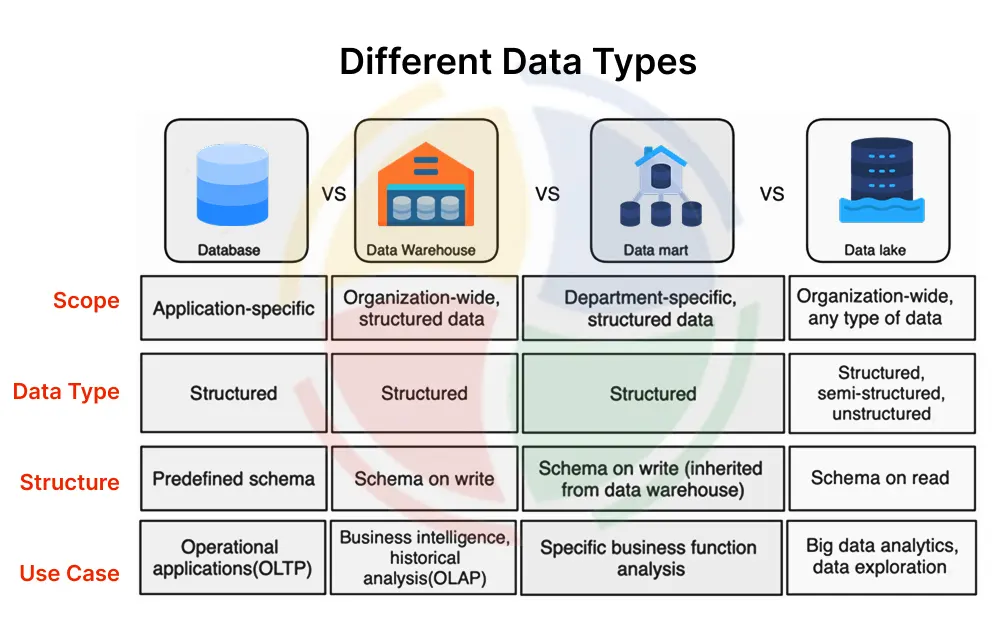
1. Data Lakes
Data lakes are storage repositories that accumulate data in different forms (structured, unstructured, and semi-structured) and multiple source systems. Raw data is converted to a format usable by skilled analysts for future needs.
Data Lake vs Data Warehouse
- Storage: Raw and processed data are stored in Lake, while cleaned and transformed data are stored in DWH.
- Schema: Lakes follow a ‘schema-on-read’ approach wherein the schema is not decided while storing, but while accessing. Warehouses follow a ‘schema-on-write’ approach wherein the schema is finalized before being loaded.
- Cost & Scalability: Lakes are known to be more cost-effective and have a higher scalability level because they store data in a native, raw format.
- Use Cases: Lakes are great for storing humongous data sets of mostly unstructured data for advanced analytics and ML. DWHs are better for data reporting, analytics, and BI on structured data.
2. NoSQL Databases
NoSQL DBs do not resort to traditional data representation in rows and columns like Relational database management systems (RDBMS). Instead, they present more flexible models for better flexibility, scalability, and speed.
MongoDB and Couchbase are two popular NoSQL databases for handling tons of structured and unstructured data.
NoSQL Databases vs Data Warehouse
- Purpose: IoT devices, social media platforms, and e-commerce sites that highly regard performance, flexibility, and scalability prefer NoSQL. Organizations centred on their historical data can use warehouses to gain significant BI and analytical processing insights.
- Data Structure: NoSQL can handle semi-structured and unstructured data through models like column families, key-value, graph, etc. Warehouses often use a dimensional model for storing structural data.
- Storage: While NoSQL can store quite an enormous amount, it has limitations beyond a single partition. Warehouse, on the other hand, is often preferred for long-term analysis and storage, especially historical data.
3. Data Lakehouse
A data lakehouse stands between a data lake and a warehouse, combining their best elements in a single platform. It follows a highly unified approach, wherein structured and unstructured data are stored and analyzed together.
Lakehouses offer scalability, flexibility, quality, and performance under a single tag.
Data Lakehouse vs Data Warehouse
- Purpose: Lakehouse presents a unified platform for the functionalities of a lake and a warehouse. A warehouse, however, is mostly fit for data analysis, reporting, and BI.
- Schema: Lakehouse uses both schema-on-read and schema-on-write approaches, while warehouse uses only the schema-on-write approach.
- Data: Lakehouse stores both structured and unstructured data, while a warehouse stores only structured, pre-processed data.
How Aegis Softtech Helps You Build Your Data Warehousing Pipeline?
Has your business outgrown its current data management system, and in search of one that’s more goal-aligned? Our end-to-end support simplifies your data warehousing adoption journey.
It begins with analyzing initial requirements and includes seamless data integration, architectural design, and ongoing maintenance.
Tap into the true potential of your data with our seasoned data warehouse consulting services.
FAQs
Q1. What industries use a data warehouse?
The top industries utilizing data warehouse services include banking, healthcare, retailing, financial investments, supply chain management, and others.
Q2. What is ETL in a data warehouse?
ETL (Extract, Transform, Load) is a fundamental process in data warehousing, used to collect data from various source systems, prepare it for analysis, and then store it in a central data repository.
Q3. Is SQL a data warehouse?
No, SQL (Structured Query Language) is not a data warehouse itself. It can be used to interact with a data warehouse and unlock the power of the data stored within it.
Q4. What is a semantic layer in data warehousing?
A semantic layer in data warehousing is an abstraction for translating complex technical data into business-friendly terms. It ensures consistent definitions and easier access for all users.
Q5. What is Google Cloud’s modern and serverless data warehousing solution?
BigQuery is Google Cloud’s modern and serverless data warehousing solution. It’s a fully managed and cost-effective enterprise DWH for analytics at a petabyte scale.