
An effective data warehouse design starts with understanding what the business wants to measure, analyse, and improve. From there, teams identify data sources, decide how to structure data, select the right architecture, and establish reliable pipelines and governance.
This guide walks you through the entire process of designing a data warehouse. It discusses data modelling, schema design, architecture, tools, security, scalability, and best practices for building a reliable data environment.
How to Design a Data Warehouse Step by Step
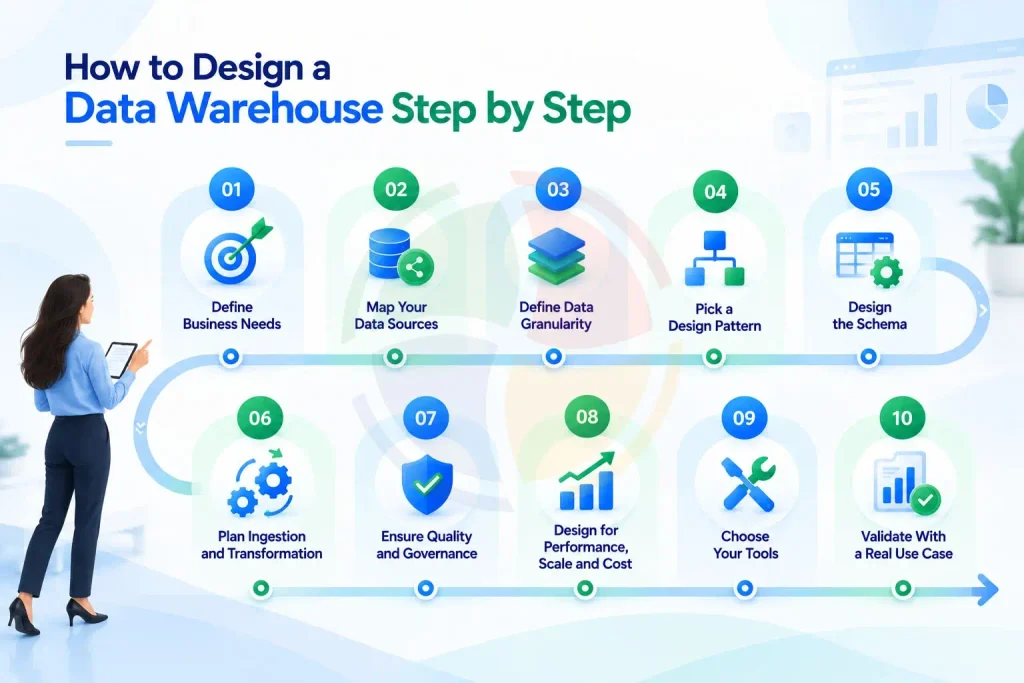
If you want to know how to design a data warehouse, you need to think more than just tables and schemas. The data warehouse needs to link business demands to source systems, standardised data models, pipelines, management, and analytics.
Here is a practical process organizations can follow.
Step 1: Figure Out What the Business Actually Needs
Before you start building tables or picking a platform, sit down and understand what people expect from this warehouse. Talk to the analysts, the business teams, whoever’s going to use this thing — find out what decisions they’re trying to make and what they need to make them.
- Pin down the big questions: What are the questions people expect this warehouse to answer through dashboards and reports?
- Nail down the KPIs: Get everyone to agree on the metrics that matter: revenue, retention, inventory, whatever — before any building starts.
- Understand the reporting cadence: Which reports and dashboards actually matter, and how fresh does the data need to be for each?
- Know who’s using it: Analysts, execs, data science, ops — they all need different things.
- Think ahead: New business units, new data sources, AI initiatives on the horizon; build room for that now.
Step 2: Map Out Your Data Sources
Once you know what you need, go find out where all that data currently lives. This step gives you a real picture of what you’re integrating, and it’ll surface quality problems early — while they’re still cheap to fix.
- List every source: ERPs, CRMs, SaaS tools, APIs, flat files, data lakes, third-party feeds — all of it.
- Check the formats: Every source stores things a little differently. Note where the naming conventions and structures don’t line up.
- Profile the data: Look for missing values, duplicates, inconsistent IDs, stale records.
- Figure out refresh rates: Does each source need to update hourly, daily, weekly, or in real time?
- Write down who owns what: You’ll want to know exactly who to call when something inevitably changes.
Step 3: Define the Data Granularity
Granularity determines how much detail your warehouse retains, and getting it right early matters — it shapes not just storage and processing, but the actual questions users can answer months from now.
- Define what each row represents: A record might be an individual transaction, an order line, a daily total, a customer interaction — decide which one, deliberately, before the schema locks it in.
- Keep detail matched to need: Enough to answer the business questions you have now and the ones you can already see coming, without hoarding data nobody asked for.
- Consider Historical Analysis: Decide how much history needs to be retained and whether changes to customer, product, or other attributes need to be tracked.
- Keep the Grain Consistent: Avoid mixing different levels of detail within the same fact table because this can lead to incorrect calculations.
Step 4: Pick a Design Pattern
The right pattern depends on your data’s complexity and how people use it, not on what’s trendy. Choose whatever makes the data easiest to work with for your actual workloads.
- Use dimensional modeling for BI: Organize around facts and dimensions when straightforward reporting is the main goal.
- Consider normalized models for complex data: Reach for these when enterprise data relationships need tighter separation and control.
- Use a hybrid approach when needed: Keep an integrated core model, then build simpler dimensional models on top for specific reporting needs.
- Expansion plan: Choose something that can absorb new sources and domains without forcing a redesign down the line.
Step 5: Design the Schema
Good schema design makes relationships between business entities obvious and keeps queries sane instead of a tangled mess.
- Identify your facts: Sales, orders, shipments, payments, customer interactions, the measurable events.
- Build your dimensions: Customers, products, dates, locations, employees, channels.
- Choose your structure: Star schema for simplicity, snowflake if your dimensions need more normalization.
- Keep relationships clean: Consistent keys between facts and dimensions across the board.
- Write it down: Document what your fields and measures actually mean, so nobody’s guessing.
Step 6: Plan Ingestion and Transformation
Now work out how data actually gets from source systems into the warehouse, and what happens to it on the way. Whether it’s ETL or ELT, this needs to hold up as sources and volumes grow. Data warehouse developers handle pipeline development, data transformation, and integration to ensure information moves reliably from source systems into the warehouse.
- Choose an ingestion method. Batch, streaming, incremental, CDC — whichever fits the source, not whichever’s easiest to set up first.
- Document transformation rules. How does raw data get cleaned, standardized, joined, and enriched? Someone besides the person who built it should be able to answer that.
- Manage dependencies. One dataset shouldn’t run before the thing it depends on has finished.
- Plan for failure. Retry logic, logging, alerting, recovery — a failed job will happen eventually, and it shouldn’t leave data missing or duplicated when it does.
- Monitor everything. Watch load times, failure counts, and volumes closely enough that problems surface before a user finds them first.
Step 7: Keep Quality and Governance Front and Center
Even a technically solid warehouse loses people’s trust fast the moment they hit bad data or conflicting definitions. Quality and governance need to be baked into the design, not bolted on afterward.
- Set real quality standards. What do accuracy, completeness, consistency, and timeliness actually mean for the datasets that matter most?
- Validate as data comes in. Missing values, duplicates, format issues, unexpected changes — catch them before they ever reach a business model.
- Assign clear ownership. Every dataset, its definitions, and its quality issues belong to someone specific, not to “the team” in general.
- Control access with role-based permissions. People see what their role requires and nothing beyond it.
- Revisit governance regularly. Access, quality rules, lineage, and retention all need checking again as the business changes, not just set once at launch.
Step 8: Design for Performance, Scale, and Cost
A warehouse needs to hold up as data and users pile up, not just work fine on day one. Make these calls during design, not after things have already slowed to a crawl.
- Understand query patterns: Know which tables get hit hardest and what filters people actually reach for.
- Optimize storage: Partitioning, clustering, compression, lifecycle policies — the mix that fits the platform you’re actually running.
- Plan for concurrency. Several BI and analytics workloads run at once; nothing should choke because of it.
- Track compute usage: Catch an inefficient workload before it turns into an expensive habit. Design for where data volume is headed, not where it sits today.
Step 9: Choose Your Tools
Tools should fit the architecture already planned, not the other way around — look at the whole stack and how well each piece actually plays with the rest of it.
- Choose modeling tools: ERwin Data Modeler and ER/Studio both handle detailed logical and physical modeling well.
- Select integration tools: Fivetran, Informatica, Matillion, Talend — the right one depends entirely on where the data is coming from.
- Handle transformation and orchestration: dbt and Airflow cover scheduling, dependencies, and workflow logic.
- Include governance tools: Collibra or Alation cover cataloging, lineage, and ownership, if that layer isn’t already accounted for elsewhere.
- Check the full technology fit: Weigh the full technology fit before committing to a stack — integration, team skills, licensing, maintenance, and scalability all factor in.
Step 10: Prove It With a Real Use Case
Before rolling this out org-wide, test it against one real business problem first. A sales, finance, or inventory workload will surface issues that planning alone never catches.
- Reconcile the numbers: Compare source and warehouse totals to confirm nothing got lost or mangled in transit.
- Validate the calculations: Have business teams confirm the KPIs actually match what was agreed on.
- Test performance: Run real reports and queries against it, not synthetic ones — that’s the only way performance testing means anything here.
- Confirm access boundaries hold: People should be able to reach exactly what their role allows. No more, no less.
- Simulate a failure: Force the pipeline to break and watch how it recovers — cleanly, without duplicating or losing data.
How to Design Data Warehouse Architecture
To design data warehouse architecture, think of the environment as connected layers rather than one central database.
A modern architecture looks like:
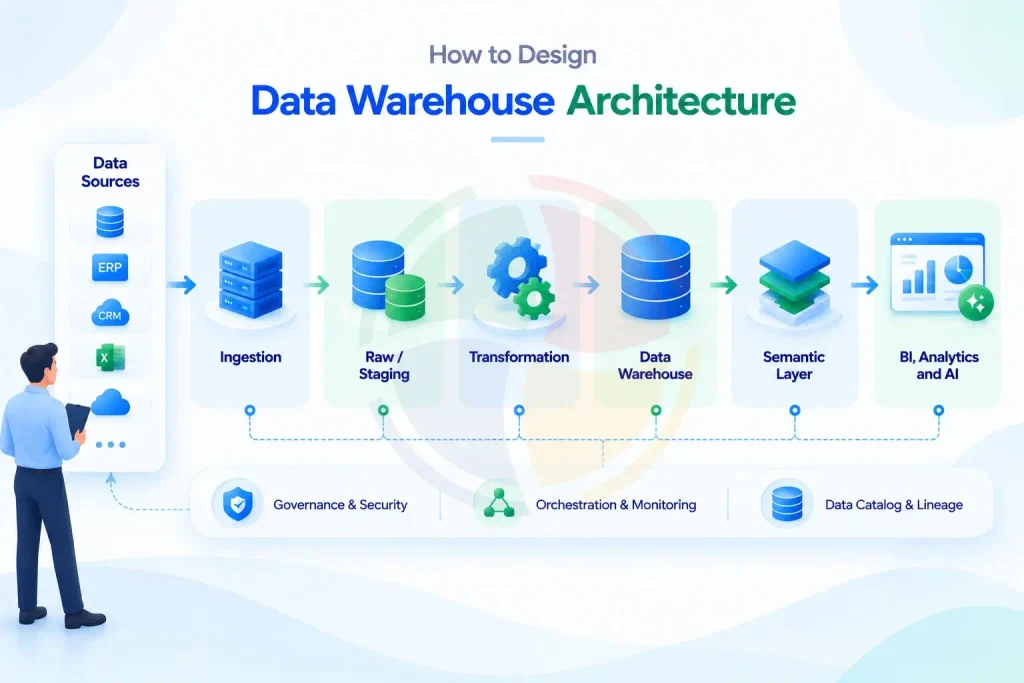
- Source layer: ERP, CRM, databases, SaaS applications, APIs, files, and external systems generate data.
- Ingestion layer: Batch or streaming pipelines move information into the analytical environment.
- Storage and processing layer: Raw data is retained and transformed into validated, standardized datasets.
- Warehouse layer: Structured business models provide governed information for analysis.
- Consumption layer: BI applications, analysts, data science workloads, and AI applications consume trusted data.
Security, governance, metadata, orchestration, data quality, and monitoring should operate across every layer.
Aegis Softtech’s data warehouse services similarly consider source systems, ingestion patterns, data modeling, cloud infrastructure, governance, workload requirements, scalability, and cost when designing modern warehouse environments.
Data Warehouse Design Best Practices
Following established data warehouse design best practices helps prevent short-term decisions from becoming long-term technical constraints.
| Best Practice | What to Do |
| Business-First Design | Design around business and analytics needs. |
| Clear Data Grain | Keep fact-table detail consistent. |
| Raw & Curated Layers | Separate source data from analytics-ready data. |
| Standardized Metrics | Keep KPI definitions consistent across teams. |
| Modular Pipelines | Build reusable, maintainable data flows. |
| Incremental Processing | Process only new or changed data when possible. |
| Early Governance | Define security, ownership, lineage, and quality early. |
Build a Data Warehouse Designed for Long-Term Growth
Successful data warehouse design is not merely choosing a schema or a cloud platform. That is, bringing together business needs, source information, modelling, pipelines, governance, performance, and future responsibilities into a single architecture. Organisations that make these choices early are able to create a warehouse that continues to perform reliably as data and analytics specifications increase.
Aegis Softtech offers data warehouse consulting, architecture, implementation, migration, and cloud services to help organisations modernise an existing warehouse or design one from scratch to build scalable data environments that meet analytics, governance, performance, and cost requirements.
Frequently Asked Questions
1. How long does it take to design a data warehouse?
A few weeks for a focused design. Several months for a full enterprise environment. Source-system complexity, business domains, governance, integrations — all of it factors in, but the real wildcard is usually how fast stakeholders agree on common metrics and definitions.
2. Should a data warehouse be designed for AI workloads?
If AI’s on the roadmap, yes — clean historical data, metadata, lineage, governance, controlled access all need to be there. But not everything belongs in the warehouse itself; some ML and unstructured-data work is better suited to a lake or lakehouse running alongside it.
3. When should an existing data warehouse be redesigned?
New sources that require extensive rework to add. Queries that consistently underperform. Departments reporting KPIs that don’t match. Pipelines failing regularly. Cloud costs climbing faster than actual usage. None of these are isolated glitches — they’re usually the architecture telling you it’s hit its limit.
4. Can a data warehouse handle both real-time and batch data?
Yes. Scheduled batch ingestion and streaming or near-real-time pipelines can run side by side. Real-time only makes sense where the business genuinely needs immediate information, since it costs more in complexity and money than batch ever does.
5. What documentation should be created during data warehouse design?
Data sources, source-to-target mappings, schemas, table grain, transformation logic, business metrics, ownership, lineage, access rules, refresh schedules, dependencies, quality checks, failure procedures — all of it.
6. What are the best data warehouse design tools?
The best data warehouse design tools depend on the architecture and requirements. Common options include Erwin and ER/Studio for modeling, dbt for transformation, Airflow for orchestration, and cloud-native tools offered by major data platforms.