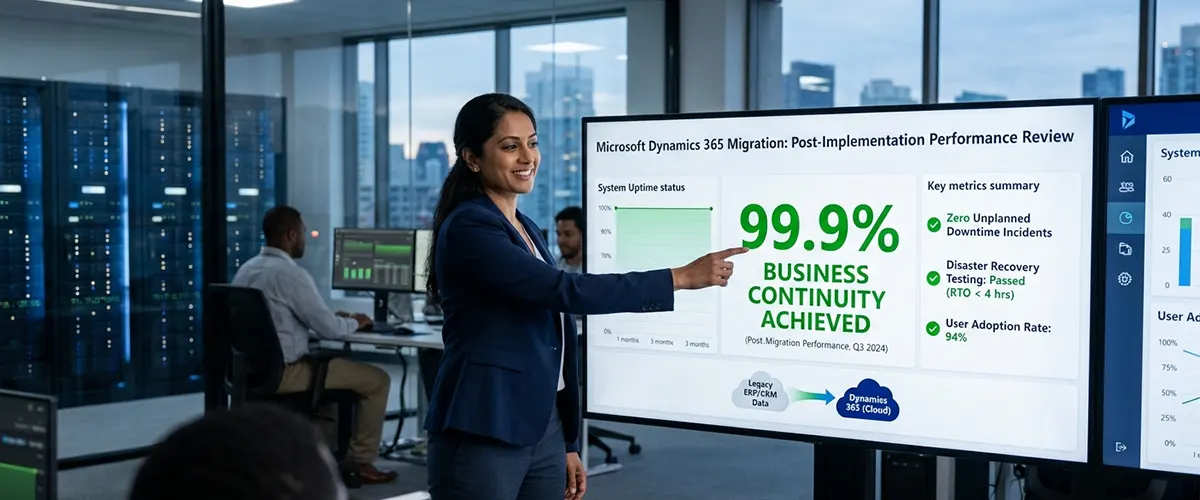
99.9% Business Continuity Achieved Through Microsoft Dynamics 365 Migration
Automated Schema Validation | Modernized Integrations | Hypercare Support
At a Glance
| Industry | Industrial Equipment & Heavy Manufacturing |
|---|---|
| Services | Microsoft Dynamics 365 Migration Services, Cloud ERP Architecture, System Integration Modernization, Post-Go-Live Managed Support |
| Challenge | Zero tolerance for migration downtime across 24/7 assembly lines, coupled with fragile legacy integrations and a severely clogged on-premise SQL database. |
| Solution | Executed a phased dual-run cloud migration with automated schema validation, modernized integrations via Azure Service Bus, and provided 60-day hypercare support. |
| Key Result | Maintained 99.9% business operational continuity during cloud cutover, eliminated 100% of legacy server upkeep, and drove user adoption to 92%. |
About the Client
The client is a leading industrial equipment manufacturer. It operates four regional assembly facilities and supports a distributor network spanning over 30 global markets. They process thousands of custom manufacturing orders, field service, and parts requisitions requests weekly.
The Challenge
The client relied on a highly customized on-premises CRM environment. This aging system served as the backbone for sales, production dispatch, and customer service. Over time, their legacy setup had created critical risks.
They approached Aegis Softtech for a phased cloud migration strategy that could securely move years of their operational data to Dynamics 365 SaaS without interrupting continuous factory operations:
- Downtime Intolerance: A system crash or prolonged migration blackout would cause lengthy halts in assembly lines. This would pause parts shipping and cost the client over $75,000 per hour in lost production.
- Fragile Legacy Integrations: Their years of custom point-to-point connections with plant-floor ERPs and warehousing software were prone to silent synchronization failures.
- Database Inflation & Speed Lags: Massive historical order databases were clogging their local SQL servers. This was causing frequent system lockups during peak order times.
- Upgrade Paralysis: The client was unable to apply security patches and feature updates without breaking custom scripts. Thus, leaving the system vulnerable and obsolete.
The Solution
Our Microsoft Dynamics team engineered a phased migration architecture built around continuous data validation and zero-downtime execution.
Phased Migration Architecture & Delta Sync Pipelines
We designed a non-disruptive migration strategy to keep factory floors running seamlessly:
- Dual-Run Data Staging: Our Dynamics 365 experts used Azure Data Factory to create real-time data replication pipelines. All this time, we ensured their old on-premise tables and new cloud Dataverse schemas ran in parallel. This ensured zero data loss during testing.
- Off-Peak Delta Cutovers: We executed multi-stage data transfers during scheduled low-traffic weekend maintenance windows. It helped us validate balance ledgers and order histories before switching primary traffic.
API Modernization & Post-Go-Live Support
We modernized how external factory applications communicate with the central CRM:
- RESTful Cloud Microservices: We replaced brittle custom scripts with secure Azure Service Bus queues and webhooks. This helped us connect Cloud Dynamics 365 to factory floor machinery.
- Hypercare Support Framework: Our team deployed dedicated migration engineers for 60 days post-go-live. The purpose was to fine-tune system rules, support end users, and monitor response speeds.
Technical Layout of the Cloud Migration Roadmap
| Migration Phase | Technical & Engineering Execution | Core Platform Architecture Feature | Global Operational Impact |
|---|---|---|---|
| Schema Discovery | Audited C/AL & SQL dependencies | Microsoft Dataverse Entity Mapper | Identifies unindexed fields and cleans legacy data before uploading it to the cloud. |
| Delta Pipeline | Configured live dual-write sync loops | Azure Data Factory & Service Bus | Keeps cloud and on-premise databases identical in real-time. |
| Final Cutover | Executed automated validation checks | Automated System Health Telemetry | Switches live operations over smoothly with less than 0.1% planned downtime. |
The Results
The phased migration to Microsoft Dynamics 365 delivered a smooth cloud transition with long-term performance gains:
- 99.9% Business Continuity:
Plant operations, customer channels, and dispatch teams experienced zero unplanned downtime during the entire migration. - 100% On-Premise Server Retirement:
We retired physical server hardware. This saved the client over $180,000 annually in maintenance and energy costs. - 92% Active User Adoption:
We provided hands-on shadow-run training and dedicated post-go-live support. This drove daily cloud engagement to 92% within 30 days. - 3x Faster Global Query Speeds:
Moving to cloud infrastructure reduced complex order search and reporting times from 12 seconds down to under 4 seconds.
What Made the Difference?
Zero-Impact Validation
Our team decided not to rely on standard test environments and instead built a shadow cloud instance that feeds on live operational data. Real production workflows were run simultaneously in both systems for two weeks straight, verifying that every complex calculation, workflow rule, and custom pricing rule executed identically in the cloud before the final transition.
Micro-Invasive Cutover Sequencing
We split the cutover into isolated module releases. This staged approach contained operational risk and ensured the client’s technical support teams were focused on one department at a time.
Automated Data Integrity Checkpoints
Our team engineered automated data-reconciliation scripts. These ran every hour during cutover windows and validated millions of historical records and inventory balances between on-premise SQL and Dataverse. Thus, ensuring zero missing records, financial discrepancies, or duplicate files.
Technology Stack
- Microsoft Dynamics 365 Supply Chain & Customer Engagement SaaS
- Azure Data Factory
- Azure Service Bus
- Dual-Write Integration Engine
- Microsoft Dataverse with SQL Server Migration Toolsets (SSMA)
- Azure Application Insights
- Power BI Operational Dashboards
Planning a Migration Away From a Vulnerable Legacy CRM or ERP?
Whether you need to migrate on-premise systems with zero operational downtime or ensure smooth post-go-live adoption, our certified Microsoft specialists are ready to execute your cloud strategy.
Talk to a Dynamics 365 Specialist
*Client identity is confidential. Project details verified through internal delivery records. Reference available on request.*