

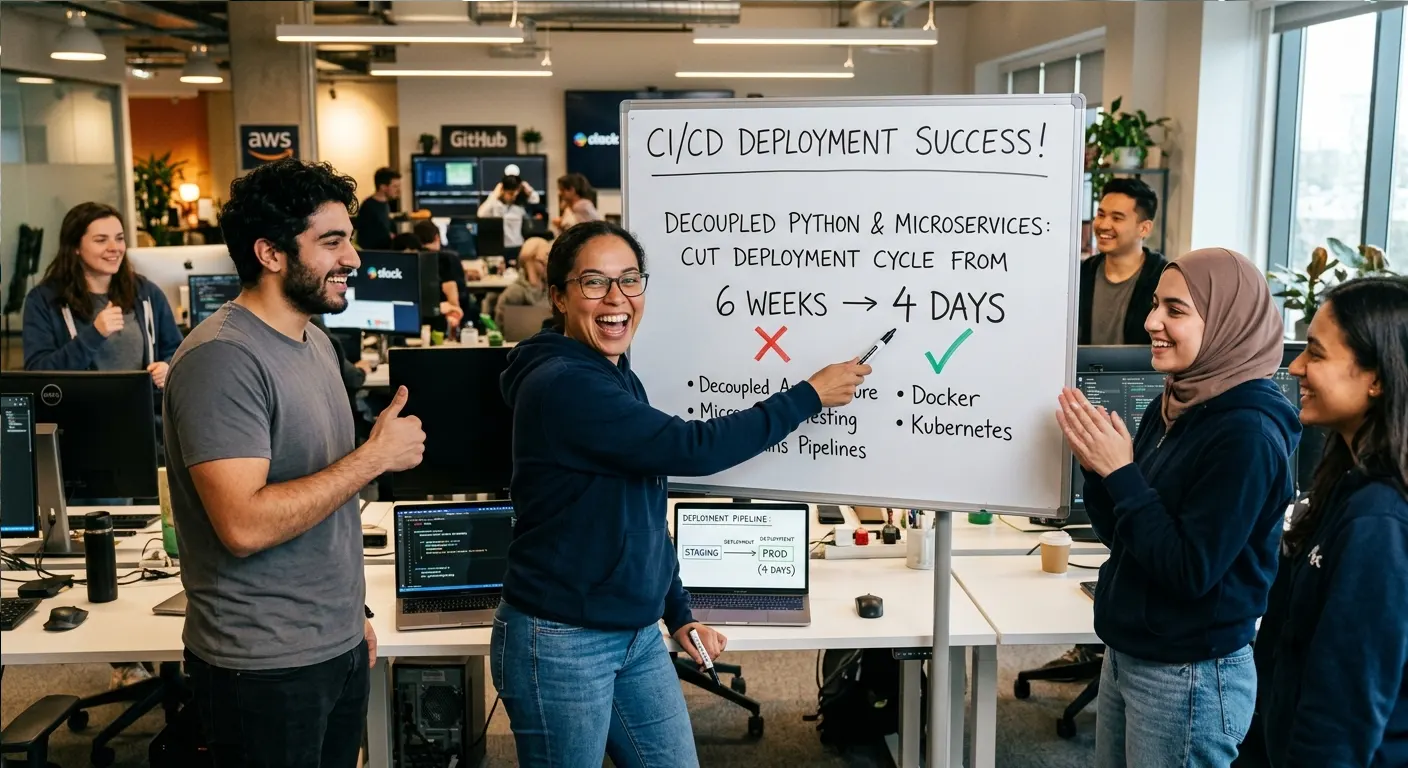
Decoupled Python and Microservices Cut the deployment Cycle From 6 Weeks to 4 Days
Systematic Migration | Modern Web Frameworks | Zero-Downtime Routing Strategy
At a Glance
| Industry | B2B SaaS & Cloud Enterprise Software |
| Services | Monolith Deconstruction, Python Microservices Architecture, API Gateway Engineering, DevOps Pipeline Automation |
| Challenge | A bloated, 5-year-old Flask monolith is slowing down engineering velocity, causing a restrictive 6-week deployment cycle, and stalling new feature releases. |
| Solution | Systematic migration of core business logic into decoupled Python microservices using modern web frameworks and a zero-downtime routing strategy. |
| Key Result | Deployment cycle cut from 6 weeks to 4 days, massively accelerated feature delivery, and completely zero deployment downtime. |
About the Client
The client is an established business-to-business (B2B) Software-as-a-Service (SaaS) enterprise. They deliver high-demand, cloud-based operational workflow and project management software to corporate clients globally.
The Challenge
Our client had undergone an aggressive product expansion for five years. Consequently, their core software platform had expanded into a massive, interdependent monolith built atop the Flask web framework. While their codebase was initially agile, it had become a complex web of dependencies, limiting their engineering velocity.
They approached Aegis Softtech to secure expert backend support to resolve several architectural limitations:
- Stalled Engineering Velocity: A single code modification required cross-team regression testing on a wide scale. It was locking new product features behind a rigid 6-week deployment pipeline.
- Brittle Code Interdependency: Their monolithic Flask layout was giving way to minor bugs in secondary modules, like notification services, to cascade. It was threatening the availability of core business modules like payment routing.
- Inflexible Resource Scaling: The entire application had to be scaled together. This forced the client to over-provision cloud infrastructure for the entire monolith, enabling them to handle traffic spikes on a single high-demand endpoint.
- The Zero-Downtime Absolute: Thousands of enterprise businesses rely on their SaaS platform for daily operations. Hence, the client could not afford to have a maintenance window or any operational downtime during the migration.
The Solution
We provided the client with a specialized squad of Senior Python Architects and to break down the monolithic application into an agile microservices ecosystem.
Monolith Deconstruction
Our developers applied the Strangler Fig Pattern. We mapped out their monolithic codebase, isolating self-contained business capabilities, such as User Authentication, Notification, and Invoicing engines. This helped extract them systematically into standalone services.
High-Performance Python Microservices
To maximize data communication and modern capabilities of the new infrastructure, our Python developers redesigned the service layers:
High-Speed API Development
We utilized FastAPI for the newly extracted microservices. FastAPI’s native asynchronous support and automated Pydantic data validation allowed faster data processing by the new services.
Asynchronous Event-Driven Communication
An asynchronous event bus was implemented using RabbitMQ to prevent services from tightly blocking one another. Services now communicate via decoupled, lightning-fast message queues.
Zero-Downtime Migration Architecture
For smooth operations for active platform users throughout the multi-month transition, our backend architects built a strong deployment bridge:
Centralized API Gateway Implementation
We deployed an API Gateway tier to act as a single entry point for all frontend requests. Different migration strategies were implemented to route traffic between the legacy Flask monolith and the new Python microservices based on endpoint rules.
Strangler Migration Strategy
As each new microservice was compiled and pushed to production, we shifted traffic routing at the gateway level. Users were automatically routed to the new services with zero disruption.
The Results
The migration strategy executed by our dedicated Python developers resulted in massive agility improvements to the client's engineering organization:
- Deployment Cycle Cut from 6 Weeks to 4 Days: Their product teams can now push new features and critical security patches to production independently, shortening release cycles down to days.
- Absolutely Zero Production Downtime: The API Gateway traffic-strangling strategy resulted in live execution of the entire data migration, without a single minute of service disruption for active SaaS clients.
- Fault-Isolated System Resiliency: Isolating code boundaries ensured that even if a background service encountered an error, the primary user interface remained fully functional. This increased overall platform uptime.
- Accelerated Onboarding for New Engineers: Breaking the codebase into modular Python microservices made it simpler for new developers to understand and maintain code.
What Made the Difference?
Automated CI/CD Isolation
We used GitHub Actions and Docker containers to design independent deployment pipelines for each microservice. Their individual development teams could thus build, test, and push code modifications to production independently.
Pydantic Data Type Enforcement
Our Python developers utilized Pydantic schemas within FastAPI to enforce type-checking across service boundaries. This helped them catch data mismatches before they hit production databases.
Kubernetes Orchestration
We containerized the entire Python development services matrix and deployed it into Amazon EKS (Elastic Kubernetes Service). Automated horizontal pod autoscaling enabled high-demand services to scale up or down as required.
Technology Stack
- Python (highly optimized 3.11+ async runtimes)
- FastAPI
- Pydantic
- Legacy Flask (Strangled)
- RabbitMQ (Asynchronous Event Bus)
- Celery
- Docker
- Kubernetes (Amazon EKS)
- Helm
- PostgreSQL (Isolated per-service databases)
- Redis (Session Caching)
- GitHub Actions
- Terraform
- AWS API Gateway
Want to Modernize Your Software Architecture or Hire Dedicated Python Developers?
Whether you need to break down a rigid legacy monolith with zero downtime, automate your cloud deployment pipelines, or migrate existing platforms to frameworks like FastAPI, Aegis Softtech provides the senior engineering talent to deliver it.
*Client identity is confidential. Project details verified through internal delivery records. Reference available on request.*