

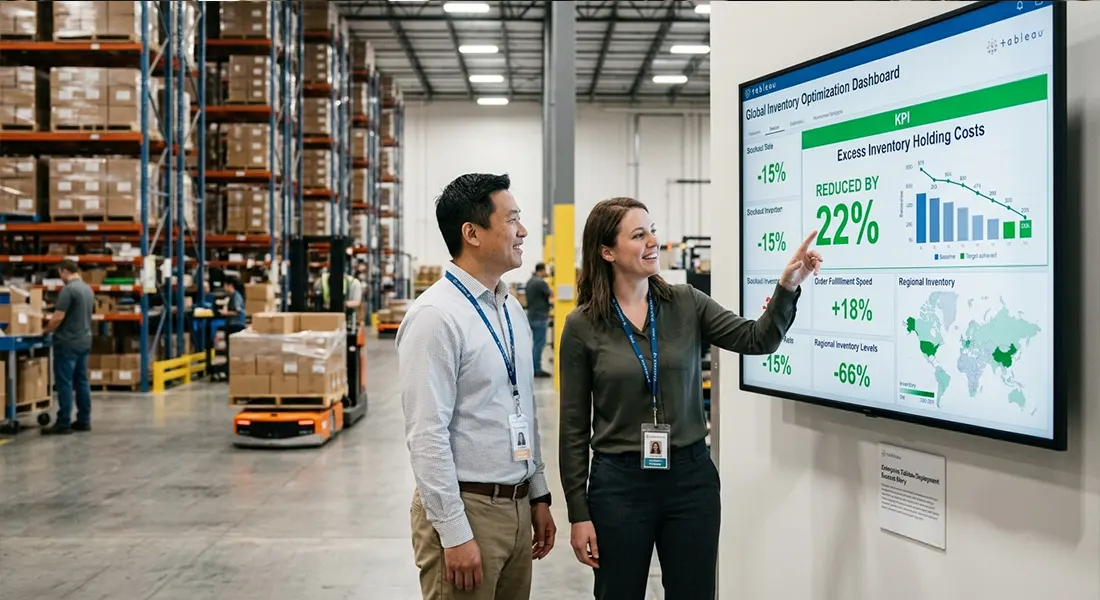
Enterprise Tableau Deployment Reduces Excess Inventory Holding Costs by 22%
Centralized Supply Chain Command Center | Custom Parameter Controls | Automated Alerts
At a Glance
| Industry | Logistics & Supply Chain Management |
| Services | Business Intelligence (BI), Data Integration (ETL), and Tableau Dashboard Development |
| Challenge | Fragmented warehouse data, manual spreadsheet reporting, frequent stockouts, and high inventory carrying costs. |
| Solution | A centralized Tableau Supply Chain Command Center integrating live WMS and ERP data with custom parameter controls and automated low-stock alerts. |
| Key Result | 22% reduction in excess inventory holding costs and a 35% decrease in stockout occurrences within the first quarter. |
About the Client
The client is an enterprise-scale multinational logistics and distribution provider operating complex, multi-regional warehouse setups across several continents. It manages high-velocity freight and fluctuating inventory cycles daily, while directing lance table, large-scale supply chain movements for global retail and manufacturing sectors.
The Challenge
The client relied heavily on legacy infrastructure and disconnected operational tracking. This led to significant data fragmentation across their regional warehouses.
They approached Aegis Softtech with critical supply chain visibility limitations. The customer faced a highly reactive operational loop driven by several core architectural challenges:
- Fragmented Warehouse Silos: Their siloed regional Warehouse Management Systems (WMS) and independent, on-premises ERP frameworks locked several crucial inventory parameters, preventing cross-regional data parity.
- Static Reporting: Their operational teams were compiling cross-facility inventory counts via static spreadsheet reports. By the time these documents were processed and emailed to executive stakeholders, the data was heavily delayed. There was no real-time tracking.
- Fulfillment Inefficiencies: They completely lacked live visibility into their daily depletion patterns. It was causing frequent inventory stockouts and delayed customer shipping schedules, which significantly increased overall capital ties.
- Inflated Operational Expenses: Over-correcting for shipping gaps forced regional hubs to maintain excess safety inventory. This was compounding warehouse carrying costs and product stagnation.
The Solution
As an established business intelligence and analytics services company, Aegis Softtech deployed a team of Tableau-certified developers to create, set up, and deploy a real-time analytics layer.
Data Ingestion and ETL Pipeline Setup
We utilized custom connectors to ingest data streams directly from the client’s legacy ERP networks and active Warehouse Management Systems (WMS), establishing direct, high-performance data pipelines. Our unified staging database removed conflicting terminology from the data, ensuring consistent data formats across all regional facility logs.
Supply Chain Command Center Dashboard Development
A centralized, multi-tier Supply Chain Command Center dashboard environment was built inside Tableau Server. The dashboard architecture was strategically divided into distinct analytical modules to serve both field operators and executive decision-makers:
Technical Layout of Dashboard Components
| Dashboard Component | Data Source Integration | Key Metrics Displayed | Target Persona |
|---|---|---|---|
| Global Stock Allocation Map | WMS + Geolocation Database | Stock-on-Hand, Regional Buffer Levels, In-Transit Volume | Supply Chain Directors |
| Fulfillment & Depletion Matrix | ERP Order Logs + Active Shipments | Safety Stock Thresholds, Live Depletion Rates, SKU Turnover | Warehouse Inventory Managers |
| Financial Overhead Tracker | Corporate ERP Finance Module | Carrying Costs, Stagnant Stock Values, Outbound Logistics Costs | Chief Financial Officer (CFO) |
| Proactive Notification Desk | Tableau Server Alert Rules | Real-Time SKU Stockout Risks, Low-Buffer Triggers | Procurement A |
Customized Parameter Controls
Customized parameter controls and calculated fields are built directly within the visualization workbook. These configurations allowed users to:
- Simulate dynamic hypothetical supply chain delays and model safety-stock lifespans on the fly.
- Adjust regional lead-time assumptions manually to observe immediate downstream depletion forecasts.
- Inject real-time automated rules within Tableau Server. It configures instantaneous low-stock alerts that immediately email regional procurement heads when specific SKU volumes fall below safety thresholds.
Results
Modernized logistics pipeline for great quantitative and qualitative operational improvements within the first quarter of deployment.
- 22% Reduction in Excess Inventory Holding Costs:
Elimination of over-ordering habits and clearing stagnant stock across regional nodes freed up the client's vital capital reserves. - 35% Decrease in Stockout Occurrences:
Proactive low-stock alerts helped replenish critical SKUs before fulfillment blockages affected consumer distribution networks. - Elimination of Manual Spreadsheet Overhead:
Automated data synchronization replaced the tedious manual spreadsheet loop, saving hundreds of hours every month. - Unified Source of Truth:
Centralized calculations ensured that multi-regional offices evaluated supply metrics using identical KPIs.
What Made the Difference?
Custom Data Partitioning and Hyper Extracts
Executing live, unoptimized queries against the production ERP was previously causing severe performance lag. Our developers took a different route. They structured optimized incremental refreshes using Tableau Hyper extracts, cutting dashboard load times from minutes to sub-seconds.
Security First Approach
Because the client operates across multiple international borders, data privacy was paramount. Row-level security parameters within Tableau Server ensured regional warehouse managers could only interact with their specific facility logistics, while corporate leadership retained a global overview.
Context Filter Optimization
The dashboard’s visual pipeline was restructured to handle millions of active SKU rows efficiently without processing timeouts. Tableau uses strict context filters to create a temporary interface table ahead of complex analytical calculations, reducing server memory strain significantly.
Technology Stack
- Tableau Desktop (for advanced dashboard design, calculated fields, and parameter modeling)
- Tableau Server (for secure, enterprise-wide distribution and automated low-stock email triggers)
- Talend Enterprise Data Integration (to orchestrate high-velocity data cleaning, deduplication, and transformation workflows)
- Microsoft SQL Server (acting as the centralized data warehouse repository hosting the unified staging layer)
- On-Premises Legacy ERP (Corporate Financial and Order Management modules)
- Regional Warehouse Management Systems (WMS via native API endpoints)
Optimizing Global Supply Chain Visibility or Inventory Infrastructure?
Whether you need Tableau consulting, high-performance Tableau dashboards, or scalable ETL data pipelines, Aegis Softtech brings the supply chain domain knowledge and business intelligence expertise to deliver it.
*Client identity is confidential. Project details verified through internal delivery records. Reference available on request.*