
Microsoft Fabric architecture brings data ingestion, engineering, data science, real-time analytics, warehousing, and business intelligence into one SaaS analytics platform. OneLake provides the common data foundation, allowing Fabric workloads to access and work with organizational data without relying on disconnected analytics systems.
What Are the Core Components of Microsoft Fabric Architecture?
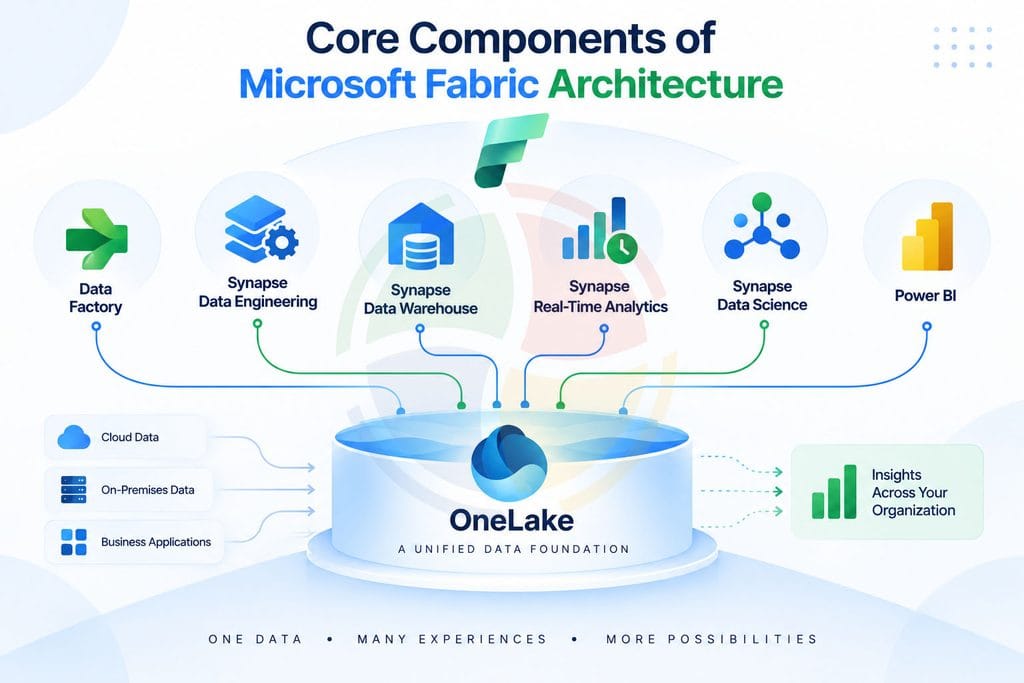
Microsoft Fabric employs a data lakehouse architecture that uses a data lake for storing data, rather than a relational data warehouse. The Microsoft Fabric architecture features integrated capabilities for data engineering, warehousing, data science, real-time intelligence, and business intelligence. All the data is stored in a Delta Lake format, with the data lake acquiring features similar to a relational data warehouse.
Let’s understand the seven key components of Microsoft Fabric Architecture:
OneLake
OneLake provides a unified logical data lake for Fabric. Through capabilities such as shortcuts, Fabric workloads can access data across locations without requiring unnecessary copies, helping reduce data duplication and simplify governance.
Data Engineering
Data Engineering is an experience with Microsoft Fabric. You can build robust, scalable data pipelines and perform large-scale data transformations. Its powerful Apache Spark-based environment is useful for utilizing familiar tools, including Spark notebooks (supporting Python, Spark SQL, Scala, R) and Spark job definitions.
At its core is the concept of a Lakehouse. It amalgamates the structure and management capabilities of a data warehouse and the flexibility of data lakes. Ingest, clean, transform, and prepare vast datasets for subsequent AI and analytical workloads with high efficiency and performance.
Data Warehouse
Data Warehouse delivers an industry-standard SQL data warehousing experience directly over OneLake. You can create and manage warehouses with its fully managed, scalable SQL engine (T-SQL). It’s for situations requiring traditional data warehousing capabilities. Thus, you can consolidate your structured data into a central source of truth.
It not only benefits from Fabric’s unified governance but also seamlessly integrates with all of its other experiences. In short, Data Science can access warehouses for machine learning initiatives, or Power BI can directly query them for reporting.
Real-Time Intelligence
Real-Time Intelligence is built to analyse fast-paced data streams as it happens, where the data is high volume. It enables teams to ingest, analyse, and search for time-series information, telemetry and logs in real-time, using Kusto Databases (KQL Databases) and Kusto Query Language (KQL).
The result makes it appropriate for use cases like IoT analytics, fraud identification, cybersecurity and application performance tracking, where information can change rapidly and postponed insights can impact decisions. Teams can detect challenges, track operations, and adjust to events more quickly by handling live data as it is received.
Data Science
Data Science provides a unified environment for building, deploying, and training machine learning models at scale. For a team working with massive datasets, that translates into a Spark-based compute platform accessible through notebooks that support Python, Scala, R, and more.
An important aspect is integration with OneLake and Lakehouses for zero-copy data access, model training, and feature engineering. With built-in MLflow support for model management and experiment tracking, that translates into a streamlined ML lifecycle — turning your data into predictive insights with high AI accessibility.
Data Factory
Data Factory is a comprehensive data integration and orchestration service. It’s the key gateway to get your data into the Fabric ecosystem. You can experience seamless data ingestion with its on-premises and cloud connectors.
You can build robust data pipelines, orchestrate complex Extract, Transform, Load (ETL) or Extract, Load, Transform (ELT) processes, and design modern dataflows. It efficiently collects, transforms, and delivers your raw data to appropriate Fabric experiences for further processing and analysis.
Power BI
Power BI is a globally leading Business Intelligence (BI) and data visualization experience, now deeply integrated within Microsoft Fabric. You can create interactive dashboards, robust semantic models, and compelling reports that consume data directly from all other Fabric items, without any data movement.
The optimized compute engines and unified data in OneLake are behind the faster performance and consistency. It transforms the curated and processed data into actionable insights for self-service analytics. Consequently, it promotes data-driven decision-making across your organization.
How Does Microsoft Fabric Architecture Work?
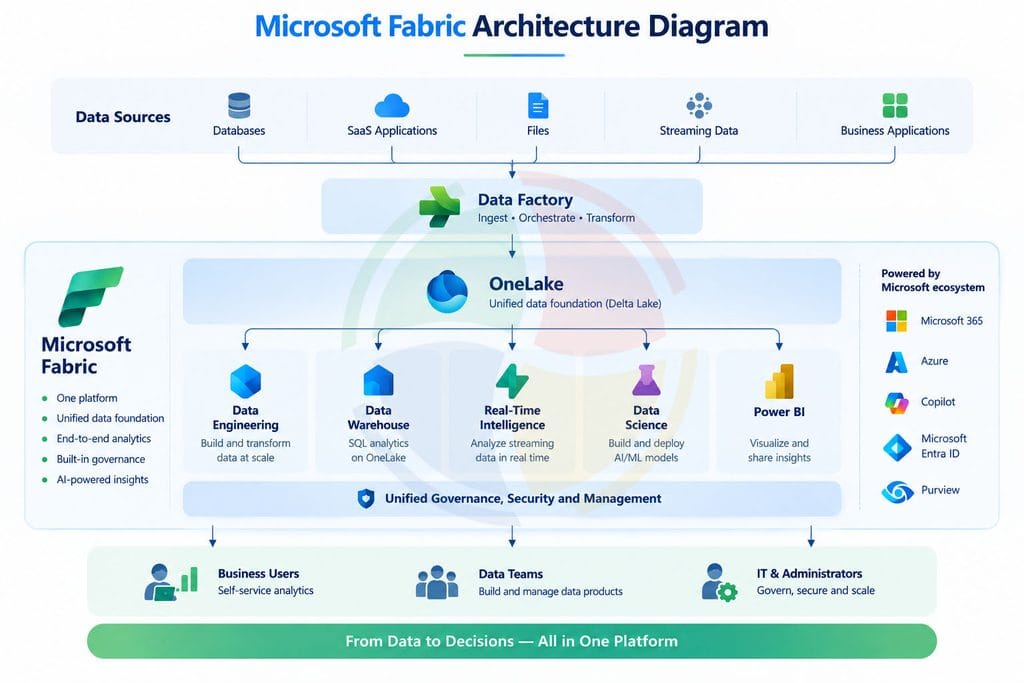
Data enters Microsoft Fabric from cloud, on-premises, application, and streaming sources. Data Factory handles ingestion and orchestration, while OneLake provides the common data foundation used by engineering, warehousing, data science, and real-time workloads. Power BI then turns this processed data into reports and business insights.
Microsoft Fabric Architecture Benefits
The biggest benefit of Microsoft Fabric architecture is that it brings data storage, integration, engineering, analytics, and business intelligence into one connected environment. For a team that used to move data between disconnected tools, that translates into working from a common data foundation in OneLake instead.
Unified Data Environment
Break down data silos by giving teams consistent access to trusted organizational data through OneLake.
Reduced Data Duplication
Data accessed where it lives instead of copied five times across five systems. Storage overhead and management effort drop because of it.
End-to-End Analytics
Engineering, analytics, AI, BI — connected, not handed off between disconnected tools. That’s what actually shortens the path from data ingestion to a business decision.
Centralized Security and Governance
Access policies, data lineage, governance — consistent across the whole data estate, not enforced differently depending on which team owns which system.
Faster Access to Insights
Less time moving and preparing data means teams get to the actual decision sooner, not stuck waiting on a pipeline.
Scalable Data Architecture
Analytics, AI, warehousing, real-time workloads — built to expand as the business grows into them, not rebuilt from scratch when it does.
How Does Microsoft Fabric Handle Security and Governance?
Centralized Security Management
Microsoft Fabric eliminates fragmented controls to consolidate security management across the data estate. It uses Microsoft Entra ID for identity and access management (IAM). As a result, it provides a single foundation for managing user authentication, roles, and authorization across all OneLake data and Fabric experiences.
The centralized approach significantly simplifies administration while allowing for granular access controls. In short, only authorized users can interact with specific data items and workloads to minimize potential vulnerabilities.
Data Governance and Compliance
Fabric’s integrated architecture ensures the quality and compliance of data. With OneLake as the single source of truth, data consistency is inherently improved. The outcome is fewer discrepancies that often arise due to data duplication.
Furthermore, deep integration with Microsoft Purview means governance capabilities are built for automatic data discovery and lineage tracking. The unified approach helps you meet regulatory requirements (like GDPR and HIPAA) to maintain high data integrity.
Future-Proof Your Data Strategy with Microsoft Fabric
Microsoft Fabric offers a resilient data strategy that brings together your entire data estate into one cohesive, powerful platform. It’s an unparalleled integrated environment that brings together all necessary data from engineering to business intelligence and AI. It empowers your teams to streamline operations, act on real-time insights, and scale with confidence. Amid all this, your business thrives.
Aegis Softtech goes beyond mere implementation. We design unified data ecosystems that leverage Microsoft Fabric for real-time insights and automated workflows. We ensure that Fabric scales with your business to deliver tailored solutions.
Ready to build this intelligent, future-ready data ecosystem? Contact our Microsoft Fabric consulting services to learn how integrating Microsoft Fabric can transform your approach and deliver sustained value.
Frequently Asked Questions
Q1. What is Microsoft Fabric used for?
Microsoft Fabric streamlines the entire data lifecycle, from data ingestion to visualization. It solves data warehousing, real-time analytics, integration, machine learning, and data science requirements.
Q2. What are the top Microsoft Fabric architecture benefits?
Key Microsoft Fabric architecture benefits include streamlined data management, reduced delivery time, enhanced focus on high-value activities, and improved business decisions.
Q3. What makes Microsoft Fabric unique?
Fabric distinguishes itself with its unified analytics platform, seamless integration with other Microsoft products, and lake-centric architecture, all while being built for the cloud.
Q4. How does Microsoft Fabric handle existing data and workloads?
It connects to both cloud and on-premises sources, pulling existing data into one analytics environment rather than requiring a rebuild. Existing pipelines and workflows can integrate too.
Q5. Is Microsoft Fabric suitable for small and large organizations?
Microsoft Fabric scales across different data volumes and workloads, so size alone isn’t the deciding factor. What actually matters is data complexity, what infrastructure is already in place, and what the business needs it to do.
Q6. How does Microsoft Fabric differ from using separate data and analytics tools?
Microsoft Fabric brings data integration, engineering, warehousing, analytics, data science, and BI — all on one connected platform. That means data stops getting shuffled between tools just to move through the pipeline.