

ServiceNow ITSM vs ITIL isn’t really a debate; they solve two different problems. ServiceNow ITSM is software that logs, routes, and resolves incidents, problems, changes, and requests. ITIL is a framework — it tells you how those processes should be designed to actually deliver value.
You don’t choose between them. You decide how closely you configure ServiceNow ITSM to follow ITIL’s guidance, versus building your own process model from scratch.
This comparison breaks down exactly how ServiceNow ITSM and ITIL differ, where they overlap, and how to use them together.
ServiceNow ITSM vs ITIL at a Glance
The main difference between ServiceNow ITSM and ITIL is category. Here’s how the two stack up across ownership, cost, certification, and scope before we break each one down in detail.
| Feature | ServiceNow ITSM | ITIL |
| Core Offering | SaaS platform for running IT service processes | Best-practice framework for designing service processes |
| Scope | Incident, problem, change, request, CMDB, knowledge, SLAs | People, process, and value-creation guidance across the service lifecycle |
| Flexibility | Highly configurable to any process model | Adaptable “practices” (ITIL 4), not rigid scripts |
| Certification | Product certifications (CSA, CIS-ITSM) | Individual certifications (Foundation to Master) |
| Cost Model | Subscription licensing per user/instance | Training and exam fees; no software cost |
| AI Capabilities | Now Assist, Predictive Intelligence, AI Search | No native AI, framework-level guidance only |
| Governance | Configurable RBAC, SLAs, audit trails within the platform | Governance principles (four dimensions, value co-creation) |
For a closer look at the workflows and features, see our guide to the ServiceNow platform for ITSM.
ServiceNow ITSM vs ITIL: Detailed Comparison
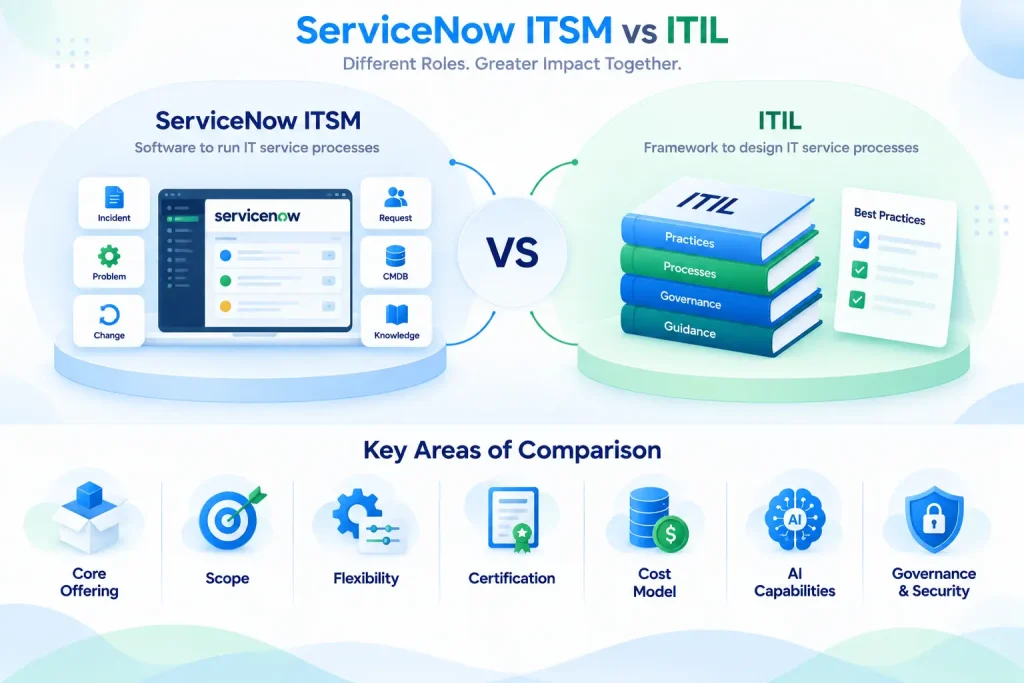
Let’s dig into how each one actually works, what it covers, and how well it fits into how you already run IT.
Core Offering
- ServiceNow ITSM: A SaaS platform built on the Now Platform, used to run day-to-day IT service processes — logging, routing, resolving, and reporting on incidents, problems, changes, and requests.
- ITIL: A published framework of best practices, originally developed by the UK’s Central Computer and Telecommunications Agency in the 1980s, that defines how service processes should be designed to deliver value.
If you need help understanding the ITSM vs ITIL difference and turning this guidance into a process design, Aegis Softtech’s ServiceNow consulting services can help map the requirements before configuration begins.
Scope
- ServiceNow ITSM: Covers incident management, problem management, change management, request fulfillment, a configuration management database (CMDB), knowledge management, and SLA tracking.
- ITIL: Covers the Service Value System, four dimensions of service management (organizations and people, information and technology, partners and suppliers, value streams and processes), and 34 management practices spanning general, service, and technical management.
A CMDB supports several of these processes; our ServiceNow CMDB implementation guide explains the setup in more detail.
Flexibility
- ServiceNow ITSM: Highly configurable — two organizations on identical licenses can run completely different workflows, approval chains, and automation rules.
- ITIL: Adaptable through “practices” rather than rigid, numbered processes (a shift introduced in ITIL 4), but it remains a structured, published reference rather than something you rebuild from scratch.
When that process design calls for custom forms, integrations, or automation, experienced ServiceNow developers can configure and extend the workflows.
Certification
- ServiceNow ITSM: Offers product certifications, such as CSA and CIS-ITSM, for professionals who configure and administer the platform.
- ITIL: Offers a globally recognized certification path for individuals, from Foundation through Practice Manager, Strategic Leader, and Master.
Cost Model
- ServiceNow ITSM: Subscription licensing, priced per user, scaling with modules and add-ons like Now Assist.
- ITIL: There is no software cost; expenses come from official training courses, certification exams, and publications.
AI Capabilities
- ServiceNow ITSM: Includes built-in AI tooling — Now Assist for generative drafting and summarization, Predictive Intelligence for auto-categorizing tickets, and AI Search for faster knowledge retrieval.
- ITIL: No native AI features; as a framework, it provides the reasoning (via principles like “optimise and automate”) for where automation should be applied, without executing it.
Governance
- ServiceNow ITSM: Enforces governance through configurable role-based access control (RBAC), SLA policies, and built-in audit trails.
- ITIL: Provides guidance rather than enforcement, explaining how access, risk, and value decisions should be structured, while leaving the actual controls to the platform.
Which Should You Focus On: ServiceNow ITSM or ITIL?
Start with the problem you need to solve.
Focus on ITIL when:
- You’re defining how incidents, changes, and problems should be handled.
- You need a recognized reference for governance or process reviews.
- Your team needs a shared service management vocabulary and training path.
If you’re planning a rollout, review the phases in our ServiceNow implementation timeline
Focus on ServiceNow ITSM when:
- You need to replace email, spreadsheets, or disconnected ticketing tools. If you’re moving from a legacy service desk, plan the transition through ServiceNow migration services.
- You’re ready to automate approvals, track SLAs, and report on service performance.
- You want to improve self-service and use AI to help classify and route tickets.
If you’re doing both, define the process with ITIL guidance, then configure it in ServiceNow ITSM. For a new rollout, ServiceNow implementation services can turn that design into working processes.
Build the Right ITSM Foundation
ITIL provides the guidance for designing effective IT services. ServiceNow ITSM puts that guidance into practice through workflows, automation, SLAs, and reporting. Together, they help teams deliver services consistently and measure where they can improve.
Aegis Softtech enables organisations to translate ITIL practices into ServiceNow ITSM workflows that match their procedures, people, and service targets. No matter if you’re implementing ServiceNow or optimising your existing implementation, we can assist you in developing a solid ITSM foundation that’s effective in the real world.
For an existing environment that needs ongoing monitoring and optimization, explore our ServiceNow managed services.
Frequently Asked Questions
Is ServiceNow ITSM based on ITIL?
Yes. ServiceNow ITSM incorporates many ITIL methods like Incident, Problem, Change, and Configuration Management. That said, ServiceNow can be customised to accommodate other service management systems or customised procedures.
Do I need ITIL certification to use ServiceNow ITSM?
No. ITIL certification is about service management theory, while running ServiceNow ITSM day-to-day is a matter of platform training, not passing an ITIL exam. Plenty of ITSM admins end up with both, but neither one requires the other.
Can I run ServiceNow ITSM without following ITIL?
Yes, you can. You could build it around COBIT, ISO/IEC 20000, something homegrown, or no formal framework at all. Most enterprises stick with ITIL mainly because it’s the most battle-tested and widely adopted option, not because ServiceNow demands it.
What’s the current version of ITIL?
ITIL Version 5 is now the latest release, with ITIL Foundation (Version 5) already available. ITIL 4 is still around during the transition period, though its modules are set to be phased out by December 31, 2027.
Which should I learn first, ServiceNow or ITIL?
For a hands-on service desk or admin role, start with ServiceNow product training. For a process, governance, or service management leadership role, start with ITIL Foundation. Most careers eventually need both.