Data Lakehouse vs Data Warehouse: Differences & Use Cases

We’re here to talk about something truly critical for your business—the very foundation your insights are built on.

The future of data analytics does not only entail collecting gigantic amounts of information. Instead, it’s about harnessing that data instantly and with incredible flexibility. While your organization is pushing the boundaries of cutting-edge AI and machine learning, it is integral for your underlying data infrastructure to keep pace.

The intense demand fuels the Data Lakehouse vs Data Warehouse conversation, pushing leaders to re-evaluate their long-term strategies.

With the global data analytics market now valued at over $82.23 billion and growing, the demand for smarter approaches also rises. Thus, exploring these two powerful architectures isn’t just an option anymore. It has become an absolute essential to drive innovation and maintain a competitive edge.

So, which path should your enterprise take? Let’s find out!

Key Takeaways


1. Data Warehouse: Structured, secure, and ideal for predictable BI and reporting. It’s expensive and rigid.
2. Data Lakehouse: Flexible, scalable, and cost-effective. It handles all data types and is perfect for AI/ML and real-time analytics.
3. Key points of comparison: Supported Data Types. Scalability & Cost, Performance, Flexibility, and AI/ML Readiness
4. Choose DWH: For compliance-heavy, structured data environments.
5. Choose DLH: For flexible, diverse data workloads and future-proof analytics.

What is a Data Warehouse?

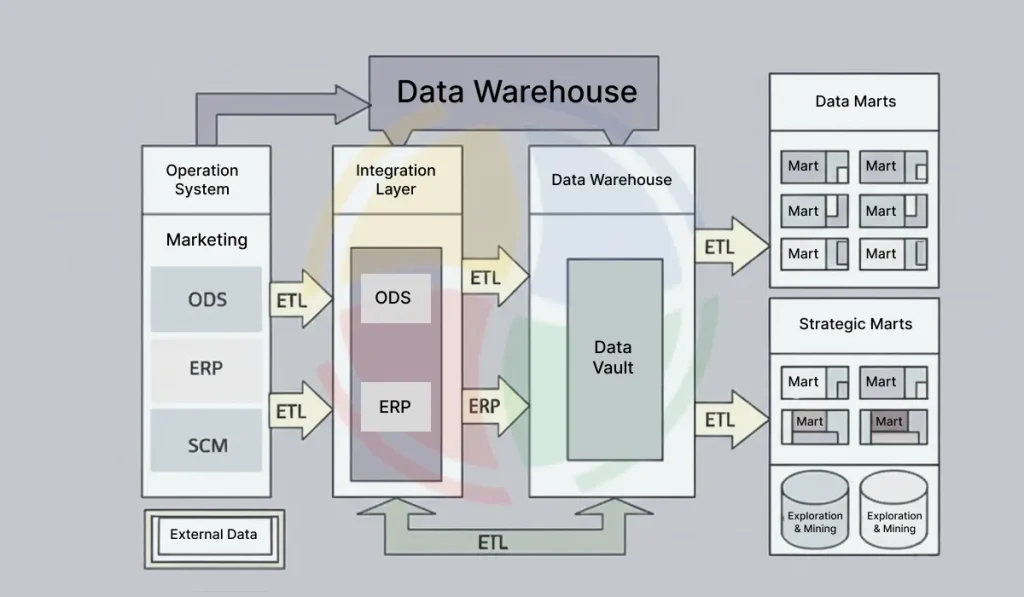
Diagram illustrating a traditional Data Warehouse architecture with ETL, integration layer, and data marts

Imagine a highly organized library that is specifically designed to answer precise questions related to your business’s past performance. That’s essentially what a data warehouse is.

Valued at US$31.80 billion in 2023, the Data Warehousing Market size is expected to reach nearly US$64.79 billion, growing at a CAGR of 10.7%.

The data warehouse architecture is for storing and managing huge volumes of historical data for further analysis and reporting. With an architecture built upon a structured schema, it meticulously organizes data into tables with predefined relationships and usually resides in relational databases.

ETL (Extract, Transform, Load) processes help organize data into this structure by meticulously cleaning, transforming, and loading it from various operational systems.

Key Strengths

1. Performance

Designed for structured, data-based mass performance queries, high-scale business intelligence, and reporting.

2. Data Integrity

Sound governance and data management frameworks guarantee high-quality and integrity of data.

3. Security

Proven and reliable security mechanisms protect your sensitive organizational data.

Ideal Use Cases

1. Business Intelligence Dashboards

They are the backbone for traditional BI dashboards and offer consistently fast data to report key performance indicators.

2. Financial Reporting

For compliance-heavy tasks, including financial reporting, it emphasises data accuracy and ACID (Atomicity, Consistency, Isolation, Durability) compliance.

3. Healthcare, Banking & Government

Industries like healthcare, banking, and government have stringent regulatory requirements. They thus rely heavily on data warehouses for their robust data governance and auditing capabilities.

Limitations

1. Cost

The high initial setup costs and the significant burden of ongoing maintenance expenses.

2. Scalability

You are bound to ever-increasing investment in hardware and infrastructure as your business grows.

3. Flexibility

Low in handling unstructured or semi-structured data due to its inability to meet modern data needs.

Ready to solidify your data foundation and empower smarter decisions? Explore how our expert data warehouse solutions can transform your enterprise analytics today.

What is a Data Lakehouse?
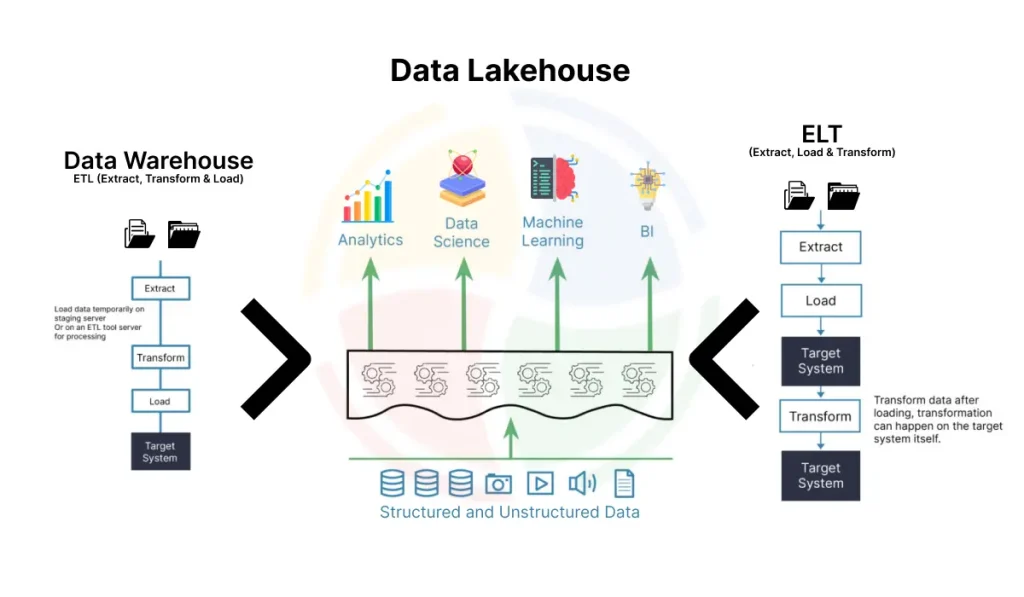
 Diagram explaining Data Lakehouse architecture, contrasting it with traditional Data Warehouse and ELT processes

A data lakehouse takes the best features of two powerful data systems, a data warehouse and a data lake, and combines them into a unified, powerful solution.

Standing at a value of USD 8.9 billion in 2023, the Global Data Lakehouse Market size is expected to soar to around USD 66.4 billion by 2033, growing at a CAGR of 22.9%.

Data lakehouse boasts a hybrid architecture, strategically blending the strengths of traditional data lakes and data warehouses.

Thus, you get the massive flexibility and scale of data lakes to store all types of data (structured, unstructured, and semi-structured) without rigid schemas.

Simultaneously, its critical governance, reliability, and performance from data warehouses enable robust analytics and direct consumption by BI tools.

Key Strengths

1. Scalability

Data Lakehouses can be easily scaled up for expansion and scaled down when business demands are low.

2. Cost-Effective

It is a cost-effective option, as it utilizes cloud-based storage solutions and open-source tools.

3. Flexibility

It can manage structured, semi-structured, and unstructured data types. Hence, you can flexibly utilize it in different use-case situations.

4. Advanced Analytics

A data lakehouse enables ML and AI technologies through a single platform that caters to various data types, along with real-time data processing.

Ideal Use Cases

1. Advanced Analytics & ML

Data lakehouses store huge and diverse sets of data for model training, making them ideal for AI and ML.

2. Real-time Analytics & Streaming Data

Handle high-velocity streaming data for immediate structuring and processing, offering near real-time analytical queries.

3. Unified Data Platform

Consolidates diverse workloads, from data science to BI and streaming, onto a single platform, eliminating silos and fostering efficiency.

Limitations

1. Complexity

Presents information in multiple formats and is often extracted from various sources. It complicates governance and management of sophisticated tools.

2. Performance Variability

Performance can vary across query engines and data handling tools. Thus, you have to stay agile for varying scenarios.

3. Security Concerns

They offer strong built-in security for end-to-end security, but that can be quite a challenge at times.

Data Lakehouse vs Data Warehouse: Comparative Table
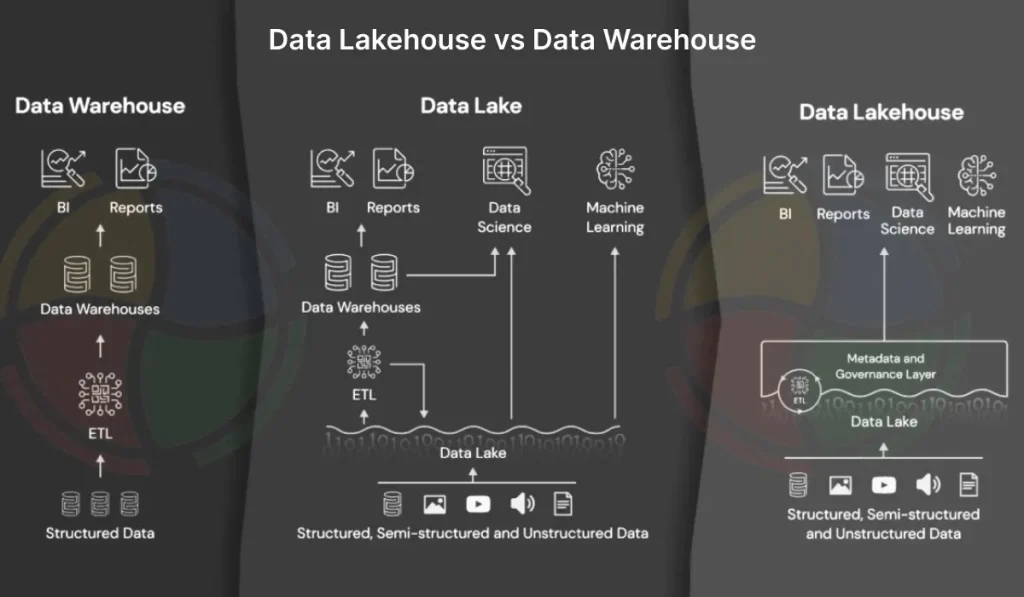
Visualizing data architectures: Warehouse (structured) and Lakehouse (hybrid)

Data has grown beyond the point of just being called an asset. It is now the very lifeblood of innovation and competitive advantage.

The exploding data volumes and growing AI demands pave the way to crucial questions around the robustness of your data architecture. And more importantly, which one?

Agile data lakehouse is here to challenge the long-standing reign of the data warehouse, forcing a pivotal decision for every enterprise.

Here’s a sleek data lakehouse vs data warehouse comparative table for a quick understanding:

FeatureData LakehouseData Warehouse
ArchitectureHybrid architecture combining the scale of data lakes with the governance/performance of data warehouses.Optimized architecture for structured, historical data for reporting and analysis. Based on relational databases.
ScalabilityHighly scalable, leveraging cloud object storage; more cost-effective for large data volumes.Expensive and rigid to scale, especially with rapidly growing data volumes.
Data Structure / SchemaFlexible schema; supports Schema-on-Read, allowing structure to be applied later.Structured schema applied before data loading (Schema-on-Write).
Data Governance / ACIDProvides ACID compliance, schema enforcement, and robust governance typically associated with data warehouses.Robust ACID compliance, strong data integrity, and reliability.
Data Types SupportedAll data types: structured, semi-structured, and unstructured.Primarily supports structured data. Poor support for unstructured data.
CostGenerally, higher cost for storage and compute, especially at scale, due to proprietary systems.Generally higher cost for storage and compute, especially at scale, due to proprietary systems.
PerformanceStrong performance for diverse workloads (BI, ML, streaming) due to optimized storage formats and engines.Strong query performance for complex analytical queries on structured, pre-defined data.
Ideal Workloads / Use CasesAdvanced analytics & ML, real-time analytics, unified platform for diverse workloads.BI dashboards, financial reporting, and compliance-heavy industries.

The table highlights the core distinctions, but a more in-depth look reveals the practical considerations behind each architecture. 

Data Warehouse vs Data Lakehouse: Key Differences

We know you’re on a quest to find the ultimate data platform that can handle your organization’s complex demands.

But with two dominant architectures vying for attention, how do you choose?

Let’s skip simple definitions and explore the contrasting philosophies and practical disparities between these two. Here’s an extensive data warehouse vs lakehouse outlook.

1. Supported Data Types

Data Warehouse

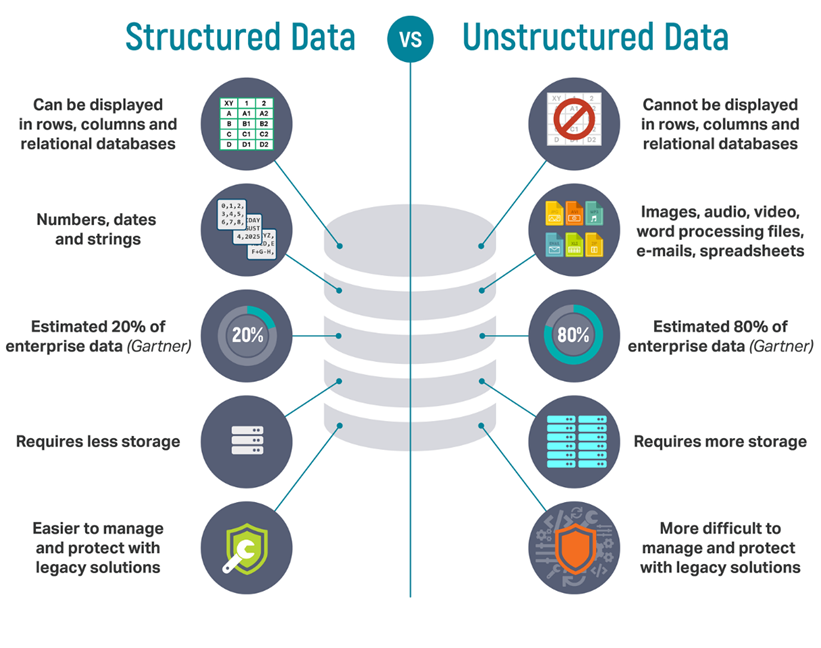
Data warehouses predominantly support structured data, offering perfectly organized rows, columns, and tables, typically used for transactional records and operational data.

It struggles with semi-structured (including JSON and XML) and unstructured data (including images and audio), or needs extensive preprocessing. Thus, limiting its usage to diverse modern data sources.

Data Lakehouse

Data lakehouses support various data types, including structured, semi-structured, and unstructured. Thus, offering you the flexibility to ingest data in its raw format without prior transformation. All types of data can reside in its unified repository, ready for various analytical needs, including advanced analytics.

2. Scalability & Cost

Data Warehouse

Scaling a traditional data warehouse requires hefty upfront investments in software licenses and proprietary hardware, thus proving expensive and complex. Scaling compute and storage is knit together and may lead to inefficiencies.

Data Lakehouse

Due to its cloud-native elasticity, it can leverage inexpensive object storage (like S3 or ADLS) that’s capable of infinite virtual scaling.

You can independently scale compute resources to pay only for what you use. A disaggregated compute and storage architecture results in a cost-effective and flexible scaling model.

3. Performance

Data Warehouse

Its strong performance in SQL workloads and traditional BI reporting is well-known. It rapidly executes complex analytical queries on predefined schemas with its highly optimized indexing and structured nature.

Data Lakehouse

Lakehouses are working to close the performance gap with data warehouses, particularly for SQL queries. It offers exceptional performance for different data types because of its advancements in open file formats (like ORC and Parquet) and powerful query engines (like Apache Spark and Trino).

4. Flexibility

Data Warehouse

Its rigid schema-on-write approach requires the data to conform to a predefined schema before being loaded into the warehouse. While the rigidity helps maintain data quality and consistency, it can also hike up the challenges and time to adapt to new data sources.

Data Lakehouse

Its schema-on-read approach offers flexibility as data can be ingested in its raw format without any immediate schema enforcement. Thus, you can quickly onboard and experiment with data.

Schema is applied at a later stage during query time for higher agility to evolve data models and explore diverse datasets.

5. AI/ML Readiness

Data Warehouse

Its alignment with modern AI/ML pipelines is limited since its primary focus is on structured data, with less support for raw or unstructured formats. Data scientists usually have to extract data into separate environments, potentially causing data duplication and complex data movement.

Data Lakehouse

These are highly aligned with AI/ML pipelines with their prowess to natively handle all data types. Data scientists can easily access raw data for model training and feature engineering directly in a single platform.

When Should You Choose a Traditional Data Warehouse?

There’s a lot of buzz around newer architectures, but that does not mean traditional data warehouses have lost their charm. They are still a formidable and reliable choice for many organizations.

It’s the tried-and-true workhorse and has powered business intelligence for decades. But where do they stand amid these evolving data demands?

Here’s when this battle-tested solution is still your best bet:

You have high compliance needs (e.g., banking, insurance)

Many industries, including insurance and banking, are heavily regulated and require strict data governance, ACID compliance, and auditing for transactional integrity.

Data warehousing, with its mature capabilities, is a better fit here due to higher reliability and consistency.

Your data is mostly structured & transactional

Clean and structured information originating from operational systems benefits more from a data warehouse, especially for storage and rapid querying.

You rely on heavy SQL-based BI/reporting with consistent workloads

Organizations that focus on traditional BI dashboards and analytical workloads through standard SQL queries on a predictable schedule prefer data warehouses. They offer superior and consistent performance.

We help businesses reimagine their data strategy—whether it’s tuning what you have or building for what’s next. Want to know how? Explore our Data warehouse consulting services.

When Should You Choose a Data Lakehouse?

Are your data needs rapidly evolving, crossing the boundaries of structured reports to step into the wild frontiers of AI, real-time insights, and IoT?

The data lakehouse truly shines here as it was born from the need for massive scaling and unparalleled flexibility. It empowers cutting-edge analytics and future-proofs your data strategy.

Let’s see when to embrace this innovative hybrid model.

You deal with varied data types (logs, images, sensor data, or documents)

Many businesses generate or need to analyze different kinds of data. The list can encompass unstructured data (e.g., images, free text, videos) or semi-structured (e.g., JSON logs), alongside structured data. Here, data lakehouses offer a unified repository and flexible schema for better handling.

You need fast experimentation and iteration with ML models

A data science team may need direct access to raw, granular data for model training, rapid experimentation, or feature engineering. A data lakehouse can offer the unified environment and agility required to accelerate AI and ML pipelines.

Your business model needs real-time analytics (e.g., eCommerce, IoT)

Certain operations demand swift insights from high-velocity streaming data. For instance, sensor data analysis in IoT or real-time fraud detection in e-commerce. A data lakehouse can ingest, process, and transform that data for query in near real-time.

Choosing the Right Architecture for the Future
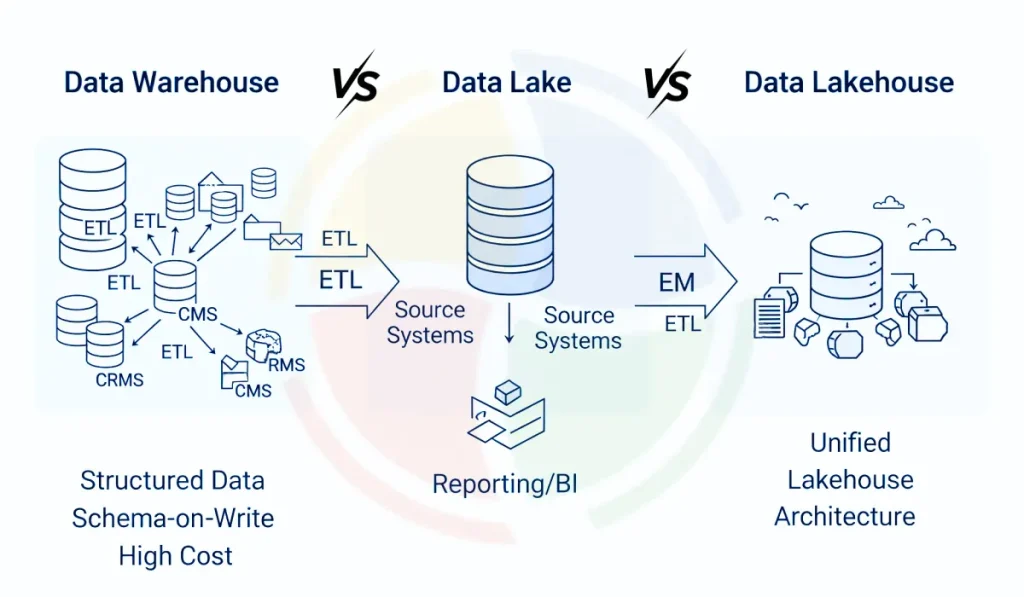
Diagram illustrating the evolution from Data Warehouse to Data Lake to a unified Data Lakehouse architecture

So, which path will truly lead your enterprise to data mastery?

There’s no single winner in the data lakehouse vs data warehouse debate. The optimal choice depends upon various factors, including your unique data needs, existing infrastructure, and future goals.

The real question is—are you all in to critically assess your strategy and consequently invest in the architecture that will truly propel your business forward?

At Aegis Softtech, we help you evaluate, build, and migrate to cloud-native data platforms on these parameters and more.

Need help choosing or optimizing your data architecture?

Whether you're modernizing a legacy warehouse or evaluating a move to a hybrid or lakehouse model, our data warehousing consultants provide clear, client-focused guidance.

FAQs

Q1. What is the difference between a data warehouse vs data lake vs lakehouse?

The key difference lies in data structure and use cases:

  • A data warehouse is designed for structured data and business intelligence.
  • A data lake stores all data types (including structured, semi-structured, and unstructured data) for flexibility and scale.
  • A data lakehouse combines the best of both these architectures. It offers the performance and structure of a warehouse with the scalability and low-cost storage of a lake.

Q2. Can a data lakehouse replace a data warehouse?

Yes, a data lakehouse can potentially replace a data warehouse for many modern use cases. It offers quite a similar performance but with added flexibility for advanced analytics and unstructured data.

Q3. Is Databricks a data warehouse or lakehouse?

Databricks is a data lakehouse platform. It amalgamates the scalable storage of a data lake and the structured performance and governance features of a data warehouse.
In the light of a data-driven world today, organizations now depend more on complex data architectures that can store, manage, and analyze significant volumes of data. Two of the most popular approaches are Data Lakehouse and Traditional Data Warehousing. They have their strengths and weaknesses, with your organization taking one or another approach possibly seeming to be quite tricky. This article delves deeply into both architectures to compare them in various respects, which will help you decide which one will be the best fit.

The Evolution of Data Storage and Analysis

The sphere of data management has been undergoing tectonic changes over the past few decades. It all began with a simple database for data management. Afterwards, with an increase in volume and variety along with the velocity of data, more sophisticated systems such as Traditional Data Warehouses were built. These can handle only huge-scale data storage/processing and complex queries. However, with big data emerging and its need for better flexible and broader scalable solutions arises the concept of a Data Lakehouse.

Defining Data Lakehouse and Traditional Data Warehousing

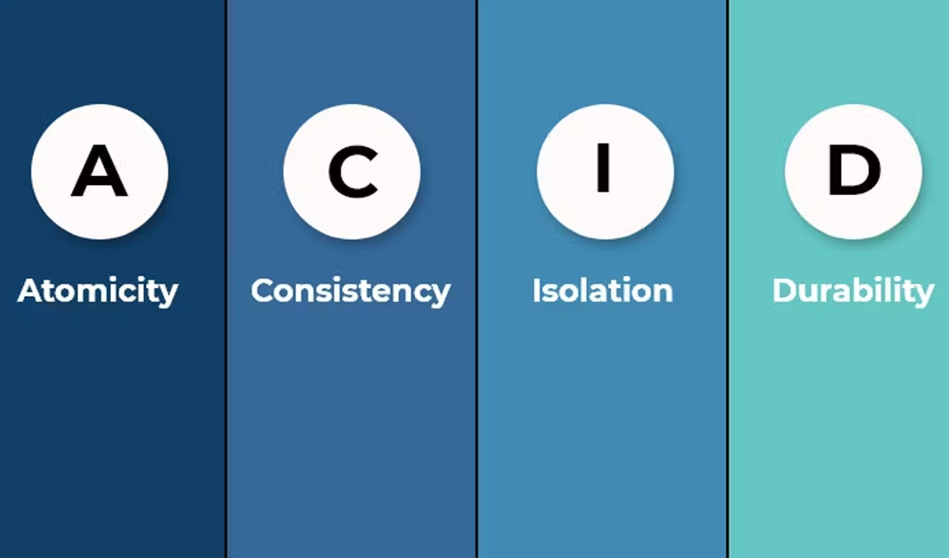
A Data Lakehouse is a modern type of architecture for data management. The best features of a Data Lake and a Data Warehouse, in principle, allowing flexibility and scalability while offering ACID (Atomicity, Consistency, Isolation, Durability) properties and data Warehouses’ reliability.

image 18

In other case, Traditional Data Warehouse involves a centralized repository where structured data comes from various sources. It is optimized for query and reporting, providing good data governance, performance, and reliability.

Key Components

Data Lakehouse

  1. Storage Layer: This layer enables the management of structured and unstructured data in a Data Lakehouse. This is often picked utilizing distributed storage centers, for instance, HDFS, AWS S3, and Azure Data Lake Storage.
image 19
  • Metadata Layer: This is the layer through which data can be found and managed since it contains the stored metadata information that helps to maintain the schema and give insights into the lineage and governance of the data.
  • Processing Layer: Tools and frameworks include Apache Spark, Presto, and Databricks for data processing. These tools luxuriate in batch and real-time data processing.
image 20
  • Query Engine: Data Lakehouse enable supporting SQL and other query languages that help users use interactive queries on the data.
  • Governance and Security: Data Lakehouse offer very secure data, such that data encryption, access control, and other measures are easily maintained in compliance with data regulations.

Traditional Data Warehousing

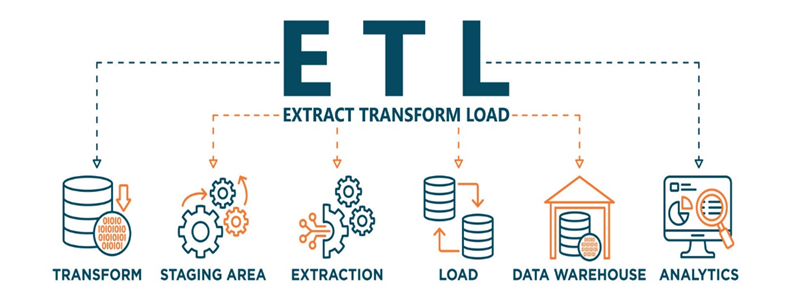
  • ETL: It initially stands for Extraction, Transformation, and Loading. ETL processes are integral to traditional Data Warehousing. Data is extracted from various sources, transformed to fit the schema, and then loaded into the Warehouse.
image 21
  • Storage: Data Warehouses are stored in structured storage, which has been optimized for query performance. In general, columnar storage formats have been found to enhance retrieval speed.
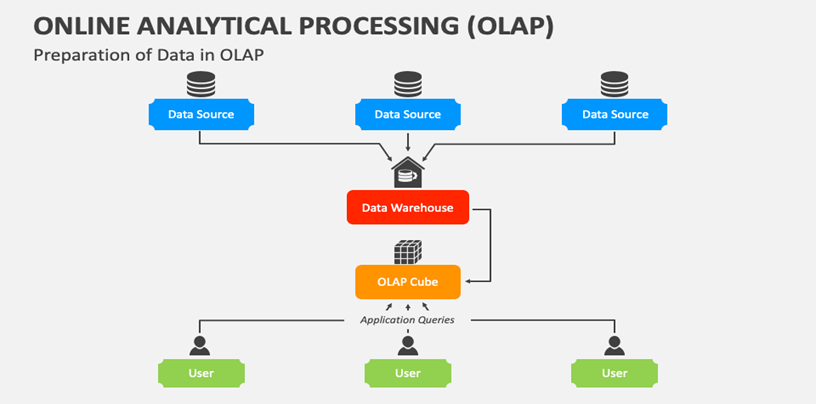
  • OLAP (Online Analytical Processing): The Data Warehouse infrastructure supports interactive OLAP operations, enabling complex analytical queries and multidimensional analysis.
image 22
  • Data Governance: Traditional Data Warehouses have robust governance mechanisms that ensure that data is of the best quality, consistent, and compliant.
  • Reporting and BI Tools: The tools within this cluster allow the creation of reports, dashboards, and data visualizations to draw inferences from the data effectively.

Comparison Criteria

For the latter to be understood concerning which architecture fits your needs, the following comparison of Data Lakehouse with Traditional Data Warehousing against several critical bases is required:

Scalability

  • Data Lakehouse: It has excellent scalability. The distributed nature of this file system is such that it can easily be scaled out by simply adding more storage and computer resources. In turn, it is apt for supporting large volumes of divergent data.
  • Traditional Data Warehousing: These can scale, but their scale-out is the most planned and invested. Scaling basically means adding more hardware, which is costly and time-consuming.

Flexibility

  • Data Lakehouse: Very flexible with all manner of datasheets—one could call it structured, semi-structured, or unstructured data. This is critical for current analytics needs since the data assumes many forms.
  • Traditional Data Warehousing: Mainly structured-data-oriented. Although some add-on tools make it possible for it to support some semi-structured data, it is more limited in scope than a Data Lakehouse.

Performance

  • Data Lakehouse: It delivers variable performance concerning the query processing engine that is used. But properly configured, it’s made to provide very high performance, especially on Data Lakehouse for big data workloads.
  • Traditional Data Warehousing: Known for high performance in query processing over structured data. It is designed and built for quick response times for queries, so it is perfect for business intelligence and reporting.

Cost

  • Data Lakehouse: Generally affordable for large-scale data storage and processing because you use an open-source technology and resolution cloud-based. Pay-as-you-go models help a lot with managing costs effectively.
  • Traditional Data Warehousing: It can prove to be costly because it involves specialized hardware and software. Licensing fees and the costs involved in scaling up its infrastructure start adding up, making it less cost-effective than Data Lakehouse.

Data Governance and Security

  • Data Lakehouse: Modern Data Lakehouse come with advanced features that deal with security and governance frameworks. Still, managing governance across diverse data types isn’t so straightforward.
  • Traditional Data Warehousing: Traditional data warehouse services are known to be equipped with sturdy governance and security mechanisms. Enables effective data management such that data integrity is preserved with compliance to specific legislations.

Use Cases

  • Data Lakehouse: Appropriate for an organization with vast and diverse data volumes that bring the need for analytics, machine learning, and AI in real time; great for a data-driven enterprise that needs to integrate silos of different data sources.
  • Traditional Data Warehousing: Most suited to those organizations that work with structured data and need business intelligence, reporting, and historical analysis. Organizations within the finance, retail, and healthcare sectors have undergone several adaptations to fulfill the need for data integrity and consistency.

Detailed Comparison Table

For a more precise comparison, presented here is a very detailed table showing the differences between Data Lakehouse and Traditional Data Warehousing:

CriteriaData LakehouseTraditional Data Warehousing
ScalabilityHigh, easily scalable with distributed systemsModerate, requires hardware investment
FlexibilitySupports all data typesPrimarily structured data
PerformanceVariable, depends on query engineHigh, optimized for structured queries
CostCost-effective, pay-as-you-go modelsExpensive, high upfront costs
Data GovernanceAdvanced, but complexStrong, robust governance
SecurityComprehensive, modern security featuresEstablished, proven security mechanisms
Use CasesBig data analytics, real-time processingBusiness intelligence, historical analysis
ETL ProcessELT (Extract, Load, Transform)ETL (Extract, Transform, Load)
ProcessingBatch and real-time processingBatch processing
Query LanguageSQL, NoSQL, and morePrimarily SQL
Data IntegrationHigh, integrates with various data sourcesLimited to structured data sources
Implementation TimeFaster, especially with cloud solutionsSlower, requires significant setup time
MaintenanceModerate, depends on the technology stackHigh, due to specialized infrastructure

Advantages and Disadvantages

Data Lakehouse

Advantages

  • Scalability: This has been reiterated and it is with the concept of scale that Data Lakehouse can easily be scaled up if there is ever an expansion.
  • Cost Effective: Using cloud-based storage solutions and open-source tools, it becomes a practical choice.
  • Flexibility: It can manage structured, semi-structured, and unstructured data types; hence, it’s very flexible to different use-case situations.
  • Advanced Analytics: This allows machine learning and AI technology to be enabled through a single platform that caters to different data types together with real-time data processing.

Disadvantages

  • Complexity: Information could be presented in multiple formats and, in most cases, extracted from various sources, which makes its governance and management complex and demanding of sophisticated tools.
  • Performance Variability: Performance can vary across query engines and data handling tools.
  • Security Concerns: Even though the modern Data Lakehouse are pretty strong in built-in security, ensuring an end-to-end security approach for different kinds of data can be pretty challenging.

Traditional Data Warehousing

Advantages

  • Performance: Designed for structured data-based mass performance queries, high-scaled business intelligence, and reporting.
  • Data Integrity: Sound governance and data management frameworks guarantee quality data with integrity.
  • Security: Proven and reliable security mechanisms protect the data that are sensitive in an organization.

Disadvantages

  1. Cost: The high initial setup costs and the significant burden of ongoing maintenance expenses.
  • Scalability: There needs to be increased investment in hardware and infrastructure.
  • Flexibility: Low in handling unstructured or semi-structured data due to immobility to modern data needs.

Real-Life Examples

Data Lakehouse in Action

  • Netflix: Netflix runs and analyzes gargantuan volumes of streaming data by deploying a Data Lakehouse. This combination allows Netflix to deliver personalized recommendations and insights on user behavior in real-time.
image 23
  • Uber: Uber has utilized a Data Lakehouse to work with the massive amount of data generated by its ride-sharing platform. This structure will make real-time analytics possible to optimize routes, pricing, and driver-partner allocation.
image 24

Traditional Data Warehousing in Action

  1. Walmart: Walmart has a conventional data warehouse for inventory, sales, and customer information management. The data warehouse is highly performant and the simplicity, flexibility, and reliability of a traditional data warehouse make it possible for Walmart to conduct complex queries and generate reports for business decision-making.
image 25
  • Bank of America: Traditional data warehousing is an enabler to keep the backbone of Bank of America intact in coping with financial transactions, customer details, and regulatory reports. The robust data governance and security features ensure that financial regulations are met while sensitive customer information is protected.
image 26

Implementation Considerations

Data Lakehouse Implementation

  • Technology Stack: Choose a proper tool for the job and framework, something like Apache Spark for data processing Delta Lake for storage, or Databricks for a unified data analytical platform.
  • Cloud Integration: Would cut down on the complexity of implementation and will allow for storage and processing power that scales with cloud services like AWS, Azure, or Google Cloud.
  • Data Governance: It is vital to establish concrete data governance to ensure data quality, security, and compliance across all data types.
  • Skillset: A Data Lakehouse project will require an expert prominent data technologist, cloud platform, and data governance expert team.

Traditional Data Warehousing Implementation

  • Infrastructure Setup: Hardware and software infrastructure setup may be costly and time-consuming to configure. Redundancy and backup systems ensure reliability.
  • ETL Processes: Designing effective ETL processes given carrying out extraction, transformation, and loading of data into the warehouse. Practical tools for this are Informatica, Talend, and Apache Nifi.
  • Data Modeling: You create a robust data model that can model the data such that it’s queryable and reportable easily.
  • Maintenance: The system shall be regularly and optimally maintained to ensure performance and reliability, including but not limited to hardware and software updating and data integrity.

Future Trends

Data Lakehouse

  • Increased Adoption of AI and ML: As organizations use more AI and machine learning, the need for Data Lakehouse that can handle different data types and real-time processing will increase.
  • Cloud Service Integration: Better integration with cloud platforms is likely further to propel the adoption of Lakehouse in huge numbers. Ease of implementation and scaling will come with serverless computing and managed services.
  • Improved Data Governance: As data privacy-related regulations tighten up, data Lakehouse will mature to provide more robust governance and compliance functionalities.

Traditional Data Warehousing

  • Hybrid Approaches: Organizations might implement hybrid data management approaches that optimally combine the strengths of Data Warehouses and data Lakehouse. To ensure effective implementation and optimization, you can Hire Data Warehousing Developers who bring the expertise needed to manage and integrate these complex systems.
  • Automation and Optimization: Classical data warehouses are becoming much more effective due to enhancements in automation and optimization, which will further help to cut costs and enhance performances.
  • Enhanced Integration: The integration will be improved with other data systems and platforms so that the flow of data and analytics within the firm proceeds without hitches.

Case Studies

Case Study: Data Lakehouse – Spotify

image 27

Spotify: Spotify deploys the robust Data Lakehouse architecture to process the tremendous volume of data it generates through the streaming service for real-time analytics while delivering personalized music recommendations and driving the necessary insights into user behavior. It allows Spotify to apply cloud-based storage capabilities and processing such that its data infrastructure can scale up when required with no heavy investment.

Challenges:

  • Managing the scalability and intricacy of data types.
  • Ensuring data quality and consistency throughout the Data Lakehouse.

Solutions:

  • Establishment of robust frameworks and tools for data governance.
  • Cloud-based solutions are also used for scalable storage and processing.

Case Study: Traditional Data Warehousing – Coca-Cola

image 28

Coca-Cola: Coca-Cola is using a Traditional Data Warehouse to handle data concerning supply chain, sales, and marketing. This warehouse provides for intensive reporting and analysis, which allows Coca-Cola to fine-tune its operations and make critical data-related decisions. Furthermore, it ensures proper governance and robust security controls to meet industry standards.

Challenges:

  • High initial investment and maintenance costs.
  • Lack of flexibility in dealing with unstructured data.

Solutions:

  • Infrastructure investment and optimization tools that will make a difference in performance.
  • Integrating additional tools for handling semi-structured and unstructured data.

Conclusion

Choosing between a Data Lakehouse and Traditional Data Warehousing would require considering the organizational needs, data types, and use cases. You should take help from a Data Warehouse Consulting Firm to make the best decision suited for your business. Here are some of the takeaways from this comparison that will make your decision an informed one:

Choose Data Lakehouse If:

  1. You will have to work with huge volumes of various data types.
  • Your operations rely on real-time analytics, machine learning, and AI.
  • Scalability and cost-effectiveness have to be the most important things.
  • There was built a flexible architecture that can interface with different sources of data.

Choose Traditional Data Warehousing If:

  1. Your data is mainly structured and you need high-performance querying.
  • Robust data governance, security, and compliance are essential.
  • Your focus is on business intelligence, reporting, and historical data analysis.
  • You have the required infrastructure and the budget to set up and maintain the service.

Both architectures have their respective values, and they may enhance your organization’s data management process to a new level. By understanding the advantages and limitations of each approach, you will be in a position to choose the right solution by your business objectives and data strategy.

FAQs

1. Will the Data Lakehouse Replace the Traditional Data Warehouse?

Sometimes, a Data Lakehouse implementation can replace a Traditional Data Warehouse in an organization’s infrastructure, primarily for organizations that must deal with diverse data types and require real-time analytics. But if the business is related to structured data and demands high-performance querying, then ample data storage would be preferable to a Traditional Data Warehouse. Most organizations use both architectures in tandem with each other to meet their specific needs.

2. What are the cost implications of having a Data Lakehouse vs. a Traditional Data Warehouse?

In general, the cost efficiency of Data Lakehouse is more or less related to the use of open-source technologies and cloud-based storage solutions with a pay-per-use model at scales enterprise-level. This is generally above what traditional Data Warehouses offer regarding cost efficiency because the related hardware and software are specialized, incurring scalability and maintenance costs.

3. What are the differences in the data governance and security provisions for a Data Lakehouse compared with a Traditional Data Warehouse?

Traditional Data Warehouses have robust data governance and security frameworks, as well as high-quality, integrity data compliant with numerous guidelines. While this provides some advanced governance and security features, the handling of governance management across the diversity of data types can get somewhat complicated.

4. What type of expertise is required to implement a Data Lakehouse compared to the expertise necessary to implement a more Traditional Data Warehouse?

Data Lakehouse will need skills in big data technology, cloud platforms, data governance, and data tools such as Apache Spark, Delta Lake, and most cloud offerings (AWS, Azure, Google Cloud). Traditional Data Warehouse skills are predominantly needed for ETL processing, data modeling, and hardware or software infrastructure maintenance. One should possess knowledge about various tools such as Informatica and Talend, and, importantly, they should have knowledge of traditional database systems.

5. Can a Data Lakehouse handle real-time data processing?

Yes, the core benefit of a Data Lakehouse is being empowered with real-time data processing to bring applications that need real-time data insights for personal recommendations, fraud detection, dynamic pricing, and so forth.

Avatar photo

Yash Shah

Yash Shah is a seasoned Data Warehouse Consultant and Cloud Data Architect at Aegis Softtech, where he has spent over a decade designing and implementing enterprise-grade data solutions. With deep expertise in Snowflake, AWS, Azure, GCP, and the modern data stack, Yash helps organizations transform raw data into business-ready insights through robust data models, scalable architectures, and performance-tuned pipelines.He has led projects that streamlined ELT workflows, reduced operational overhead by 70%, and optimized cloud costs through effective resource monitoring. He owns and delivers technical proficiency and business acumen to every engagement.

Scroll to Top