

Retrieval-augmented generation (RAG) is the mechanism through which an AI gets the ability to have memory that goes beyond training data. Rather than responding based on information stored a while back in its memory, it retrieves data from a knowledge source, for example, your documents and data, then responds. Same model. Better answers.
This article discusses what retrieval-augmented generation is and how it works, the advantages and actual use cases of RAG, how RAG is different from fine-tuning, the current limitations, and common FAQs on RAG.
What is Retrieval Augmented Generation?
For example, the doctors who learned everything at the medical school are great. But a doctor who can also pull up your latest test results before giving advice? That’s better. RAG gives AI that second layer, real, current, contextual information.
The idea was first described in a paper by researchers from Meta AI in 2020. From then on, it has become one of the most popular patterns in enterprise AI.
How Does RAG Work? The Basic Process
At a high-level, there are three key elements of retrieval augmented generation. All three processes are quick but important.
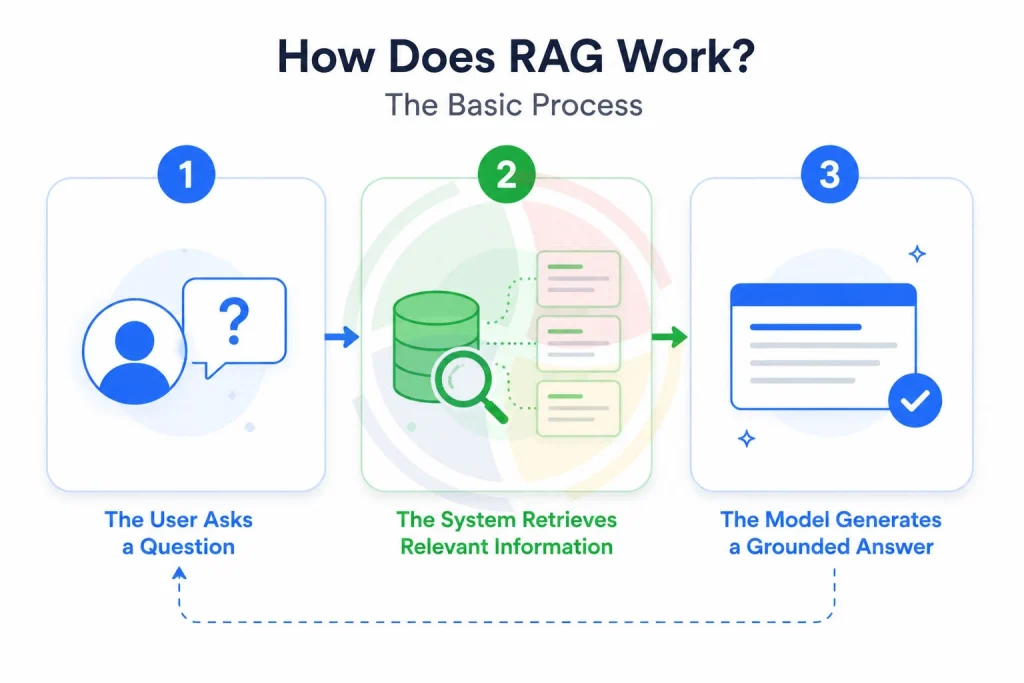
1. The User Asks a Question
Someone types a query. It could be a customer asking about a refund policy, a developer looking for internal docs, or an analyst hunting for a quarterly figure. That query kicks off the process.
2. The System Retrieves Relevant Information
Before the model responds, a retrieval component searches a knowledge base. This is usually a vector database, which stores documents as numerical representations (embeddings). The retrieval system finds the chunks of content most semantically similar to the query.
It doesn’t look for exact keyword matches. Instead, it finds content with a similar meaning even if different words are used. This helps retrieve more relevant information.
3. The Model Generates a Grounded Answer
The retrieved content is fed into the language model alongside the original question. The model then generates a response that’s informed by what it just retrieved. This is not just what it learned during training.
The result is an answer that’s more accurate, more current, and easier to trace back to a source.
Why Do You Need RAG?
Standard large language models (LLMs) such as GPT, 4.1 Claude Sonnet, and Gemini 2.5 are trained on massive datasets up to a certain date. After that, they’re frozen. They don’t update automatically. They don’t know about last quarter’s earnings. They’ve never read your internal wiki.
This limitation creates real problems, such as:
- Hallucinations. When a model doesn’t know something, it sometimes makes things up. Not out of malice. It’s just pattern-matching to what seems plausible. This is dangerous in any professional context.
- Stale information. The world moves fast. A model trained in early 2024 knows nothing about what happened in late 2024 or beyond. For many use cases, such as legal, financial, or medical, lag is unacceptable.
- No access to private data. Most organizations run on internal knowledge: HR policies, product documentation, and client records. None of that is in any LLM’s training set. RAG is often the only practical way to make AI useful on proprietary information.
RAG doesn’t solve all of these perfectly. But it meaningfully reduces hallucinations, keeps answers current, and makes it possible to work with data that was never public in the first place.
Key Benefits of RAG
Here’s where retrieval augmented generation earns its place in production systems. Common benefits of RAG include:
- More accurate responses: Grounding answers in retrieved documents reduces the chances that the model drifts into fabrication. It has something real to work with.
- Up-to-date knowledge: Update the knowledge base, and the model’s answers update with it. No retraining required.
- Transparency and citations: Because the model is pulling from specific documents, it can point to its sources. That’s a big deal for regulated industries and for trust in general.
- Cost-effective: Fine-tuning a model on new data is expensive and slow. Updating a retrieval database is neither. RAG lets organizations stay current without rebuilding from scratch.
- Works with private data: This is maybe the biggest one. RAG makes it possible to build AI assistants over internal knowledge, without exposing that knowledge to third-party training pipelines.
RAG Use Cases Across Industries
Retrieval augmented generation isn’t a niche solution. It’s showing up in almost every industry that handles large volumes of information. Here are some RAG use cases across different industries.
Customer support and chatbots
This is probably the most common deployment of RAG. A support bot powered by RAG can pull from live product documentation, FAQs, return policies, and ticket history to answer customer questions. It doesn’t hallucinate a policy that doesn’t exist. In fact, it finds an actual one.
Companies that have switched from standard LLM chatbots to RAG-based ones consistently report fewer escalations and higher resolution rates. The difference isn’t subtle.
Healthcare and Clinical Decision Support
In the healthcare industry, clinicians deal with an enormous amount of information, which includes research papers, drug databases, patient records, and clinical guidelines. RAG makes it possible to build tools that surface the right information at the right moment. A physician asking about drug interactions gets an answer grounded in current pharmacological data. Not a guess.
There are regulatory and privacy considerations here, of course. But the use case is real and growing.
Legal Research
Law firms and legal teams are using RAG to search through case law, contracts, and internal precedents. A lawyer can query a system and get relevant clauses or rulings sourced from actual documents in seconds. It doesn’t replace legal judgment. It removes the hours of manual searching before judgment happens.
Financial Services
Analysts, compliance teams, and advisors use RAG to query earnings reports, regulatory filings, internal policy documents, and market data. The retrieval-first approach means they get answers they can actually trace.
Internal Knowledge Management
Maybe the most underrated use case. Large organizations sit on enormous amounts of internal documentation, including onboarding guides, SOPs, product specs, and archived decisions. RAG turns that static archive into something people can actually ask questions of. New employees get answers faster. Institutional knowledge stops walking out the door.
RAG vs. Fine-Tuning: Which One Should You Use?
Use RAG when you need current or private data. Use fine-tuning when you need to change model behavior or tone.
Both are valid. They solve different problems. Here’s how they stack up directly:
| Factor | RAG | Fine-Tuning |
| What it changes | Information the model retrieves at runtime | The model’s internal weights and behavior |
| Best for | Current data, private docs, factual accuracy | Tone, style, domain-specific behavior |
| Cost | Low, just update the knowledge base, not the model | High, requires compute-intensive retraining |
| Speed to update | Instant | Slow |
| Hallucination risk | Lower | Higher if the training data is limited |
| Typical use case | Customer support bots, internal wikis, legal tools | Brand voice, specialized terminology, formatting |
Challenges and Limitations of Retrieval Augmented Generation?
Despite the benefits that RAG brings in terms of accuracy and up-to-date knowledge in business-related information, it is important to note that there are challenges associated with retrieval quality, latency, contextual constraints, knowledge base management, and data security.
- Retrieval quality matters: If the retrieval step surfaces the wrong documents, the model generates a confident but wrong answer. Garbage in, garbage out still applies. Chunking strategy, embedding quality, and index design all affect what gets retrieved.
- Latency: Adding a retrieval step adds time. For most applications, it’s acceptable. But for real-time voice interfaces or extremely low-latency requirements, it’s something to architect around.
- Context window limits: You can only pass so much retrieved content into a language model at once. If the relevant information is scattered across many documents, fitting it all in becomes a challenge. This is getting better as context windows grow, but it’s not solved.
- Keeping the knowledge base current: RAG is only as fresh as what you feed it. If the underlying database isn’t updated, the answers go stale. Someone needs to own that process.
- Sensitive data risks: If your RAG system can retrieve confidential documents, you need strong access controls. Without them, a user could inadvertently receive information they shouldn’t have. This isn’t unique to RAG, but it’s a real operational concern.
How Does Aegis Softtech Support Your Retrieval-Augmented Generation?
Retrieval-augmented generation is one of those ideas that seem obvious in retrospect. Of course, you would want an AI to check actual documents before answering. You would also want it to mention sources, and of course, keeping a knowledge base updated is cheaper than retaining a model.
But executing it well requires some careful consideration, including what you’re retrieving, how you’re chunking documents, and which model you are pairing it with.
If you’re building with AI and your users need accurate, current, traceable answers, retrieval augmented generation is very likely part of your answer. At Aegis Softtech, we design and implement enterprise Retrieval-Augmented Generation (RAG) solutions using vector databases, LLMs, secure knowledge repositories, and modern AI orchestration frameworks. Whether you’re building an internal knowledge assistant, customer support chatbot, or domain-specific AI application, our Generative AI experts can help you deploy scalable, production-ready RAG systems tailored to your business.
Frequently Asked Questions
What is retrieval augmented generation in simple terms?
RAG connects an AI model to an external knowledge base before it responds. The model searches for relevant documents first, then uses that content to generate a more accurate, current, and traceable answer.
What is the difference between RAG and a regular LLM?
A standard LLM answers using only its training data, which has a cutoff date and no private information. RAG adds a real-time retrieval step, pulling relevant content from a database before the model responds, making answers fresher and more specific.
Is RAG better than fine-tuning?
They solve different problems. Fine-tuning shapes how a model behaves, which is the tone, style and specialization. RAG shapes what it knows at the moment of answering. For current, grounded, traceable responses, RAG is faster and cheaper. Many teams use both together.
Does RAG prevent AI hallucinations?
It significantly reduces them. Grounding responses in retrieved documents gives the model less reason to fabricate. But retrieval quality, prompt design, and model behavior all still matter. RAG makes hallucinations less likely, not impossible.
What is an embedding in RAG?
Embedding is a numeric representation of the text, allowing the RAG pipeline to find semantically similar documents in the knowledge base rather than the keyword-matching-based document retrieval.
Does RAG work with private company data?
Indeed it can, and this is what makes enterprise RAG so useful. Your internal documents, policies, and records remain in your knowledge base and do not go anywhere near any third-party model training pipeline.
Which LLMs are compatible with RAG?
Most popular and widely used LLMs can use the RAG architecture. These include GPT-4, Claude, and Gemini, to name a few. The model compatibility is secondary to retrieval quality and chunking strategy implementation.
Can RAG be used with Snowflake?
Yes. Snowflake’s Cortex Search is effectively a managed RAG AI layer built into the platform. It handles embedding, retrieval, and semantic search over your Snowflake data natively.
Is RAG suitable for healthcare?
Absolutely! The healthcare industry can benefit from using the RAG pipeline that can provide drug interaction information, guidelines, and patient records right when you need them in real documents, not models’ suggestions.
What is Enterprise RAG?
Enterprise RAG is RAG at an organizational scale that includes access control, auditing, security of knowledge stores, and compatibility with existing data infrastructure. The need for accuracy and governance is higher compared to prototypes.