
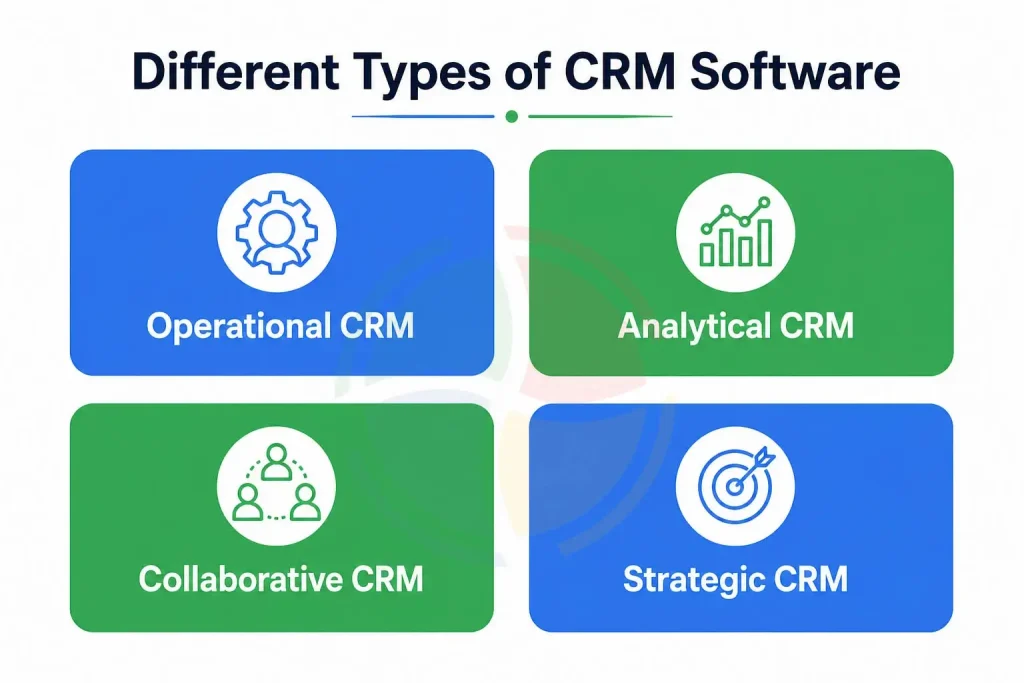
There are four types of CRM software, including Operational CRM, Analytical CRM, Collaborative CRM, and Strategic CRM. They all serve various business purposes ranging from automating customer interaction to making decisions using data. Knowledge of these types of CRM software enables organizations to identify CRM software that can help them meet their objectives regarding sales, marketing, and customer support.
In this article, we will discuss what these types do, how they are different, and how to select the best for your organization.
Why Do CRM Types Matter?
Customer relationship management (CRM) types matter because each one fixes a different problem. Buy the wrong type, and you end up with automation when you need data, or data when you need teamwork.
This is why so many businesses buy a CRM and then realize after six months that it doesn’t do what they actually required. A sales team drowning in follow-ups requires something different from a leadership team that needs to figure out why customers leave after year one.
Understanding the different types of CRM is important as it helps businesses avoid investing in software that doesn’t support their workflows or long-term growth.
According to Grand View Research, the size of the global CRM market stood at USD 79.6 billion in 2025. The market size is also forecasted to increase from USD 86.4 billion in 2026 to USD 161.3 billion by 2033.
What Are the 4 Types of CRM?
The four types of CRM are Operational CRM, Analytical CRM, Collaborative CRM, and Strategic CRM. Operational CRM automates day-to-day activities, Analytical CRM gives insights into customers, Collaborative CRM improves team communication, and Strategic CRM deals with customer relationships.
Here’s a quick side-by-side if you’re trying to place each type fast:
| Type | Main Focus | Best For | Common Features |
| Operational | Automating daily tasks | Sales & support teams | Workflow automation, ticketing |
| Analytical | Understanding customer behaviour | Data & marketing teams | Reporting, segmentation |
| Collaborative | Shared customer visibility | Cross-functional teams | Shared records, internal notes |
| Strategic | Long-term retention | Leadership & CX teams | Lifetime value tracking |
Operational CRM
Operational CRM encompasses lead generation, lead follow-up, call tracking, and email campaigns. These automations eliminate repetitive sales, marketing, and customer service tasks, while Dynamics 365 support services help maintain and optimize the CRM environment after deployment. Most of the CRM systems like Salesforce and HubSpot start with operational CRM. This is the base for the majority of companies, because it reduces manual intervention and selling.
It’s usually split into three smaller pieces:
- Sales automation (think pipelines and reminders)
- Marketing automation (email drips, lead scoring)
- Service automation (ticketing, live chat routing)
Analytical CRM
Analytical CRM is all about numbers. It analyzes customer data including purchase history, customer behavior, and support tickets. Then it presents it in usable form. If you need to determine which customers will be leaving your company soon, or which group of customers is buying the most, this is the CRM type to go for. Analytical CRM does not perform your sales calls, but determines which calls you should make.
From the technical standpoint, analytical CRM implies data mining, OLAP reporting, and dashboards using data obtained from all interaction points of customer relations.
Collaborative CRM
Collaborative CRM removes barriers between teams. Sales, marketing, and support use the same customer record, which helps to avoid redundant questions and context gaps. The support representative sees what was offered by marketing. The sales rep sees that there are some open tickets before making a renewal call. This model is not about automation; it is about ensuring that all parties are informed.
The importance of this model appears when a company surpasses the stage where its representatives know every client personally. With sales, support, and success teams having their own picture of clients, something has to be done to unify this picture into a common view.
Strategic CRM
Strategic CRM is the broadest and highest-level category of CRM systems. Unlike other models that focus on short-term goals like pipeline or immediate response to clients’ questions, this model focuses on long-term relations with customers. Its aim is the analysis of customer lifetime value, identification of the most valuable customers, and business design around serving these customers successfully over many years. It leans heavily on the data from analytical CRM but applies it to decisions at the leadership level.
This one rarely lives inside a single software tool. It’s more of a company-wide mindset, backed by the data the other three types feed it. Businesses that treat CRM as purely operational often miss this piece entirely, and it shows up later as customer churn nobody saw coming.
B2B CRM vs B2C CRM
B2B CRM tracks longer sales cycles and multiple decision-makers within one account. B2C CRM handles higher volumes of individual customers with shorter, simpler buying journeys. Here’s how the two CRM’s differentiate:
| Aspect | B2B CRM | B2C CRM |
| Decision-makers | Multiple, within one account | Usually just the individual buyer |
| Sales cycle | Longer, multi-stage | Shorter, simpler |
| Deal volume | Fewer, higher-value deals | High-volume contacts |
| What it tracks | Company hierarchies, account relationships | Individual customer behaviour |
| Focus | Long nurture cycles, relationship building | Quick personalisation, loyalty triggers |
| Configuration style | Deal stages and account hierarchies | Segmentation and volume-based automation |
Neither is strictly a separate ‘type’ of CRM the way operational or analytical are. It’s more about how you configure the same system. A B2B setup will lean on deal stages and account hierarchies, while a B2C setup leans on segmentation and volume-based automation. Some businesses genuinely need both, especially if they sell to individuals and resellers side by side.
What are the types of CRM Tools You Can Use?
However, there is no shortage of CRM tools that have different specialties and features. Though most platforms tend to cover multiple CRM aspects in one package, each of them usually focuses on certain features and functions. Some of them are as follows:
- Operational tools: The most popular operational tools include Salesforce, HubSpot, Microsoft Dynamics 365, and Zoho CRM. They automate your sales pipeline, follow-ups, and support tickets.
- Analytical tools: Some common examples are Zoho Analytics and Tableau. These turn customer data into dashboards that you can actually read.
- Collaborative tools: Examples include tools such as Monday CRM or Pipedrive. These keep every team working off the same customer information.
- Strategic tools: Common examples include customer success platforms like Gainsight. These track loyalty and retention so that leadership can spot the bigger picture.
How to Choose the Right CRM for Your Business
Choosing the right CRM involves defining your business goals first, and then evaluating internal workflows and ensuring seamless integration with your current tools. These answers point you to the CRM type you actually need.
- List your team’s biggest daily frustration first, not the features you want.
- Check if it integrates with tools you already use, such as email, invoicing, and support desk platforms, using Dynamics 365 integration services to connect CRM with the rest of your business systems.
- Ask how steep the learning curve is. A CRM nobody uses is dead weight.
- Compare pricing per user, not just the sticker price on the homepage.
- Look for a free trial before committing to an annual contract.
What Is the Best CRM Software for Your Business?
There’s no single ‘best CRM software’. It depends upon your budget and team strength. But here are a few that you may consider shortlisting.
- Salesforce: Best CRM tool for a full range of functionalities.
- HubSpot: Easiest to learn and a good free version.
- Zoho CRM: Economical and has good automation facilities.
- Pipedrive: Specifically designed for sales teams for their pipelines.
- Freshsales: Good AI functionality at an affordable cost.
Is CRM Worth It for Small Businesses?
Yes, even a basic CRM for small businesses saves a lot of time associated with manual monitoring. Most of the time, small companies do not require all advanced features. They will require a tool that can give contact history, reminders, and reports, all together in one single package.
What most of the small firms do is purchase an enterprise-level CRM, which would be used in case of operational requirements of 200 people sales floor and get lost in its menus. You can start with an operational CRM, which is easy to implement, while Dynamics 365 implementation services can help configure the platform around your business requirements as your needs grow.
Each company has different sales processes, different customer journeys, and different report generation requirements. That is why the selection of a CRM is not simply a comparison of the features but a bit more complex process.
Conclusion
Choosing the correct type of CRM is more than just buying software. Choosing a CRM system that will support the processes related to sales, customers, and business development is the key step. Having determined what CRM you need for your business, the next step will be the selection of a platform that can adapt to your growing business.
If you are going to buy Microsoft Dynamics 365 CRM, Salesforce, HubSpot, or any other CRM platform, you should know that successful deployment depends not only on the software’s functionality but also on other factors such as strategy, integration, and customization.
At Aegis Softtech, we offer Microsoft Dynamics 365 CRM consulting services and and Dynamics 365 CRM developers to assess CRM requirements, implement solutions, customize workflows, and integrate CRM with the rest of the business systems.
Frequently Asked Questions
What is the most popular CRM?
Salesforce is generally considered the most common and widely used CRM globally. It is especially popular among mid-size and enterprise businesses. Other than Salesforce, HubSpot and Zoho CRM are famous among smaller teams and startups.
Is Excel a CRM?
Excel is not a CRM. It tracks contacts and deals manually. Moreover, it lacks advanced CRM features such as automation, reminders, and reporting.
What are the 7 components of CRM?
The 7 components of CRM include strategy, segmentation, technology, processes, organisation, customer data, and communication channels. These all work together to manage customer relationships.
What are the 4 pillars of CRM?
The four pillars of CRM are people, process, technology, and data. All four pillars need to work together for the CRM system to be effective.
What is the difference between CRM and ERP?
CRM manages customer relationships and sales data, while enterprise resource planning (ERP) manages internal business operations like finance, inventory, and HR. Some platforms today combine both into one platform.
Can one CRM include all four CRM types?
Yes. Modern CRM platforms such as Salesforce, Microsoft Dynamics 365, HubSpot, and Zoho CRM combine operational, analytical, collaborative, and strategic capabilities within a single solution.
Which CRM type is best for small businesses?
The operational CRM is always the ideal choice for small businesses as it automates sales, marketing, and customer support operations in order to enable small organizations to save time, stay organized, and grow.
Which CRM type is best suited for B2B businesses?
The operational CRM can be used by the majority of B2B organizations as it will assist them in managing leads, generating sales opportunities, and performing follow-up activities. Analytical CRM can also be helpful in terms of customer behavior analysis and decision-making.
Which CRM type is best for customer service?
The collaborative CRM will prove to be the most suitable one for customer service because it will assist different departments in sharing customer information.
Can CRM improve customer retention?
Yes, it does. CRM helps organizations in retaining their customers by ensuring quick response to customer needs, personalized communication, and solving customer problems quickly.
What CRM does Microsoft offer?
Microsoft Dynamics 365 is the CRM system that Microsoft has provided to its business customers.