
Generative AI is a type of artificial intelligence system capable of generating novel content, such as text, images, code, audio, and video, using pattern recognition from large data sets.
You’ve probably already seen it in action. ChatGPT writing emails. Midjourney is producing visuals. GitHub Copilot is suggesting code. That’s all generative AI at work.
In our guide, you’ll learn all about generative AI technology, its definition, how it is different from predictive AI, how exactly it works, examples from various industries in 2026, its primary business advantages, limitations, and risks you should be aware of. You will also find answers to some frequently asked questions.
Key Takeaways
- Generative AI creates new content such as text, images, code, and audio rather than just analyzing or predicting from existing data
- It runs on models like LLMs, diffusion models, and transformers, each suited to different types of output
- Real-world adoption is already wide, including marketing, healthcare, finance, legal, and software development, which are all active use cases in 2026
- Enterprise deployments often combine generative AI with RAG to keep answers grounded in current, private, internal data
- Without proper governance, generative AI carries real risks, including hallucinations, bias, data leakage, and compliance gaps that don’t fix themselves
What is Generative AI?
Generative AI involves the usage of advanced deep learning models that were trained on vast amounts of data in the form of text, images, and code. By identifying the patterns and relationships within the data, the models learn how to produce output similar to humans. The technologies include Large Language Models (LLMs) to generate text/code; diffusion models for images, and transformers to generate other types of content.
The process involved here entails training these generative AI models using trillions of tokens of text, images, code, and much more till they can predict and produce coherent, contextually correct output.
Snowflake Research (2025): Organizations already using AI report an average return of $1.41 for every $1 invested (41% ROI).
Deloitte (2026): Worker access to AI increased by 50% in 2025, and the number of organizations with 40% or more of their AI projects in production is expected to double within six months, indicating that enterprises are moving rapidly from AI pilots to large-scale deployment.
Generative AI vs Predictive AI: What’s the Difference?
The primary distinction between generative AI vs predictive AI is that while Generative AI generates new content, Predictive AI predicts the results based on already available data. The table given below
| Feature | Generative AI | Predictive AI |
| Primary Goal | Create new content | Forecast outcomes |
| Output | Text, images, code, audio, video | Labels, scores, predictions |
| Training Data | Large unlabeled/self-supervised datasets | Labeled historical data |
| Common Models | GPT, DALL-E, Gemini, Claude | Decision trees, regression, XGBoost |
| Example Use Case | Write a product description | Predict customer churn |
| Industry Focus | Content, code, creative tasks | Analytics, forecasting |
However, in reality, many current AI systems implement both. For example, a recommendation engine (predictive) can generate natural language explanations for its recommendations using generative AI. Both these technologies fit each other really well.
How does Generative AI Work?
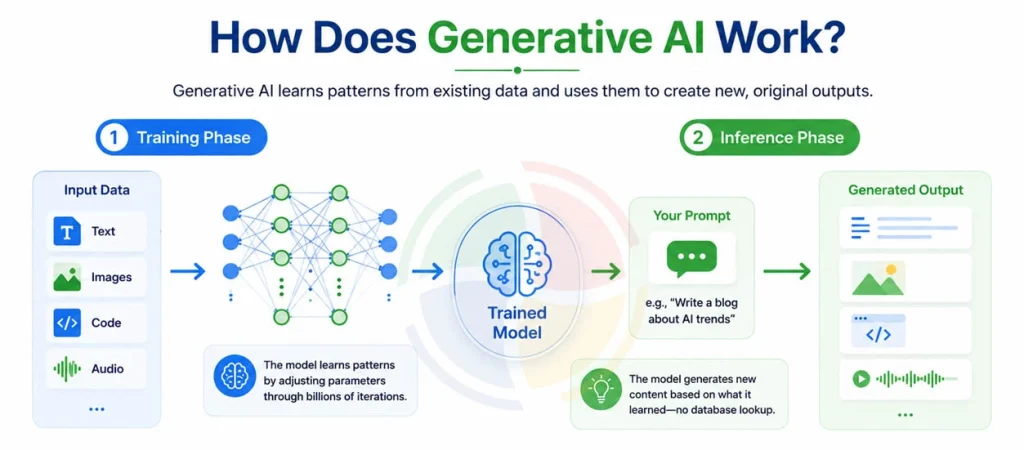
Generative AI finds patterns in the input data and utilizes them to create new outputs according to the input; that is the whole concept. Many modern generative AI systems also use Retrieval-Augmented Generation (RAG).
Training Phase
This model is fed with gigantic amounts of data sets, be it words, images, or code lines. In the course of training, it tunes its parameters to minimize prediction errors. After billions of such iterations, it becomes quite efficient in its ability to predict what’s next. It could be the next word in the sequence or the next pixel in the image.
Inference Phase
When the training is done, the model accepts your prompt and generates a corresponding output. It does not “look up” any information in some database; it simply makes predictions according to what was learned in the course of training. That is why two prompts could lead to completely different results.
Technologies That Make It Possible
- Transformer architecture: Helps to understand context in lengthy sequences
- Attention: Helps the system focus on important aspects of input
- Reinforcement Learning from Human Feedback (RLHF): Allows tuning the model to make it safer and more useful
- Retrieval-Augmented Generation (RAG): Uses up-to-date information to avoid generating fake facts
Generative AI Examples in 2026
The applications have far surpassed chatbots. Here are some of the areas where generative AI is currently creating actual value.
Content & Marketing
Marketing departments use generative AI to create blog posts, copy, social media posts, and email sequences at lightning-fast speed. Claude, ChatGPT, Jasper, and other such generative AI solutions are common content creation tools now. Businesses are conducting A/B testing of the copy generated by these AI assistants quickly, and they usually end up shocked by the outcome.
Software Development
The tools like GitHub Copilot and Amazon CodeWhisperer enable developers to write code templates, generate functions, resolve bugs, and generate tests. The people using those tools are getting their work done much faster and more productively. It’s not replacing the developers; it’s eliminating the boring work.
Healthcare & Drug Discovery
Generative AI is widely used in healthcare in modeling protein structures and suggesting new drug compounds for pharmaceutical companies. The process that previously took years to be carried out at the research stage is now done in a matter of weeks. Generative AI is also generating synthetic patient data to run clinical trial simulations.
Customer Service
AI-powered chatbots handle almost all types of customer queries in any kind of business. It doesn’t follow any set of rules; rather, it can maintain the context throughout the conversation and understand the intention and escalate the issue if needed.
Design and Creative Services
Text prompts are used by interior designers, architects, and brand specialists to develop visual ideas. Previously, such a process would take weeks; now it takes a few hours. It is applied to mood boards, advertisements, product mockups, and storyboards for videos.
Finance
Generative AI solutions are used in financial institutions to create reports, drafts of regulatory documents, fraud stories, and personalized summaries of investments. It does not replace an analyst; it only frees time that was previously wasted on routine documentation.
Education
In education, learning platforms create personalized learning trajectories, instructions, and problems. The teacher uses it to generate quiz questions, lesson plans, and feedback to the texts written by students.
Benefits of Generative AI
The benefits of Generative AI include faster content creation, reduced operational costs, personalized customer experiences and increased developer productivity. Let’s have a look at each one of these.
| Benefit | What It Means for Your Business |
| Faster Content Creation | Produce drafts, campaigns, and reports in minutes, not days |
| Cost Reduction | Automate repetitive tasks and reduce dependency on large teams |
| Personalization at Scale | Deliver tailored experiences to thousands of customers simultaneously |
| Accelerated R&D | Drug discovery, materials science, and product design move faster |
| Better Customer Support | AI chatbots handle 70–80% of queries without human intervention |
| Code Generation | Developers write less boilerplate; shipping cycles get shorter |
| Faster Software Development | Accelerate build cycles with AI-assisted coding, testing, and debugging across the entire development pipeline |
| Better Knowledge Management | Surface institutional knowledge instantly, from SOPs to archived decisions |
What are the Limitations and Risks of Generative AI?
Generative AI has some really amazing capabilities, but we need to keep in mind that it has some limitations as well:
- AI Hallucinations: There is always a chance that models could provide some false, yet credible-looking information.
- Bias: Biases present in training data would be passed to the model. The problem is especially relevant when hiring, financing, and providing medical care.
- Privacy issues: There is always some risk associated with uploading your company’s confidential information to third-party models.
- Ideological problems: There is still no legal clarity about the intellectual property rights of generated content.
- Overdependence: Relying on AI without human input may cause mistakes to pile up, especially in a professional environment. This is where AI consulting helps. Having experienced practitioners guide implementation reduces the risk of overdependence from the start.
- Security & Compliance: Generative AI outputs are hard to audit. Meeting regulatory standards like HIPAA or GDPR requires extra governance layers most deployments don’t have out of the box.
- Prompt Injection: Malicious users can manipulate AI behavior by embedding hidden instructions in inputs. This is a real attack vector in customer-facing generative AI applications.
- Data Leakage: Models can inadvertently surface confidential information from training data or retrieval systems. Without strict access controls, sensitive data can end up in the wrong hands.
- Model Governance: Without clear ownership of who monitors model behavior, output quality, and updates, generative AI systems drift. Governance isn’t optional — it’s what keeps production systems trustworthy.
Build Enterprise Generative AI Solutions With Aegis Softtech
Generative AI is here. It’s real. And the companies that leverage it aren’t those showing the best demos; they’re those that did everything right in implementing it.
There’s a lot that goes into deploying functional generative AI in practice. Model choice, data pipelines, access restrictions, hallucination prevention, and compliance all of these impact whether or not your solution provides consistent results or consistently incorrect answers.
At Aegis Softtech, we work with organizations to turn their proofs of concept into production. This means designing and building custom generative AI solutions, enterprise-scale RAG pipelines, integration with LLMs, AI agents, and conversational AI. All this is integrated with your data, controlled by your access policies, and scalable beyond just one use case.
RAG is one of our most powerful implementations of generative AI. iI ensures that your AI remains grounded in accurate and current information without having to constantly train your models. But RAG is part of an even broader architecture designed around your organization’s needs.
Whether you want an internal knowledge assistant, an AI that can answer customers based on living documentation, or any kind of RAG pipeline for health, financial, or legal domains, we will do the architecture, data layer, and maintenance of it for you. A system your team can trust and grow.
Explore our Generative AI Services to see how we can help your organization get there.
Frequently Asked Questions
1. What are the top 3 generative AI tools?
In 2026, the most widespread generative AI applications include ChatGPT (OpenAI), which generates texts and makes reasoning on their basis, Midjourney, which generates images, and GitHub Copilot for the generation of code.
2. Is ChatGPT a generative AI?
Yes, ChatGPT can be regarded as generative AI as it is developed on the basis of the GPT series of large language models and generates texts on the basis of prompts from the user.
3. What is an example of generative AI?
You give ChatGPT the task of writing a product description for wireless headphones. In response, the program generates an original copy. This is what the generation of new content from the given prompt means, and it is considered generative AI.
4. Can generative AI replace human jobs?
It would be more accurate to say that AI affects the scope of the work, not the role itself. Routine work gets automated; however, jobs requiring decision-making, creativity, and human interaction remain specifically human. The majority of employees will transform their skills, but won’t disappear.
5. How is generative AI different from traditional AI?
Traditional AI classifies, predicts, or optimizes something based on existing data sets. Generative AI generates net-new content in the form of text, image, code, audio, and so forth. The former performs analysis while the latter creates something out of thin air.
6. What are the risks associated with generative AI?
The major risks include hallucinations, bias due to biased training data, data privacy concerns, and ambiguity related to intellectual property rights. All these risks can be handled through human oversight and appropriate governance practices.
7. What industries use Generative AI?
Healthcare, finance, legal, ecommerce, education, marketing, software development, and manufacturing all use generative AI today. It shows up anywhere large volumes of content, data, or decisions need to move faster with fewer people.
8. What is Retrieval-Augmented Generation (RAG)?
RAG connects a language model to an external knowledge base before it responds. Instead of relying only on training data, it retrieves relevant documents first, making answers more accurate and current.
9. Which programming languages are used for Generative AI?
Python is the dominant language for generative AI development. JavaScript, R, and Julia are also used. Most major frameworks, such as LangChain, Hugging Face, and PyTorch, are Python-first.