
Generative AI models form the base for various tools like ChatGPT, Claude, Gemini, Midjourney, and Stable Diffusion. These machine learning models are trained on large datasets to produce completely new data. These models can produce text, images, code, audio, videos, and other forms of media according to the prompt given by the user.
In the upcoming article, we will discuss all these aspects of generative AI models, such as their features, working, types of models, including GANs, VAEs, diffusion models, transformers, and more, applications, and promising ones in 2026.
Key Takeaways
- Generative AI models produce new content, such as text, images, code, audio, and video, based on statistical models that they learn, unlike other models that search for and classify the content.
- The five major generative AI model types are GANs, VAEs, diffusion models, transformers, and flow-based models. Each takes a different mathematical approach to the same goal of producing realistic new output.
- Transformer models are used in almost all recent LLMs, including ChatGPT, Claude, and Gemini, while diffusion models are becoming the go-to architecture for building top image and video generation systems.
- Generative models and predictive models are two different concepts. Predictive models predict the next occurrence from current data, while generative models generate new content that never existed before.
- There is no one-size-fits-all generative AI model that is better than others. You should choose a model based on your application requirements and constraints.
What Are Generative AI Models?
Probability forms the basis of most generative AI model types. Instead of remembering all the previous answers, the model calculates the probability of a particular output from all it has learned before and produces the closest possible answer. This is the reason why identical inputs yield slightly different results sometimes.
Why Are Generative AI Models Important?
Generative AI models allow companies to automate content generation, speed up software development, enhance customer service, synthesize training data, facilitate scientific discoveries, and provide intelligent business applications. It is the ability to produce new content instead of analyzing old content that makes them different from other machine learning models.
How Do Generative AI Models Work?
Generative AI models operate by analyzing the probability distribution of a training set and generating samples from their distribution. Four major processes are involved in this case.
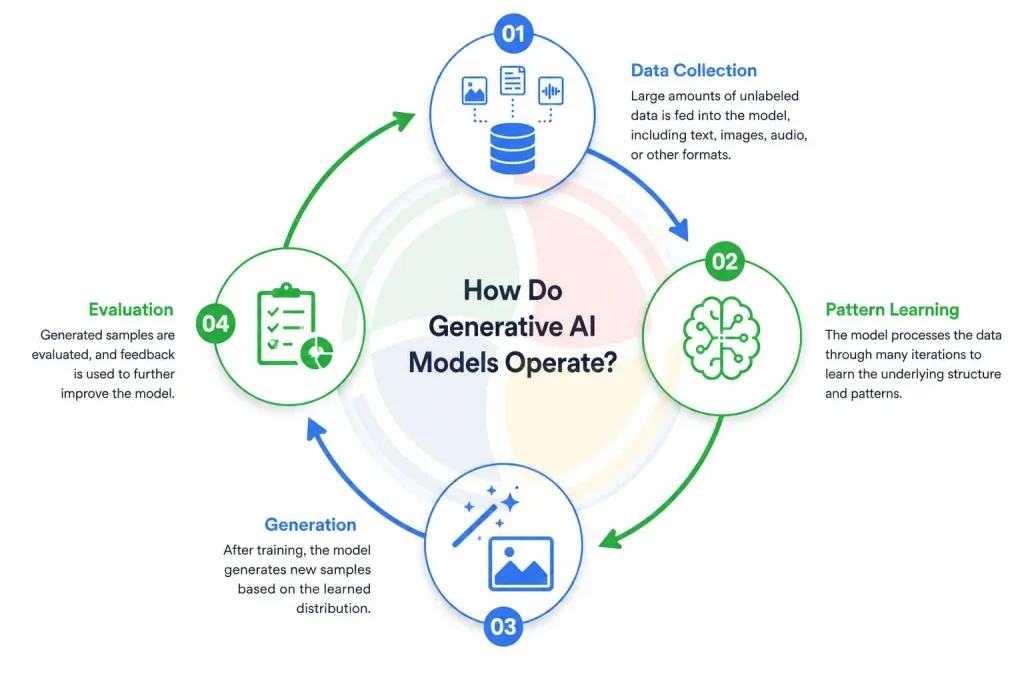
- Data collection: Data of some kind is fed into the model, a lot of unlabeled datasets, varying from text and images to audio depending on the task at hand.
- Pattern learning: The model goes through a number of iterations to learn something from the data, which is the structure of the data itself.
- Generation: After training, the model can generate samples based on the learned distribution.
- Evaluation: Evaluating these samples leads to further improvements in the model.
What Are the Different Types of Generative AI Models?
There are several types of generative AI models, and each one follows a different mathematical path in order to achieve the same result: to create realistic data. Let’s do a quick side-by-side comparison before diving into each one.
| Model type | How it generates output | Best suited for | Main drawback |
| GANs | Generator and discriminator compete until the output looks real | Photorealistic images, deepfake detection research, and design | Training is unstable, prone to mode collapse |
| VAEs | Encodes data into latent space, then decodes it back out | Anomaly detection, data cleanup, and light image work | Outputs can look blurry next to GANs |
| Diffusion Models | Adds noise to data, then learns to reverse it step by step | High-end image and video generation, art tools | Slow to sample, needs heavy computing |
| Transformers | Self-attention predicts the next token using the full context | Text generation, chatbots, code, translation | Expensive to train, hard to fully interpret |
| Flow-Based Models | Maps data through invertible transformations end-to-end | Density estimation, scientific and molecular modeling | Struggles with long-range dependencies |
Generative Adversarial Networks (GANs) Explained
The GAN operates on the principle of two competing neural networks. There is a generator network that generates synthetic data and a discriminator network that seeks to identify this synthetic data.
The main strengths of Generative Adversarial Networks are their capability in generating images, style transfers, and augmentation of data. Their weakness lies in the fact that their training might be unstable, and they may end up getting stuck at producing a single distribution of data, called mode collapse. GANs became widely known through NVIDIA’s StyleGAN, which produces highly realistic human faces.
Variational Autoencoders (VAEs) Explained
In a VAE model, input data is encoded to produce a compressed code, which is decoded to generate new data. It can be termed as a squeeze and then a reconstruction.
VAEs are typically stable and less expensive to train compared to GANs. They are generally employed for applications like anomalies, data cleaning, and denoising, where stability is important rather than visual clarity. The drawback of VAEs is that their output, particularly images, tends to be fuzzy. VAEs are also commonly used for latent-space representation learning.
Diffusion Models Explained
Diffusion models generate content by adding random noise to training data, then learning how to reverse that noise step by step until something realistic emerges. It’s like sculpting an image out of static.
This approach now powers most of the leading image tools, best generative AI models like Stable Diffusion, DALL·E, and FLUX both of which run on this principle. The same diffusion-based approach also drives leading video generation models, and running a seedance 2.0 vs kling 3.0 comparison is a good way to see how these principles play out in motion rather than still images. Quality tends to beat GANs in many cases, though diffusion models are slower and need more compute to sample from.
Transformer and Autoregressive Models Explained
Transformers are sequence generators that create a sequence of tokens based on what has been generated so far in a process known as self-attention.
This technique fuels models like GPT-5, Claude 4, Gemini 2.5,, and other recent chatbot models. The working principle behind autoregressive models is the prediction of one element at a time, which makes them very efficient in dealing with sequences of data like text data, code data, and time-series data. They require vast amounts of data and high computational resources.
Flow-Based Models Explained
Flow-based models learn a series of reversible mathematical transformations that map simple data into complex, realistic data, and back again. Because the process can be reversed, the model can calculate exact probabilities instead of making estimates.
Although uncommon in popular AI applications, these models can be beneficial for scientific fields like molecule design and data analysis because, in these cases, precision is more important than creating visually realistic images.
How Are Generative Models Different From Predictive Models?
While often used interchangeably, Generative models and Predictive models serve different purposes. Generative models create new content such as text or images. On the contrary, predictive models forecast an outcome from existing data. Here’s how the two models stack up against each other.
| Aspect | Generative Models | Predictive Models |
| Goal | Create new, original content | Forecast a future value or outcome |
| Training data | Mostly unlabeled, it learns the data’s structure | Mostly labeled, learns input-output mapping |
| Typical output | Image, text, audio, video, code | A number, score, or category label |
| Example | ChatGPT | Fraud detection |
Where Are Generative AI Models Used Today?
The most common use cases of generative models today are healthcare, entertainment, marketing, and manufacturing, which help to make things faster for content production, designing, and researching that was previously done much more slowly by people.
- Healthcare: In the healthcare industry, researchers working on drugs apply generative models to suggest possible molecular compositions, saving several years of initial research.
- Entertainment: Production companies create music, concept designs, and environments for games without having to create everything from scratch.
- Marketing: Marketers generate ads, product pictures, and personalized campaigns that can’t be created manually.
- Software development: Code-generation models speed up routine programming inside software development services pipelines.
- Design and manufacturing: Generative design tools try out thousands of part iterations, considering the constraints of cost and materials automatically.
- Financial services: Generative models assist in generating narratives to detect fraud, generate reports automatically, give risk summaries, and provide personalized AI financial advice.
- Customer support: Use of AI agents to answer questions and generate answers saves time and money as human assistance becomes unnecessary.
- Education: Generative models help generate personalized content for students.
- Legal: The law firms can now generate contracts and do due diligence, which used to take weeks earlier, in a matter of minutes by using generative AI models.
- Retail: Generative models help in creating product descriptions, personalized recommendations, dynamic pricing narratives, and visual content in catalogs, which would not be possible without them.
What Are the Best Generative AI Models in 2026?
The best generative AI model depends on the task rather than a universal ranking. Transformer models dominate text generation, while diffusion models remain the standard for image generation. These are some of the best generative AI models in 2026.
| Model Family | Architecture | Known For | Common Use |
| GPT series | Transformer | Conversational text, reasoning | Chatbots, content, and code help |
| Gemini | Multimodal transformer | Text, image, and audio together | Search, assistants, research |
| Stable Diffusion / Midjourney | Diffusion | High-fidelity image generation | Design, marketing visuals |
| Claude | Transformer | Long-context reasoning, writing | Enterprise workflows, coding |
| Llama (open-source) | Transformer | Customizable, self-hosted LLMs | Private enterprise deployments |
What Challenges Do Generative AI Models Still Face?
Generative AI models are still struggling with issues like hallucinations, biased training datasets, and copyright/content ownership.
- Hallucination: Models sometimes produce confidently wrong responses as they make predictions based on plausible patterns, rather than facts.
- Bias: If there is any form of skewness in the training data, then the output will be biased as well, especially when used for applications like hiring or lending.
- Compute cost: Diffusions and big transformers require serious GPU power and prevent most small groups from experimenting with advanced levels of training.
- IP and ownership: who owns AI-generated art or text is still being argued out in courts and policy circles worldwide.
Conclusion
Generative AI models aren’t one single technology. They’re a family of approaches, GANs, VAEs, diffusion, transformers, and flow-based, each solving the same basic problem of creating realistic new data differently.
Picking the right one depends entirely on what you’re building. Need sharp images fast? Diffusion or GANs. Need long, coherent text? Transformers. Need stable anomaly detection? VAEs are usually the safer bet.
The field is growing and developing at a tremendous pace, with research being applied to business tools very fast. It is useful to get familiar with all these types of models today to make informed decisions in the future instead of guessing.
If you wish to move on beyond experimenting with generative AI and are keen on building something production-grade. Aegis Softtech provides enterprise-grade Generative AI services, custom-built LLMs, RAG applications, and AI development solutions that offer security, scalability, and ROI. The team will guide you to decide and build the appropriate model that could be either a transformer or any other kind.
FAQs
What are all the generative AI models?
The most prominent of them are GANs, VAEs, diffusion models, transformers, autoregressive models, and flow-based models. Though each of them has a different method for content generation, none of them generates anything without taking into consideration the patterns it has learned from the training data.
Is ChatGPT an LLM or generative AI?
ChatGPT is both an LLM and generative AI. It is an application (Generative AI) that is powered by a large language model (LLM).
Are generative AI models able to process more than one kind of data?
Yes, those models are multimodal and can use several kinds of data, like text, images, and audio in a single system to produce a description, image, or both as a result of your prompt.
Do generative AI models always need huge amounts of data to train?
No, not necessarily. Transformers and GANs usually need to process large datasets, but there are methods like transfer learning and fine-tuning that can be used with small datasets.
Which Generative AI Model Is Best?
It is impossible to name one generative AI model because there is no universally best AI model. Your decision should depend on your needs: you need transformers for texts, diffusion models for images, and VAE for anomaly detection and structured data.
Are ChatGPT and Gemini based on transformer models?
Indeed, both ChatGPT and Gemini are constructed based on transformer architecture. ChatGPT is created by OpenAI, while Gemini is designed by Google DeepMind. Both of these models use large transformer models trained on a huge amount of text data.
What is the difference between an LLM and a generative AI model?
Generative AI models refer to any kind of model which is able to generate content such as text, images, audio, code. LLM is a kind of generative AI which uses only text data for training and is based on the transformer architecture.