

Generative AI in software testing helps QA teams analyze requirements, generate test scenarios, maintain automated tests, and investigate failures. It can also help teams validate AI-generated software and test complex combinations of inputs and configurations.
This guide explains the leading GenAI testing tools, practical use cases, benefits, and where human QA expertise still matters.
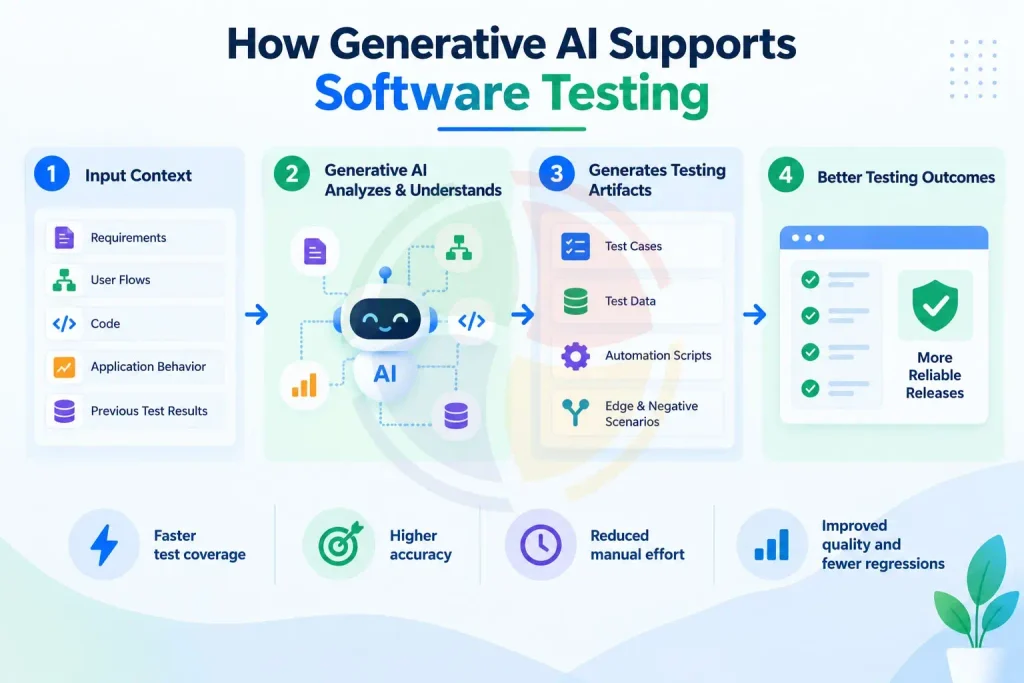
Generative AI in Software Testing Tools
Popular generative AI tools for software testing include Katalon, Playwright, BrowserStack, and mabl. These tools bring AI into different parts of the QA process, from test creation and maintenance to test execution, cross-browser testing, and failure analysis. Here’s a closer look at what each one offers.
Katalon
Katalon takes the broader platform route. Its AI features can work from requirements, pick out ambiguities, generate test cases, and expand scenarios with negative and edge cases. It also extends into API testing and execution, so it fits better when you want more of the QA workflow in one place rather than adding another tool just to generate automation.
Playwright
Playwright’s current Test Agents split these tasks up. The planner explores the application and puts together a test plan. The generator then turns that plan into Playwright tests, while the healer can replay a failed test and work through possible fixes. For teams already working with Playwright, this means they can bring GenAI into the setup they have instead of replacing the automation stack.
BrowserStack
BrowserStack becomes more relevant when the execution environment itself is part of the challenge. You can generate and manage tests with AI, but the bigger advantage is being able to take those tests across the browsers and real devices your product has to support. That makes it useful when the team needs to see how an application behaves across different environments, not just whether the generated test passes once.
mabl
mabl takes a more AI-native approach, with test creation, execution, failure analysis, and maintenance tied closely together. That becomes useful once the test suite starts changing as often as the application. Instead of treating every broken test as a manual cleanup task, the platform is built to help the automation adapt as the product changes.
Implementing Generative AI in Existing QA Environments
A testing stack rarely stays as clean as it looks on a tool comparison page. One application may still run on Selenium while another has moved to Playwright, with device testing and manual exploratory work sitting elsewhere in the pipeline. That’s the kind of setup we work with at Aegis Softtech.
Rather than pushing the same framework onto every project, we look at the application, release cycle, and existing QA setup first and build around what’s already there. Where AI can make the process more efficient, we bring it into test generation and maintenance through our generative AI services, keeping those capabilities connected to the broader QA workflow.
| Tool | GenAI Capability | Best For |
| Katalon | Test design, generation & analysis | End-to-end QA workflows |
| Playwright | AI-assisted planning, generation & healing | Code-based browser automation |
| BrowserStack | AI testing + browser/device execution | Cross-browser and device coverage |
| mabl | AI-native automation & maintenance | Continuous testing |
Generative AI Use Cases in Software Testing
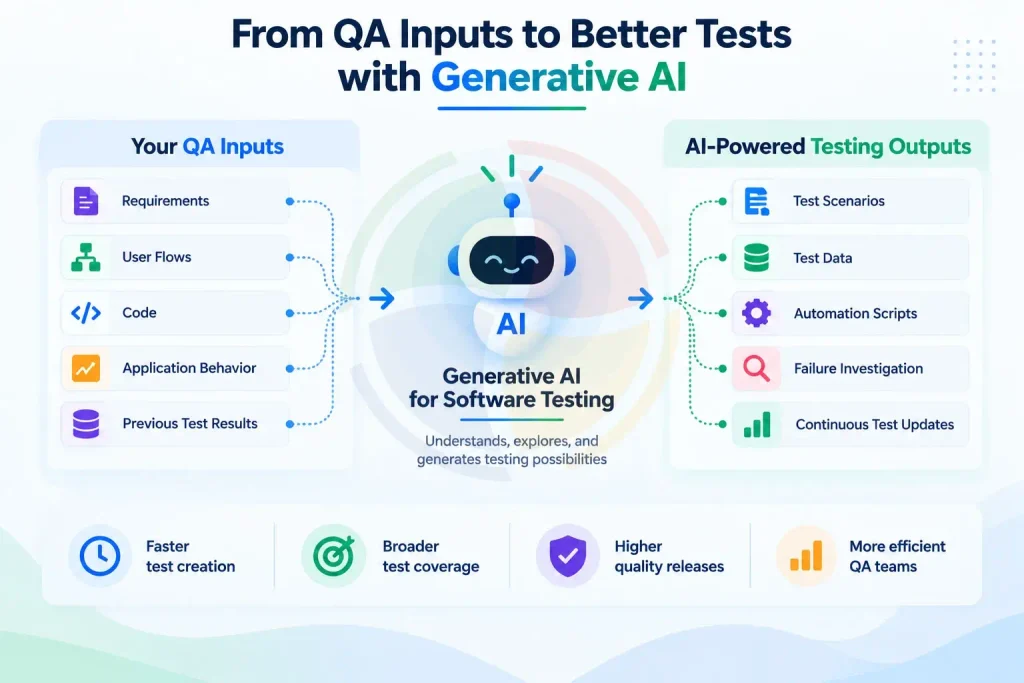
1. Requirements and Test-Scenario Analysis
Testing can get messy before anyone has written a test. A user story may look complete until you put the acceptance criteria, API contract, existing coverage, and old defects next to it. That is when the missing pieces tend to show up: a negative path nobody considered, an edge condition buried in another requirement, or two features whose interaction was never really tested. GenAI can help QA work through that material and bring those gaps to the surface before they become failures downstream.
2. Testing AI-Generated and Vibe-Coded Software
When you build and change software with AI coding tools, the implementation can move faster than the test strategy around it. A feature may work on the intended path while hiding problems around state transitions, authorization, unexpected input, integrations, or error handling. GenAI can help you examine both the generated code and the application’s behavior to explore those less obvious paths, especially when the implementation contains assumptions that were never captured in the original requirements.
3. AI-Assisted Test Maintenance and Regression Updates
A large test suite has a way of becoming its own maintenance project. Change a DOM structure and selectors can break. Update an API contract, and checks further down the workflow may start failing. Even a small change to a user journey can leave regression tests asserting behavior the product no longer follows. GenAI can help connect those application changes to the tests they affect, suggest updates to automation, and bring stale or incomplete coverage to a tester’s attention.
4. Failure Analysis and Root-Cause Triage
A failed test is usually the beginning of the investigation, not the answer. The useful clue could be buried in a stack trace, a browser trace, a network request, a screenshot, or a code change from the last deployment. Pulling all of that together can take longer than the failure itself. GenAI can help connect those signals, group related failures, and narrow down whether you’re looking at a product defect, broken test logic, an environment issue, or bad data.
5. Configuration and Combinatorial Test Design
Things get harder when the variables start interacting. A workflow may behave differently depending on the user’s role, region, subscription tier, device, account state, and a handful of feature flags. You don’t have to test every possible combination to find useful coverage, but choosing those combinations gets difficult as the matrix grows. GenAI can help map the variables, reason about their interactions, and give QA a more deliberate set of combinations to work with.
Benefits of Generative AI in Software Testing
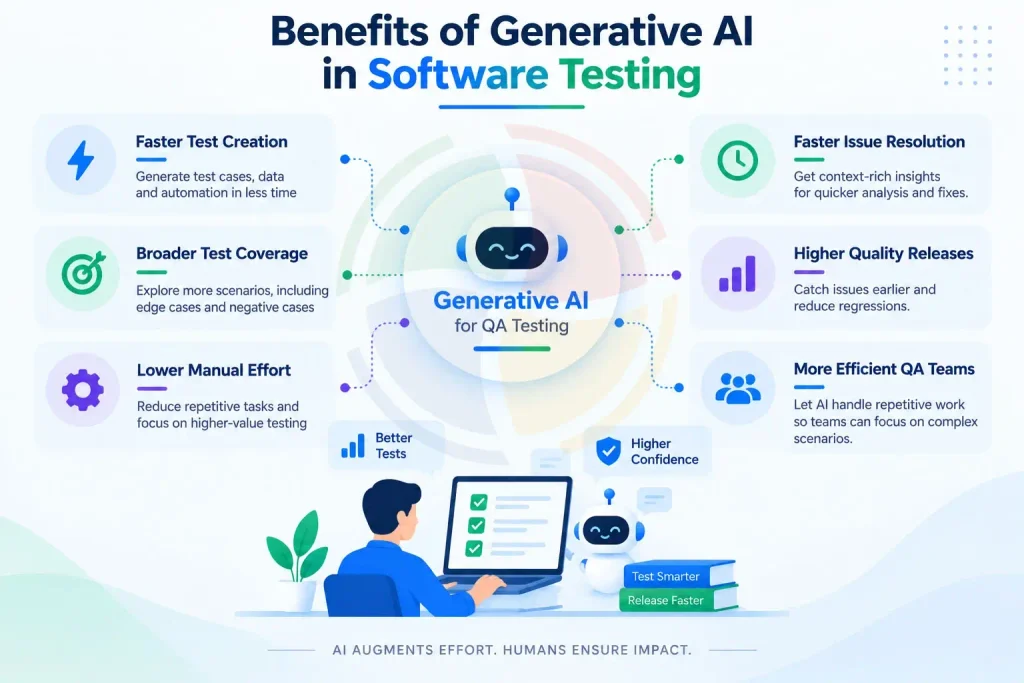
Faster Test Design and QA Execution
When the development side of the team starts moving faster, simply adding more repetitive QA work doesn’t scale very well. GenAI can take some of the load from test design, maintenance, data preparation, and failure analysis, leaving your testers with more time for product behavior, risk, and the cases that need actual judgment.
There is some evidence that this translates into measurable gains. The World Quality Report 2025–26 found an average 19% productivity improvement from GenAI in Quality Engineering. The catch is worth noting: about a third of organizations reported little effect, which suggests that putting AI into the workflow isn’t enough on its own.
Lower Test Maintenance Effort
A mature regression suite is an investment, and application changes can slowly eat away at that value. Tests become stale, selectors break, workflows change, and nobody wants to spend a sprint just cleaning up automation. GenAI can help trace product changes back to affected tests and bring outdated coverage to your attention, so more of the suite stays useful as the application evolves.
Faster Failure Analysis
A failed test can leave you with a stack trace, logs, screenshots, traces, network activity, and a recent code change to sort through. GenAI can help connect those pieces and give you a narrower place to start investigating. You still make the call on whether something is a defect, but you don’t have to spend as much time just assembling the evidence.
More Time for Exploratory and Risk-Based Testing
Once you aren’t spending as much time updating repetitive tests or reading through every failed run, you can put more attention into the decisions that shape the quality of a release. You can question a requirement before it becomes a defect, dig into a workflow that looks risky, or spend longer exploring behavior that a predefined regression path won’t cover.
Making Generative AI Work in Your QA Workflow
GenAI can take repetitive work off your QA team’s plate, but the goal isn’t to fully automate testing. It’s to reduce the time spent on tasks like test generation, maintenance, and failure analysis, so experienced testers can stay focused on product risk, exploratory testing, and release quality.
That’s where the broader testing setup matters. At Aegis Softtech, we work across automation, manual exploratory testing, and AI-assisted test generation and maintenance, adapting the approach to the application and the way your team already works. You can explore our software testing services or generative AI services to see where those capabilities could fit into your QA workflow.
Frequently Asked Questions (FAQs)
What are the main use cases of generative AI in software testing?
A lot of the value shows up outside simple test-case generation. Teams can use GenAI to spot gaps in requirements, test AI-generated code, maintain automated tests, investigate failures, and work through different combinations of configurations and inputs.
What tools are used for generative AI in software testing?
The tools vary depending on the testing stack. Katalon brings AI into test creation and analysis, while Playwright has AI-powered agents for planning, generation, and maintenance. BrowserStack and mabl use AI in areas such as execution, maintenance, and failure analysis.
Can generative AI replace manual software testing?
Not really. GenAI can take care of repetitive parts of the process, but someone still has to explore the application, question unexpected behavior, and decide whether a generated test actually covers a meaningful risk.
Can Aegis Softtech help implement generative AI in software testing?
Yes. Aegis Softtech works across software testing and generative AI, so the approach can fit into an existing QA setup. Its services include AI-assisted test generation and maintenance alongside broader software testing capabilities.