

Microsoft Fabric and Snowflake are both cloud data platforms, but they take different approaches. Microsoft Fabric brings data integration, engineering, warehousing, data science, real-time analytics, and Power BI into one SaaS platform. Snowflake offers a multi-cloud data platform with independently scalable compute and strong data-sharing capabilities.
The choice depends on your existing technology stack, workloads, cloud strategy, BI requirements, and preferred cost model.
This Microsoft Fabric vs Snowflake comparison breaks down the differences without the complexity.
Microsoft Fabric vs Snowflake at a Glance
The main difference is platform scope. Fabric aims to bring the analytics lifecycle into one Microsoft environment. Snowflake provides a flexible data platform that can operate across major public clouds.
| Feature | Microsoft Fabric | Snowflake |
| Core Offering | Unified, end-to-end SaaS analytics platform | Cloud data platform (Data Warehouse & more) |
| Architecture | Lakehouse (OneLake) for all data, open formats | Multi-cluster, shared-data, proprietary format |
| Data Formats | Standardizes on open Delta Parquet | Supports structured & semi-structured formats |
| Cloud-Native / Support | Azure-native; deeply integrated within Microsoft | Multi-cloud (AWS, Azure, GCP); cloud-agnostic |
| Real-time Analytics | Strong focus via Real-Time Intelligence (KQL) | Near real-time ingestion (Snowpipe), streaming ETL |
| Data Sharing | In-place sharing via OneLake shortcuts | Secure data sharing, Data Marketplace. |
| Pricing Model | Capacity-based (FCUs) for all workloads | Usage-based (credits) for compute + storage |
| Machine Learning / AI | Integrated data science, built-in Copilot | Snowpark for ML, Snowflake Cortex AI |
| Governance & Security | Integrated, centralized Microsoft Purview | High Snowflake security with Horizon, robust RBAC, and data masking |
Microsoft Fabric vs Snowflake: Detailed Comparison
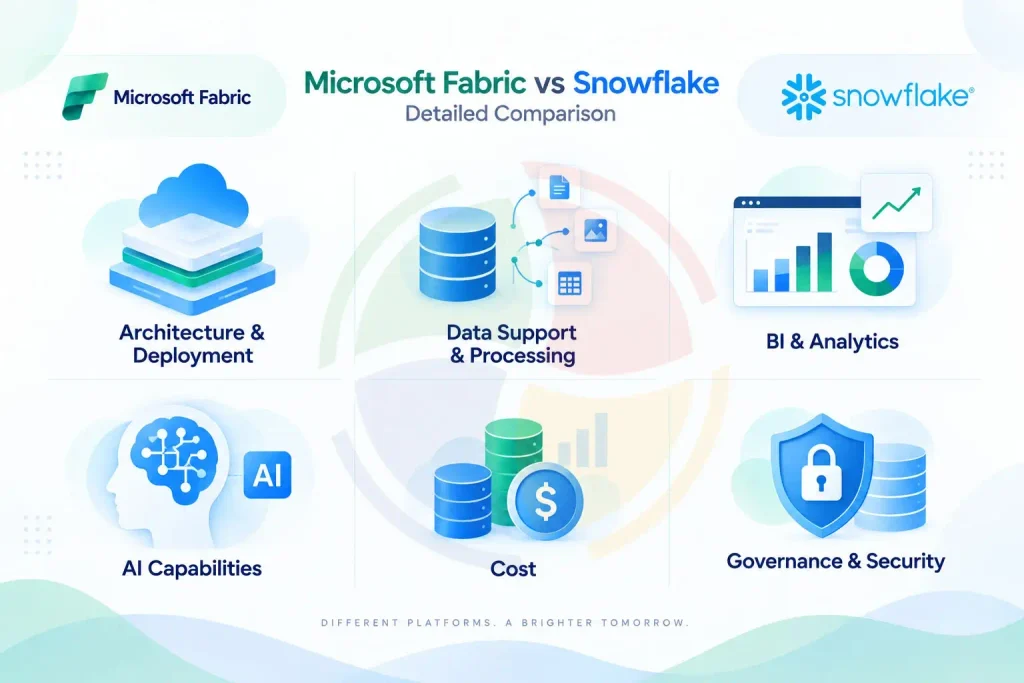
A table can give you a quick snapshot of the key differences in the Microsoft Fabric vs Snowflake debate, but it can’t tell the whole story.
To get there, we’ll dig deeper and walk through a more detailed comparison — looking at their core architectures, how they handle your data, and how well they fit with the tools you already use.
Let’s break it down.
Architecture & Deployment
Microsoft Fabric: The Fabric architecture revolves around OneLake, a single logical data lake. Its unified design simplifies deployment and management, as Microsoft handles the underlying infrastructure.
Its deep integration with Azure offers a cohesive environment for all its workloads to operate on a common data foundation without data movement.
Snowflake: Snowflake’s unique multi-cluster, shared-data architecture decouples storage and compute. With independent scaling, you can adjust processing power without any effect on the storage.
It’s a cloud-native platform, deployed across leading providers including AWS, Azure, and Google Cloud. Organizations with multi-cloud strategies or specific cloud preferences benefit from its flexibility.
Data Support & Processing
Microsoft Fabric: Fabric leverages an open Delta Parquet format within OneLake for data interoperability across its various engines. Fabric supports a wide range of ways to bring in data from low-code pipelines for data to real-time event streams. It also effectively manages data for warehousing, AI workloads, and analytics, to provide a single source of truth and avoid duplicated information.
Snowflake: Supports a wide range of structured as well as semi-structured data types, stored in optimised micro-partitions. Its virtual warehouses are specialised compute facilities for handling and searching while offering superior concurrency and efficiency.
Integration with BI & Analytics Tools
Microsoft Fabric: Fabric is deeply integrated with the Microsoft ecosystem that encompasses Power BI, Microsoft 365, Azure Synapse, and many other services. You can have a seamless and unified experience if you’re already invested in Microsoft tools.
It simplifies data flow from source to visualization and collaboration. The outcome is a lower need for complex connectors.
Snowflake: Snowflake opens up the opportunity for broad connectivity, along with a rich ecosystem of third-party integrations. The list encompasses leading BI, analytics, and ETL (Extract, Transform, Load) tools like Power BI, Tableau, dbt (Data Build Tool), and Fivetran.
Its open approach gives you the freedom to choose your preferred tools. High flexibility and no vendor lock-in make it adaptable to diverse data stacks.
AI Capabilities
Microsoft Fabric: Fabric brings AI and Copilot capabilities. It includes natural language querying in Power BI and AI-assisted code generation for data science and engineering. You can also seamlessly integrate it with Azure Machine Learning to build, train, and deploy ML models directly.
Snowflake: Snowflake improves AI/ML workflows through Snowpark, enabling you to build and deploy models using familiar languages (such as Python, Scala, and Java) directly on Snowflake data. Snowflake Cortex AI is great for generative AI and LLM use cases.
Cost
Microsoft Fabric: Fabric works on a capacity-based pricing model. With this model, you purchase a unified compute capacity, measured in Fabric Capacity Units (FCUs), shareable across all workloads. It simplifies cost management and reduces idle spend, since you are charged separately for storage in OneLake.
Snowflake: Snowflake follows a consumption-based pricing model. Here, you are charged separately for compute (billed by credits per second) and storage. Its pay-as-you-go approach offers high flexibility, but also requires careful management of auto-suspend settings and virtual warehouse sizes.
Governance & Security
Microsoft Fabric: Fabric administration is built around Microsoft Purview, providing you with one central location to find, categorise, catalogue, and regulate data across your business. It also ties in to Microsoft Entra ID for managing access and identity, and role-specific restrictions on access allow you to maintain tight oversight of who gets access to what data or responsibilities.
Snowflake: Snowflake ships with its own built-in security and governance toolkit — role-based access control, encryption, authentication, and data masking, to name a few. It also handles data classification, access policies, auditing, and secure data sharing.
Which Use Cases Are Best Suited to Microsoft Fabric vs Snowflake?
It’s one thing to know what each platform does, and a totally different one to decide which one is the right fit for your business.
You cannot decide only by comparing features. You need a strong ally to help you align a powerful technology with your existing infrastructure, unique strategy, and long-term vision.
Let’s explore a few scenarios where each platform truly shines.
Microsoft Fabric: Ideal Use Cases
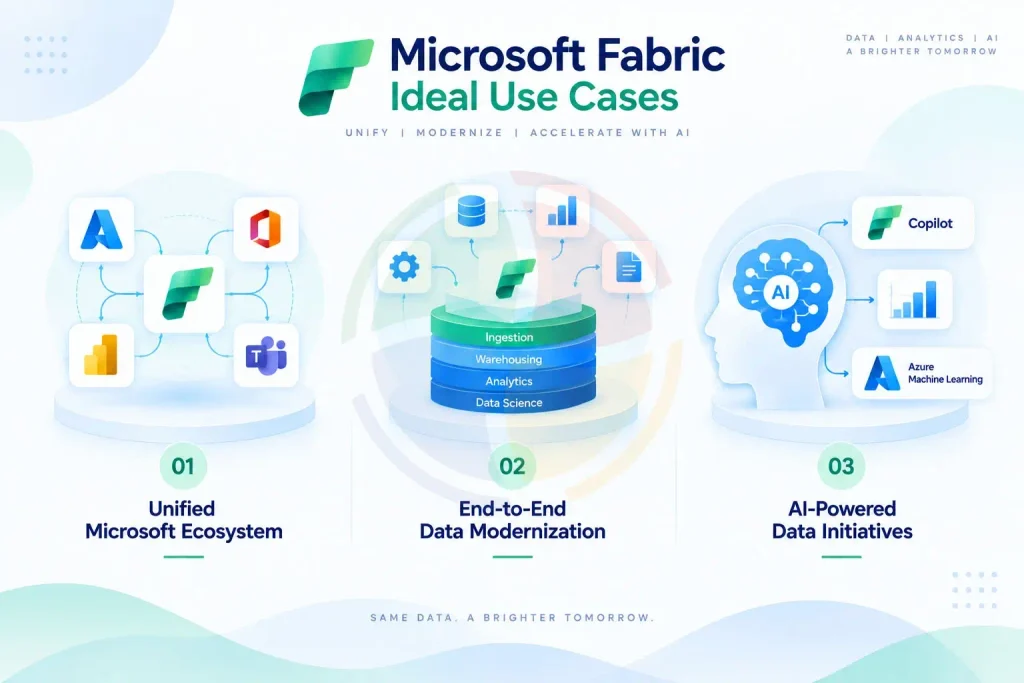
- Unified Microsoft Ecosystem
Suitable for organizations deeply invested in Azure and Microsoft 365. It can consolidate all their data analytics, AI workloads, and BI onto a single, integrated SaaS platform because of native Azure services and Power BI connectivity.
- End-to-End Data Modernization
Companies that want to simplify their entire data ingestion, warehousing, real-time analytics, and data science can leverage Fabric’s unified lakehouse architecture. It comes with built-in AI and governance.
- AI-Powered Data Initiatives
Businesses can use Fabric’s Copilot features for rapidly infusing AI into their data processes. Its seamless Azure ML connectivity helps accelerate insights and model development directly on their data.
Snowflake: Ideal Use Cases
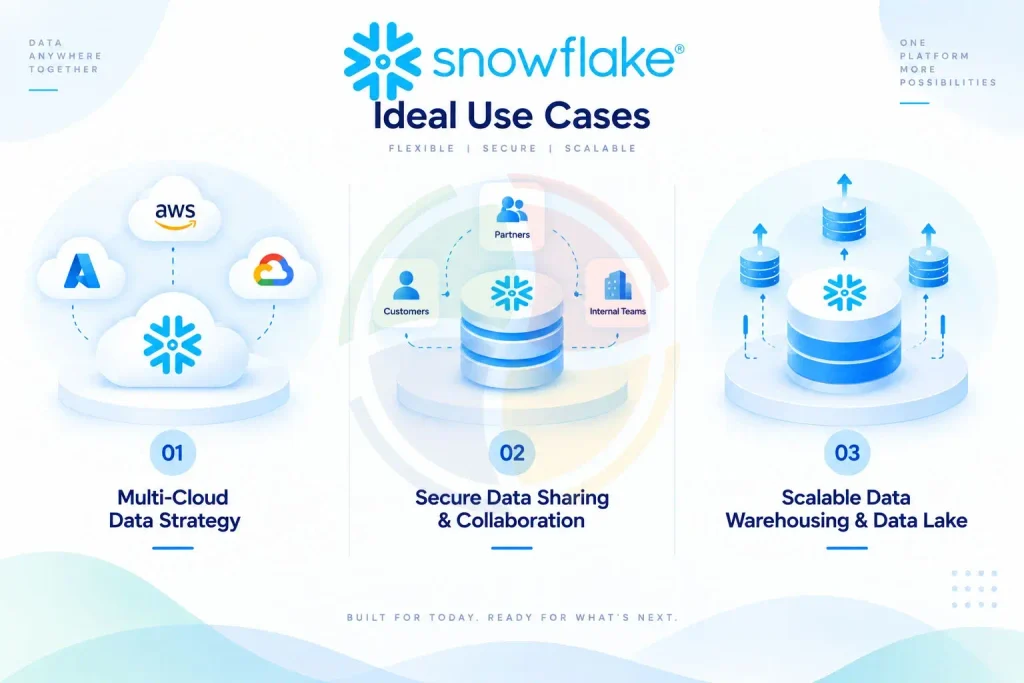
- Multi-Cloud Data Strategy
Enterprises gain flexibility to operate their data analytics and warehouse workloads across multiple public clouds. It also helps avoid vendor lock-in.
- Secure Data Sharing & Collaboration
Organizations that must share live, governed data securely with customers, partners, or internal departments benefit heavily. They do not have to copy or move data because of Snowflake’s Data Marketplace.
- Scalable Data Warehousing & Data Lake
Companies with large-scale data volumes require a highly performant and independently scalable data lake and data warehouse solution. Snowflake handles diverse analytics and concurrent user demands.
Looking to maximize your data investments? Choose Snowflake consulting services: Unlock your data’s full potential across any cloud.
Build the Right Data Platform with Aegis Softtech
Microsoft Fabric and Snowflake both answer the needs of current enterprise analytics, but in unique ways.
If you want a single analytics system across data engineering, warehousing, analytics in real time, AI, and Power BI, particularly within the Microsoft ecosystem, then go with Microsoft Fabric.
If you want self-sufficiently scalable compute, multi-cloud adaptability, broad connectivity, and safe data exchange, choose Snowflake.
Aegis Softtech helps organisations evaluate routine tasks, modernise outdated data platforms, and build scalable analytics. Our teams work across Microsoft Fabric and Snowflake to support and align platform architecture to data, analytics, and business needs.
Frequently Asked Questions
Is Microsoft Fabric similar to Snowflake?
Yes. Both support enterprise data and analytics workloads, but their architectures differ. Fabric provides an end-to-end Microsoft analytics environment built around OneLake, while Snowflake services provides a multi-cloud data platform with independently scalable compute.
What is the main difference between Microsoft Fabric and Snowflake?
The main difference is Fabric ties multiple analytics workloads to Power BI inside the Microsoft ecosystem. Snowflake leans the other way — flexible workloads, independent compute scaling, multi-cloud by design.
Does Microsoft Fabric work with Snowflake?
Yes. Connectors, plus Snowflake Mirroring into OneLake — the two can run together, not necessarily replace each other.
How does Microsoft Fabric pricing differ from Snowflake?
Fabric primarily uses capacity-based pricing through F SKUs measured in Capacity Units. Snowflake uses consumption-based pricing where running compute resources consume credits. Storage is also an important cost component for both platforms.
Is Snowflake only a data warehouse?
No, not anymore Data engineering, application development, AI/ML, data sharing — Snowflake’s grown well past traditional cloud data warehousing.
What should enterprises compare before choosing?
Enterprises should compare cloud strategy, existing tech stack, BI tools already in use, workload patterns, governance requirements, team skills, scalability needs, total cost of ownership — that’s the actual comparison, not just feature lists.