

Snowflake Cortex Analyst is Snowflake’s managed text-to-SQL service that converts natural language questions into governed SQL queries against enterprise data. Built on semantic models and integrated with Snowflake’s security framework, it enables business users to access analytics without writing SQL while maintaining RBAC, data masking, and audit controls.
Cortex Analyst is used for executive reporting, financial analytics, customer analysis, and business intelligence by organizations operating in regulated industries, like banking, healthcare, and insurance.
What Is Snowflake Cortex Analyst?
Snowflake Cortex Analyst is an enterprise-grade text-to-SQL service within Snowflake Cortex AI that enables users to ask business questions in natural language and receive answers directly from Snowflake data.
Unlike traditional BI tools that rely on dashboards or SQL expertise, Cortex Analyst uses semantic models to understand business metrics, relationships, and definitions, enabling more accurate and governed SQL generation.
Because queries execute entirely inside Snowflake, organizations retain:
- Role-based access control (RBAC)
- Dynamic data masking
- Row-level security
- Auditability
- Regulatory compliance
This Snowflake architecture allows enterprises to adopt AI-powered analytics without moving data outside Snowflake.
How Does Snowflake Cortex Analyst Work?
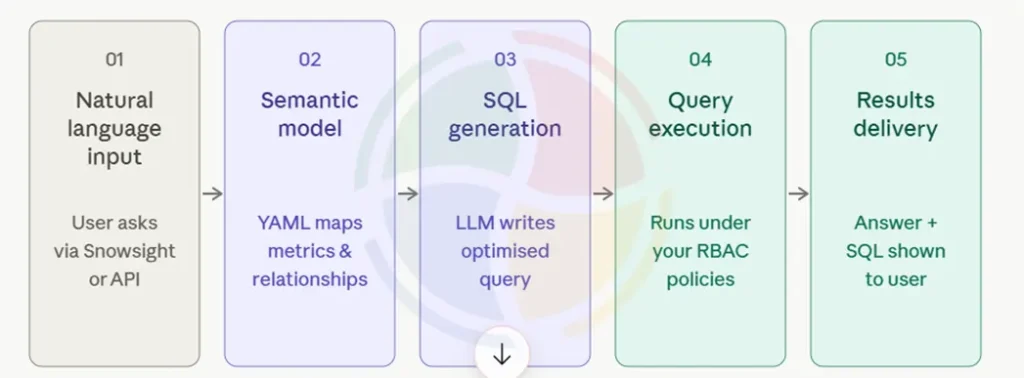
The technology behind the Snowflake Cortex Analyst includes language models, semantic understanding, and governance features from Snowflake that allow for proper and efficient text-to-SQL transformations at Snowflake. The entire process consists of five stages:
1. Natural Language Input: A user asks a business question through things like Snowsight or internal applications or chat interfaces or custom AI assistants or Cortex Agents.
2. Semantic Model Interpretation: Snowflake Cortex Analyst does not look at tables directly. Instead, it looks at models that define things like business metrics, relationships, dimensions, approved calculations and data definitions. This really helps improve the accuracy of SQL and reduces mistakes.
3. SQL Generation: SQL is generated by the LLM in response to the business question, making use of the semantic model.
4. Query Execution: Generated SQL runs on the Snowflake data warehouse infrastructure using the pre-existing governance framework.
5. Results Delivery: The user gets the results of the query, the generated SQL code, explanations, and additional suggestions for analysis with Snowflake Cortex Analyst.
This architecture enables self-service analytics while maintaining enterprise-grade governance.
From semantic model design to governed AI deployments, our Snowflake experts help enterprises implement Cortex Analyst securely and at scale.
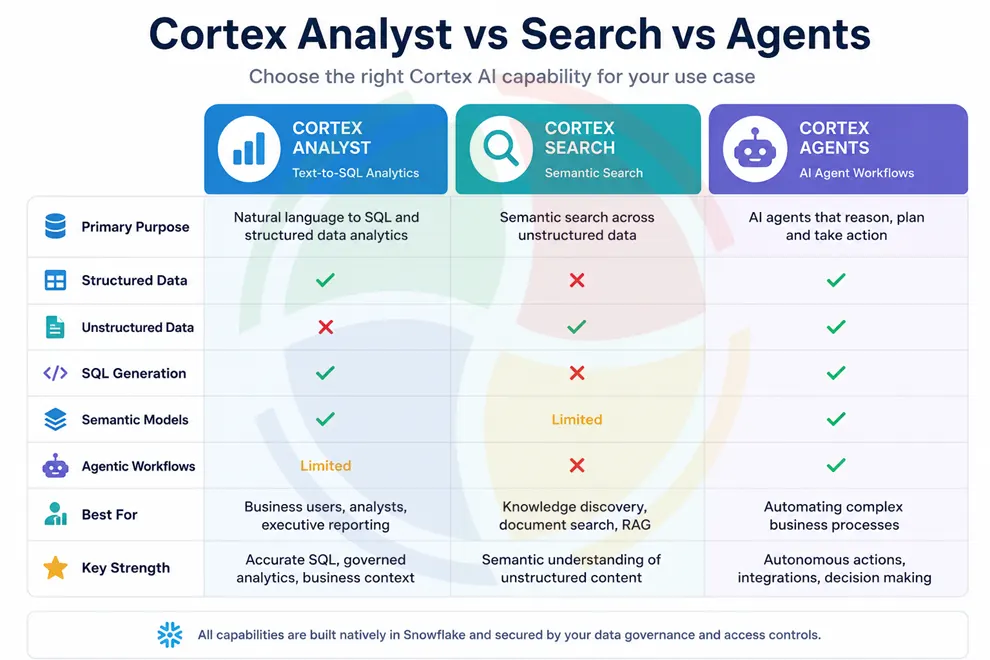
Cortex Analyst vs Search vs Agents comparison
Snowflake Cortex products serve different AI use cases. Cortex Analyst focuses on structured analytics, Cortex Search enables semantic retrieval from unstructured data, and Cortex Agents orchestrate multi-step AI workflows.
Why Are Enterprises Adopting Snowflake Cortex Analyst?
Business teams need answers fast. Analytics teams are overwhelmed with repetitive requests. Cortex Analyst closes that gap.
| Enterprise Challenge | Cortex Analyst Solution |
| SQL expertise required | Natural language interface |
| Analytics request backlog | Self-service reporting |
| Inconsistent metric definitions | Semantic model governance |
| Data access concerns | Snowflake RBAC enforcement |
| Slow dashboard development | Instant query generation |
| AI governance risk | Native Snowflake controls |
For regulated industries such as banking, insurance, healthcare, and capital markets, Cortex Analyst maintains role-based access controls, auditability, data masking, row-level security, and compliance requirements, all within Snowflake’s security framework.
Key Benefits
Common benefits of Snowflake Cortex Analyst include:
- Faster access to business insights through natural language queries
- Reduced dependence on SQL expertise and analytics teams
- Self-service analytics for business users and executives
- Consistent KPI and metric definitions through semantic models
- Improved accuracy for text-to-SQL queries
- Built-in governance, security, and access controls
- Reduced reporting bottlenecks across teams
- Greater transparency through explainable SQL
- Faster decision-making with real-time data access
Key Capabilities of Snowflake Cortex Analyst
Five features define how Cortex Analyst works in practice:
Natural Language to SQL Conversion
Ask in plain English. Cortex Analyst handles the text-to-SQL conversion on Snowflake, covering revenue analysis, segmentation, financial reporting, trend analysis, and forecasting.
Semantic Model-Based Understanding
Semantic models teach Cortex Analyst your business language — what “churn,” “revenue,” or “active customer” means in your data. More accurate than generic AI tools.
SQL Generation Transparency
Every answer shows the SQL behind it. Analysts can verify results. No black box.
Conversational Analytics
Follow-up questions build on previous ones, like a real back-and-forth with a data analyst.
Snowflake Cortex Analyst Use Cases
Snowflake Cortex Analyst enables self-service analytics across business functions while maintaining governance, consistency, and security.
Financial Services Analytics
Financial industries use Snowflake Cortex Analyst for portfolio performance analysis, risk reporting, fraud monitoring, customer segmentation, and regulatory compliance.
Executive Self-Service Reporting
Leaders don’t have to wait on analysts anymore. They can ask for revenue growth by unit or trends over time and get instant reports themselves.
Operations Analytics
Operations teams can check supply chains, service levels, or workforce productivity. They can spot bottlenecks without digging into SQL, saving time and effort.
Customer Experience Analysis
By combining Cortex Analyst with AI search, companies can track satisfaction, support trends, and retention. It helps them see what keeps customers happy or what drives them away.
Regulatory Reporting
In industries with strict rules, governed text-to-SQL ensures compliance. Reports are accurate, auditable, and safe, making regulatory checks far less stressful.
Snowflake Cortex Analyst vs Traditional BI Tools
Unlike traditional BI tools that rely on dashboards and analyst-driven workflows, Cortex Analyst enables conversational analytics directly on governed enterprise data.
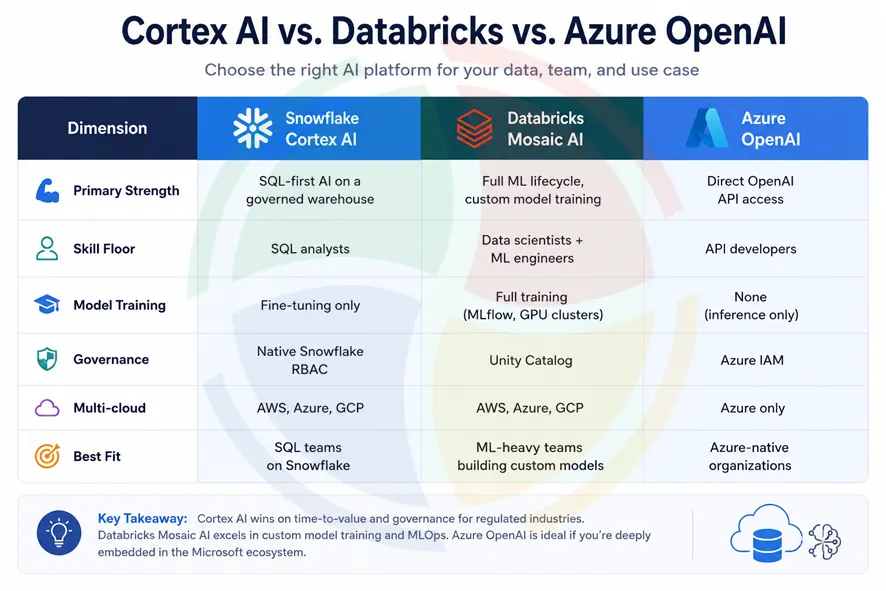
How to Implement Snowflake Cortex Analyst?
Snowflake Implementation follows five phases. Move sequentially, each step builds on the last.
Phase 1: Data Readiness Assessment
Audit data quality, governance, and Snowflake setup. Messy data produces messy insights.
Phase 2: Build Semantic Models
Define KPIs, metrics, and business rules. Strong semantic models are the single biggest driver of query accuracy.
Phase 3: Pilot High-Value Use Cases
Start small. Try executive reporting or finance analytics. Quick wins build confidence before broader rollout.
Phase 4: Governance & Validation
Review queries, validate outputs, monitor usage. Guardrails keep insights reliable at scale.
Phase 5: Scale Across the Enterprise
Expand to more teams, integrate AI workflows. Scale carefully, as consistency matters as much as coverage.
Limitations and Considerations of Snowflake Cortex Analyst
Cortex Analyst is powerful, but it’s not a plug-and-play solution for every scenario. A few things worth knowing before you go all in.
- Semantic Model Dependency: The quality of your results lives and dies by your semantic model. Poorly defined metrics or ambiguous column names? Expect inconsistent, sometimes frustrating outputs.
- English-Language Queries Only: Right now, Cortex Analyst understands English. If your user base speaks other languages, that’s a gap you’ll need to plan around.
- Structured Data, Full Stop: It works exclusively with structured data in Snowflake tables. Unstructured content — PDFs, emails, free-form text — sits entirely outside its scope.
- Complex, Multi-Step Analysis: It handles straightforward business questions well. But deeply layered logic, custom statistical models, or intricate multi-step reasoning? You’ll still need an analyst in the room.
- Cost and Token Consumption: Every query burns Cortex credits. High-volume environments can rack up costs quickly, so it’s worth factoring in before scaling broadly across teams.
Conclusion
Snowflake Cortex Analyst represents the next evolution of enterprise analytics by combining natural language interfaces, semantic models, and governed SQL generation within Snowflake.
For organizations seeking self-service analytics without compromising security and governance, Cortex Analyst provides a practical path toward AI-driven decision-making. Backed by expert Snowflake consulting for faster, more reliable rollouts.
As enterprises increasingly adopt agentic AI workflows, Cortex Analyst is becoming a foundational component of the broader Snowflake Cortex AI ecosystem.
Unlock Enterprise AI with Snowflake Cortex Analyst
Snowflake Cortex Analyst enables business users to query data using natural language while maintaining enterprise security and governance. Our Snowflake experts help organizations design semantic models, implement governed AI workflows, and optimize Cortex AI deployments for scale.
Our Snowflake AI Services Include:
- Snowflake Cortex AI implementation
- Semantic model design
- Text-to-SQL deployment
- AI governance and security
- Cost optimization and monitoring
- Enterprise AI consulting
Frequently Asked Questions
What is the difference between Snowflake Cortex Analyst and Search?
Cortex Analyst answers structured data questions via SQL. Cortex Search handles unstructured text lookups. Different jobs — both live under the Cortex AI umbrella.
How much does Cortex Analyst Snowflake cost?
Snowflake Cortex Analyst pricing is based on successful API calls and Virtual Warehouse compute consumption. While API usage drives cost, organizations should monitor both inference and warehouse usage to estimate total spend accurately.
Which LLMs power Snowflake Cortex Analyst, and can I choose between them?
It runs on Snowflake-hosted Llama and Mistral models. Optionally, Azure OpenAI can be enabled. You can’t pick per query — Snowflake auto-selects.
Can Snowflake Cortex Analyst handle follow-up questions?
Yes, if you pass the conversation history in each request. There’s no hidden memory — context must be explicitly included every time.
Is Snowflake Cortex Analyst a BI tool?
No. Snowflake Cortex Analyst is an AI-powered text-to-SQL service rather than a traditional BI platform. It complements BI tools by enabling conversational analytics directly on Snowflake data.
Does Snowflake Cortex Analyst move data outside Snowflake?
Absolutely not. All queries run within Snowflake. Moreover, the governance policies you have configured previously remain the same and are applicable just as they are.
What is the difference between text-to-SQL and semantic search?
The main thing about text-to-SQL is that it transforms natural language input into a SQL query, which operates on structured data – tables and rows. Meanwhile, semantic search is a completely different approach, since it’s designed for operating on unstructured data, such as documents, PDF files, knowledge bases, etc.