
Even the 402.74 million terabytes of data generated every day cannot yield any profitable results for you without refining. You have to escalate data volumes, along with real-time analytics, neither of which can be fulfilled by traditional data warehousing.
These roadblocks gave way to cloud-based data storage solutions. The outcome is high scalability, access to insights, and lower overhead.
But with names like Amazon Redshift, Google BigQuery, and Snowflake circulating in the market today, choosing the right one could be a challenge.
Picking one that suits you means digging into a Snowflake vs BigQuery vs Redshift comparison. Let’s see which platform delivers the best return on investment (ROI) on your most valuable currency, your data.
Key Takeaways
| • Snowflake, Google BigQuery, and Amazon Redshift are leading cloud-based data warehouses that address the limitations of traditional systems. • Snowflake has a unique multi-cluster, shared data architecture with independent scaling for storage and compute. It is a SaaS platform with a pay-as-you-go model and minimal user management. • Google BigQuery is a fully serverless data warehouse with decoupled compute and storage. It offers instant scalability and is optimized for real-time and ad-hoc analytics. • Amazon Redshift uses a traditional cluster-based architecture with coupled compute and storage. It is ideal for AWS users with predictable, heavy batch workloads. • The three platforms are compared on the following basis: architecture, mode of operation & performance, maintenance & server management, scalability, backup & recovery, and security. |
Snowflake vs BigQuery vs Redshift: A Tabular Differentiation
| Feature | Amazon Redshift | Google BigQuery | Snowflake |
| Architecture | Cluster-based MPP; coupled compute and storage | Serverless; decoupled compute (Dremel) and storage (Colossus) | Multi-cluster shared data; separate storage, compute, and services |
| Mode of Operation and Performance | Provisioned clusters but requires tuning; suitable for structured batch analytics | Fully automated; apt for ad-hoc and real-time analytics | Virtual warehouses, high concurrency, and mixed workload performance |
| Setup, Maintenance, and Server Management | Manual cluster provisioning and ongoing management | Fully serverless with zero user management | Fully managed SaaS and no infrastructure management |
| Scalability | Manual node scaling, potential downtime | Automatic, instant, and elastic scaling | Independent, instantaneous compute and storage scaling |
| Pricing | Node-based (hourly) | Pay-as-you-go | Consumption-based; compute can be paused |
| Backup and Recovery | Automated and manual snapshots; point-in-time recovery | Automatic replication; built-in time travel | Time Travel; Zero-Copy Cloning for data manipulation and recovery |
| Security | AWS IAM, VPC, and encryption | Default encryption, Google Cloud IAM, and column-level security | End-to-end encryption, MFA, RBAC, and robust compliance |
| Integrations | Deeply integrated with the AWS ecosystem | Seamless integration with Google Cloud services | Broad ecosystem support; designed for multi-cloud |
| Support for third-party tools | Good via JDBC/ODBC | Strong, including native ML | Extensive support |
| Use Case | AWS users and predictable heavy batch workloads | GCP users, real-time analytics, and unpredictable data | Multi-cloud, flexible scaling, and secure data sharing |
What is Snowflake?
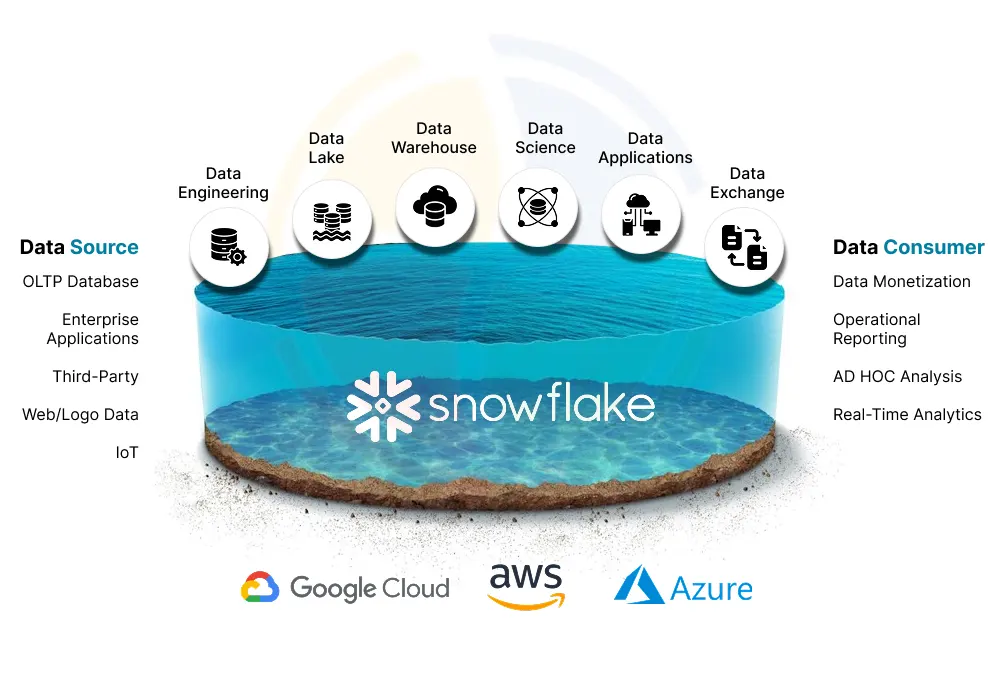
Snowflake is a cloud-based data platform containing a new SQL query engine. It is a Software-as-a-Service (SaaS) solution with offerings opposite to traditional data warehouses. It cannot be run on-premises. Thus, it offers highly flexible and easily usable data analysis, storage, and processing options.
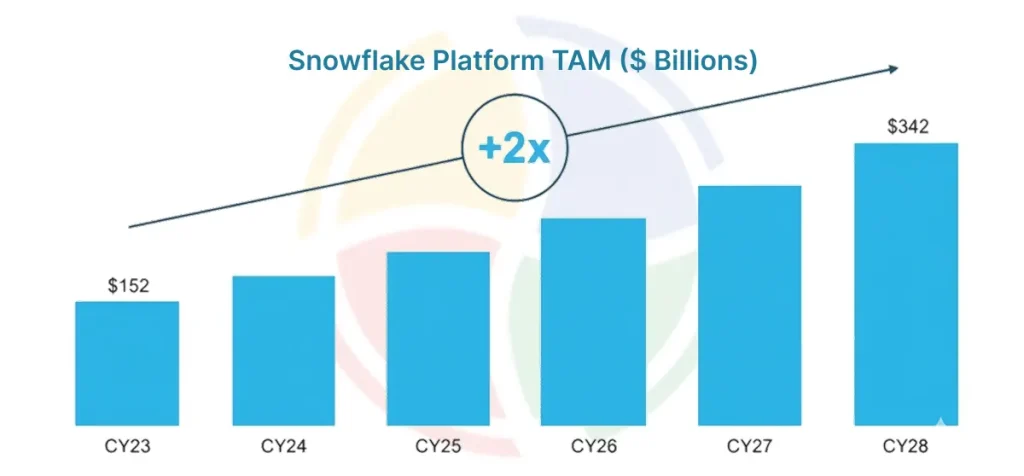
Its standard ANSI SQL protocol supports structured and semi-structured data formats, including XML, JSON, Parquet, and others. It is suitable for business operations that don’t need dedicated resources for physical or in-house operations. You can benefit financially from its pay-as-you-go service.
Build the right foundation Our Snowflake development services help build scalable, future-proof data solutions that grow with your business and maximize performance.
What is BigQuery?
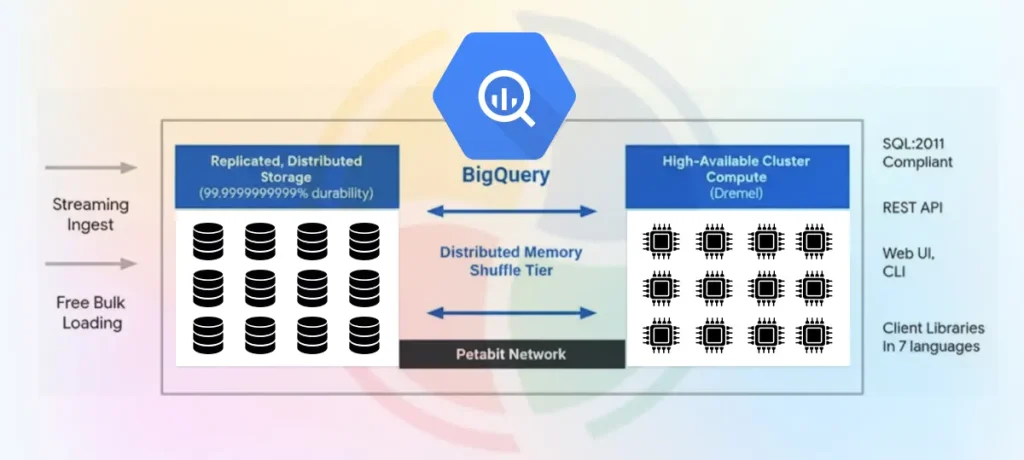
Google BigQuery is a completely managed serverless enterprise data warehouse solution. It gives you control over who queries and views your data, without having to download and install the setup. Its decoupled architecture separates the compute engine and storage for independent scaling according to your needs.
You can use SQL to query petabytes of data as the platform boasts a distributed analytical engine. BigQuery is a cost-effective option available with multiple tools, including BigQuery BI Engine, BigQuery GIS, and BigQuery Omni.
What is Redshift?
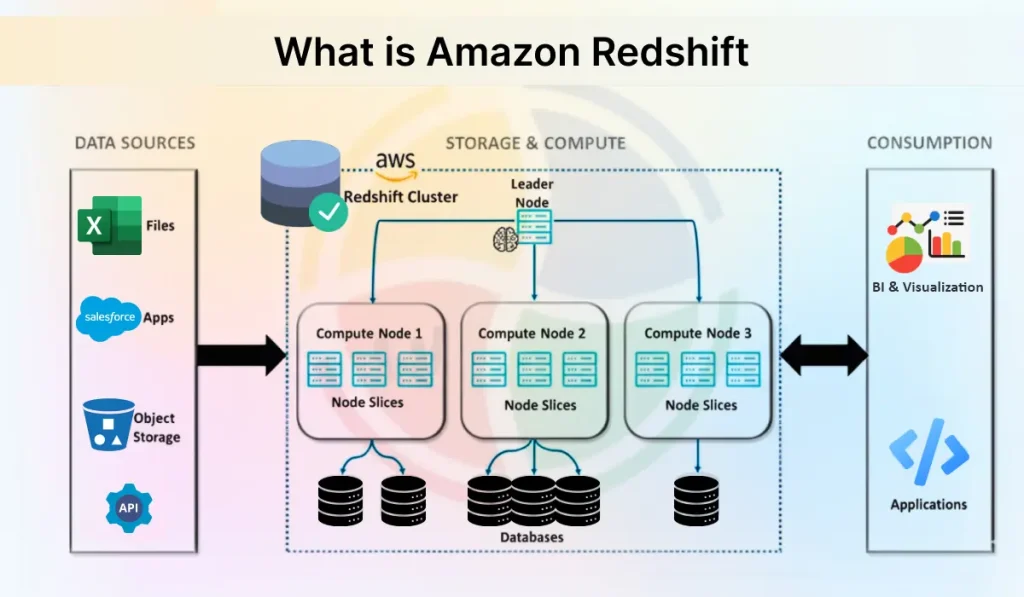
Amazon Redshift uses the Massively Parallel Processing (MPP) technology to process petabytes of data at lightning speed. Since it can process structured and unstructured data, it is suitable for large-scale migrations. It is fast, has a simple interface, and flexible query options for running complex analytical queries.
You can easily load and transform data from sources like Amazon EMR, Amazon S3, Amazon DynamoDB, and even your transactional database. It is a great option because you need not worry about administrative overhead or managing infrastructure.
Let’s do a cloud data warehouse comparison with the main ones: Snowflake vs Redshift vs BigQuery.
Snowflake vs Redshift vs BigQuery: Key Factors
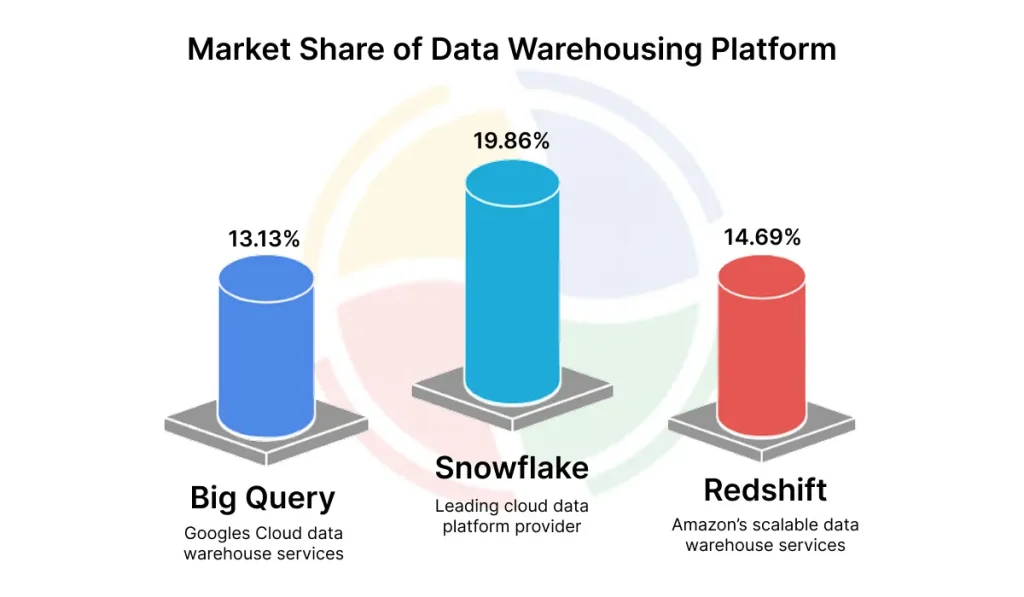
Snowflake, Redshift, and BigQuery are the three names at the forefront of the soaring cloud data warehousing industry. They are the market leaders offering the best scalability, cost-efficiency, and performance.
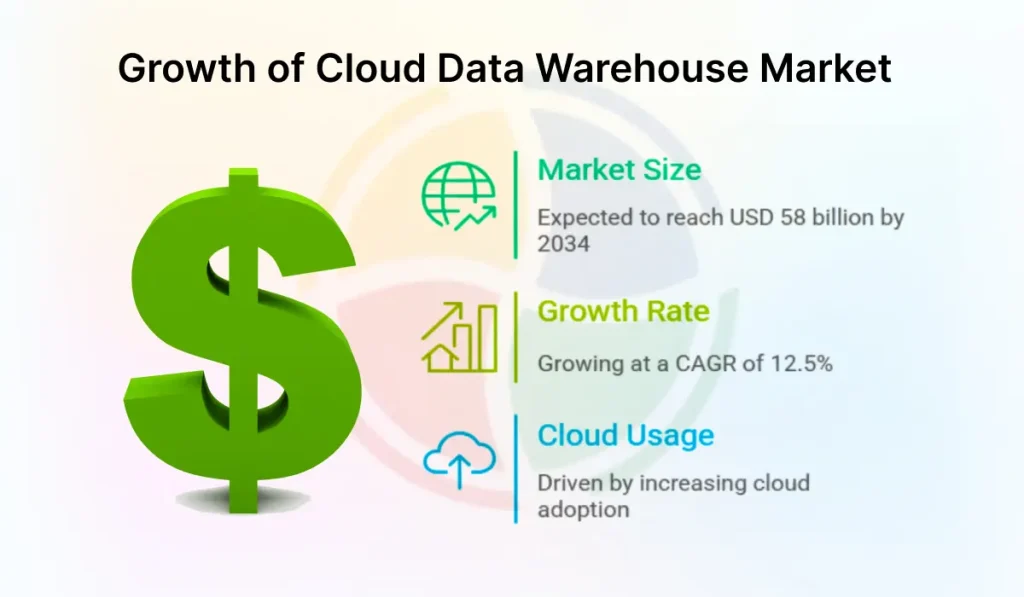
The cloud data warehouse market is expanding due to the high cloud usage. The said market is expected to reach USD 58 billion by 2034.
Here’s an in-depth Snowflake vs BigQuery vs Redshift comparison for more informed decisions.
1. Architecture
Amazon Redshift
Redshift follows a traditional Massively Parallel Processing (MPP) cluster-based architecture. The nodes include compute and storage, neatly organized into clusters. Its architecture distributes data and processing across multiple nodes for high-performance analytical queries.
Google BigQuery
BigQuery’s serverless architecture decouples compute from storage. It’s a unique design for managing all underlying infrastructure and automatically provisioning resources according to your needs. It eliminates server management for high-level flexibility.
Snowflake
Snowflake has a distinctive multi-cluster shared data architecture. Its architecture is also decoupled, since it segregates into three independent layers, namely storage, compute (virtual warehouses), and cloud services. Separation enables the layers to scale elastically and independently, and supports various workloads concurrently.
2. Mode of Operation & Performance
Amazon Redshift
Redshift operates on provisioned clusters, where you are in charge of managing configurations and node types. While its performance is optimized for complex analytical queries on large, structured datasets, manual tuning becomes essential for optimal efficiency. In short, performance might be less ideal for semi-structured data or highly concurrent ad-hoc queries.
Google BigQuery
Being a fully serverless data warehouse, BigQuery automatically allocates computing resources on demand. It’s swift for real-time analytics and ad-hoc queries for gigantic data. No need for performance tuning or indexing since it has columnar storage.
Snowflake
Snowflake’s virtual warehouses offer flexible operation with dedicated compute resources. You can scale these virtual warehouses to optimize cost and performance. The architecture is made to handle diverse workloads while delivering high concurrency and performance.
Is your data confusing you? Our Snowflake consulting services offer strategic clarity to define your data roadmap. Let’s simplify everything from migration to full-scale modernization.
3. Setup, Maintenance & Server Management
Amazon Redshift
Choosing Redshift means setting up and configuring clusters, including selecting node sizes and types, yourself. Additionally, you are partially responsible for ongoing maintenance tasks, such as vacuuming tables, managing workloads, and scaling.
Google BigQuery
There is no setup or ongoing server management with BigQuery, as it is a fully serverless service. Google manages all infrastructure provisioning, patching, scaling, and maintenance.
Snowflake
It is a SaaS solution where installing, configuring, or managing any hardware or software is not your responsibility. It significantly brings down the operational burden for quicker deployment.
4. Scalability
Amazon Redshift
Redshift resizes nodes to add more compute nodes to a cluster for horizontal scaling. These scaling operations, however, usually need manual intervention and may even result in temporary downtime.
Google BigQuery
BigQuery is a big name for its industry-leading, instant, and automatic scalability. Compute resources can scale dynamically according to query demands because of its serverless architecture. You can thus effortlessly handle unpredictable and massive data volumes without any downtime.
Snowflake
Both compute and storage scale independently in either direction in Snowflake. Virtual warehouses have the prowess to resize instantly (vertical scaling) or spin new clusters (horizontal scaling) for workload spikes.
5. Backup & Recovery
Amazon Redshift
It offers point-in-time recovery to a specific timestamp with its automated Amazon S3 snapshots. You can create manual snapshots, too. It stores the data redundantly across various locations within AWS for durability.
Google BigQuery
BigQuery automatically replicates data across multiple geographic locations for robust data availability and durability. You can query historical data versions with its built-in fault tolerance and the time travel feature.
Snowflake
Snowflake has powerful data recovery capabilities, including the Time Travel feature, to query or restore data from any point in history. Its Zero-Copy Cloning creates writable copies of databases, tables, or schemas instantly without duplicating data.
6. Security
Amazon Redshift
Redshift is known to integrate with AWS Identity and Access Management (IAM) for granular access control, while supporting Virtual Private Cloud (VPC) and encryption for data in transit (SSL) and at rest (KMS).
Google BigQuery
It encrypts data both at rest and in transit by using Google’s robust encryption mechanisms. BigQuery integrates with Google Cloud IAM for deep access control, including column-level security.
Snowflake
Snowflake highly values enterprise-grade security with multi-factor authentication (MFA), end-to-end encryption, and role-based access control (RBAC). It ensures adherence to industry compliance standards, such as HIPAA and PCI DSS.
Determining the Right Data Warehouse for Your Business with Aegis Softtech
Snowflake, Redshift, and BigQuery are the top cloud warehouses, and you can easily take your pick depending on your unique requirements. You should sign up for data warehouse consulting that helps you spearhead through this data-driven world.
Embark on this journey with a strategic partner like Aegis Softtech. If Snowflake’s innovative features and scalable architecture resonate with your company’s need for data analytics and centralization, a capable Snowflake implementation is all you need, and our seasoned experts offer just the same
Are you ready to adopt and implement the perfect data warehouse strategy for your enterprise?
Reach out to our team for a collaborative discussion and expert guidance tailored to your business vision.
FAQs
Q1. Is BigQuery better than Snowflake?
They are both powerful cloud data warehouses with different strengths. Google BigQuery seamlessly integrates with other Google Cloud services, resulting in cost-effective solutions for large datasets. Snowflake, however, is cloud-agnostic. It offers higher flexibility for data sharing and multi-cloud deployments.
Q2. Why move from Redshift to Snowflake?
Moving from Redshift to Snowflake brings along plenty of advantages. These are mostly linked to Snowflake’s cloud-native architecture and decoupled compute and storage.
Q3. What is the difference between a data warehouse and a cloud?
A data warehouse stores and analyzes huge historical data for BI purposes. Cloud computing is a computing model that provides accessible resources, such as storage, software, and processing power, over the internet.
Q4. Why use Snowflake instead of AWS?
Use Snowflake if you are looking for a simpler, multi-cloud-friendly data warehousing experience. It also offers enhanced data collaboration features.
Q5. Which cloud data warehouse is best?
There is no single best cloud data warehouse that suits everyone equally. The choice depends on various factors, including your existing cloud ecosystem, budget, specific analytical needs, and data volume. The top contenders, however, are Snowflake, BigQuery, and Redshift.