

Are you able to clearly demonstrate the financial return of your digital workflow investments?
You continue to scale digital workflows to improve service delivery, governance, and cross-functional coordination.
As your workflows expand, dashboards fill with operational metrics, such as ticket resolution time and automation rates. These indicators reflect activity. They do not automatically demonstrate profits.
Without quantifying ServiceNow ROI in business terms, the platform risks being viewed as an operational expense rather than a strategic value driver.
To change that perception, you must translate workflow performance into cost savings, margin influence, and scalable capacity gains.
In this blog, we will explain structured ROI formulas, measurable KPIs, and workflow automation metrics for you to calculate and justify your enterprise returns.
Key Takeaways
- ServiceNow ROI: Shows how automation, AI, and governance create measurable business value.
- Productivity metrics: Reduces operational effort, improve ticket handling, and optimize labor without extra headcount.
- Automation maturity: Expands workflow coverage, minimizes manual touchpoints, and strengthens AI-driven processes.
- Financial impact: Converts efficiency gains into cost savings, labor hour recovery, and reduced overtime.
- Experience and capacity: Enhances SLA adherence, agent productivity, and scalable workflow capability.
- Cost components: Includes licensing, implementation, integrations, ongoing operations, AI usage, and hidden adoption or customization factors.
- ROI framework: Establishes baselines, define improvement targets, quantify financial gains, and track results quarterly.
ServiceNow ROI: What It Means for Your Business
Besides direct operational cost savings, ServiceNow ROI indicates how effectively the platform contributes to measurable business performance beyond ticket reduction or automation percentages.
When evaluated correctly, ROI connects workflow efficiency to cost structure, capacity expansion, risk reduction, and scalable growth.
For executives, ROI translates into financial clarity. For platform owners, it connects technical performance to profitability outcomes.
So, how do you calculate this ROI?
The Standard ROI Formula
ServiceNow ROI follows a simple calculation:
The formula is straightforward, but the complexity lies in defining what qualifies as a benefit.
Net benefit includes both direct and indirect value.
Direct value refers to measurable financial improvements, such as reduced cost per ticket, lower labor dependency, decreased overtime, or infrastructure consolidation. These are quantifiable and usually appear in operational budgets.
Indirect value includes improved employee productivity, faster onboarding, reduced compliance risk, improved SLA adherence, and stronger service experience. These don’t immediately result in cost savings, but influence margins, scalability, and long-term operational resilience.
ROI modeling must distinguish between cost avoidance and revenue enablement.
Cost avoidance prevents future spending. Examples include eliminating additional hiring due to automation or reducing incident backlogs before they escalate.
Revenue enablement supports growth. Faster service resolution, improved customer experience, and scalable workflows contribute to retention, expansion, and cross-functional efficiency.
Measuring the Business Value of ServiceNow
Many organizations focus initially on cost reduction. While necessary, this perspective alone does not represent the actual business impact of your ServiceNow platform.
Enterprise ROI requires outcome-based measurement that connects your workflows to broader objectives, such as margin protection, service scalability, and operational reliability.
Your operational maturity directly influences this impact. As governance improves, automation expands, and integrations stabilize, your financial gains begin to compound.
Continual improvement tracking sustains that momentum by aligning quarterly reviews, performance dashboards, and executive reporting with measurable financial outcomes.
Disciplined ROI measurement positions ServiceNow as a strategic investment lever rather than a technical reporting tool.
Core ServiceNow ROI Metrics for Workflow Automation
Now that you understand what ServiceNow ROI means in a business context, let’s look at the metrics that contribute to ServiceNow workflow automation. The platform becomes more credible when your performance metrics translate into enterprise outcomes.
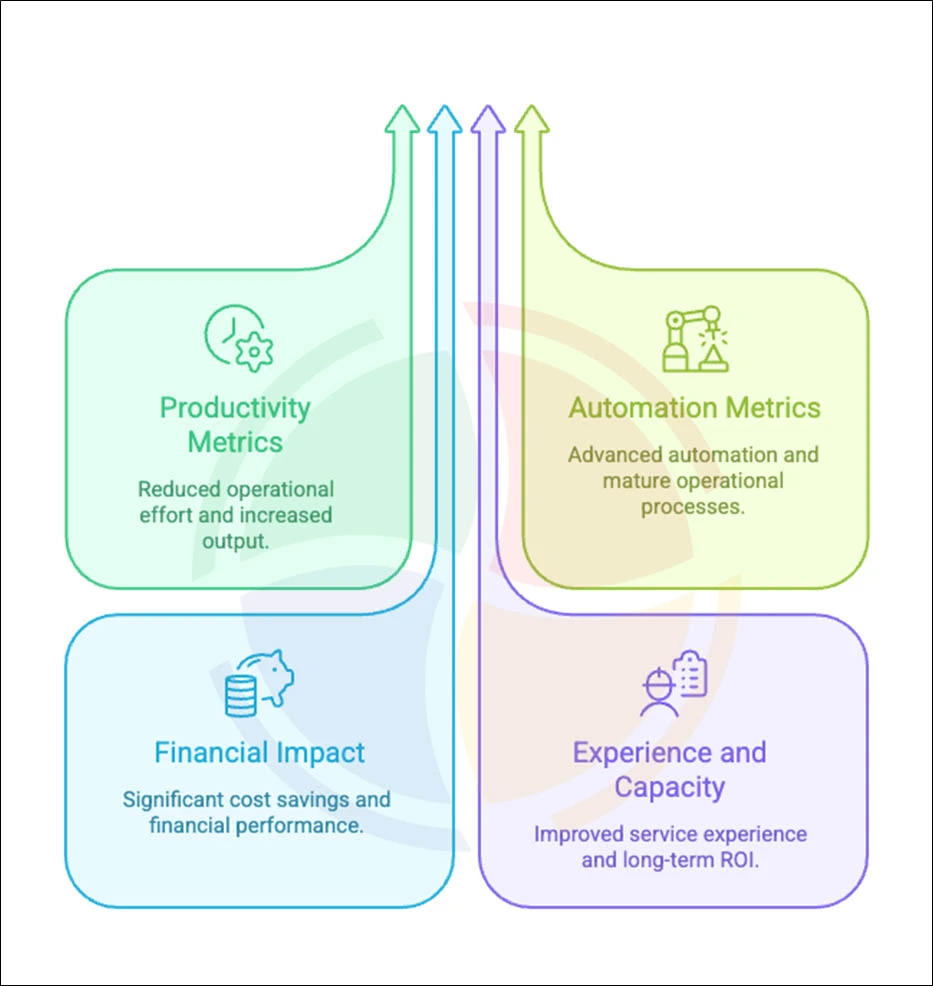
Productivity Metrics That Reduce Operational Effort
Productivity metrics indicate how efficiently your teams handle workload without increasing headcount. These parameters show whether automation reduces manual effort while maintaining service quality.
When productivity improves, labor optimization follows. You process higher ticket volumes with the same workforce, or reallocate capacity toward higher-value initiatives.
Key indicators include:
- Mean Time to Resolution (MTTR) reduction: Lower MTTR shortens service cycles and reduces time spent per incident. Over time, this compounds into measurable labor savings.
- First Contact Resolution (FCR) improvement: Higher FCR reduces repeat handling and escalation effort. It directly lowers workload per ticket and improves service consistency.
- Average ticket resolution time: Shorter resolution time indicates streamlined workflows and fewer manual dependencies. It shows efficiency at a process level.
- Agent capacity increase without headcount expansion: When automation absorbs repetitive tasks, your existing teams handle more volume without additional hiring.
Automation Metrics That Indicate Maturity
Automation metrics measure depth and indicate how extensively workflows operate without manual intervention.
As automation maturity increases, cost savings become structural. Mature automation environments sustain gains across departments and use cases.
You can assess automation maturity through:
- Percentage of workflows automated: A higher automation ratio shows broader process coverage. It represents how much of your operation runs through organized, rule-based execution.
- Manual touchpoint reduction: Fewer manual approvals or handoffs reduce processing delays and reliance on labor. It improves throughput and predictability.
- Virtual agent containment rate: A strong containment rate means user requests are resolved without human escalation, directly reducing frontline workload. ServiceNow Features such as guided self-service play a critical role in improving containment and adoption.
- AI-generated resolution usage: Adoption of AI-assisted responses or summaries accelerates ticket handling. Increased usage signals workflow intelligence maturity.
Avoid measuring automation coverage alone. High automation ratios may still produce limited financial value if workflows automate low-impact tasks.
Prioritize automation for high-volume and high-effort processes to maximize ROI.
Financial Impact Metrics That Translate Performance Into Cost Savings
Operational improvements gain executive attention only when expressed as financial outcomes. Time savings and efficiency gains must be converted into monetary value.
Key financial indicators include:
- Cost per ticket reduction: If your average cost per ticket decreases from $25 to $18 across 100,000 annual tickets, you generate $700,000 in annual savings.
- Labor hour savings: If automation saves 10 minutes per ticket across 80,000 tickets annually, you reclaim over 13,000 labor hours. Multiply this by your average hourly cost to quantify savings.
- Overtime reduction: Lower backlog and faster resolution reduces after-hours effort. Reducing overtime directly improves operating margins.
- Incident backlog cost elimination: Persistent backlog often requires temporary staffing or productivity loss. Eliminating backlog prevents reactive spending and stabilizes service delivery.
Experience and Capacity Metrics That Influence Long-Term ROI
Short-term savings matter, but sustainable ROI depends on service quality and scalable capacity. Experience and reliability metrics determine whether gains endure.
The indicators influence retention, satisfaction, and operational resilience, which indirectly protect long-term margins.
You should monitor:
- Agent productivity improvements: Higher productivity means balanced workload distribution and better tool support. It strengthens retention and reduces burnout-related costs.
- Time saved per workflow: Even small time reductions compound across high-volume processes. Over a year, incremental efficiency becomes structural value.
- SLA adherence improvement: Improved SLA compliance reduces penalty risk and strengthens service trust. It also reflects operational predictability, which supports scalable growth.
Total Cost Components That Influence ServiceNow ROI
ServiceNow costs extend beyond licensing. You also need to consider investment in ServiceNow implementation, integrations, governance, ongoing optimization, and adoption efforts. Each layer affects your final return.
To calculate ROI accurately, you must account for direct investments, recurring operational expenses, and hidden factors that can quietly reduce value over time.
The following cost components establish a realistic financial baseline:
Direct Investment Costs
Direct investments form the foundation of your ServiceNow deployment. They represent the capital and contractual commitments required to activate and operationalize the platform.
Understanding these components prevents underestimation during ROI modeling.
Licensing
Your licensing model includes subscription tiers, selected modules, user types, and enterprise packages. The recurring contractual costs establish the financial baseline of your platform investment.
Implementation
Consulting engagement, workflow configuration, architecture planning, testing cycles, and go-live execution require structured investment. Implementation determines how efficiently the platform begins delivering value.
If you are evaluating execution partners, governed ServiceNow development services help ensure workflows are built for scalability, maintainability, and measurable ROI.
Integrations
Connecting ServiceNow with ERP, CRM, monitoring, HR, or security systems requires API development, middleware configuration, and validation. Integration complexity directly affects cost and long-term maintainability.
Custom Workflows
Tailoring the platform beyond out-of-the-box capabilities involves scripting, advanced configurations, and business rule development. Higher customization increases initial cost and future upgrade effort.
Training and Change Enablement
User onboarding, administrator training, and documentation, change management drive adoption. Without proper enablement, projected efficiency gains rarely materialize.
Ongoing Operational Costs
Long-term ROI depends on how well you sustain and govern the platform after deployment. Recurring expenditures shape whether early gains remain stable or erode over time.
You should account for the following operational commitments:
Platform Administration
Internal teams or ServiceNow managed service partners handle updates, access management, monitoring, and performance optimization. Consistent administration preserves system reliability.
Governance
Defined oversight structures maintain workflow consistency, security controls, and compliance alignment. Strong governance reduces duplication and protects data integrity.
Enhancements and Continuous Improvements
Automation expansion, new module adoption, and incremental optimization projects require planned investment. Continuous refinement often drives the highest long-term ROI.
AI Consumption and Usage Costs
AI-enabled features, virtual agents, and advanced automation capabilities may introduce usage-based pricing. Monitoring consumption ensures innovation does not exceed financial expectations.
Hidden Costs That Reduce Returns
Certain cost factors rarely appear in formal budgets, but significantly influence realized ROI. Identifying them early protects long-term value.
Low Adoption Rates
When employees underutilize workflows or revert to manual processes, expected efficiency gains remain theoretical. Adoption directly determines financial realization.
Over-Customization
Excessive tailoring increases maintenance effort, upgrade friction, and technical debt. Over time, customization inflates the total cost of ownership.
Redundant or Inefficient Workflows
Digitizing flawed processes preserves inefficiency rather than eliminating it. Poor workflow design reduces automation effectiveness and limits cost reduction.
Weak Governance Structures
Inconsistent configuration practices, unclear ownership, and uncontrolled development introduce security risks and duplicated effort. Governance gaps gradually erode net returns.
Step-by-Step Framework to Calculate ServiceNow ROI
After identifying value drivers and cost components, standardized measurement follows.
A disciplined framework enables calculation, validation, and continuous tracking of ServiceNow ROI.
ServiceNow consulting services align automation strategy with financial reporting through clear KPIs, governance models, and ROI validation frameworks.
The following steps establish a repeatable calculation model:
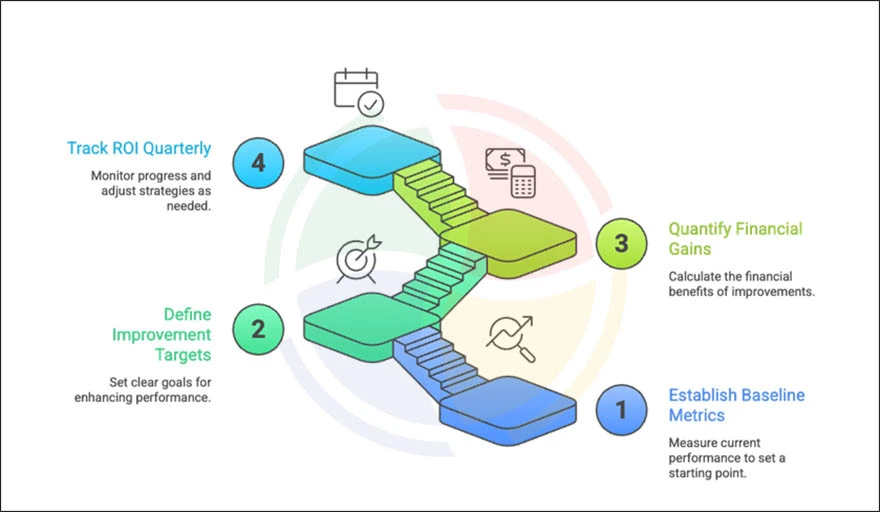
Step 1: Establish Baseline Metrics
Start by documenting your current operational performance. These metrics represent your pre-automation state and define the financial opportunity.
Current Ticket Volume: Measure total annual incidents and service requests across teams. Higher volume increases the financial impact of automation improvements.
Average Resolution Time: Track the mean time required to close tickets. Resolution time directly influences labor consumption and service capacity.
Cost per Ticket: Calculate the average labor and operational expense per transaction. This metric becomes the primary input for financial modeling.
SLA Compliance Rate: Document the percentage of tickets resolved within agreed timelines. SLA adherence shows service reliability and risk exposure.
Your baseline establishes the reference point for all future ROI calculations.
Capture at least three to six months of historical operational data before automation expansion. Reliable baseline metrics improve ROI accuracy and prevent inflated performance comparisons.
Step 2: Define Improvement Targets
Once the baseline is clear, define measurable performance improvement goals. Targets should align with your automation maturity and operational readiness.
Increase in Automation Coverage (%): Set a realistic percentage of workflows to automate. Higher coverage expands cost optimization potential.
Reduction in Resolution Time (%): Define expected efficiency gains from workflow standardization and automation. Time reduction translates directly into labor savings.
Decrease in Escalations or Rework (%): Estimate how automation will reduce repeated effort and cross-team dependencies. Fewer escalations lower operational overhead.
Clear targets convert technical initiatives into measurable performance commitments.
Step 3: Quantify Financial Gains
Translate performance improvements into monetary value. Operational efficiency only becomes ROI when expressed financially.
Labor Cost Savings: Multiply hours saved by the average labor cost per hour. This calculation produces a direct cost reduction.
Productivity Expansion: Measure increased ticket handling capacity without additional hiring. Capacity growth represents economic value even when headcount remains stable.
Avoided Hiring or Overtime Costs: Calculate how automation offsets projected workforce expansion or reduces overtime dependency. Avoided expense strengthens the net return.
Financial translation ensures that operational metrics align with executive reporting standards.
Step 4: Track ROI Quarterly
Institutionalize ROI measurement beyond the initial calculation. Sustained value requires continuous monitoring.
Align Dashboards with KPIs: Integrate operational metrics with financial indicators. Visibility ensures performance improvements remain measurable.
Monitor Automation and Adoption Growth: Track the expansion of automated workflows and user engagement levels. Increasing maturity compounds long-term ROI.
Present Quarterly Executive Summaries: Deliver defined financial and operational updates. Regular reporting reinforces accountability and strategic alignment.
Quarterly tracking transforms ROI from a static formula into an ongoing performance discipline.
Integrate ROI reporting into executive governance meetings. When automation performance appears alongside financial metrics, ServiceNow shifts from an IT platform to a strategic investment discussion.
Now Assist ROI: 3 Ways to Measure ServiceNow AI Returns
The AI-driven value requires a different measurement approach because impact depends on usage and behavioral adoption.
To calculate ServiceNow Now Assist ROI accurately, you must track how frequently it is used, how effectively it reduces effort, and how directly it influences ticket outcomes.
The following three models provide a structured approach:
1. Tracking AI Adoption
AI returns begin with usage. If teams do not actively use AI-generated suggestions, summaries, or knowledge prompts, financial gains remain theoretical.
You should measure adoption through clear engagement indicators:
Prompt Usage: Track how often agents invoke AI assistance during ticket handling. Higher prompt frequency typically correlates with greater time savings.
Knowledge Article Generation: Measure the number of AI-generated knowledge drafts created and published. Increased knowledge production improves self-service maturity and reduces repetitive effort.
Resolution Accuracy: Evaluate how often AI-assisted responses resolve cases without rework or escalation. Accuracy determines whether AI saves time or introduces correction overhead.
Adoption Rate Across Teams: Compare AI usage levels across departments. Uneven adoption often signals training gaps or workflow misalignment that may limit ROI realization.
Adoption metrics validate whether AI capability is actively influencing operations.
2. Time-to-Financial Conversion Model
Once usage is confirmed, translate time savings into monetary value. AI ROI becomes measurable when recovered time converts into cost reduction or capacity expansion.
Use the following calculation:
For example, if AI saves 5 minutes per ticket, supports 100,000 tickets annually, and the average labor cost is calculated per hour, you can annualize the financial impact with precision.
3. Ticket Deflection Model
AI-driven self-service and virtual assistance often reduce ticket volume entirely. Deflected tickets represent avoided operational cost rather than incremental efficiency.
Use the following formula:
If virtual agents or AI-generated knowledge prevent users from creating tickets, the organization avoids full resolution costs. This model captures AI value beyond agent productivity gains.
Ticket deflection becomes particularly powerful in high-volume service environments where marginal reductions scale rapidly.
AI ROI improves significantly when knowledge management maturity is high. Well-maintained knowledge bases increase resolution accuracy and amplify ticket deflection outcomes.
Mapping ServiceNow ROI to Enterprise Profitability
To make ServiceNow ROI meaningful at the enterprise level, you must connect operational performance to financial outcomes. When you translate efficiency into margin, revenue protection, and scalability, the value becomes clear.
The impact can be evaluated across the following dimensions:
Operating Margin Improvement
Operating margin improves when operational expenses are controlled without limiting output. Workflow automation reduces manual effort, minimizes escalations, and shortens resolution cycles, which collectively lower the total cost of service delivery.
As the cost per transaction declines and support functions operate more efficiently, operating expenditure grows at a slower rate than business activity. Over time, this efficiency directly contributes to stronger margin performance.
Improved asset utilization further strengthens this impact, as existing workforce capacity and technology investments are optimized rather than expanded prematurely.
Revenue Protection
Profitability is influenced by both cost control and revenue continuity. Service disruptions, prolonged incidents, and recurring system failures can directly affect productivity and customer experience.
Faster incident response and standardized resolution workflows reduce downtime and limit operational interruption. As reliability improves, internal teams maintain productivity, and customer-facing services remain stable.
Consistent service performance supports customer retention and contract renewals, ensuring that operational stability contributes to sustained revenue protection.
Scalability Without Linear Hiring
Business growth typically increases service demand, which can drive proportional headcount expansion if processes remain manual. Automation alters this equation by increasing output capacity without matching increases in staffing.
As workflow maturity advances, teams can manage higher ticket volumes while maintaining service levels. Productivity gains absorb incremental workload, allowing revenue to scale without equivalent growth in support costs.
Over time, the automation maturity curve reduces marginal service cost, strengthening contribution margin during expansion phases.
Risk and Compliance Value
Risk exposure carries measurable financial consequences, including audit penalties, regulatory fines, and reputational damage. Inconsistent workflows and weak oversight structures increase that exposure.
Standardized processes, automated approvals, and clear audit trails strengthen governance and reduce compliance gaps. As operational controls improve, the likelihood of financial penalties decreases.
Lower exposure cost may not immediately appear as direct savings, but it protects enterprise value and preserves long-term profit.
Common Mistakes That Distort Your ServiceNow ROI
Even strong implementations can reveal weak ROI if measurement discipline is flawed. The following mistakes commonly distort financial visibility:
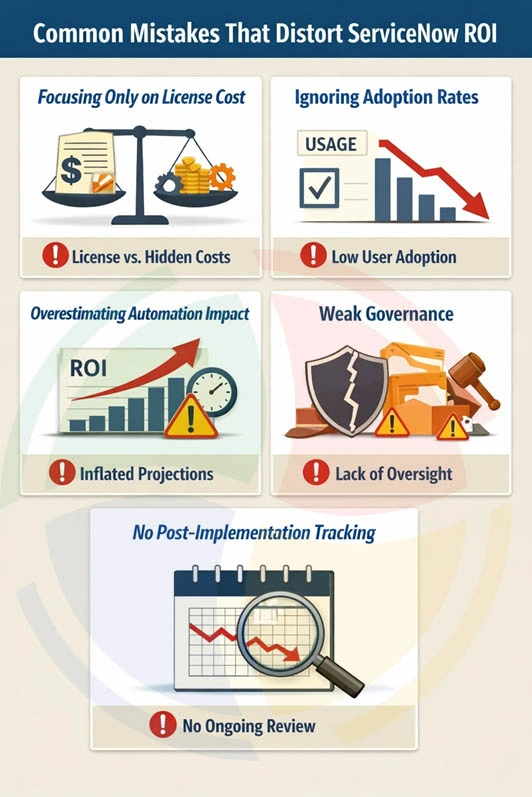
- Measuring only the license cost vs savings: Comparing savings only against subscription fees ignores implementation, integrations, administration, and governance costs, which skews the return calculation.
- Ignoring the adoption rate: If agents and teams do not consistently use workflows or AI features, projected efficiency gains will not translate into financial value.
- Overestimating automation impact: Assuming aggressive time savings or high automation coverage too early inflates ROI projections and reduces reporting credibility.
- Failing to include governance: Weak oversight increases technical debt, duplication, and maintenance effort, which gradually erode long-term returns.
- No post-implementation tracking: Calculating ROI once and not reviewing it quarterly prevents you from validating gains, correcting gaps, and expanding value over time.
Turn ServiceNow ROI Into a Long-Term Profit Strategy with Aegis Softtech
ServiceNow ROI determines how effectively automation, AI, and governance translate into enterprise profitability.
Defined measurement across baseline metrics, automation maturity, and AI adoption supports predictable returns. Quarterly validation reduces performance drift, and disciplined governance protects long-term value realization.
Our ServiceNow consulting and development services align workflow optimization with measurable financial outcomes and executive reporting. Hire our ServiceNow experts to strengthen automation maturity, expand AI-led efficiency, and institutionalize ROI tracking.
FAQ
Q1: How do you measure the ROI?
ROI is measured by subtracting total investment from net financial benefit, dividing by total investment, and multiplying by 100. In ServiceNow environments, you quantify cost savings, productivity gains, and avoided expenses against full platform cost.
Q2: What does a 24% ROI mean?
A 24% ROI means the return equals 24% of the total investment over a defined period. For example, a $1 million investment generating $240,000 in net benefit shows a 24% return.
Q3: What is ROI in ITSM?
ROI in ITSM indicates how service management improvements translate into financial value. It connects metrics such as resolution time, automation coverage, and SLA compliance to cost reduction, scalability, and risk control.
Q4: Are ROI and EBIT the same?
No, ROI and EBIT measure different financial dimensions. ROI evaluates investment efficiency, while EBIT (Earnings Before Interest and Taxes) measures overall operating profitability at the business level.