
For IT leaders, choosing between a cloud and on-premise data warehouse is a high-stakes decision boardroom-level decision. It’s not just about infrastructure. It’s about how quickly your business can generate insights, meet compliance obligations, and scale analytics without breaking budgets.
Every enterprise today relies on a data warehouse to power business intelligence, reporting, and decision-making. Without it, data stays siloed and strategy runs on guesswork.
But the real debate today is on-premise vs cloud data warehouse deployment models and which one better aligns with your organization’s needs.
Cloud-native platforms like Snowflake, BigQuery, and Redshift promise agility, near-infinite scalability, and flexible OpEx pricing. On the other side, on-premise solutions like Teradata or Oracle Exadata still dominate, where performance consistency, compliance control, and capital expenditure models are preferred.
If you’re evaluating these options, this guide will help you cut through the noise.
We’ll compare both approaches, outline their trade-offs, and also show how hybrid models are reshaping enterprise data strategies.
Key Takeaways
- Cloud vs On-Premise: A strategic decision that impacts cost, scalability, compliance, and long-term data strategy.
- Cloud warehouses: Offer elastic scaling, lower upfront costs, faster integrations, and pay-as-you-go flexibility.
- On-premise warehouses: Provide maximum control, predictable performance, tighter compliance, and long-term cost stability.
- Cloud: For variable, fast-growing, analytics-heavy workloads
- On-prem: Excels when governance, security, or latency are non-negotiable.
- Hybrid Data Warehouse Models: Balances cloud agility with on-premise control for complex enterprises.
Cloud vs On-Premise: Quick Comparison Chart
| Factor | Cloud Data Warehouse | On-Premise Data Warehouse |
| Cost | Subscription-based (OpEx). Lower upfront costs but ongoing usage fees. Scales with demand. | High upfront capital investment (CapEx). Lower long-term recurring costs if stable. |
| Scalability | Virtually unlimited scalability. Scale up/down instantly with workload needs. | Limited by hardware capacity. Scaling requires purchasing and installing new gear. |
| Security & Compliance | Cloud vendors offer strong security, encryption, and compliance certifications, but data residency laws may be a concern. | Greater control over data location and compliance. Strong for highly regulated industries. |
| Maintenance & Upgrades | Managed by provider. Automatic updates, patches, and performance tuning. | Requires in-house IT staff for monitoring, patching, and hardware/software upgrades. |
| Integration & Flexibility | Seamless integration with modern analytics, AI/ML, and cloud-native tools. Easy API connectivity. | Integration can be complex and slower. Limited flexibility with legacy systems. |
| Performance | High for distributed workloads, but dependent on internet/network connectivity. | Consistent low-latency performance, especially for local workloads. |
Cloud Data Warehouse: An Overview
A cloud data warehouse is a managed, cloud-native platform that centralizes enterprise data for analytics and Business Intelligence (BI) workloads. Unlike traditional setups, you don’t buy or maintain hardware. You rent elastic compute and storage from a provider, paying only for what you use.
The core traits of cloud data warehouses include:
- Elasticity: Instantly scale up or down as query loads fluctuate. No waiting on procurement cycles.
- Managed Service: The vendor handles infrastructure, updates, patching, and availability. Your team focuses on data and insights, not maintenance.
- OpEx Model: Instead of large capital expenditure (CapEx), costs flow as operating expenses (OpEx), scaling with usage.
Benefits of Cloud Data Warehouses
Here’s why enterprises are rapidly shifting toward cloud-native data platforms:
1. Scalability on Demand
Cloud warehouses scale compute and storage independently, letting you handle spikes without planning capacity months in advance. This can be the end-of-quarter reporting, seasonal traffic surges, or AI model workloads.
2. Lower Upfront & Operational Costs
No hardware purchases, no data center contracts, no costly upgrades. You pay only for consumption, giving finance teams predictable OpEx models and reducing wasted capacity.
3. Native Integration Ecosystem
Cloud data warehouses plug into the modern analytics stack effortlessly:
- BI tools: Tableau, Power BI, Looker
- AI/ML platforms: Databricks, SageMaker
- ETL/ELT tools: Fivetran, Matillion, Talend
- Cloud storage: S3, GCS, Azure Blob
This accelerates analytics development and removes the friction traditional systems face when connecting to cloud services.
4. Faster Performance Through Modern Architecture
Features like compute–storage separation, massively parallel processing (MPP), automatic query optimization, and caching layers deliver faster analytics without manual tuning.
5. High Availability & Global Reach
Cloud providers offer multi-zone and multi-region failover, automatic backups, and global replication. This means resilience without the cost and complexity of maintaining secondary data centers.
6. Accelerated Time to Insight
With no procurement cycles or installation overhead, teams can ingest data, build models, and launch dashboards in hours—not weeks or months.
7. Built-In Security & Compliance
Cloud warehouses provide encryption, IAM controls, audit logs, network isolation, and compliance certifications (SOC 2, HIPAA, GDPR, ISO). You get enterprise-grade protection without building it from scratch.
8. Future-Proofing for AI & Real-Time Use Cases
Cloud-native environments integrate easily with streaming pipelines, vector databases, LLM workflows, and real-time analytics tools—capabilities that are harder and more expensive to retrofit on-premise.
Cloud Data Warehouse Platform Examples
Some of the leading cloud data warehouse platforms include:
Snowflake: A cloud-native platform with fully managed compute–storage separation, elastic scaling, and strong data-sharing capabilities across teams and regions.
Amazon Redshift: AWS’s scalable, cost-efficient data warehouse service optimized for large analytical workloads and tight integration with the broader AWS ecosystem.
Google BigQuery: A serverless, highly elastic analytics warehouse designed for petabyte-scale queries with near-instant compute provisioning and built-in ML capabilities.
Microsoft Azure Synapse Analytics: A unified analytics platform blending data warehousing, big data processing, and integration pipelines. Ideal for enterprises already invested in Azure. If you’re evaluating your next data warehouse move, our data warehouse developers at Aegis Softtech can help accelerate your data modernization journey.
On-Premise Data Warehouse Explained
An on-premise data warehouse is a traditional deployment model where the organization owns and operates all the infrastructure—servers, storage, networking, and software—within its data center. Unlike cloud data warehouses, every component must be procured, configured, secured, and maintained internally.
Running an on-premise data warehouse typically requires:
- Hardware & Infrastructure: High-performance servers, dedicated storage systems, networking equipment, backup solutions, and physical facilities.
- IT Staff: Skilled DBAs, system administrators, and infrastructure engineers to manage monitoring, patching, optimization, upgrades, and incident response.
- CapEx Model: Large upfront capital investment for equipment, licenses, and data center resources, followed by ongoing maintenance, power, cooling, and support costs.
Benefits of On-Premise Data Warehouses
1. Maximum Control
With on-prem data warehousing, enterprises own every layer of the environment—hardware, security posture, access policies, network routing, and upgrade cycles. No abstraction, no dependency on a third-party provider.
2. Compliance Made Simpler
Healthcare, banking, insurance, government, and defense all deal with regulated or sensitive data. Keeping information physically on-site removes ambiguity around data residency and makes audits far easier to manage. You always know exactly where data lives, who touched it, and how it’s secured.
3. Predictable, Low-Latency Performance
On-prem systems run on dedicated resources, tuned for the workloads that matter, batch processing, analytical queries, overnight reporting. Because everything runs locally, performance is consistent and unaffected by internet connectivity or shared cloud infrastructure. For mission-critical operations, that reliability is a major advantage.
4. Deep Customization When You Need It
Unlike cloud platforms with standardized architectures, on-prem deployments can be shaped to the business. Hardware specs, storage tiers, network designs, and even security models can be fine-tuned for specific workloads or compliance obligations.
5. Long-Term Cost Stability
The upfront CapEx is real, but for predictable workloads, on-prem often wins on total cost of ownership. No surprise egress fees, no unpredictable consumption spikes, just steady, planned operating costs over time.
Example Platforms
Here are some of the most widely adopted on-premise data warehouse platforms trusted by large enterprises:
Teradata: A long-standing powerhouse built for extreme-scale analytics. Known for parallel processing, high throughput, and rock-solid reliability in complex enterprise environments.
Oracle Exadata: A tightly integrated hardware + database appliance engineered for ultra-fast OLTP and analytical workloads. Ideal for organizations that need predictable performance at scale.
Traditional Appliances: Legacy or custom-built data warehouse appliances that remain common in sectors where control, data locality, and deterministic performance matter more than elasticity.
On-Premise vs Cloud: Key Considerations Before You Decide
There’s no universal “better” option between cloud and on-premise data warehouses. The right fit depends on your organization’s size, workloads, compliance requirements, and future strategy. Before making the call, weigh these key factors:
1. Size and Maturity of the Organization
- Cloud: Ideal for startups and mid-sized enterprises that want agility without heavy capital investments.
- On-Premise: Large enterprises with established infrastructure may find it easier to justify and manage in-house systems.
2. Workload Predictability
- Stable workloads (e.g., financial reporting with steady demand) often benefit from on-prem, where predictable costs align with consistent performance.
- Variable or seasonal workloads (e.g., retail spikes, campaign-driven analytics) align better with cloud elasticity—pay more when usage peaks, scale back when idle.
3. Regulatory Environment
Industries bound by strict compliance (finance, government, defense, healthcare) may need the data residency guarantees and full control of on-premises. However, many cloud providers now offer compliance certifications (HIPAA, GDPR, FedRAMP), making them viable for regulated workloads if carefully managed.
4. IT Team Skillsets
- Cloud reduces the burden on in-house teams by outsourcing maintenance, upgrades, and tuning to the provider
- On-Prem demands a deep bench of skilled DBAs, system engineers, and network staff. Something not every IT department can sustain.
5. Future Growth and Hybrid Readiness
If your organization is preparing for AI, machine learning, or advanced analytics, cloud platforms offer faster integration with modern toolchains. On-premises can still play a role in handling sensitive workloads, but most enterprises benefit from preparing for a hybrid architecture that allows both models to coexist.
6. Scalability & Agility
- Cloud: Elastic by design. You can scale compute and storage independently, instantly, and without downtime. Ideal for organizations with unpredictable or fast-growing data volumes.
- On-Premise: Scaling is hardware-bound. Adding capacity means buying new servers, provisioning racks, and enduring long procurement cycles. Works best when workloads are stable and predictable.
7. Cost Models (CapEx vs OpEx)
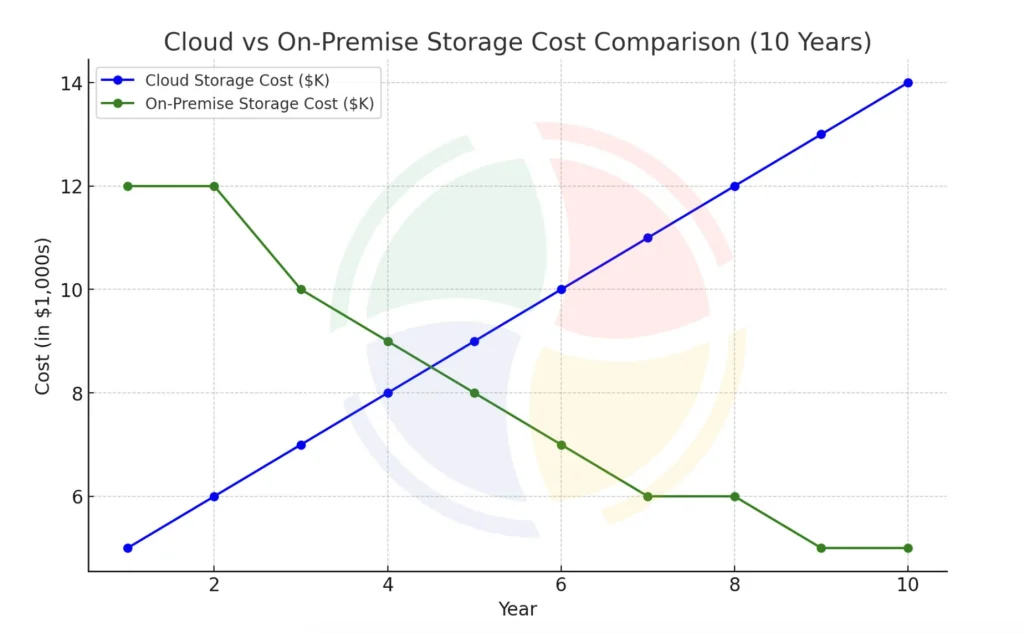
- Cloud: Operates on an OpEx (operating expense) model, pay for what you use. Lower upfront cost, but ongoing fees can rise quickly if workloads are heavy or poorly optimized.
- On-Premise: Requires significant CapEx (capital expenditure) upfront for hardware, software, and licenses. Long-term recurring costs may be lower if workloads are stable and capacity is fully utilized.
8. Control & Compliance
- Cloud: Vendors offer compliance certifications (GDPR, HIPAA, SOC 2), but ultimate data residency may depend on the provider’s region. Enterprises must ensure cloud terms align with industry regulations.
- On-Premise: Offers full control over where and how data is stored, encrypted, and accessed. Strong fit for industries with strict compliance mandates (finance, healthcare, defense).
9. Security & Data Residency
- Cloud: Providers deliver enterprise-grade encryption, role-based access, and intrusion detection—often stronger than in-house setups. The main concern is data sovereignty: some regions require sensitive data to stay within national borders.
- On-Premise: Physical control of servers ensures data never leaves your facilities. Security posture depends entirely on your IT team’s skills and investment.
10. Performance & Latency
- Cloud: Excellent for distributed workloads and global access, but performance is tied to internet connectivity. Network bottlenecks can affect latency-sensitive queries.
- On-Premise: Consistently low latency for local workloads, as data and compute reside in the same environment. Ideal for real-time applications that can’t risk network slowdowns.
Hybrid Approach: Best of Both Worlds?
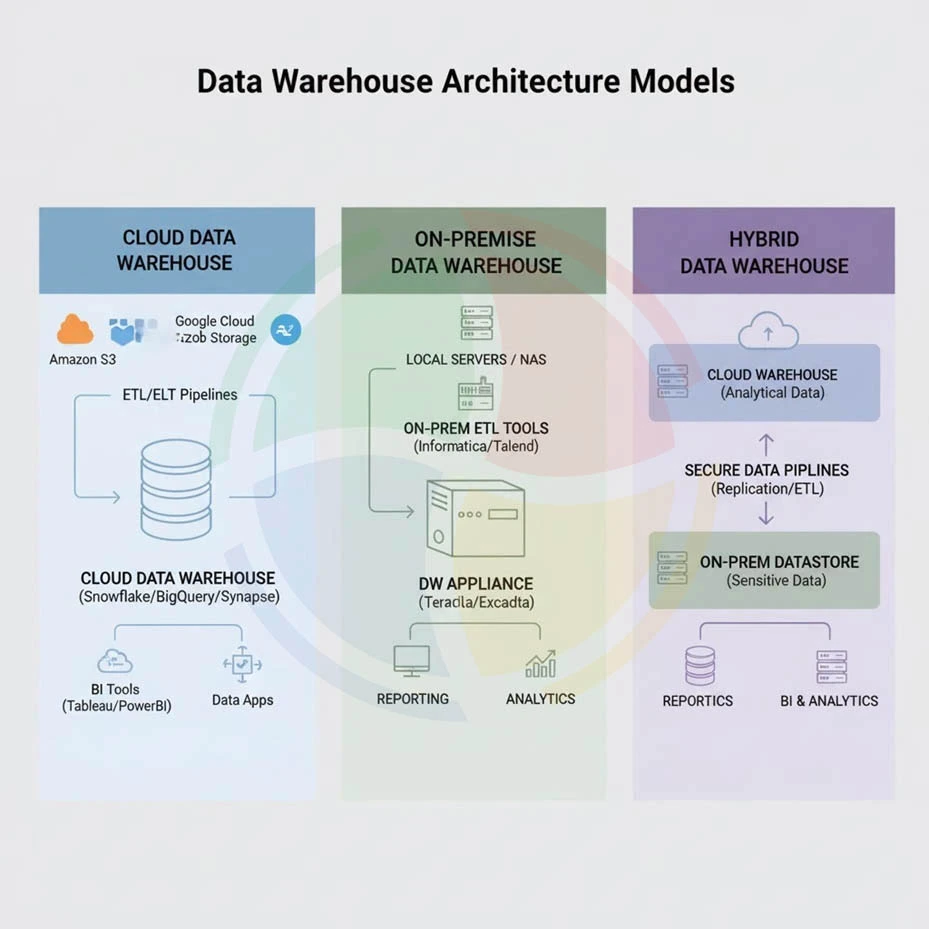
For many enterprises, the decision isn’t strictly cloud vs on-premise, it’s a blend of both. A hybrid data warehouse that combines the elasticity of the cloud with the control of on-prem systems, offering flexibility while mitigating risks.
What is a Hybrid Data Warehouse?
A hybrid data warehouse model lets organizations keep sensitive or regulated data on-premise while offloading less critical or high-volume workloads to the cloud. This setup enables companies to balance compliance needs with modern scalability.
In practice, the hybrid approach is often the “default” for large enterprises. Rarely is everything 100% cloud or 100% on-prem. Instead, IT leaders mix both to optimize performance, cost, and compliance.
Key Advantages of Hybrid Warehousing
- Scalability without full data warehouse migration: Offload analytics bursts or seasonal workloads to the cloud without overprovisioning hardware on-premise.
- Regulatory alignment: Sensitive datasets remain on-site, ensuring compliance, while non-sensitive workloads benefit from cloud agility.
- Business continuity: Cloud can serve as a backup or disaster recovery environment for on-prem systems, reducing downtime risks.
Common Use Cases
- Gradual Migration: Enterprises can transition to the cloud step by step, starting with analytics or BI while maintaining core systems on-prem.
- Sensitive Data Compliance: Healthcare or finance firms keep critical records in-house but analyze anonymized datasets in the cloud.
- Disaster Recovery: On-prem warehouses replicate to the cloud for resilience, ensuring operations continue during outages or hardware failures.
So, What’s the Right Choice for You?
When it comes to cloud vs on-premise data warehouses, the right choice depends on your organization’s scale, compliance obligations, workload patterns, and long-term data strategy.
- Cloud warehouses excel in flexibility, scalability, and speed of deployment. They’re a natural fit for organizations that want to modernize their data warehouse quickly and integrate seamlessly with AI, ML, and cloud-native analytics.
- On-premise warehouses remain strong for enterprises that need complete control, strict data residency, and predictable local performance.
- Hybrid models often provide the best balance. It allows IT leaders to tap into the agility of the cloud while retaining the assurance of on-premise control for sensitive workloads.
Think of this decision as less about choosing one and more about choosing the right mix. Many organizations start with a phased approach. Moving certain workloads to the cloud while maintaining mission-critical systems on-premise, then evolving toward a hybrid model as needs mature.
At Aegis Softtech, we help enterprises assess their current data landscape and plan future workload architectures with our data warehouse services.
We implement on-premise, hybrid, and cloud data warehouse solutions that balance cost, control, and performance for industry-specific needs.
FAQs
1. What is the difference between a cloud data center and an on-premises data center?
A cloud data center is hosted by third-party providers like AWS, Azure, or Google Cloud, offering elastic capacity and managed services. An on-premises data center is owned and operated by the organization, requiring in-house hardware, maintenance, and staff.
2. Is on-prem faster than cloud?
On-premise systems usually deliver lower latency for local workloads since data doesn’t travel over the internet. Cloud warehouses can match or exceed performance for distributed workloads, but speed depends on network connectivity.
3. Which is more secure, on-premise or cloud?
Security depends on implementation. On-premise gives full control over data, access, and policies. Cloud vendors invest heavily in advanced encryption and compliance certifications, but data residency and shared responsibility must be managed carefully.
4. What is the difference between ETL in cloud and on-premise?
Cloud ETL tools are scalable, managed, and integrate easily with cloud-native services. On-premise ETL runs on local infrastructure, offering control but less flexibility for handling large or variable data volumes.