
Large Language Models (LLMs) are revolutionizing the way that businesses automate their processes, enhance their customers’ experience, and extract value from their own internal data. An efficient design for an LLM integration architecture links language models with enterprise applications, data, security, and operational processes.
The typical time needed for LLM integration projects ranges from 8 to 24 weeks, while costs can vary from $25,000 for pilots up to $500,000+ for enterprise-scale implementations. The organizations that implement scalable architecture achieve increased efficiency, quicker decision-making, and operational savings.
This guide outlines the architecture, deployment approaches, cost, timeline, and vendor evaluation considerations that enterprise customers need to be aware of before implementing their LLM project.
What Is LLM Integration Architecture?
The architecture for LLM integration refers to the way through which Large Language Models can be integrated with business applications, data sources, processes, and security frameworks. Organizations use AI Integration Services to integrate artificial intelligence with business applications without compromising on security and scalability concerns.
The architecture ensures that the AI solution can have access to business information, provide correct output, comply with regulations, and be scalable across the organization. Without an appropriate architecture, businesses may end up having incorrect output, security issues, increasing operational costs, and unsuccessful AI projects.
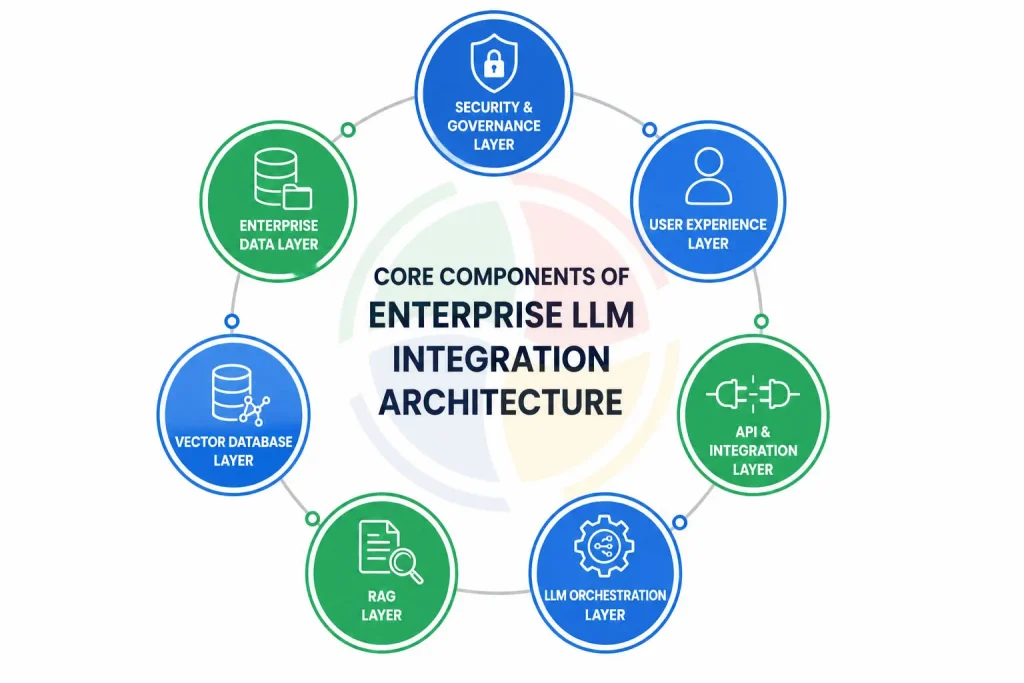
Core Components of Enterprise LLM Integration Architecture
A successful architecture consists of multiple interconnected layers. The user interface determines how employees and customers interact with AI-powered systems.
1. User Experience Layer
The user interface determines how employees and customers interact with AI-powered systems. Chatbots also depend on a chat API to handle real-time message delivery and history. This layer includes:
- Customer portals
- Employee applications
- Internal knowledge assistants
- Mobile applications
- Enterprise chatbots
- Workflow automation tools
2. API and Integration Layer
The integration layer is used as the communication channel for business systems and AI services. The integration layer allows the use of AI in existing workflows and not as a standalone solution.
Generative AI Integration Services can be used to integrate large language models with CRM, ERP, and other key business applications for workflow automation. Some popular integrations include:
- CRM platforms
- ERP systems
- HR software
- Customer support systems
- Document management platforms
- Business intelligence tools
3. LLM Orchestration Layer
The orchestration layer serves as the command center for AI activities. More companies are turning to orchestration systems for managing several AI models at once. Responsibilities include:
- Model routing
- Prompt management
- Context injection
- Response validation
- Multi-model coordination
- Workflow automation
Orchestration is now possible even at the data layer through platforms like Snowflake Intelligence that enable enterprises to create and manage their AI workflows at the data layer itself without requiring additional orchestration tools.
4. Retrieval-Augmented Generation (RAG) Layer
One of the key architectural elements is Retrieval-Augmented Generation. It greatly enhances precision and minimizes errors. RAG does not depend on pre-existing knowledge only; rather, it enables LLMs to search for data from:
- Internal documents
- Knowledge bases
- Policies
- Product catalogs
- Research repositories
- Operational systems
Example Use Cases
For most enterprise deployments, RAG is considered a foundational architectural requirement. Here are a few use cases of RAG:
- Enterprise search
- Customer support
- Policy assistance
- Contract analysis
- Compliance reviews
5. Vector Database Layer
Vector databases store embeddings that help AI systems understand semantic relationships between pieces of information. Popular enterprise options include:
- Pinecone
- Weaviate
- Chroma
- Snowflake Cortex Search
- PostgreSQL with pgvector
Role of Vector Databases
Without this layer, enterprises struggle to provide context-aware AI experiences. They enable:
- Semantic search
- Context retrieval
- Knowledge discovery
- Personalized responses
6. Enterprise Data Layer
The quality of AI outputs depends directly on the quality of business data. Organizations often discover that data preparation is one of the largest contributors to project timelines.
Common enterprise sources include:
- Data warehouses
- Data lakes
- CRM databases
- ERP systems
- SharePoint repositories
- Cloud storage platforms
For organizations, Snowflake Cortex AI enables LLMs to query and reason over warehouse data natively, reducing pipeline complexity and keeping sensitive data within a governed environment.
7. Security and Governance Layer
Security remains the top concern for enterprise AI initiatives. Industries such as healthcare, banking, and insurance often require additional governance frameworks before deployment.
A robust architecture should include:
- Role-based access control
- Data masking
- Encryption
- Audit logging
- Prompt security controls
- Model governance
- Compliance monitoring
Reference Enterprise LLM Architecture
An effective enterprise architecture for LLM does not consist of a single piece of software; rather, it is a structured set of layers, where each layer serves its own purpose. This architectural design depicts how top companies set up their LLM in order to make it scalable, secure, and sustainable. It is vital to carefully consider and design each of these layers in order to avoid any gaps, which can create bottlenecks, security issues, or low-quality modeling.
LLM Provider Comparison
Not all LLM service providers are suitable for enterprise-level use cases. There can be significant differences in terms of security position, data location, customizability, and interoperability with cloud ecosystems among different providers. Below is the table comparing leading providers based on relevant factors.
| Provider | Enterprise Readiness | Security | Cost | Customization |
| OpenAI | High | High | Medium | Medium |
| Azure OpenAI | Very High | Very High | Medium | High |
| Anthropic Claude | High | High | Medium | Medium |
| Google Gemini | High | High | Medium | Medium |
| Open Source Models | Variable | Depends on deployment | Low to Medium | Very High |
Which LLM Provider Is Best for Enterprise Use?
Most enterprise buyers evaluate multiple models during the proof-of-concept phase rather than committing immediately.
The best provider depends on:
- Compliance requirements
- Existing cloud investments
- Data residency requirements
- Customization needs
- Budget constraints
LLM Integration Cost Estimates
| Project Type | Estimated Cost Range |
| Proof of Concept | $25,000 – $75,000 |
| Department-Level Deployment | $75,000 – $250,000 |
| Enterprise Rollout | $250,000 – $1M+ |
Key Cost Drivers of LLM Integration Projects
Organizations should evaluate the total cost of ownership rather than model pricing alone.
- Data preparation
- Integration complexity
- Security requirements
- Number of users
- Model consumption costs
- Ongoing support
LLM Implementation Timeline
Most enterprise implementations require between 2 and 6 months before full production rollout. Here are the phases of LLM implementation with the duration.
| Phase | Duration |
| Discovery & Assessment | 1–2 Weeks |
| Architecture Design | 2–4 Weeks |
| Integration Development | 4–12 Weeks |
| Testing & Validation | 2–4 Weeks |
| Deployment | 1–2 Weeks |
| Optimization | Ongoing |
How to Choose an LLM Integration Partner?
LLM integration partner selection involves much more than technical expertise alone. Your choice of a partner can affect not only your speed of deployment but also the security of your data and the scalability of the solution as your requirements change.
Vendor Evaluation Checklist
Evaluate providers based on:
✓ AI architecture expertise
✓ Data engineering capabilities
✓ Cloud platform certifications
✓ Security and compliance experience
✓ Integration experience
✓ Industry-specific knowledge
✓ Long-term support capabilities
✓ Proven AI implementation track record
The best-fitting providers offer AI development, data engineering, cloud architecture, and enterprise integration as an integrated stack, thus saving you time on coordinating work with multiple specialized partners.
Companies providing Generative AI Development Services are capable of assisting businesses in developing custom AI apps, fine-tuning models, and deploying solutions for their needs.
Conclusion
AI success in enterprise depends on architecture more than anything else. Enterprises that develop secure, scalable, and well-governed LLM integration architectures are more likely to realize business results from their investments while keeping the risks low. Before choosing a model or a platform, enterprises need to assess their requirements for integration, data readiness, governance, and partnerships for successful ROI realization.
Frequently Asked Questions
How much does LLM integration cost?
The cost varies between $25,000 and more than $1 million for enterprise-level projects based on the project scope, complexity, and regulatory needs.
Is Retrieval-Augmented Generation required?
For most enterprise applications, it is recommended as it increases accuracy, provides access to internal databases, and avoids hallucinations.
Can LLMs integrate with legacy systems?
Yes, since modern integration approaches employ APIs, middleware, and data connectors to join artificial intelligence to legacy systems.
What kind of ROI should enterprises expect?
Organizations commonly measure ROI through productivity gains, reduced support costs, improved decision-making speed, and process automation efficiencies.