

Why do some ServiceNow deployments complete on schedule while others stretch for months?
Enterprises implement ServiceNow to modernize workflows, automate service operations, and improve visibility across IT and business functions.
However, timelines often become difficult to predict once implementation begins!
ServiceNow implementation timeline can range from three months for a focused module rollout to more than twelve months for a large enterprise transformation.
The difference usually comes down to scope, integrations, CMDB readiness, and your organization’s preparedness for process change.
For IT leaders planning a rollout, a clear view of the implementation phases makes it easier to set expectations and keep delivery on track.
In this guide, we will discuss structured ServiceNow implementation, including phases, modules, and governance, reduce delays, and deliver measurable enterprise value.
Key Takeaways
ServiceNow implementation timeline: Enterprise deployments typically range from 3 months to 12+ months, depending on scope, integrations, CMDB readiness, and process maturity.
6-phase implementation model: Discovery, design, build, testing, deployment, and stabilization guide the platform from planning to steady operations.
Module timelines: ITSM, CMDB, HRSD, CSM, and asset management modules vary in rollout duration based on configuration complexity and integrations.
Timeline drivers: Customization scope, data quality, governance speed, integration landscape, and user adoption significantly affect delivery timelines.
Enterprise rollout strategy: Phased expansion, strong governance, and a scalable roadmap help maintain platform stability while extending ServiceNow capabilities.
ServiceNow Implementation Timeline: 6-Phase Process
ServiceNow implementation follows six structured phases that guide the platform from discovery to post-deployment stabilization. Each phase addresses a specific stage of planning, configuration, validation, and operational readiness.
This six-phase approach is commonly used for enterprise deployments, where multiple modules, integrations, and workflows require coordinated planning and governance.
If you require a smaller deployment, it may be completed within a few months using a condensed version of the same approach.
The following six-phase model provides a structured path for scaling ServiceNow from initial deployment to stable platform operations:
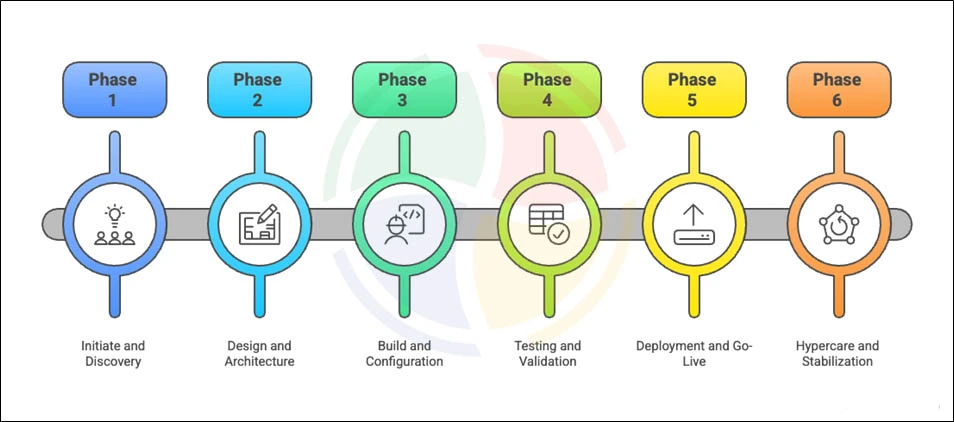
Phase 1: Initiate and Discovery (4 to 6 weeks)
The implementation begins with a discovery phase that defines the scope, priorities, and operational objectives for the platform rollout. Teams evaluate how ServiceNow will support existing service delivery models and identify improvement opportunities.
Implementation teams engage process owners and operational stakeholders to document service workflows, escalation paths, and ownership structures. The stage also clarifies which processes will be standardized, automated, or redesigned.
You receive a clear implementation roadmap that aligns with priorities, identifies early dependencies, and confirms the modules and capabilities to be delivered in the initial rollout.
By the end of discovery, stakeholders have a shared understanding of the implementation goals, scope boundaries, and delivery priorities.
Phase 2: Design and Architecture (5 to 12 weeks)
Once the implementation scope is defined, the focus shifts to designing how the platform will operate within your organization’s technology landscape.
Architects convert business requirements into platform structures that define workflows, data relationships, and operational controls. These decisions shape how requests flow through the system, how services are organized, and how automation rules will function.
The design phase also establishes governance standards that guide configuration and future platform expansion.
At this stage, you will have the architectural foundation finalized.
Phase 3: Build and Configuration (8 to 16 weeks)
During the configuration phase, teams configure workflows, integrations, and automation logic in ServiceNow.
Implementation teams translate architectural designs into functional workflows, automation logic, and service catalog structures.
Most organizations rely on agile sprint cycles, allowing teams to configure functionality incrementally while validating progress with stakeholders.
This phase focuses on maintaining platform simplicity while delivering value from automation.
Phase 4: Testing and Validation (4 to 5 weeks)
Moving on, testing ensures the configured platform performs reliably in real operational scenarios. This phase validates the technical behavior of workflows and the platform usability for service teams.
Professional ServiceNow experts execute structured testing cycles to confirm that automation rules, approval paths, and integrations perform as expected.
Operational teams also participate in validation exercises to confirm that your platform supports day-to-day service activities.
The testing cycles help address configuration gaps and ensure operational readiness before going into production.
Phase 5: Deployment and Go-Live (1 to 2 weeks)
In the deployment phase, the focus shifts from testing to full production rollout, ensuring the organization is ready to operate on the new ServiceNow platform.
The production cutover plan is executed, moving workflows, configurations, and data into the live environment while minimizing disruption to ongoing operations.
During this phase, users receive training through workshops, documentation, and guided sessions to help them adopt the platform.
Early monitoring helps you identify and resolve immediate issues, allowing teams to fine-tune performance and ensure stability.
By the end of this phase, ServiceNow becomes your primary platform for all service delivery processes.
Phase 6: Hypercare and Stabilization (Continuous)
Implementation isn’t all about deployment. The robust ServiceNow platform requires proper stabilization after go-live. Your teams have ample time to adapt to the new environment.
Implementation experts monitor the platform closely to resolve early issues, refine workflows, and support user adoption.
This phase also establishes the operational routines that will support the platform long term.
Once the stabilization phase is complete, the ServiceNow platform moves into steady-state operations and becomes ready for future expansion across additional services.
Partnering with experienced ServiceNow development services can accelerate setup while maintaining platform best practices.
Timeline Shifts Due to Platform Scope and Capabilities
The six phases outlined earlier mention how a ServiceNow implementation progresses. However, the actual timeline depends on the rollout scope and the capabilities included in the deployment.
Most organizations begin with a limited set of workflows and gradually expand the platform as adoption increases.
As the scope expands, additional configurations, integrations, and data management requirements increase implementation effort.
Here are the parameters that push the implementation timeline to shift:
Core ServiceNow Product Modules
Several enterprise workflow products are implemented during ServiceNow rollouts. Each module often combines with additional workflows, integrations, and operational processes, affecting the rollout span.
IT Service Management (ITSM): 3 to 6 months
IT Service Management is frequently the starting point for many ServiceNow implementations. It introduces defined workflows for incident management, request fulfillment, change management, and problem management.
Even when organizations rely on out-of-the-box processes, teams still need to configure service catalogs, approval structures, and operational workflows, which adds to implementation effort.
HR Service Delivery (HRSD): 2 to 4 months
HR Service Delivery extends the platform to employee services, such as onboarding, HR case management, and employee requests.
Implementing HR workflows requires integration with HR information systems and coordination with employee data sources, which adds planning and configuration steps during deployment.
Customer Service Management (CSM): 3 to 7 months
Customer Service Management enables you to manage customer cases, service requests, and support interactions through digital workflows. Implementations involve designing customer service processes and integrating the platform with CRM or external support systems.
Software Asset Management and Hardware Asset Management: 3 to 4 months
Asset management products help track software licenses, hardware devices, and asset lifecycles across the enterprise. Deployments usually involve consolidating asset inventories, normalizing license data, and aligning procurement records with operational systems.
Platform Capabilities
In addition to product modules, ServiceNow’s core capabilities support infrastructure visibility and service management operations. These capabilities influence implementation complexity due to data modeling, discovery processes, and governance requirements.
Here are the major ones that affect the timeline:
Configuration Management Database (CMDB): 2 to 4 months
The ServiceNow CMDB is a central repository for configuration items, such as applications, servers, and infrastructure components, along with their relationships. Establishing accurate configuration models typically requires defining data structures, ownership models, and governance practices.
ServiceNow Discovery: 1.5 to 2 months
ServiceNow Discovery automatically scans infrastructure environments to identify devices, applications, and services, and then populates configuration data into the CMDB. Implementing discovery requires configuring credentials, establishing network access, and validating discovered assets to maintain accurate infrastructure visibility.
Partner with experts to reduce risks and scale your platform with confidence.
ServiceNow Implementation Best Practices
Rolling out ServiceNow successfully requires clear governance, defined workstreams, and strong organizational readiness.
Many enterprises face delays or adoption challenges because governance isn’t clear, workstreams aren’t defined, or teams aren’t fully prepared for change.
Following best practices of ServiceNow implementation helps reduce risk and maintain consistent delivery.
Read on for the breakdown:
Align Implementation With Business Goals
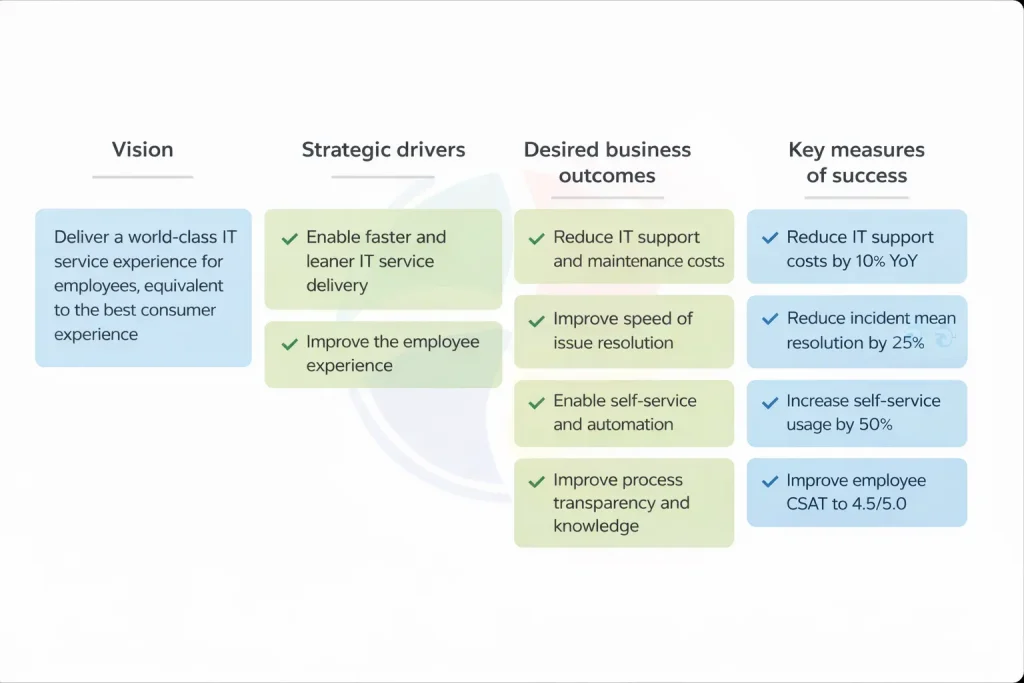
Before you get into configurations, integrations, or module selection, clarify what ServiceNow should achieve for your organization. It ensures priorities, scope, and success metrics are clearly defined.
- Define measurable outcomes by setting targets, such as reducing incident resolution time, improving visibility into IT assets, automating repetitive HR tasks, or enhancing customer service experiences
- Build a business case that identifies key challenges and improvement opportunities, so implementation activities align with business priorities
- Prioritize capabilities that deliver the most impact by focusing on modules and workflows that provide early operational improvements
- Tie every phase to business objectives by aligning tasks and configurations from Discovery through Hypercare with defined outcomes
- Capture quick-win opportunities to encourage early adoption and stakeholder confidence
- Regularly revisit your service strategy to adjust priorities as business requirements evolve
- Establish KPIs and metrics upfront to track usage, performance, and value delivered from each ServiceNow capability
Establish Governance and Organizational Readiness
Effective governance ensures decisions are made quickly, responsibilities are clear, and the implementation maintains consistent progress across teams.
Strong oversight helps reduce delays and maintain alignment with project objectives:
- Engage an executive sponsor who provides strategic guidance and can resolve organizational barriers
- Define roles and responsibilities clearly across architecture, configuration, integrations, and change approvals to ensure accountability across teams
- Establish a structured governance cadence with steering committees or review boards to approve complex decisions and manage cross-functional dependencies
- Use a RACI framework to clarify who is responsible, accountable, consulted, and informed for each task, ensuring accountability and faster decision-making
- Use experienced and certified ServiceNow resources to guide planning, estimate timelines, and identify potential risks early
- Implement progress tracking and regular reviews to monitor risks, maintain alignment with priorities, and track implementation progress
Build Strong Foundations
Laying a strong foundation early helps ensure platform stability and long-term scalability.
- Define your configuration items and relationships upfront to maintain accurate infrastructure visibility
- Determine architectural models and integration strategies before starting configuration to avoid rework during testing or deployment
- Use standard ServiceNow features wherever possible to reduce complexity, shorten testing cycles, and simplify future upgrades
- Only customize workflows or create new applications when required for specific business needs
By investing in foundational planning, organizations can reduce risk and simplify future platform expansion.
Manage User Adoption Effectively
Even the best-implemented platform fails if users don’t adopt it. Organizational change management (OCM) ensures teams are ready, confident, and capable from day one.
- Develop a training plan that addresses all user groups and operational teams
- Communicate the purpose, benefits, and expected workflows to end-users in advance
- Include adoption checkpoints during every implementation phase to track readiness
- Offer ongoing ServiceNow support and feedback channels during Hypercare to resolve issues and reinforce adoption
Effective OCM helps reduce post-go-live disruption and improve platform adoption.
Leverage Workstreams for Predictable Delivery
ServiceNow’s Now Create organizes implementation into structured workstreams that run across all phases. These workstreams help maintain clarity and accountability.
Here’s how:
- Value Management & Analytics helps you track progress against business objectives and measure ROI
- Project & Program Management allows you to maintain visibility on schedules, resources, and risks
- Architecture & Technical Governance ensures consistent design, integration, and data standards
- Design, Build & Unit Testing enables you to configure workflows and validate functionality incrementally
- Testing & Validation confirms technical reliability and operational readiness
- Organizational Change Management drives adoption, communication, and training
- Support & Transition oversees Hypercare, stabilization, and the transition to steady-state operations
For expert support in planning and executing your ServiceNow rollout, explore our ServiceNow consulting services. We support you in streamlining implementation and improving delivery outcomes.
Reduce Risk and Avoid Timeline Delays
Even with a structured implementation plan, ServiceNow programs face delays if execution is not managed carefully. Issues related to scope, decision-making, or data ownership quickly impact sprint schedules and rollout timelines.
Below are a few ways to maintain delivery momentum and reduce implementation risk:
- Control customization scope: Limit unnecessary customization and rely on platform capabilities where possible. It helps reduce configuration complexity and shortens testing cycles.
- Define clear milestones: Break the implementation into clear checkpoints to track progress and resolve issues early.
- Maintain sprint cadence: Consistent sprint planning and backlog clarity sustain steady delivery throughout the build phase.
- Escalate decisions quickly: Timely decisions around workflows, integrations, and architecture prevent development blockers from slowing implementation progress.
- Assign configuration data ownership: Clear ownership ensures configuration data remains accurate and usable as the platform evolves.
- Deliver incremental value: Releasing capabilities in stages allows your teams to validate workflows early and refine the platform as adoption grows.
Gain Long-Term Value from ServiceNow Implementation with Aegis Softtech
A ServiceNow implementation timeline shapes how effectively the platform supports your service operations, automation initiatives, and long-term transformation goals.
When planning and governance are aligned, each implementation phase builds toward a stable and scalable platform foundation.
By planning your roadmap carefully and introducing new workflows at the right pace, you can turn ServiceNow into a long-term engine for service efficiency and innovation.
Our ServiceNow developers help you plan scalable rollouts, optimize platform architecture, and accelerate enterprise adoption.
FAQ
How long does it take to implement ServiceNow?
Most organizations implement ServiceNow within 3 to 6 months, depending on scope, integrations, and workflow complexity. If you start with core ITSM modules and phased rollout, you can go live faster and expand capabilities later.
What is P1, P2, P3, P4 in ServiceNow?
These are incident priority levels used to classify urgency and business impact. P1 indicates a critical outage requiring immediate resolution, while P2–P4 represent decreasing levels of urgency that allow progressively longer response and resolution times.
What is the implementation schedule and timeline?
ServiceNow implementation timelines typically range from 3 to 8+ months for an initial deployment, depending on the number of modules, integrations, and customization involved. The timeline can extend if multiple products, complex workflows, or large-scale data integrations are included.
Which is bigger, SAP or ServiceNow?
In overall enterprise software scale and revenue, SAP is larger because it covers ERP, finance, supply chain, and more. However, ServiceNow leads specifically in digital workflow and IT service management platforms, where its specialization gives it strong market influence.