
What if one unified platform could automate workflows across IT, HR, customer service, security, and business operations?
No more forcing teams to juggle disconnected tools.
Fragmented systems, manual processes, and inconsistent data limit productivity and complicate innovative procedures.
ServiceNow Now Platform centralizes workflows, data, and automation into a single, scalable ecosystem that drives operational clarity and efficiency.
In this guide, you will understand its architecture, core features, deployment considerations, and the value it creates for enterprises. You’ll also learn where the Now Platform fits into your digital strategy and how implementation partners like Aegis Softtech help organizations achieve the desired ROI.
Key Takeaways
- The ServiceNow Now Platform eliminates fragmented tools, streamlines enterprise workflows, and introduces AI-driven automation across IT, HR, customer service, security, and operations.
- Core reasons to choose ServiceNow: Replace siloed processes, standardize service delivery, enable self-service, improve governance, and consolidate data into a single system of action.
- Readiness signals: Teams rely on manual approvals, SLAs vary across departments, data sits in multiple tools, workflows lack visibility, and leadership demands enterprise-wide automation.
- Enterprise priorities: Strengthen workflow governance, improve cross-functional visibility, unify processes on a single data model, enhance service consistency, and scale automation without technical sprawl.
- Outcome & value: Reduced operational costs, faster resolution times, lower manual effort, improved compliance, and better forecasting.
What is the ServiceNow Now Platform?
It is an enterprise cloud foundation designed to streamline, automate, and optimize workflows across the entire organization.
The platform started as a focused IT service management solution but quickly evolved into a comprehensive ecosystem for enterprise automation. With architectural expansion, the Now Platform supported cross-department workflows, low-code development, AI-driven decisions, and large-scale digital operations.
Over the years, it expanded into a secure and highly scalable cloud environment that empowers organizations to modernize services, unify processes, and deliver consistent employee and customer experiences.
Why Modern Enterprises Rely on It
Modern enterprises rely on the Now Platform for scalability and AI automation with its cloud architecture, apart from its unifying capabilities.
It eliminates repetitive work and accelerates service delivery. The platform’s low-code and no-code tools allow faster app development with minimal engineering cycles.
You will understand this better by learning about the features and architecture. Keep reading.
ServiceNow Now Platform Features
The ServiceNow Now Platform is a connected, scalable foundation to modernize operations across IT, HR, customer workflows, and enterprise functions.
Below are the core features that shape how the platform delivers speed, intelligence, and consistency across your business:
Low-Code and No-Code Development
You can build enterprise-grade workflows and applications without depending heavily on engineering teams. With tools like App Engine Studio, you design forms, automation logic, business rules, and service experiences using intuitive visual tools.
This helps you:
- Launch new applications faster
- Reduce backlog and IT dependency
- Empower business users to build what they need
- Deliver solutions that mirror your real processes
Unified Data Model
The platform runs on a single, integrated data architecture, ensuring every module and application has a single source of truth. It eliminates inconsistencies that come from scattered systems.
This gives you:
- Accurate, reliable reporting
- Easier and cleaner integrations
- Reduced data duplication
- Streamlined compliance reporting
Workflow and Process Automation
You can automate end-to-end workflows across IT, HR, customer service, operations, and more. Tools like Flow Designer, orchestration engines, and Playbooks help you design automation at scale.
You gain:
- Predictable and repeatable process outcomes
- Fewer manual steps and reduced errors
- Better SLAs and faster resolutions
- Consistent operational standards
Now Assist and AI-Powered Capabilities
With Now Assist, the platform brings generative AI and predictive intelligence into your daily operations. It understands your tasks, data, and context, giving your teams personalized, real-time support.
AI helps you with:
- Conversational self-service for employees
- Automated case summarization
- Intent-based ticket routing
- Automated request fulfillment
- Predictive insights to reduce issues before escalation
Platform Security and Governance
Strong cloud protection for governance and security is built into the platform’s multi-instance architecture. You get granular control over access, data protection, and regulatory compliance
Security capabilities include:
- Role-based access control
- Audit logs and forensic trails
- Field-level data segmentation
- Enforcement of security and compliance policies
- Encryption and secure instance isolation
ServiceNow Now Platform Architecture Explained
Instead of behaving like a typical SaaS tool, ServiceNow is built like an extensible enterprise platform that adapts to your scale, security needs, and integration strategy.
Here are the architectural elements that make the platform resilient and secure:
Multi-Instance Cloud Architecture
ServiceNow operates on a true multi-instance architecture, meaning you have an independent, isolated application layer, database, and security boundary. Unlike shared SaaS models, where resources are pooled across tenants, ServiceNow gives each customer a fully independent environment.
This gives you critical advantages, such as:
- Performance isolation: Another customer’s workload never affects your instance.
- Stronger security boundaries: Your data, logs, and encryption keys remain segmented.
- Controlled upgrades: You decide upgrade timing and manage customizations safely.
- Compliance readiness: Easier to align with industry or regional regulations.
Data Architecture & CMDB Backbone
At the center of the platform is the Configuration Management Database (CMDB), a structured system that stores all your assets, services, and their relationships. For any enterprise, the CMDB becomes the backbone that powers intelligent automation and reliable operations.
A strong CMDB enables:
- Accurate incident routing: Tickets automatically reach the right team.
- Root-cause analysis: Teams understand upstream and downstream dependencies.
- Dependency mapping: Visual relationships between services, apps, and infrastructure.
- Change impact prediction: Identify risk before executing a change.
Application Layer and Extensibility
The platform allows you to build and extend applications in ways traditional SaaS products cannot. You can create custom apps, enhance existing ServiceNow solutions, or implement domain-separated structures for complex business units or managed services.
This extensibility gives you:
- Apps tailored to your unique workflows: Build applications that meet your specific business needs.
- Separate data structures for different business units: Maintain isolated configurations for multiple departments or divisions.
- Extended ITSM, HRSD, CSM, and other modules: Enhance existing modules without affecting core functionality.
- Reusability of platform services: Use AI, workflow engine, and security controls across all custom and standard apps.
Integration Hub and Connectivity
ServiceNow’s Integration Hub acts as a centralized orchestration layer for your enterprise ecosystem. With prebuilt spokes for SAP, Workday, Azure, AWS, Salesforce, Jira, and more, you eliminate manual integrations and reduce dependency on middleware tools.
Integration hub supports:
- API-based connectivity: Enables real-time data exchange between ServiceNow and external systems.
- Event-driven triggers: Automate actions based on specific events in connected applications.
- Secure file transfers: Moves files across systems with encryption and compliance controls.
- Data synchronization: Maintains consistency across multiple systems and platforms.
AI Layer & Foundation Models
The modern Now Platform includes an evolving AI architecture powered by generative AI, domain-specific foundation models, and predictive intelligence. ServiceNow’s AI layer is trained on enterprise workflows, request patterns, knowledge content, and service data.
Here’s what you get access to:
- Conversational AI: Provides employees with faster, context-aware support.
- Automated summaries: Generates concise summaries of tickets, cases, and incidents.
- Context-based routing: Directs work based on intent, historical patterns, and workflow context.
- Predictive intelligence: Anticipates potential issues before they impact users.
- Automated decision-making: Executes routine or complex decisions that previously required human intervention.
ServiceNow Now Platform Capabilities for Enterprise-Wide Transformation
By now, you know that the ServiceNow Now Platform helps you unify service delivery across teams, removing issues caused by siloed tools and disconnected processes.
Let’s link the capabilities to different areas of application and outcomes for better understanding.
Below is a simplified table that outlines the core capabilities across key business functions:
| Area | What It Enables | Key Outcomes |
| Incident, Request & Operations Management | Incident handling, service requests, problem management, change processes, operational visibility | Faster resolution, proactive operations, improved service quality |
| HR & Employee Experience | Onboarding, case management, employee transitions, lifecycle workflows | Consistent journeys, streamlined HR operations |
| Customer Service Management (CSM) | Omnichannel support, case handling, knowledge use, automation, and field service integration | Reduced customer friction, better support efficiency |
| Security & Risk | Security incident response, vulnerability management, GRC, third-party risk monitoring | Unified security processes, stronger compliance posture |
| Asset & Operations Automation | IT asset management, lifecycle automation, facilities & workplace operations, orchestration | Proactive asset control, data-driven operations |
ServiceNow Now Platform Deployment: What You Need to Know
A successful deployment in the ServiceNow Platform requires aligning workflows, data, and governance with the outcomes your business expects. When done right, the platform becomes a scalable foundation that supports cross-functional transformation rather than isolated automation.
At Aegis Softtech, our ServiceNow development services ensure your deployment follows a structured approach, helping you launch quickly, scale confidently, and avoid long-term technical debt.
Here’s what you should know about the deployment journey:
Common Deployment Models
You can adopt different deployment models depending on where your organization stands. Some of our clients begin with a focused rollout—ITSM or HRSD to stabilize core workflows.
Others choose a phased, multi-department approach, and mature enterprises opt for an enterprise-wide transformation.
Our team of ServiceNow developers helps you select a model that aligns with your maturity, priorities, and the desired velocity of change.
Implementation Phases
Your deployment follows a structured lifecycle to reduce risk at every stage. We start with discovery and requirement mapping, refine your platform and data architecture, build and configure workflows, design integrations, and establish automation standards.
Rigorous testing and user enablement ensure that when you go live, the platform performs with stability, consistency, and strong adoption.
Governance, Roles, and Best Practices
We help you establish a governance framework that maintains the health and scalability of your platform. You’ll gain clarity on roles such as platform owners, product managers, architects, developers, QA teams, and security teams.
Strong governance prevents over-customization, protects data quality across CMDB and workflows, and ensures your workflows evolve without adding technical debt.
Scaling the Platform Across Departments
As your workflows mature and governance stabilizes, scaling becomes significantly easier. You can extend capabilities from IT to HR, CSM, Security, Facilities, or Operations with minimal duplication.
We guide you through this expansion, so each department benefits from a consistent experience and shared data foundation.
When to Choose the ServiceNow Now Platform
Your readiness to shift to a unified platform matters the most while deciding to choose the ServiceNow Now Platform.
Let’s find out if youshould adopt:
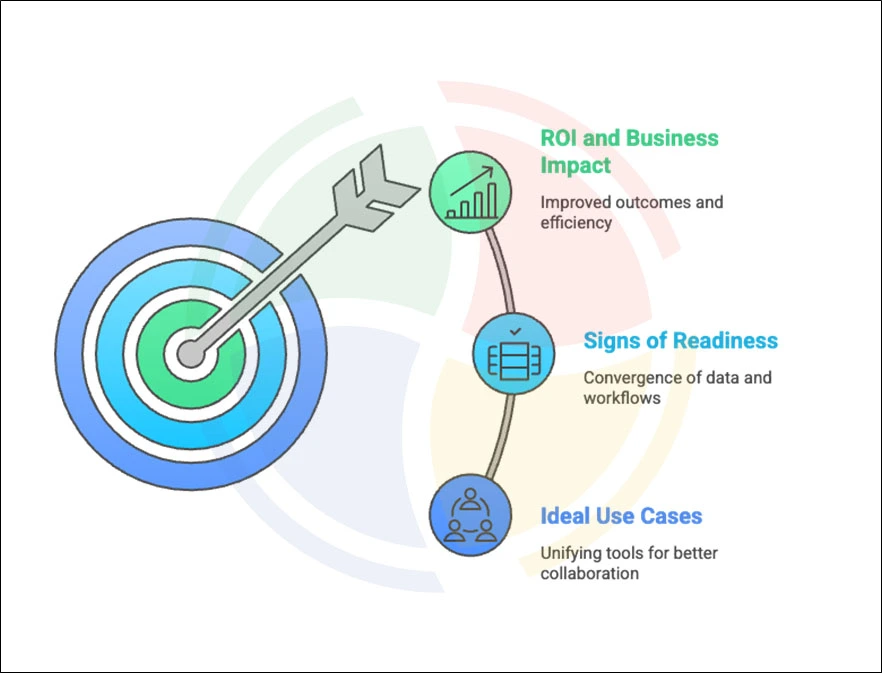
Ideal Use Cases
ServiceNow is the right choice when your organization is looking to:
- Replace fragmented systems with a unified platform
- Standardize processes across the enterprise
- Adopt AI-driven automation at scale
- Improve service delivery and operational consistency
- Enable self-service across internal and external functions
Signs Your Organization is Ready
You’re prepared for the Now Platform if you’re experiencing:
- Heavy reliance on manual approvals
- Data scattered across multiple tools
- Inconsistent SLAs between teams or departments
- Limited workflow visibility and governance
- Leadership push toward enterprise automation
ROI and Business Impact
Organizations adopting ServiceNow typically achieve:
- Lower operational costs through automation
- Faster resolution times and improved SLAs
- Reduction in manual, repetitive work
- Higher employee and user satisfaction
- Stronger compliance and audit readiness
- Better forecasting and decision-making from unified data
Grow Your Enterprise with the Right ServiceNow Foundation
The ServiceNow Now Platform delivers the most value when we treat it as a long-term system of action. Its strength comes from unifying data, architecture, and AI-driven automation to standardize how work flows across the enterprise.
In our experience, organizations that achieve sustained results invest early in strong platform foundations—clean CMDB data, governed workflows, scalable architecture, and clear ownership. This makes it far easier to expand from IT into HR, customer service, security, and operations without rework, fragmentation, or technical debt.
At Aegis Softtech, we take a foundation-first approach to ServiceNow by designing stable environments. Our developers extend the platform responsibly and scale automation in line with your business priorities.
FAQs
Q1: What is the ServiceNow Now Platform used for?
It is used to automate workflows across IT, HR, customer service, and operations. Organizations rely on it to improve service delivery, centralize data, and eliminate manual processes.
Q2: Is the Now Platform the same as the ServiceNow AI Platform?
The Now Platform is the core enterprise workflow engine, while the AI layer (including Now Assist) extends it with generative AI, predictive intelligence, and automation features.
Q3: What applications run on the Now Platform?
Applications such as ITSM, ITOM, HRSD, CSM, Security Operations, GRC, Asset Management, and custom low-code apps all run on the Now Platform.
Q4: How long does a typical ServiceNow deployment take?
Deployments range from 8-16 weeks for single modules to several months for multi-department implementations, depending on process complexity, integrations, and data readiness.