

Most enterprises want to tap into AI and ML, but the reality is painful. The infrastructure is complex, data movement raises security red flags, and hiring specialized teams isn’t exactly cheap or easy. That’s the gap Snowflake Cortex AI was designed to close.
Snowflake Cortex AI is a fully managed service that brings powerful LLMs and AI capabilities directly into your Snowflake Data Cloud.
No clusters to manage. No pipelines to re-engineer. No data leaving your secure perimeter.
Teams can now analyze unstructured data, build AI-powered applications, etc. You even get access to industry-leading models from Anthropic, Meta, Mistral, and OpenAI with a single SQL command.
In this guide, we’ll walk through what Cortex AI is, its core features, pricing factors, and how decision-makers can adopt it effectively inside their existing Snowflake ecosystem.
Key Takeaways
- What It Is:
Cortex AI in Snowflake is a native service for AI and ML, enabling users to build, deploy, and scale intelligent applications directly within the Snowflake Data Cloud.
- Key Features:
AISQL functions, Cortex Search (hybrid semantic + keyword search), and Cortex Agents for multi-step automation.
- Model Access:
Use leading LLMs (Anthropic, Meta, Mistral, OpenAI) through simple SQL commands.
- Use Cases:
Customer experience insights, fraud detection, document intelligence, RAG apps, forecasting, and regulated analytics, etc.
- Best Fit: :
Organizations already running on Snowflake that want fast, compliant, enterprise-grade AI without hiring specialized ML teams.
What is Snowflake Cortex AI? How is It Different From Traditional AI?
Cortex AI is Snowflake’s fully managed generative AI layer built directly into the Snowflake Data Cloud. It allows teams to run Snowflake LLM-powered analytics, search, and automation without moving data or stitching together complex infrastructure. It’s fast, secure, and built for real enterprise use.
Snowflake introduced Cortex AI in late 2023 as part of its push to evolve from a cloud data warehouse solution into a full AI/ML intelligence platform.
Since then, Snowflake has expanded capabilities around AISQL, vector search, and intelligent agents. It does all this while staying focused on one principle: AI should come to the data, not the other way around.
“Cortex isn’t just ‘AI inside Snowflake’; it’s the point where your governed warehouse becomes an intelligence layer. The moment AI comes to the data, you cut a huge chunk of integration friction compared to traditional stitched-together stacks.”
— Lead Snowflake Architect, Aegis Softtech
Snowflake Cortex AI vs Traditional AI: A Quick Overview
Traditional AI requires stitching together data pipelines, vector databases, ML infrastructure, and specialized engineering teams. Cortex AI eliminates that entire barrier.
You don’t move data. You don’t provision clusters. You don’t build custom integrations. You open Snowflake, call an AISQL function, and you’re in the game.
Here’s a deeper understanding of the key differences between Snowflake Cortex AI vs traditional AI:
| Factor | Traditional AI Approach | Snowflake Cortex AI |
| Infrastructure | Requires separate GPU infrastructure, model serving platforms | Fully managed, serverless within Snowflake |
| Data Movement | Extract and move data to external AI systems | Data never leaves Snowflake security perimeter |
| Time to Deploy | Weeks to months (infrastructure + integration) | Hours to days (SQL functions ready to use) |
| Skill Requirements | Data scientists, ML engineers, DevOps specialists | SQL analysts can start immediately |
| Cost Structure | Fixed infrastructure costs + expertise salaries | Consumption-based, pay per token usage |
| Model Access | Limited to deployed/licensed models | Multiple LLMs (Anthropic, Meta, Mistral, OpenAI) via a single interface |
| Governance | Complex integration with data governance systems | Built-in RBAC, masking, and audit logs |
| Maintenance | Ongoing model updates, infrastructure management | Automatic updates, no maintenance required |
Core Snowflake Cortex AI Features: The Three Pillars
- AISQL Functions Pre-built AI tasks accessible via SQL (no coding required)
- Search: Hybrid semantic + keyword search for documents
- Agents: Multi-step task automation across data sources
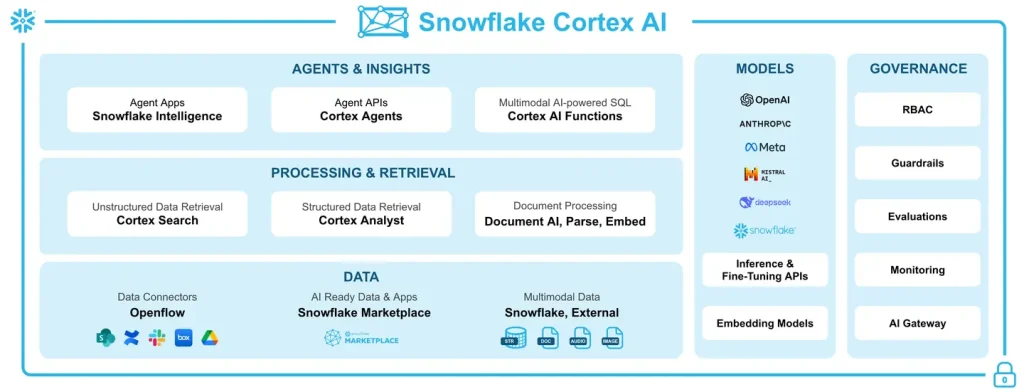
Here’s an elaborate explanation of the three core Snowflake Cortex AI capabilities:
1. Cortex AI Functions (AISQL):
This is where Snowflake makes AI feel easy. Cortex’s most accessible superpower is its AISQL layer—AI functions that can be called directly in SQL.
Key AISQL functions include:
- COMPLETE: Access industry-leading LLMs for content generation, reasoning, and custom prompts
- TRANSLATE: Convert text across 60+ supported languages with simple SQL syntax
- SENTIMENT: Analyze text sentiment with scores from -1 (negative) to +1 (positive)
- SUMMARIZE: Generate concise summaries of long-form content automatically
- EMBED_TEXT: Create vector embeddings for similarity searches and RAG applications
- EXTRACT_ANSWER: Pull specific information from documents using natural language questions
- ANALYST: Translate natural language questions into optimized SQL
These make Cortex AI feel less like a “new tool” and more like an upgrade to the SQL muscle analysts and Snowflake development teams already have.
“Teams that start with AISQL functions typically ship their first production use case in weeks, not quarters.”
— Head of Data Engineering, Aegis Softtech
Watch how to use Cortex ANALYST, explained by Snowflake Developers:
2. Cortex Search:
Cortext Search is one of the Snowflake Cortex AI capabilities that blurs the line between search and intelligence.
Cortex Search combines:
- Semantic vector search (understanding meaning)
- Keyword search (exact matching)
The hybrid model is the backbone of Retrieval-Augmented Generation (RAG) applications. Cortex Search handles embedding, indexing, and retrieval automatically—no separate vector database, no new pipelines, no ETL.
3. Cortex Agents:
Agents are one of the most popular Snowflake Cortex AI features. These are Snowflake’s autonomous AI operators. They handle multi-step workflows across structured and unstructured data.
Agents can analyze documents, query tables, validate answers, and choose the right LLM (GPT or Claude) for each task. They break complex questions into smaller components and return grounded, source-aware responses.
How Does Snowflake Cortex AI Work?
Snowflake Cortex AI works by bringing generative AI into your Snowflake environment without the need for data movement, external APIs, or extra infrastructure. Everything runs inside Snowflake’s security perimeter, which is a huge win for teams navigating GDPR, HIPAA, or SOC 2 requirements.
At its core, Cortex AI uses a SQL-based interface, so analysts (not just data scientists) can run AI tasks instantly.
A simple query like: SELECT SNOWFLAKE.CORTEX.SENTIMENT(customer_feedback) FROM support_tickets delivers real-time insights without Python, ML frameworks, or pipeline engineering.
Execution is serverless, meaning Snowflake auto-scales based on workload. And, because the data never leaves Snowflake, your governance stack remains intact.
What Are The Key Benefits of Snowflake Cortex AI?
Snowflake Cortex AI gives teams a faster, simpler, and more secure way to deploy enterprise-grade AI without spinning up new infrastructure or wrangling GPUs.
Here’s why organizations are leaning into Cortex AI:
- Unified platform:
Everything runs inside Snowflake—no extra AI infrastructure, no vector DB setup, no integration sprawl.
- Speed to value:
You can deploy AI features in just a few hours or days.
Analysts can run sentiment analysis or summarization directly through AISQL on day one.
- Cost efficiency:
You avoid GPU provisioning and pay only for the AI functions you use, maximizing existing Snowflake investment.
- Enterprise-grade security:
Since data never leaves Snowflake, you eliminate governance gaps and data movement risks.
- Flexibility:
Swap between LLMs (GPT, Claude, Snowflake models) without rewriting workflows.
- Scalability:
Cortex’s serverless architecture grows with you – prototype on Monday, production workload by Friday.
Still running critical workloads on fragmented data stacks? Our Snowflake migration services help consolidate your data into Snowflake and prepare it for Cortex AI.
Use Cases & Industry Applications of Snowflake Cortex AI
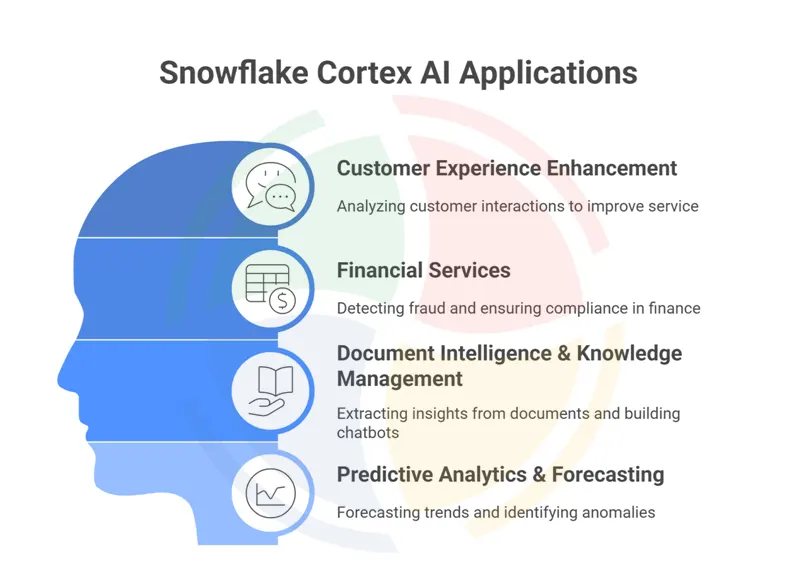
Cortex AI brings intelligence directly to your enterprise data, making AI adoption faster, cleaner, and far more scalable than traditional approaches.
Here are some of its primary use cases across industries:
Customer Experience Enhancement
Cortex AI transforms raw customer interactions into real-time insights and automated actions that improve satisfaction and operational efficiency.
What teams can do:
- Analyze call transcripts, chat logs, and support tickets for sentiment and themes
- Auto-categorize and route support tickets using LLM-based classification
- Generate personalized, context-aware customer responses at scale
Business Impact:
| Area | Impact |
| CS Ops Efficiency | Shorter resolution times and lower support workload |
| Customer Loyalty | Improved CX through personalized, accurate responses |
| Insight Quality | Better trend detection for product and service improvement |
Snowflake Cortex AI for Financial Services
Cortex AI strengthens risk management, market intelligence, and operational oversight by running AI directly in the highly-regulated financial industry.
What teams can do:
- Detect fraud via pattern analysis across transactions and communications
- Process financial documents, news, and reports for real-time market signals
- Automate compliance reviews and document assessments
- Identify anomalies in trading and customer behavior
Business Impact:
| Area | Impact |
| Risk Reduction | Earlier detection of fraud and compliance issues |
| Decision Speed | Faster market and portfolio insights |
| Regulatory Confidence | Lower audit burdens and better governance |
Working in financial services and juggling risk, compliance, and analytics teams becomes overwhelming.
Our Snowflake consultants can help you architect Cortex AI patterns that satisfy regulators while actually speeding up investigations and reporting cycles.
Document Intelligence & Knowledge Management
Cortex AI turns disconnected documents into structured, searchable, conversational knowledge.
What teams can do:
- Extract key data from legal docs, contracts, and research papers
- Build RAG chatbots to query enterprise knowledge securely
- Automate document tagging, search, and retrieval
Business Impact:
| Area | Impact |
| Productivity | Reduced manual document review time |
| Knowledge Access | Faster answers for internal teams |
| Data Utilization | Better use of unstructured content assets |
Predictive Analytics & Forecasting
Cortex ML functions enable accurate forecasting and anomaly detection without external ML infrastructure.
What teams can do:
- Run time-series forecasting for demand, sales, and inventory
- Detect anomalies indicating risks or opportunities
- Pinpoint trend drivers through contribution analysis
Business Impact:
| Area | Impact |
| Operational Planning | Improved inventory and supply chain decisions |
| Revenue Optimization | More accurate demand and performance forecasts |
| Issue Prevention | Early visibility into performance deviations |
Snowflake Cortex Pricing (and How To Track Cost)
Cortex AI follows a token-based consumption model. You pay only for the tokens you process, nothing more. It does not have a model hosting fee or extra infrastructure charges; only input and output tokens.
How Snowflake Cortex AI Pricing Works
Snowflake charges per 1,000 tokens, and the cost varies based on the model you choose:
| Model Type | Approx. Cost per 1K Tokens | Notes |
| Small Models (e.g., Mistral-7B) | ~$0.0003 | Ideal for summaries, classification, and routine analytics |
| Large Models (Claude 3.5 Sonnet) | ~$0.003 input / ~$0.015 output | Best for reasoning-heavy tasks and complex generative workloads |
You can track all usage through CORTEX_FUNCTIONS_USAGE_HISTORY, which makes auditing and chargeback models easier.
When Should You Use Snowflake Cortex AI? (And When Shouldn’t You?)
Snowflake Cortex AI is perfect when you want fast, secure, enterprise-ready AI inside your existing Snowflake environment. But like any tool, it shines in some scenarios and isn’t the best choice in others.
Before you jump into Cortex AI, it’s worth getting clear on fit:
Ideal Scenarios
- You already use Snowflake as your data warehouse and want to avoid data movement
- Your data contains significant unstructured content (text, documents, audio) requiring analysis
- You need a quick AI implementation without building specialized ML teams
- Security and governance are non-negotiable requirements (regulated industries)
- You want to democratize AI access across business users via SQL interface
Consider Alternatives When
- You need highly specialized, domain-specific models that are not available in Cortex
- Your use case requires extensive model customization beyond fine-tuning capabilities
- Cost sensitivity is extreme, and you have ML engineering resources to optimize custom infrastructure
- You’re processing minimal data volumes where serverless premium isn’t justified
- Real-time, millisecond-latency inference is critical (edge computing scenarios)
How to Get Started with Snowflake Cortex AI: Practical Roadmap
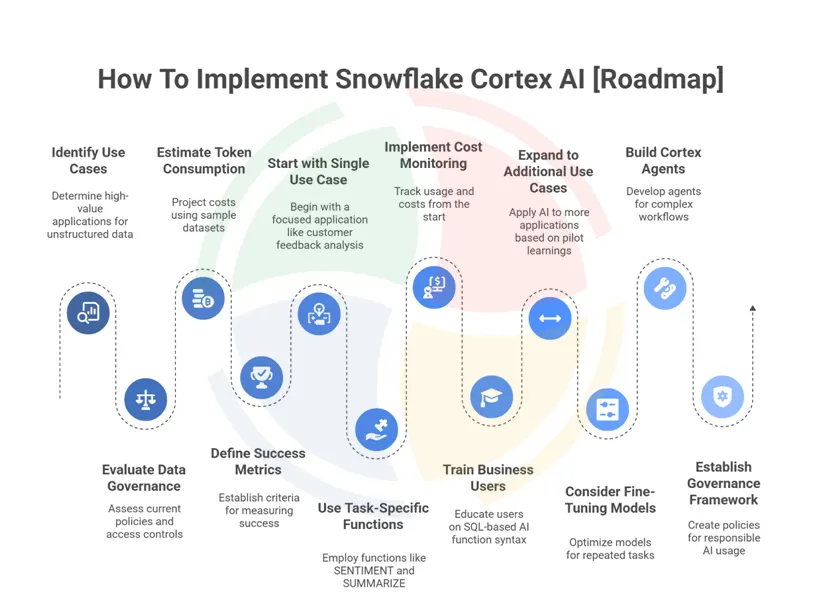
If you’re already operating inside the Snowflake ecosystem, adopting Cortex AI is like unlocking a capability you already own. The transition from “We should explore AI” to “We’re running AI in production” becomes dramatically faster because everything happens directly inside your Snowflake environment.
Here’s how you can get started with Snowflake Cortex AI:
Skills Your Team Needs
Cortex AI lowers the barrier to entry so teams with basic SQL skills can run powerful LLM workloads immediately.
| What You Need | Skill Level | Why It Matters |
| SQL proficiency | Minimal | AISQL functions run natively in SQL, making AI instantly accessible. |
| Basic prompt engineering | Helpful | Helps shape higher-quality outputs from LLM-driven functions. |
| Python for Streamlit + Snowpark ML | Advanced | Adds flexibility for custom apps and deeper ML workflows. |
| No data scientists or ML engineers required | Critical Note | A core differentiator of Cortex AI’s design philosophy. |
Phase 1: Assessment (Week 1-2)
During the first two weeks of Snowflake implementation, your goal is simply to understand where Cortex AI fits.
To-do checklist:
- Pinpoint use cases with strong business value.
- Review governance, access controls, and data sensitivity.
- Run sample token tests to estimate usage-based pricing.
- Lock in success metrics: accuracy lift, time saved, error reduction.
Phase 2: Pilot (Week 3-6)
With clarity on your target use case, move into a focused pilot.
Start simple with task-specific functions like SENTIMENT, SUMMARIZE, or TRANSLATE that often deliver immediate value without requiring full LLM orchestration. This keeps your pilot fast, predictable, and cost-efficient.
From day one, monitor resource usage through Snowflake’s built-in cost views so you understand consumption patterns as your prompts evolve.
Make sure your business users get comfortable with AISQL syntax and experimentation; this is where confidence and momentum build.
“The most successful Cortex rollouts pair a tight pilot scope with guardrails: prompt patterns, cost alerts, and review workflows. That balance of speed and governance is what turns ‘cool demos’ into repeatable production AI inside Snowflake.”
— Director of AI Solutions, Aegis Softtech
Phase 3: Scale (Week 7+)
Once the pilot performs reliably, expand your footprint. Add additional use cases that benefit from text understanding, search, or automated reasoning.
For workflows that require multi-step logic, like validating answers, querying tables, and summarizing documents, introduce Cortex Agents to orchestrate more complex behaviors.
If you notice recurring domain-specific patterns, consider fine-tuning models to boost accuracy and reduce token usage over time.
As adoption grows, formalize a responsible AI framework so teams can innovate confidently while staying aligned with governance, compliance, and cost controls.
This phased approach keeps your AI rollout practical, fast, and grounded in real business value; exactly the environment Snowflake Cortex AI was built for.
What’s Next for Snowflake Cortex AI: Latest Updates
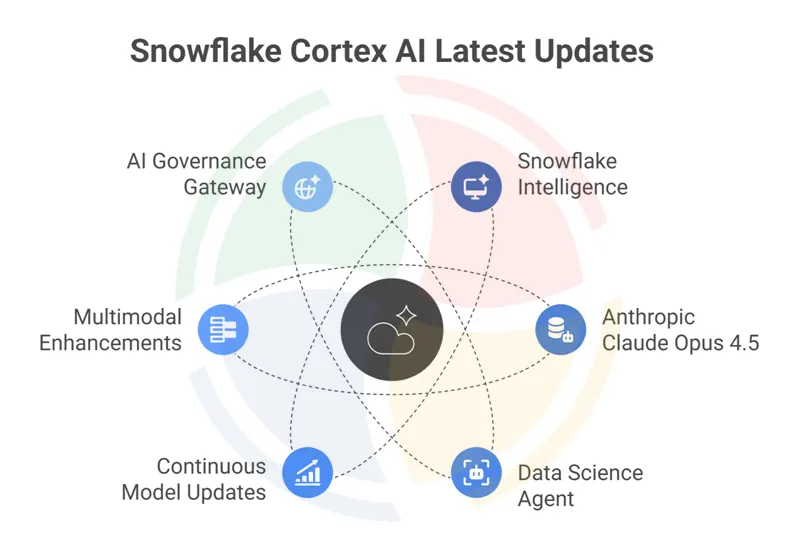
Snowflake Cortex AI is rapidly evolving into a full enterprise intelligence layer with more autonomous, more multimodal, and far more capable than even its launch vision.
Here’s what’s coming next:
- Snowflake Intelligence:
A new enterprise-wide AI agent designed to deliver trusted, context-aware answers at scale across all your Snowflake data.
The latest frontier-level Anthropic reasoning model is fully integrated for high-precision analytics and complex workflows.
- Data Science Agent:
Simplifies ML experimentation and quantitative analysis without spinning up separate environments.
- Continuous Model Updates:
Ongoing partnerships with Anthropic, Meta, and Mistral ensure Cortex always has current-gen LLMs.
- Multimodal Enhancements:
Deeper support for image and video analysis, enabling advanced use cases across industries.
- AI Governance Gateway:
A centralized control layer for faster, compliant generative AI deployment.
Turn Snowflake Cortex AI Into Real Outcomes with Aegis Softtech
Snowflake Cortex AI gives you the power to turn ambitious ideas into reality—fast.
But even the most advanced AI capabilities can only be as good as the data platform supporting them. Your Snowflake architecture, data models, cost controls, and security framework? They still matter. A lot.
The companies seeing real success with Cortex AI are building it on top of a solid, well-designed Snowflake foundation, one that’s ready to scale, secure by design, and optimized for performance.
If you’re ready to implement Cortex AI on a Snowflake platform that’s truly prepared for it—not just patched together—we can help you get there.
Our team of certified developers helps you modernize, optimize, and operationalize, without slowing down your roadmap.
- Snowflake Development:
Development, performance tuning, warehouse sizing, cost engineering, and workload refinement
- Strategy & Consulting:
Architecture design, governance frameworks, AI readiness, and cost planning
- Implementation Services:
End-to-end setup, integrations, AISQL enablement, and Cortex AI deployment
- Snowflake Data Migration:
Secure, low-disruption migration from legacy warehouses and lakes
FAQs
1. What is Cortex AI in Snowflake?
Cortex AI in Snowflake is a native AI and ML service that lets users build, deploy, and scale intelligent applications directly within the Snowflake Data Cloud. It streamlines workloads by eliminating infrastructure management and enabling secure in-platform computation.
2. Which LLM does Snowflake Cortex use?
Snowflake Cortex supports a range of large language models selected for accuracy, efficiency, and enterprise-grade governance. These models are integrated natively so teams can use powerful text and reasoning capabilities without external configuration.
3. What AI model does Snowflake use?
Snowflake offers a curated set of foundational and task-optimized AI models designed to handle text generation, search, embeddings, and predictive workloads. These models operate entirely within Snowflake’s secure, governed environment.
4. Is Snowflake AI better than other AI platforms?
Snowflake AI stands out by combining scalable compute, native governance, and seamless data access in a single ecosystem. Its integrated design reduces friction often seen in multi-tool AI pipelines.
5. Can I run AI tasks without exporting data out of Snowflake?
Yes, Snowflake allows you to run AI workloads fully inside its platform, keeping sensitive data protected. This reduces compliance risks and removes the complexity of moving datasets between external services.
6. How to enable Cortex AI in Snowflake?
Enabling Cortex AI in Snowflake involves activating supported features through your account settings and ensuring proper role permissions. After configuration, users can immediately access AI-powered functions, models, and orchestration tools within their workflows.
7. How secure is Cortex AI?
One of the main Snowflake Cortex AI features is strong security by leveraging Snowflake’s governance, data isolation, and enterprise-grade encryption. Its design ensures models run inside your Snowflake environment, reducing exposure and strengthening compliance for sensitive workloads.
8. What tasks can be performed using Snowflake Cortex AI?
Snowflake Cortex AI capabilities include text summarization, sentiment analysis, predictive modeling, and operational automation directly on platform data. It also enables natural-language querying, workflow generation, and embedded AI applications without additional infrastructure.