
You are looking for a customer service platform that sustains scalability and multiple tool integrations for at least the next five years.
So, you know it’s not just about another ticketing tool.
ServiceNow and Zendesk are two of the best options to consider, but which one will meet your challenges is what you need to decide. Workflow visibility, automation maturity, cross-functional alignment, governance, and long-term operational control: what are your business challenges?
We are here with a detailed comparison—Zendesk vs ServiceNow—based on all the critical parameters, like automation, ticketing, pricing, ITSM, and scalability.
Let’s start with a quick overview before getting into the details.
Key Takeaways
- Speed of deployment and ease of use are top priorities
- Your focus is on customer support and omnichannel CX
- Ticketing volume is high, and front-line efficiency matters most
- You need transparent, tier-based pricing for predictable scaling
Choose Zendesk when:
- Service operations span IT, HR, security, and enterprise workflows
- ITIL alignment, governance, and compliance are critical
- Tickets require CMDB linkage, SLA enforcement, and traceability
- You are investing in long-term automation and digital transformation
Choose ServiceNow when:
Zendesk vs ServiceNow: Quick Comparison Table
Before digging deep, let’s take a look at the high-level comparison of Zendesk and ServiceNow across key parameters:
| Parameter | Zendesk | ServiceNow |
| Core Purpose | Customer experience and support ticketing | Enterprise service management and workflows |
| Ticketing System Features | Simple, intuitive, CX-focused | Process-driven, ITIL-aligned |
| Customer Service Capabilities | Strong omnichannel CX | Advanced CSM with backend orchestration |
| ITSM & Enterprise Workflows | Limited native ITSM | Industry-leading ITSM |
| Automation & AI | AI for support efficiency | AI for enterprise-wide automation |
| Ease of Use | Fast setup, low learning curve | Powerful but complex |
| Integrations | Marketplace-driven | Deep enterprise integrations |
| Scalability | Scales support teams | Scales entire organizations |
| Customization | Moderate | Extensive, low-code + pro-code |
| Pricing Approach | Transparent, tier-based | Quote-based enterprise licensing |
| Best For | SMBs, CX-led teams | Enterprises, shared services, IT-heavy environments |
What are Zendesk and ServiceNow?
Although both platforms support service teams, their architectures are designed for different operational priorities.
Overview of Zendesk
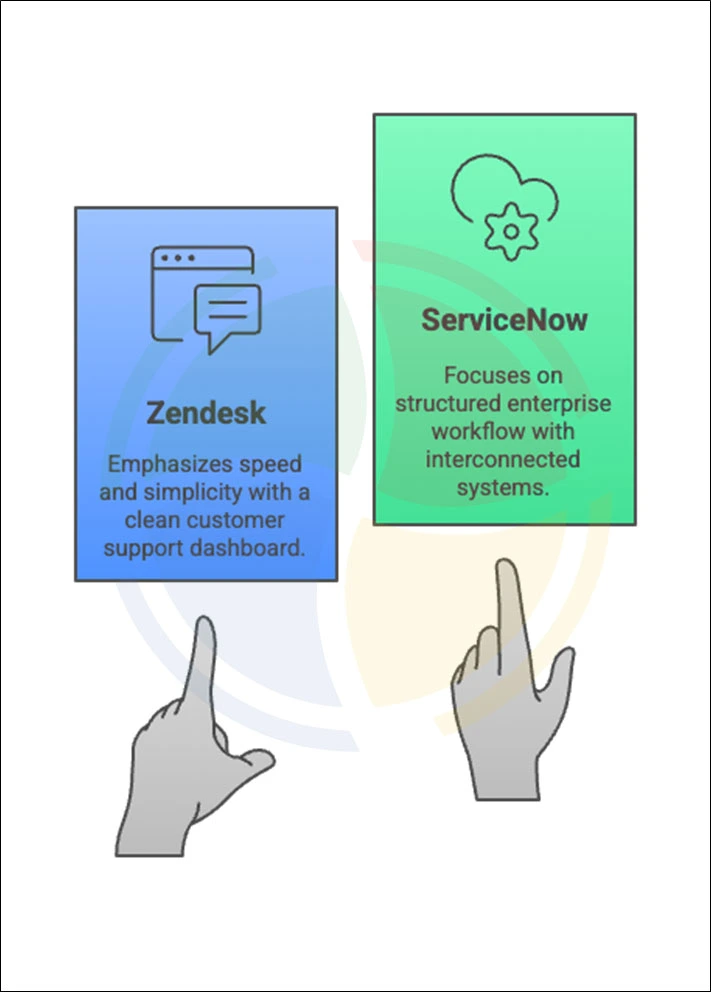
Zendesk is a customer support platform that enables the management of customer conversations across multiple channels through a unified interface. The platform prioritizes usability and rapid deployment with limited configuration requirements.
Its core strengths include:
- Fast deployment with minimal setup
- Intuitive ticket management that agents adopt quickly
- Omnichannel support across email, chat, voice, and social channels
Zendesk works well if your priority is resolving customer issues efficiently without introducing complex processes.
Overview of ServiceNow
ServiceNow is a service management platform designed to orchestrate workflows across IT, customer service, HR, security, and operations. The platform links service requests with enterprise systems, processes, and governance models.
Key strengths include:
- Strong ITIL alignment for structured service management
- Enterprise-grade governance, compliance, and audit controls
- End-to-end workflow automation across departments
If you are running multiple service domains and integrated systems, ServiceNow fits well to standardize service delivery and manage operational risk in complex enterprise environments.
Zendesk vs ServiceNow: A Detailed Comparison
Now that you understand what Zendesk and ServiceNow are designed to do, let’s understand how their strengths translate into solutions to your customer service challenges.
This section breaks down where the platforms differ across ticketing, customer service, ITSM, automation, and enterprise readiness.
Ticketing System Comparison
As critical as ticketing is for a service platform, it doesn’t fulfill the same purpose across all platforms. Our detailed Zendesk vs ServiceNow ticketing system comparison highlights how each platform handles speed, structure, and operational control.
Ticketing with Zendesk
Zendesk’s ticketing system is built around speed, clarity, and agent productivity. It is designed to support your teams in responding quickly without navigating complex workflows.
It ensures:
- A clean, intuitive ticket lifecycle
- Omnichannel ticket intake across email, chat, voice, and social
- Faster agent onboarding with minimal training
If your team needs to handle high ticket volumes, you can benefit from Zendesk’s faster resolution times and improved customer satisfaction.
Ticketing with ServiceNow
ServiceNow treats ticketing as part of a larger service ecosystem rather than an isolated function. Tickets are embedded within IT and enterprise workflows.
Its ensures:
- Tight linkage between incidents, problems, and changes
- Advanced routing, prioritization, and SLA management
- Strong dependency on CMDB and IT operational data
This approach suits environments where tickets represent operational events requiring traceability, approvals, and cross-team execution.
Key Ticketing Differences
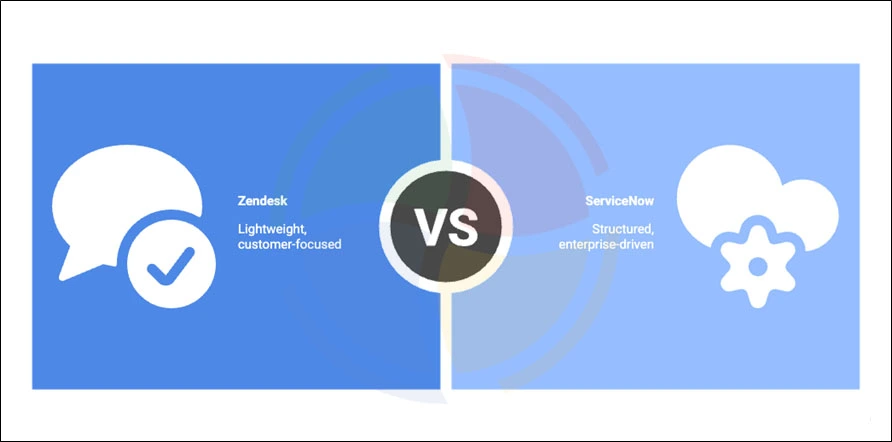
- Zendesk prioritizes customer experience and speed
- ServiceNow prioritizes control, traceability, and process integrity
Make a choice based on whether your tickets are primarily customer conversations or operational triggers that must align with broader enterprise workflows.
Customer Service Comparison
The Zendesk vs ServiceNow customer service comparison below shows how each tool supports customer interactions—either through fast, front-line CX or deeper backend service orchestration.
Zendesk Customer Service Capabilities
Zendesk excels when customer service is front-line, high-volume, and experience-driven. Its tools are designed to reduce friction for both agents and customers.
Key capabilities include:
- Strong self-service portals and knowledge bases
- Seamless omnichannel engagement
- A customer-first interface optimized for responsiveness
If your success metrics focus on CSAT, first-response time, and resolution speed, Zendesk can be your ideal pick.
ServiceNow Customer Service Capabilities
ServiceNow’s Customer Service Management (CSM) is built for environments where customer issues extend beyond the support desk and into backend systems.
It is designed to handle:
- Complex, multi-step service cases
- Cross-department coordination
- Integration with billing, fulfillment, and operations
The model is especially relevant in industries like telecom, fintech, and healthcare, where resolving a customer issue often requires orchestration across multiple internal teams. In such environments, experienced ServiceNow consulting company help align backend workflows with customer-facing operations.
You may also want to explore ServiceNow Guided Self-Service, which supports structured customer journeys for more complex service requests.
Which Platform Delivers Better CX?
- Choose Zendesk if customer experience is your primary focus
- Choose ServiceNow if customer service depends on deep internal workflows
ITSM & Enterprise Workflow Capabilities
ITSM is where the Zendesk vs ServiceNow comparison clearly separates SMB-friendly tools from enterprise platforms. Let’s understand how each solution supports service governance, workflow standardization, and cross-functional operations at scale.
Why ServiceNow Leads in ITSM
ServiceNow is widely regarded as the industry benchmark for ITSM. Its strength lies in enforcing consistency, governance, and scalability across large organizations.
It offers:
- Native ITIL-aligned processes
- Strong governance, compliance, and audit controls
- Support for large, distributed teams
By unifying IT operations, HR services, and customer workflows on a single platform, ServiceNow helps enterprises reduce silos and operational risk. A closer look at the ServiceNow Now platform architecture explains why it scales effectively for long-term growth.
ITSM Gaps in Zendesk
Zendesk includes basic ITSM functionality, but it has clear limitations:
- Limited change and problem management
- Minimal CMDB capabilities
- Not designed for enterprise governance
It works best when IT support is lightweight and does not require strict process enforcement or regulatory oversight.
Workflow Automation Differences
- Zendesk focuses on low-friction automation that improves support efficiency without adding complexity.
- ServiceNow supports low-code and pro-code extensibility, making it suitable for complex, enterprise-wide automation initiatives.
ServiceNow offers significantly more flexibility for complex, cross-department workflows.
ServiceNow decisions impact workflows, governance, and long-term scalability. Getting this alignment right early makes a measurable difference.
At Aegis Softtech, we help teams assess readiness and design ServiceNow implementations that scale without unnecessary complexity.
Ease of Use, UI, and Adoption
Ease of use of your CSM platform impacts long-term adoption and ROI. A platform’s learning curve, configuration effort, and training requirements determine how quickly teams can become productive, and how much ongoing effort is needed to maintain momentum.
Zendesk User Experience
Zendesk is designed for fast adoption and minimal friction, especially for customer support teams that need to become productive quickly.
You benefit from:
- Faster setup and deployment
- Minimal configuration requirements
- Low training overhead
It makes Zendesk a strong fit for growing teams or organizations seeking results without a lengthy implementation cycle.
ServiceNow User Experience
ServiceNow delivers significantly more power, but adoption requires a structured approach.
You should plan for:
- A formal implementation strategy
- Role-based training across teams
- Ongoing optimization as workflows evolve
Many organizations work with experienced partners or hire remote ServiceNow developers to ensure platform stability and long-term performance. Upon partnering with our team of experts, you will experience reduced implementation risk and measurable operational outcomes.
Automation, AI, and Scalability
Automation and AI play a critical role in modern service operations, but their value depends on how well they scale with organizational complexity. The difference lies between optimizing support workflows and automating services across the enterprise.
Zendesk AI & Automation
Zendesk’s automation capabilities focus on improving support efficiency.
The primary areas seeking automation include agent productivity enhancements, intent detection, intent routing, and automated responses.
- Agent productivity enhancements
- Intent detection and routing
- Automated responses and macros
These features help your support teams resolve issues faster while maintaining a clean, manageable setup.
ServiceNow AI & Automation
ServiceNow’s AI capabilities, such as Now Assist and predictive intelligence, extend far beyond the support desk.
They enable automation across IT operations, customer service, and enterprise-wide workflows. This makes ServiceNow suitable for organizations pursuing large-scale automation and operational transformation.
Integrations & Extensibility
No service platform operates in isolation. The ability to integrate with existing systems and extend functionality determines how well the platform fits into your broader technology ecosystem with evolving needs.
Zendesk App Ecosystem
Zendesk offers a flexible ecosystem built around speed and simplicity, making it easier to extend core functionality without heavy customization.
You get a strong marketplace of ready-to-use apps and plug-and-play integrationswith faster time to value. It works well when your technology stack is relatively simple and integration speed matters more than deep system orchestration.
ServiceNow Enterprise Integrations
ServiceNow enables deep, enterprise-grade integrations designed for complex environments, including custom application development and unified data models across systems. It also supports smooth integration with your ERP, CRM, and other business identity systems.
The level of extensibility is critical when service delivery depends on data consistency, governance, and cross-platform automation.
Pricing, Licensing, and Total Cost of Ownership
Pricing decisions directly influence long-term scalability, flexibility, and operational cost. Evaluating the total cost of ownership provides a clearer picture of what each platform demands over time.
Zendesk Pricing Structure
Zendesk follows a:
- Tier-based pricing model
- Clear feature differentiation
- Predictable cost structure
The transparency simplifies budgeting, especially for SMBs and support-led organizations.
ServiceNow Pricing Approach
ServiceNow uses:
- Quote-based enterprise licensing
- Modular pricing tied to usage
- Higher implementation and setup costs
Planning effectively requires understanding the ServiceNow implementation cost beyond just licensing.
TCO Differences
- Zendesk’s total cost is largely tool-centric
- ServiceNow’s total cost reflects its role as a platform, including implementation, governance, customization, and ongoing optimization
Make the Right Platform Choice for Your CSM with Aegis Softtech
The choice between ServiceNow and Zendesk depends on service maturity and long-term operational intent.
Zendesk is adopted when speed, usability, and customer-facing efficiency are primary requirements.
Whereas ServiceNow is designed for organizations where service operations are embedded across IT, HR, security, and enterprise workflows.
The right choice depends on where your organization stands today, and where it plans to be in the future.
At Aegis Softtech, we support organizations in assessing service maturity, evaluating platforms, and implementing ServiceNow using structured, governance-driven approaches. If you’re evaluating ServiceNow seriously or planning an enterprise-grade rollout, explore our ServiceNow development services.
FAQs
Q1: Is ServiceNow better than Zendesk?
Yes, ServiceNow is better if you want to manage enterprise workflows and ITSM, along with customer support. Go with Zendesk for more customer-centric support. The right choice depends on your use case.
Q2: Who is ServiceNow’s biggest competitor?
ServiceNow competes with Zendesk, BMC, Freshworks, and Jira Service Management, depending on the service domain.
Q3: Is Zendesk suitable for large enterprises?
Yes, but it has limitations when compared to ServiceNow in governance, workflow depth, and ITSM maturity.
Q4: What are the disadvantages of Zendesk?
Zendesk lacks deep ITSM capabilities, complex workflow handling, and enterprise-grade governance features.