


Generative AI in Logistics
Transforming Supply Chain Efficiency
Chatbots and smart speakers are no longer the only ones using artificial intelligence (AI). Recent years have seen an increase in the number of modern warehouses and automotive and healthcare companies.
The result? AI has quietly revolutionized the logistics space.
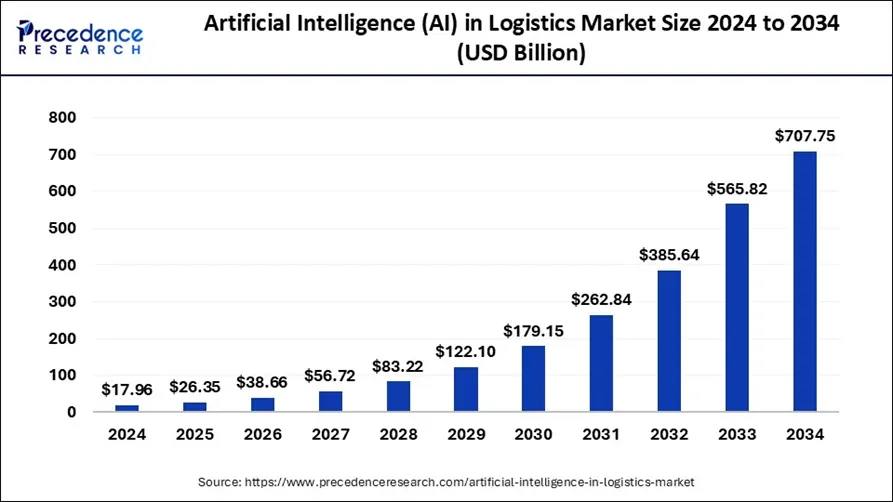
To such an extent that the use of Generative AI in logistics is forecast to expand at a staggering CAGR of 44.40% from 2025 to 2034, reaching approximately USD 707.75 billion by 2034.
Logistics companies are increasing their efficiency in last-mile delivery by incorporating AI. It has outgrown task automation to enable proactive strategies, such as predictive demand forecasting and dynamic route optimization.








You too can build a highly profitable and resilient operation by adopting the right tools and technologies. AI is your best bet at survival in this hyper-competitive market, and we’re going to tell you just how to utilize it correctly.
Let’s get going!
Key Highlights
- Market Growth: The AI in logistics market is growing rapidly, with a projected CAGR of 44.40% through 2034.
- Uses of AI: It uses predictive and prescriptive analytics to forecast demand, prevent shipping delays, optimize strategy, warehouse automation and robotics, route optimization, predictive maintenance for fleets, and anomaly detection.
- Gen AI Benefits: Better efficiency, lower costs, smarter decision-making, and improved sustainability and customer experience.
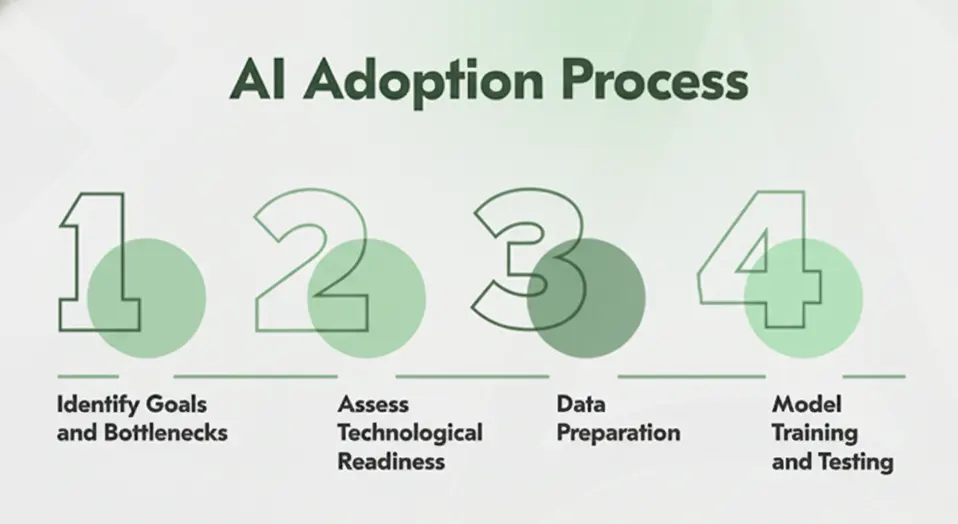
- Gen AI Implementation: It involves a four-step process, including identifying specific business goals and bottlenecks, assessing technological readiness, preparing the necessary data, and training and testing the AI models.
- Challenges of Gen AI in Logistics: Data accuracy and system integration, managing high implementation expenses, data inaccessibility, diversity of data sources, and short-term optimization.
The Inevitable Shift in Logistics—From Manual to AI
Manual processes have been at the center of global logistics and supply chain industries for decades now. While the traditional model worked very well once, increasing e-commerce volume and supply chain volatility have rendered it obsolete.
The pressures exposed its limitations—slower processing times and an inability to process increasing amounts of data. Thus, the inevitable shift from manual to AI.
The shift is an indispensable strategic necessity. Machine learning algorithms ingest data from a myriad of sources, such as ERP systems, telematics, external market trends, and sensor data, in real-time. It then offers insights that are otherwise impossible for human teams to generate at scale.
The benefits of the transition are immediate and tangible, creating a competitive advantage for your organization.
How Generative AI Supports the Logistics Industry

— Lior Ron, founder and CEO of Uber Freight
AI is molding how you manage risk, reduce cost, ensure transparency, drive sustainability, and increase efficiency.
Gen AI-powered systems utilize technologies such as computer vision and predictive analytics for real-time visibility across a supply chain. You can, thus, proactively identify and mitigate potential disruptions.
Here are certain benefits of AI in transportation and logistics:
1. Increased Efficiency
The integration of Gen AI in transportation reduces human-driven paperwork and improves operational accuracy by automating digital workflows. It translates to fewer manual data entry errors, increasing the overall efficiency of your work.
Amazon has launched a new AI foundation model to power its robotic fleet of over a million AI-powered robots. These bots use gen AI technology to improve the travel time of their robotic fleet by 10%, enabling faster delivery of packages to customers at lower costs
2. Reduced Costs
Gen AI models analyze huge datasets to predict market shifts, potential disruptions, and delays, allowing you to adjust your strategies and optimize expenditures. It also suggests the best ways to make it happen, such as managing fuel usage or choosing cost-effective routes.
Adoption of deep learning techniques in logistics operations improves route optimization by 27% and reduces fuel consumption by 19%.
3. Smarter Decision-Making
Generative AI logistics solutions make smarter decisions by collecting and analyzing huge amounts of data from sources such as GPS and IoT sensors. Machine learning algorithms forecast trends to help optimize routes and needs.
DHL’s Smart Trucks use ML algorithms to reroute deliveries according to factors like traffic, new pickup requests, and weather.
4. Improved Customer Experience
AI-powered systems offer real-time updates and tracking options to enhance customer experience. It boosts trust and confidence, resulting in higher satisfaction levels.
Shipping giant CMA CGM and French AI startup Mistral AI have collaborated to reduce response times for customer service representatives.
5. Sustainability in Logistics
Logistics that are AI-backed optimize delivery and shiploads/truckloads routes to significantly lessen their environmental impact. Shipping activities emit air pollutants and greenhouse gases, resulting in water and noise pollution. But with AI, the best routes can help reduce emissions.
Maersk’s AI-driven maritime logistics offer predictive maintenance, cutting vessel downtime, reducing carbon emissions, and saving costs.
With our generative AI services, we can help you utilize data insights and intelligent automation to drive unprecedented growth.

Key Applications of Generative AI in Logistics
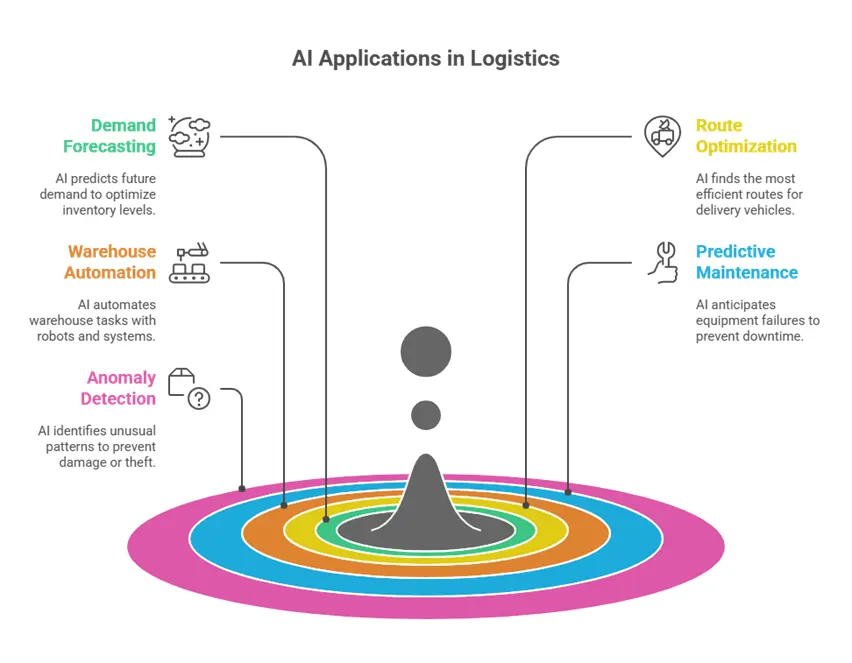
Pinpointing the applications of AI in logistics can be a tricky task. After all, its roots are so deeply entrenched in the sector that it’s almost everywhere along the value chain.
The Gen AI-powered systems allow you to track shipments in real-time, anticipate potential disruptions, suggest proactive measures, and even assist you in taking them.
Here are a few applications of AI in logistics:
1. AI-Powered Demand Forecasting & Inventory Management
AI-powered demand forecasting tools analyze third-party data, including fluctuating customer demand patterns, weather, regional events, and political disruptions, to enhance accuracy. It uses historical and real-time data to predict the future.
You can thus adjust the pricing and optimize your inventory and resources. It also improves your customers’ satisfaction level by reducing the frequency of delays or stock-outs.
SPAR Austria, a leading food retailer with over 1,500 stores, uses AI-powered solutions to improve its demand forecasting capabilities and accuracy.
2. Route Optimization & Last-Mile Delivery Automation
The cost associated with the ‘last mile’ of fulfillment has increased since customers expect faster delivery speeds. Route optimization with AI systems reduces fuel costs, proving to be both financially and economically efficient.
Real-time data analytics and load management algorithms maximize space utilization in warehouses and vessels.
Over the last few years, DHL Express has begun optimizing its last-mile delivery and precise route planning by utilizing an AI-powered logistics software.
3. Warehouse Automation & Robotics
An important use of Gen AI in logistics to improve your business’s supply chain management is by investing in warehouse robots. These robots manage operations by automating human-led tasks such as sorting, picking, packing, and inventory management.
Warehouse robots adapt to dynamic environments, optimize workflows, process orders more efficiently, and lower labor costs.
In 2023, Amazon deployed 750,000+ robots in its warehouses, alongside human employees, to enhance operational efficiency.
4. Predictive Maintenance for Fleet & Equipment
AI systems offer predictive maintenance, helping you prepare for the future by predicting potential machine failures. It collects real-time data from IoT sensors on these machines using ML-powered analytics tools.
In September 2024, COMPREDICT and Renault Group announced their partnership that focuses on predictive maintenance technology using virtual sensors.
5. Anomaly & Damage Detection
Damaged goods can tarnish your image and affect customer satisfaction. AI technologies, like computer vision, automate visual inspections, detecting errors. Data science and ML-driven tools detect and flag down anomalies by analyzing thousands of images.
Uber Freight’s Insights AI is a generative AI tool that analyzes transportation dynamics, identifies key drivers, and detects anomalies to optimize transportation outcomes.
How to Adopt Gen AI in Your Logistics Business
Since success is your end goal, you should not treat AI as an optional upgrade. The logistics sector is often defined by relentless competition and razor-thin margins, which means AI can work as a key differentiator.
You already know why your business needs AI. Let’s see how you can adopt it in your logistics business.
Step 1: Identify Goals & Bottlenecks
The first step is identifying what you aim to achieve for your business by implementing Generative AI. It could be a more streamlined process, reducing delivery times, controlling expenses, or improving customer experience.
The goal will highlight the main problems or bottlenecks your business is struggling with currently. The challenges and goals will simplify the most useful tools and technologies.
Step 2: Assess Readiness for LLMs & GenAI Assistants
Adopting Gen AI can put your existing team’s technological skills and knowledge to the test. Those with experience with AI and big data analysis might not be affected much, but as an employer, you must ensure your workforce is ready to embrace the change.
Step 3: Data Preparation
Your data holds all the power. Data scientists will collect your historical data, driver and vehicle information, sensor data from equipment, and operational log to determine its quality. A data storage system is needed to manage these huge datasets and train AI.
Step 4: Model Training & Testing
ML specialists begin training models according to the prepared data and your goals. These models are then tested in a controlled environment to understand their working and response with real-world data.
Seamlessly integrate the power of Gen AI into your existing tech stack to drive immediate, measurable business growth.

Challenges of Using Gen AI in the Logistics Industry
AI undoubtedly holds a highly transformative potential in the field of logistics. However, the path to implementing and achieving a fully AI-driven supply chain is teeming with hurdles, which you can dodge with experienced AI developers.
You must remain aware of the core challenges associated with using artificial intelligence in the logistics industry.
| Challenge | Impact on Logistics | Mitigation Strategy |
|---|---|---|
| Data Accuracy and System Integration | Poor decision-making leads to wasted resources, delays, incorrect demand forecasts, and higher operating costs. | Link AI models with your existing systems via reliable data cleansing tools. |
| Managing High Implementation Expenses | Budget strain and a high barrier to entry. | Begin with pilot projects on smaller, high-ROI use cases. |
| Data Inaccessibility | An incomplete picture of the supply chain leads to suboptimal global predictions. | Create a Centralized Data Warehouse or Lake to aggregate information from all sources. |
| Diversity of Data Sources | Increased complexity in designing and training the AI model. | Employ Machine Learning Operations (MLOps) for model management and ETL/ELT pipelines to transform diverse data. |
| Short-term Optimization | Leads to local favorables that might be globally inefficient. | Implement AI models with systemic constraints and long-term performance metrics in their objective functions. |
Future of Generative AI in Logistics
AI has become increasingly important at a rapid pace. It is now a foundational pillar of logistics, with a future encompassing an intelligent and interconnected ecosystem.
What makes us say so?
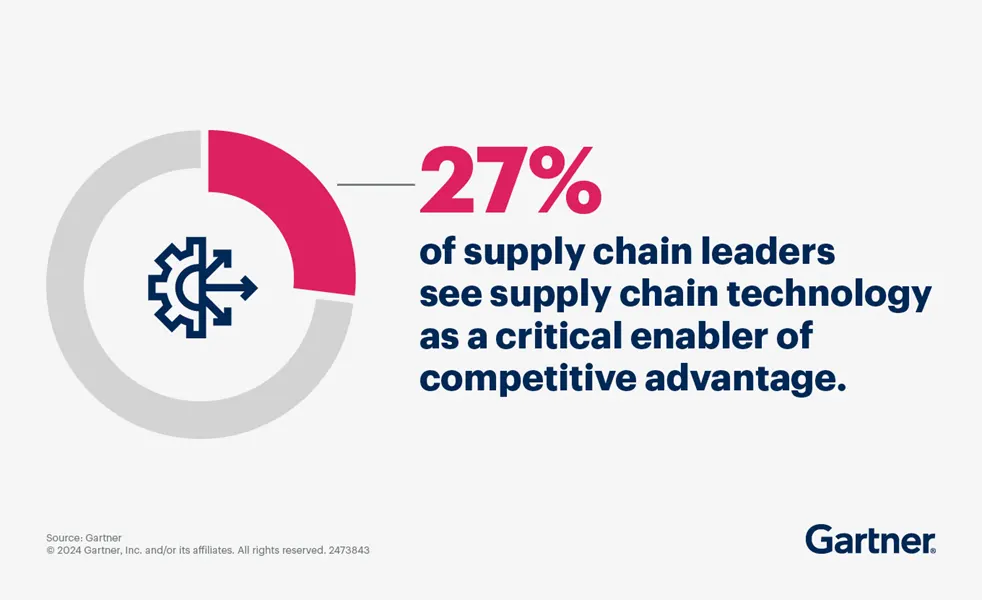
A Gartner survey suggests that 27% of supply chain leaders invest in emerging technology for competitive advantage. All the more reason for you to start investing today.
Here is what the future of AI in logistics looks like:
AI + Blockchain
AI and blockchain are coming together to revolutionize supply chain transparency. Blockchain maintains a secure ledger tracking every movement of a transaction of a product. AI then analyzes this data in real-time for complete visibility.
Supplies and customers can instantly verify the product’s ethical sourcing and authenticity via this chain. It will offer a single source of truth for everyone involved, reducing disputes and fraud.
Autonomous Trucks & Drones
Autonomous trucks are proposed to handle long-haul routes for fuel optimization and round-the-clock operation. Delivery drones will take over the last-mile since they can seamlessly bypass geographical barriers and traffic.
Hyper-Automation
Hyper-automation is the use of multiple technologies, including IoT, AI, and robotics, in an orchestrated manner. It automates the complete business process and not just individual tasks. Thus, it reduces human error and boosts operational agility.
Also Read: Generative AI in Manufacturing
Partner with Aegis Softtech for AI-Powered Logistics Transformation
Generative AI in logistics is a quantum leap, enabling predictive analytics and intelligent automation across supply chains. It optimizes delivery routes, improves inventory accuracy, and reduces operational costs, all the while benefiting the environment.
AI empowers logistics leaders to stay agile in an unpredictable market.
At Aegis Softtech, we create logistics ecosystems around your business goals. Our specialists use their expertise in advanced analytics and machine learning models to get you an intelligent approach for supply chain management.
We curate solutions that align with your operational challenges. It’s not a one-size-fits-all drape, but a custom-fit suit that will help you gain a competitive advantage.
Modernize your outdated systems and improve your last-mile delivery efficiency by hiring our AI developers.
Let’s build scalable platforms that will minimize disruption while maximizing ROI.
Frequently Asked Questions
Generative AI can be used in transportation and logistics to improve demand forecasting, automate warehouse operations, streamline contract management, and enable predictive maintenance for equipment.
Logistics intelligence is the strategic use of AI, advanced data analytics, and other technologies to analyze and interpret huge quantities of data related to logistics and supply chain operations.