
Did you know that AI infrastructure demand is skyrocketing, and global data centers may require nearly US$6.7 trillion in investment by 2030?
McKinsey’s latest research shows that more than 75% of this growth will be driven by AI-specific compute needs.
As you accelerate your AI adoption journey, you’ll quickly notice that traditional data centers simply weren’t designed for the scale, speed, and intelligence your modern workloads demand. AI-ready data centers meet these needs head-on, bringing GPU-first architectures, higher energy efficiency, and intelligent automation to unlock far greater performance.We will walk you through the core benefits of AI data centers and help you understand how it boosts productivity, drives sustainable performance, and solidifies your enterprise operations.
Key Takeaways
- AI adoption is outpacing traditional infrastructure—AI data centers are now essential for performance, scalability, and efficiency.
- Built with GPU-accelerated architectures, high-density designs, and intelligent automation, these facilities significantly boost enterprise productivity.
- Key benefits include:
- Automated operations: Reduced manual effort and faster throughput
- Predictive maintenance: Fewer outages and higher reliability
- Massive compute scalability: Quicker AI training + faster iteration
- Energy-efficient cooling & power:: Lower costs, higher sustainability
- Rapid provisioning: Faster model deployment + business agility
- AI-driven security: Proactive threat detection and resilient operations
- Future-proof architecture: Supports next-gen GPUs and expanding workloads
- Leading industries already use AI-ready infrastructure for predictive cooling, workload automation, accelerated model training, and real-time analytics.
- Acting now gives enterprises a significant edge as AI workloads rapidly expand.
Why AI Data Centers Matter Today
AI adoption is expanding rapidly, and your infrastructure now determines how effectively you can train, deploy, and scale intelligent applications.
Traditional CPU-focused data centers weren’t built to handle the intensity of today’s AI workloads. You’re dealing with systems that demand more power, smarter cooling, and real-time orchestration—and legacy environments often fall short. That gap directly affects performance, productivity, and overall operational agility.
To keep pace, you need to build an AI data center design for high-density compute, continuous optimization, and the scale required to run modern AI at its full potential.
Here’s how they support your AI evolution:
- Handle high-density GPU workloads without overwhelming your power or cooling capacity.
- Reduce latency with network architectures built for real-time AI processing.
- Automate routine operations, enabling your team to focus on strategy instead of manual maintenance.
- Enable sustainable scaling, ensuring your infrastructure grows with your AI initiatives smoothly.
Key Benefits of AI Data Centers
With a clear understanding of why AI-ready infrastructure is becoming essential, the next step is recognizing how it directly impacts your day-to-day operations.
The true value of an AI data center, combined with a powerful AI development solution, lies in the intelligence, automation, and efficiency it brings to your business.
Here are some of the key benefits listed below:
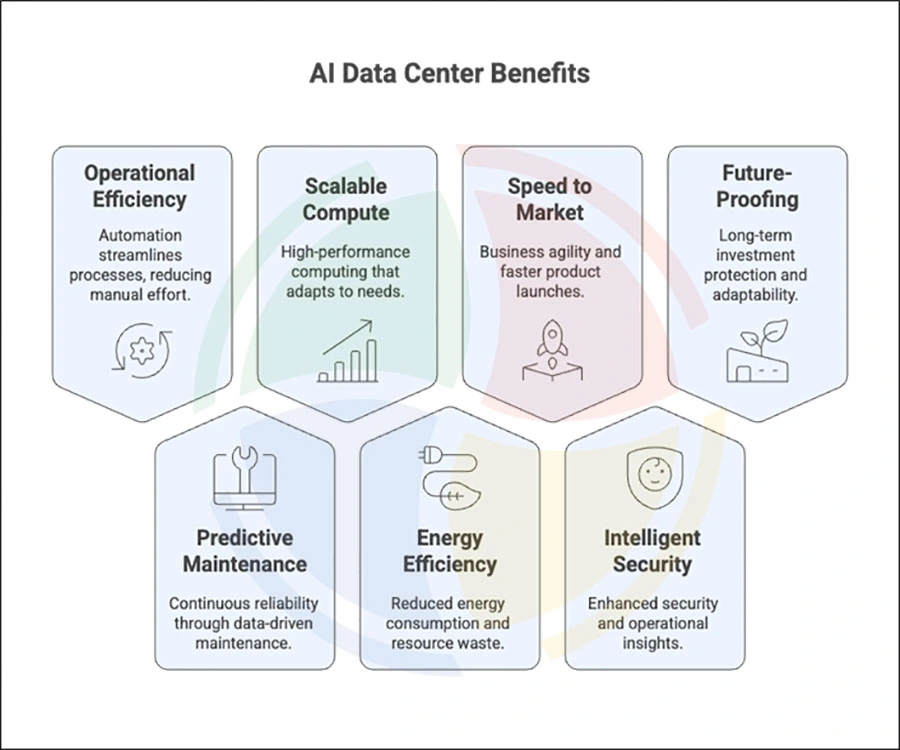
1. Operational Efficiency and Automation
AI workloads demand fast, precise, and adaptive operations, something traditional data centers cannot consistently deliver. AI data centers introduce automation at every tier, eliminating manual bottlenecks and accelerating throughput.
How productivity improves:
- AI-driven monitoring continually tracks power, temperature, and GPU utilization across thousands of sensors, enabling proactive decision-making without human intervention.
- Automated workload placement distributes training and inference tasks intelligently, ensuring GPUs never sit idle and peak performance is consistently achieved.
- Smart cooling automation dynamically adjusts airflow or liquid flow based on heat signatures, cutting energy waste and maintaining optimal performance conditions.
2. Predictive Maintenance and Continuous Reliability
When AI workloads stall, the productivity losses are immediate, making predictive maintenance in data centers essential for uninterrupted operations. AI-ready facilities use predictive maintenance to prevent disruptions before they happen.
How productivity improves:
- Real-time anomaly detection spots fluctuations in power, thermal behavior, fan activity, and component vibration before they cause outages.
- Predictive analytics calculate remaining useful life (RUL) for hardware, ensuring timely replacements and optimized maintenance schedules.
- Automated repair window planning reduces service interruptions by aligning fixes with non-peak operating hours.
3. Scalable, High-Performance Compute
Modern AI training involves billions of parameters, and GPU-accelerated data centers are purpose-built to manage these demands without bottlenecks.
How productivity improves:
- Seamless horizontal GPU scaling lets you add nodes without redesigning your architecture, accelerating capacity expansion.
- Distributed training frameworks allow large models to run in parallel across multiple clusters to shorten training cycles.
- High-throughput pipelines minimize delays during data ingestion, preprocessing, and inference.
4. Energy and Resource Efficiency
Power constraints directly limit compute productivity. AI data centers use intelligent energy management to ensure stability while reducing operational costs.
How productivity improves:
- AI-optimized workload placement reduces thermal hotspots and power spikes, enhancing equipment longevity.
- Advanced cooling (immersion, rear-door heat exchangers) enables significantly higher heat density, allowing denser GPU deployments in the same footprint.
- AI-managed PUE optimization helps facilities reach industry-leading PUE values of 1.1-1.2, translating into more predictable performance during heavy workloads.
5. Speed to Market and Business Agility
AI outcomes depend on how quickly models move from experimentation to deployment. AI data centers streamline this entire lifecycle.
How productivity improves:
- Instant provisioning lets teams spin up or scale down GPU clusters on demand, eliminating the need for approvals and waiting on hardware readiness.
- Real-time data throughput supports continuous model updates, immediate inference, and faster analytics.
- Parallel GPU clusters allow multiple teams to run experiments simultaneously without resource contention.
6. Intelligent Security and Operational Insights
Security is foundational to productivity—breaches halt operations, delay development, and erode trust. AI data centers use machine learning to reinforce protection without adding operational burden.
How productivity improves:
- AI anomaly detection monitors network traffic, identity access, and compute patterns, offering real-time visibility and automated risk mitigation.
- Automated threat isolation prevents lateral movement, reducing recovery time from potential attacks.
- Predictive intelligence identifies risk patterns early, strengthening cyber resilience.
7. Long-Term Reliability and Value Assurance
AI is evolving rapidly—from foundation models to multimodal systems and real-time inference. AI data centers give you the flexibility to grow without redesigning your infrastructure every few years.
How productivity improves:
- Modular expansion supports new accelerators and higher-density racks with minimal disruption.
- Software-defined infrastructure enables rapid reconfiguration for new AI frameworks or architectures.
- Forward-compatible power and cooling ensure your facility can support next-gen GPU generations and 100kW+ racks.
Use Cases That Illustrate Productivity Gains
To understand the real impact of AI-ready infrastructure, it is crucial to understand how leading organizations are already using these capabilities.
These examples show how AI data centers directly elevate productivity, speed, and decision-making across the business.
Predictive Cooling in Hyperscale Facilities
AI-driven thermal optimization models dynamically adjust cooling behavior in response to real-time temperature and airflow conditions. Global innovators like Google and Meta have demonstrated how automated cooling intelligence can meaningfully reduce overhead, freeing up energy capacity that can be redirected toward compute-intensive AI workloads.
Automated Workload Scheduling
Instead of manually distributing tasks across GPU clusters, AI-based orchestration continuously evaluates demand, system health, and resource availability. Enterprises adopting this approach achieve significantly higher compute utilization, with minimal waste.
Accelerated Model Training
AI clusters designed for high-speed parallelism substantially reduce the training time for complex models. What previously required weeks of compute time can now be completed in days, unlocking faster iteration cycles and enabling your teams to bring innovations to market far sooner.
Enhanced Analytics Throughput
AI-optimized networking and data pipelines support real-time ingestion, processing, and insight generation. Industries that rely on rapid, data-driven decision-making—such as finance, healthcare, and logistics—see immediate productivity gains as teams move from reactive analysis to proactive, real-time intelligence.
Considerations and Best Practices
Modernizing your infrastructure for AI is a strategic transformation that touches architecture, operations, and team capabilities. To ensure your AI data center delivers sustained productivity gains, you need a clear roadmap that balances technical readiness with long-term scalability.
Here are the key considerations that help you create an infrastructure built for long-term productivity:
Assess Infrastructure Readiness
Start by evaluating whether your existing environment can support high-density GPU workloads. This includes reviewing power availability, cooling efficiency, and rack-level capacity—foundational elements that determine how effectively AI systems will perform.
Align Design With Workload Requirements
AI workloads vary widely, and training tasks need high throughput and large parallel compute clusters, while inference emphasizes low latency and rapid response times. Aligning your design with your dominant workload profile ensures optimal efficiency from day one.
Integrate Monitoring and Automation Early
AI data centers operate best when intelligence is built into every operational layer. Incorporate ML-enabled monitoring, automated thermal management, and smart workload orchestration to reduce manual intervention and keep performance consistent.
Adopt a Modular, Scalable Architecture
A modular approach gives you the flexibility to expand without disruption. Whether you’re adding GPU pods, boosting storage, or extending network fabric, modular design accelerates deployment cycles and keeps your infrastructure future-ready.
Prioritize Sustainability and Efficiency
Energy optimization is no longer optional. Sustainable AI data centers prioritize low PUE, renewable integration, and responsible power usage.
Upskill Your Teams for AI Operations
AI-driven infrastructure demands new expertise. Equip your teams with skills in GPU optimization, ML-based monitoring tools, and AI-friendly resource planning. Strong technical capabilities ensure smooth operations and stronger ROI.
Track the Metrics That Matter
Establish KPIs such as compute utilization, latency improvements, downtime reduction, and energy efficiency. Continuous measurement helps you identify bottlenecks—creating a cycle of improvement that boosts productivity over time.
How AI Data Centers Drive Enterprise Productivity
AI-ready infrastructure reshapes how your teams work, make decisions, and deliver value across the organization.
The table below highlights the core ways AI data centers strengthen enterprise-wide productivity:
| Capability | How It Works | Productivity Impact |
| Faster Model Deployment & Product Innovation | Shorter model training cycles, automated resource provisioning, and high-performance parallel computing. | Reduced time-to-market and faster development of AI-driven features and products. |
| Predictive Operations & IT Efficiency | AI automates monitoring, resource allocation, and anomaly detection across the infrastructure. | IT teams can focus on strategic initiatives instead of routine operational tasks. |
| Data-Driven Insights & Better Decision-Making | Real-time analytics enabled by optimized throughput and low-latency data pipelines. | Faster, more accurate decisions across business functions. |
| Reliable Infrastructure & Enhanced User Experience | Intelligent load management, high uptime, and consistent low-latency performance. | Seamless experiences for employees and customers across digital applications. |
Key Challenges and Practical Trade-Offs to Consider
While AI data centers unlock significant long-term value, transitioning to this advanced infrastructure does come with a few strategic challenges you need to plan for. Addressing these early helps you build a foundation that’s resilient, efficient, and ready to scale.
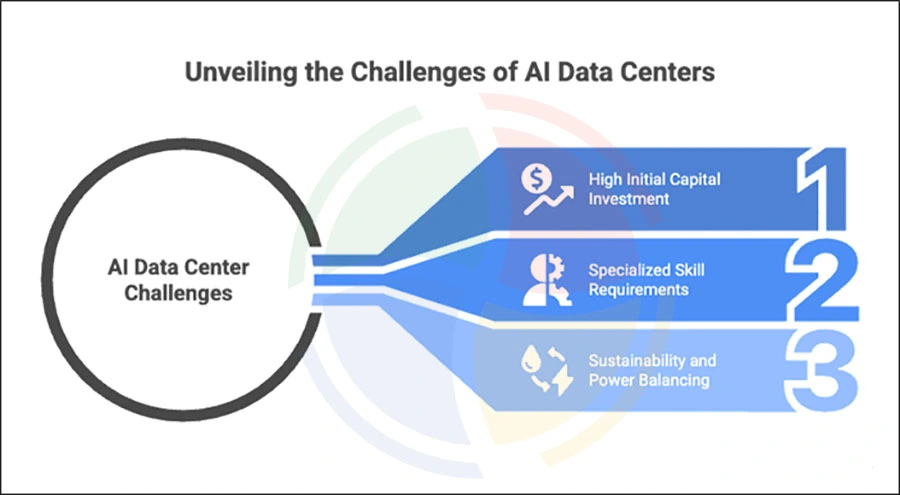
High Initial Capital Investment
Building high-density AI data centers requires robust electrical, cooling, and rack designs, which significantly increase initial infrastructure investment. Although the initial CapEx is high, it sets the stage for sustained performance and future-proof growth.
Specialized Skill Requirements
AI infrastructure introduces operational complexities—from GPU optimization to ML-driven monitoring. Many organizations face talent gaps, making upskilling and targeted hiring critical to long-term success. You can strengthen your team by choosing to hire AI developers for your infrastructure needs.
Sustainability and Power Balancing
As power density increases, maintaining environmental efficiency becomes more challenging. Achieving the right balance between performance and sustainability requires thoughtful design choices and continuous optimization.
These challenges are short-term considerations in the broader journey toward operational excellence. Once implemented, AI-ready data centers deliver significant gains in cost efficiency, scalability, speed, and innovation—far surpassing the initial hurdles.
Connect your AI-ready data center hardware with intelligent orchestration, automation, and real-time monitoring to maximize efficiency, uptime, and productivity. Experts at Aegis Softtech can guide you through generative ai solutions to design and implement AI-optimized backend systems.
Why Enterprises Need to Act Now on AI-Ready Infrastructure
Building an AI Data Center requires the precise orchestration of high-density compute, intelligent automation, and sustainable engineering.
As AI workloads accelerate and analysts project that AI-optimized infrastructure will underpin most new enterprise applications within the next few years, organizations that act now secure a clear productivity and competitiveness edge.
With Aegis Softtech as your technology partner, you gain access to decades of engineering expertise to design, modernize, and optimize GPU-driven environments that deliver consistent performance, energy efficiency, and long-term scalability.
Explore our AI integration services to embed AI-driven automation and intelligence directly into your infrastructure.
Every solution is engineered for agility, security, and sustainability, ensuring your AI investments deliver measurable operational impact.
Book a free 30-minute consultation with our AI infrastructure experts and take the first step toward building your future-ready AI data center.
FAQs
1. What distinguishes an AI data center from a traditional one?
AI data centers are optimized for GPU/TPU workloads, low-latency networking, and high-density rack designs, unlike CPU-centric traditional centers.
2. How do AI data centers improve productivity?
They automate operations, enable predictive maintenance, and accelerate AI workloads, reducing downtime and time-to-market.
3. Can existing data centers be upgraded for AI workloads?
Yes. Through retrofitting with GPU nodes, enhanced cooling, and intelligent orchestration systems, legacy data centers can be AI-enabled.
4. What challenges should businesses expect during implementation?
High setup costs, specialized skills, and complex power/cooling management. However, long-term performance and efficiency gains outweigh these challenges.