
Every AI data center you operate functions like a living organism—breathing power, circulating coolant, and processing information nonstop.
But what happens when even one system falters?
Heat rises, workloads slow down, and efficiency drops before you even notice the warning signs.
As your AI clusters become denser and more power-intensive, even a small imbalance can snowball into major downtime. Traditional maintenance models can’t match the speed and precision that high-density environments require.
That’s why your modern operations depend on AI business solutions for data center maintenance, built on prediction, automation, and continuous intelligence.
In this blog, you’ll explore how predictive systems, advanced cooling, and intelligent monitoring help you sustain uptime and future-proof your AI data center operations.
Key Takeaways
- AI-scale data centers run nonstop, GPU-heavy workloads that demand precise cooling, stable power, and intelligent telemetry to ensure reliability in high-density environments.
- Key maintenance pillars: Predictive analytics, structured preventive routines, condition-based monitoring, and real-time DCIM/CMMS visibility to minimize downtime and extend equipment lifespan.
- High-density requirements: Specialized maintenance for liquid cooling loops, power distribution systems, and high-throughput networking to prevent thermal hotspots, performance drops, and cascading failures.
- Operational enablers: Integrated DCIM–CMMS workflows, redundancy and failover testing, skilled cross-functional teams, strong security controls, and continuous energy-efficiency optimization.
- Overall impact: AI-driven, proactive maintenance ecosystems deliver higher uptime, reduced MTTR, improved resource utilization, and long-term operational resilience for AI-optimized data centers.
Why AI-Scale Data Center Maintenance Demands a New Approach
AI has changed how your data center runs. Unlike traditional enterprise workloads that rise and fall with user traffic, AI training and inference operate continuously, driving sustained, compute-heavy loads. Racks packed with hundreds of GPUs can draw 40-80 kW each, creating power and heat levels far beyond what legacy systems can handle.
The nonstop operation forces you to rethink your entire maintenance strategy. You now face three major shifts:
- Thermal sensitivity: Even slight changes in temperature or coolant flow can quickly degrade performance or trigger cascading shutdowns across your cluster.
- Continuous utilization: Maintenance windows are limited, so your redundancy and scheduling must be smarter.
- Complex interdependence: Cooling, power, and networking systems are tightly linked, so a failure in one can stop workloads instantly.
That’s why operators like you are adopting predictive, condition-based maintenance powered by real-time telemetry and machine learning.
Core Data Center Maintenance Best Practices
Running an AI data center requires maintenance that anticipates issues and prevents failures. Your strongest strategies blend intelligence, discipline, and redundancy to sustain uptime in high-density environments.
Here are the core practices that define world-class maintenance:
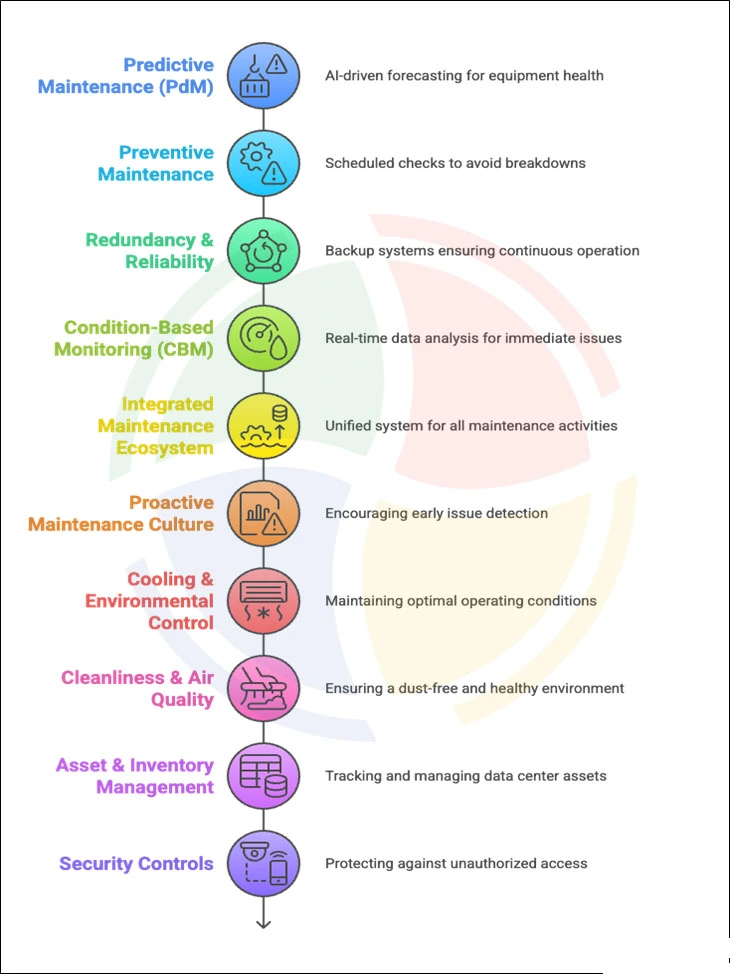
1. Adopt Predictive Maintenance (PdM)
Predictive maintenance is essential in AI-scale environments where cooling, power, and network systems operate under extreme loads. By analyzing real-time data such as coolant flow rates, pump pressure, UPS battery trends, optical power variations, and network latency, AI models surface early signals. These indicators appear long before they impact uptime.
The proactive intelligence allows you to prevent failures, stabilize GPU performance, and maintain continuous availability across high-density clusters.
Key benefits of predictive maintenance include:
- Early anomaly detection that prevents unplanned downtime
- Better workforce utilization by focusing technicians where truly needed
- Longer equipment lifespan by operating within optimal thresholds
- Reduced maintenance expenses through fewer emergency repairs
2. Implement Comprehensive Preventive Maintenance
Preventive maintenance reinforces the physical integrity of your infrastructure. In AI data centers, it implies routine actions such as fluid chemistry analysis, leak and manifold testing, condenser cleaning, breaker and switchgear inspections, and end-to-end fibre checks.
Combined with consistent firmware updates across NICs, switches, and power systems, preventive maintenance builds the operational discipline required to sustain reliability in dense, thermally demanding environments.
A strong preventive maintenance plan should include:
- Visual and mechanical inspections across power, cooling, and rack infrastructure
- Air and fluid filter replacements to maintain airflow and protect liquid-cooled systems
- Firmware and software patching to reinforce stability and security
- Sensor calibration and relay testing for accurate environmental monitoring
- Documentation aligned with ISO 9001 and Uptime Institute standards
3. Strengthen Redundancy and Reliability
Redundancy must be engineered across cooling, power, and networking layers to ensure uninterrupted AI workloads. This includes validating backup chillers and cooling loops, testing redundant UPS and PDU paths, and verifying seamless failover across alternate fiber routes.
With structured redundancy testing, your systems absorb equipment failures without compromising training throughput or inference stability.
Key redundancy practices include:
- Running failover tests for generators, UPS systems, and PDUs
- Simulating network link or switch failures to verify seamless traffic rerouting
- Documenting test outcomes and corrective actions for audit readiness
- Including redundancy validation in routine maintenance cycles
4. Employ Condition-Based Monitoring (CBM)
CBM provides real-time responsiveness by triggering actions only when conditions deviate from acceptable thresholds. IoT sensors and DCIM platforms continuously track liquid cooling pressure, transformer oil contamination, UPS thermal patterns, and optical signal quality.
Immediate alerts enable your team to intervene before small anomalies—such as coolant imbalance or fiber attenuation—affect high-performance GPU operations.
Condition-based monitoring ensures:
- Timely interventions driven by real operating conditions
- Efficient use of maintenance resources
- Minimal disruption to ongoing AI workloads
5. Integrate Predictive, Preventive, and Condition-Based Approaches
The highest reliability is achieved by combining all three maintenance models into a unified, automated ecosystem. Predictive insights forecast pump degradation or network packet loss, while preventive schedules maintain optimal conditions for cooling fluids, filters, and UPS components. Meanwhile, CBM provides real-time detection of thermal or optical anomalies.
A centralized DCIM or CMMS platform ties everything together, creating a self-correcting maintenance cycle that evolves with your infrastructure demands.
An integrated maintenance ecosystem includes:
- Predictive models that analyze performance trends
- Preventive schedules that maintain physical integrity
- Condition-based triggers that detect real-time anomalies
- A central DCIM or CMMS platform that unifies all maintenance inputs
6. Build a Culture of Proactive Maintenance
Sustained reliability depends on teams that are trained, aligned, and future-ready. A proactive culture brings electrical, mechanical, and IT teams together, enabling shared understanding of liquid cooling systems, high-speed interconnects, high-density power distribution, and emerging automation technologies.
Clear ownership, cross-functional expertise, and continuous learning position maintenance as a strategic capability, not just an operational function.
A proactive maintenance culture should include:
- Cross-functional training to improve coordination
- Regular learning sessions on new cooling and automation technologies
- Clear ownership of maintenance processes across teams
- Leadership support for position maintenance as a strategic function
7. Maintain Optimal Cooling and Environmental Control
Effective thermal management is foundational for high-density AI workloads. Maintaining ASHRAE-compliant temperature and humidity ranges ensures consistent GPU performance and prevents premature equipment degradation. Implementing airflow strategies and cooling redundancies minimizes hotspots and stabilizes rack-level operations.
Key environmental control practices include:
- Maintaining temperatures between 64.4°F and 80.6°F (18°C–27°C)
- Keeping the relative humidity between 40% and 60%
- Using hot/cold aisle containment to optimize airflow
- Deploying liquid cooling or hybrid cooling for dense racks
- Implementing N+1 or 2N cooling system redundancy
8. Enforce Cleanliness and Air Quality Standards
Dust accumulation and contaminated airflow are leading causes of hardware inefficiency and failure. A disciplined cleaning regimen protects sensitive components, preserves thermal performance, and maintains optimal airflow for both air-cooled and liquid-cooled environments.
A strong cleanliness program should include:
- Scheduled cleaning of raised floors, overhead trays, and rack environments
- HEPA-filter vacuuming to remove particulates without static risks
- Anti-static cleaning tools for servers and network gear
- Regular HVAC inspections and filter replacements
- Air quality monitoring in high-density zones
9. Strengthen Asset and Inventory Management
AI data centers depend on precise lifecycle visibility across cooling units, power systems, networking hardware, and GPUs. An asset management program helps anticipate component aging, streamline replacements, and ensure rapid recovery during failures.
Effective asset management practices include:
- Tracking lifecycle age, health, and utilization of all critical hardware
- Maintaining an inventory of spare components for fast swap-outs
- Using CMMS/DCIM platforms to centralize asset metadata
- Recording performance degradation trends to guide replacement planning
- Aligning asset lifecycle cycles with planned modernization initiatives
10. Implement Multi-Layered Security Controls
Security is a non-negotiable layer of operational reliability. Physical protection, network hardening, and access governance ensure infrastructure integrity and safeguard high-value AI workloads.
Core security best practices include:
- Biometric or keycard-based access controls for restricted zones
- 24/7 CCTV monitoring with retention policies
- Firewalls, IDS/IPS, and segmentation for network security
- End-to-end data encryption for sensitive pathways
- Logging and auditing of all physical and digital access events
11. Develop and Test Disaster Recovery (DR) and Incident Response Plans
Operational resilience depends on a validated DR strategy that ensures rapid restoration during outages, cyber events, or environmental disruptions. Regular testing helps teams understand roles, refine workflows, and reduce recovery times.
A comprehensive DR program includes:
- Documented procedures for power loss, cyberattacks, cooling failures, and facility incidents
- Scheduled DR drills and tabletop exercises
- Clear ownership of response roles across facilities and IT teams
- Replication strategies for mission-critical data
- Post-incident reviews to update the DR playbook
12. Ensure Compliance and Audit Readiness
Regulatory adherence and audit documentation reinforce operational discipline and provide external validation of safety, reliability, and security controls. Proper recordkeeping also helps identify long-term maintenance patterns.
Compliance best practices include:
- Aligning with ISO 27001, ISO 9001, and Uptime Institute recommendations
- Maintaining detailed logs for maintenance, inspections, and audits
- Documenting security, cooling, and power system changes
- Ensuring traceability for all maintenance and configuration updates
- Preparing for periodic third-party audits
13. Practice Sustainability and Energy Efficiency
AI data centers operate at extreme power densities, making sustainability both a cost strategy and an operational imperative. Energy-efficient cooling, optimized workflows, and responsible hardware disposal reduce environmental impact while controlling operational costs.
Sustainability initiatives include:
- Monitoring and improving Power Usage Effectiveness (PUE)
- Optimizing chilled water, immersion, or liquid cooling efficiencies
- Decommissioning and recycling IT equipment responsibly
- Leveraging heat reuse systems where feasible
- Implementing energy-efficient airflow and containment designs
Operational Best Practices
Once your predictive and preventive maintenance strategies are in place, the next step is ensuring that day-to-day operations run with precision and consistency.
These best practices strengthen visibility, security, and workforce capability, ensuring your AI data center remains efficient, resilient, and audit-ready:
- Leverage centralized management tools to gain unified visibility and automate workflows. Integrate DCIM with CMMS, automate sensor-triggered work orders, track assets in real time, and maintain lifecycle documentation to reduce manual oversight, accelerate response times, and improve data-driven decisions.
- Prioritize physical and cyber security by implementing biometric/RFID access controls, ensuring full camera coverage, enforcing strict firmware update processes, and performing regular penetration tests. This strengthens overall security and minimizes risks of unauthorized access or cyber threats.
- Invest in skilled personnel by training your team on SOPs/EOPs, providing vendor-specific sessions for cooling, UPS, and GPU systems, upskilling them on predictive analytics tools, and collaborating with external experts. This improves troubleshooting accuracy, speeds up problem resolution, and boosts operational reliability.
- Maintain a high-quality spare-parts inventory by stocking critical components on-site or through bonded logistics partners and tracking inventory automatically. Keeping essential items like CDUs, PDU boards, GPU trays, sensors, and pump assemblies ensures faster recovery, fewer procurement delays, and better lifecycle management.
- Monitor energy efficiency by tracking PUE and COP, calibrating sensors, fine-tuning setpoints, upgrading inefficient chiller or pump components, and exploring waste-heat reuse options. This lowers energy costs, reduces carbon footprint, and improves sustainability performance.
Maintenance Schedule Template
With a structured, proactive schedule, you bring order to complex maintenance operations. Below is a sample scheduling framework you can use for AI-intensive environments:
| Frequency | Focus Area | Sample Tasks |
| Daily | Monitoring | Review DCIM dashboards, verify telemetry integrity, and clear alarms |
| Weekly | Cooling | Check coolant levels and pump pressures, inspect CDU filters |
| Monthly | Power | Conduct UPS diagnostics, inspect cables, and perform infrared scans |
| Quarterly | Firmware & Hardware | Update firmware, clean GPU fans, check rack-level thermals |
| Annually | Full System Stress Test | Load test generators and UPS, perform full redundancy and failover testing, and review MTBF/MTTR logs |
Key Metrics & KPI Tracking During Maintenance
Tracking quantitative metrics helps you verify that your maintenance practices are genuinely improving operational performance. Below are the essential KPIs you should monitor for ongoing performance measurement:

- MTTR (Mean Time to Repair): Helps you understand how efficiently you can recover from system faults.
- MTBF (Mean Time Between Failures): Indicates the overall reliability of your AI infrastructure.
- Predictive Maintenance Accuracy: Shows the percentage of accurate fault predictions and reflects how well your AI models are performing.
- Unplanned Downtime (hours/year): Gives you a direct measure of operational resilience and service continuity.
- PUE and Cooling COP Trends: Help you track and validate improvements in energy efficiency over time.
- Spare-Parts Fill Rate: Ensures you always have the right components available for rapid maintenance interventions.
Challenges & Trade-Offs to Consider
While modern maintenance frameworks offer major advantages, you still need to address several critical challenges:
- Skills Gap: Liquid cooling and HPC systems require hybrid mechanical–IT expertise that your traditional data center teams may not yet have.
- Hardware Compatibility: You must coordinate firmware versions, drivers, and vendor-specific management tools, which can complicate daily operations.
- Vendor Lock-In vs. Open Standards: Proprietary monitoring or orchestration platforms may limit your ability to integrate open tools and future technologies.
- High CAPEX: Building redundancy, deploying AI-driven analytics, and maintaining a strong spare-parts inventory demand high upfront investment.
- Cost vs. Risk Balance: Over-maintaining your environment wastes budget, while under-maintaining it exposes you to severe outages and cascading failures.
Building Reliable AI Data Centers with Aegis Softtech
As AI workloads grow more complex and energy-intensive, data center maintenance must be predictive, data-driven, and continuous—built around the principles of reliability, visibility, and performance optimization. Leading data centers today proactively prevent issues through intelligent, automated maintenance systems.
Aegis Softtech helps you build that resilience. Our AI Engineers bring deep expertise in AI infrastructure operations—from GPU cluster optimization and liquid cooling maintenance to predictive analytics and full DCIM/CMMS integration. We align engineering precision with business continuity, helping your data center operate at peak efficiency.
FAQs
1. How is AI used in data centers?
AI enhances data center operations through intelligent workload scheduling, energy optimization, and predictive maintenance. It dynamically balances cooling, power, and compute loads for consistent efficiency.
2. How is AI being used in maintenance?
AI algorithms process sensor and log data to predict equipment failures, automate diagnostics, and optimize maintenance schedules—improving accuracy and reducing unplanned downtime.
3. What are the types of data center maintenance?
Common types include preventive maintenance (routine servicing), predictive maintenance (AI-driven failure forecasting), and corrective maintenance (post-failure repair). Hybrid frameworks combine all three to maximize reliability.
4. What is an AI-optimized data center?
An AI-optimized data center is purpose-built for GPU-heavy workloads, featuring high-density racks, liquid cooling, intelligent power distribution, and automated maintenance systems that ensure continuous performance and reliability.