
You know the drill: financial services firms generate mountains of data, but extracting real intelligence often takes longer than making the money itself.
Snowflake Cortex AI was built to break that bottleneck. It is an AI suite that lets you run LLMs, search, and automation without moving data or loosening controls.
For institutions that demand airtight compliance, Cortex AI offers a modern way to deploy enterprise-grade intelligence while keeping governance intact.
Read on to know how to use Snowflake Cortex AI for financial services, how it works, key features, and how much you should plan to invest.
Key Takeaways
- Definition:
Cortex AI runs inside Snowflake’s governed environment, bringing LLMs, agents, and AI functions to where your data already lives
- Key features:
Cortex Agents and orchestration; AISQL and Document AI; native LLM access; MCP Server integrations; Intelligence Interface.
- Use Cases:
Real-time fraud and AML, KYC automation, quant research, underwriting, claims, trading, and regulatory reporting.
- Pricing:
Consumption-based pricing that varies by model size and edition.
- Implementation path:
Pilot a focused use case, prep core Snowflake tables, build an initial agent, then scale to risk/fraud/research.
- Future Trends:
Smarter automation, deeper personalization, and real-time decision engines as new Cortex capabilities move from preview to GA.
- Key Stat:
Projected financial services AI spending to reach $93 billion by 2027 (29% CAGR since 2023)
What is Snowflake Cortex AI for Financial Services?
Snowflake Cortex AI for financial services is a fully managed suite of LLMs, AI functions, agents, APIs, and intelligent automation tools delivered inside the Snowflake Data Cloud. It helps financial institutions apply AI directly where their data already lives without pipelines, data migration, or external API risks.
For banks, insurers, and fintechs, this “AI meets data where it lives” model is a major shift from traditional AI.
Traditional AI typically demands complex infrastructure, cross-cloud transfers, and heavy engineering support; Cortex AI removes all of that friction.
Key Features of Snowflake Cortex AI
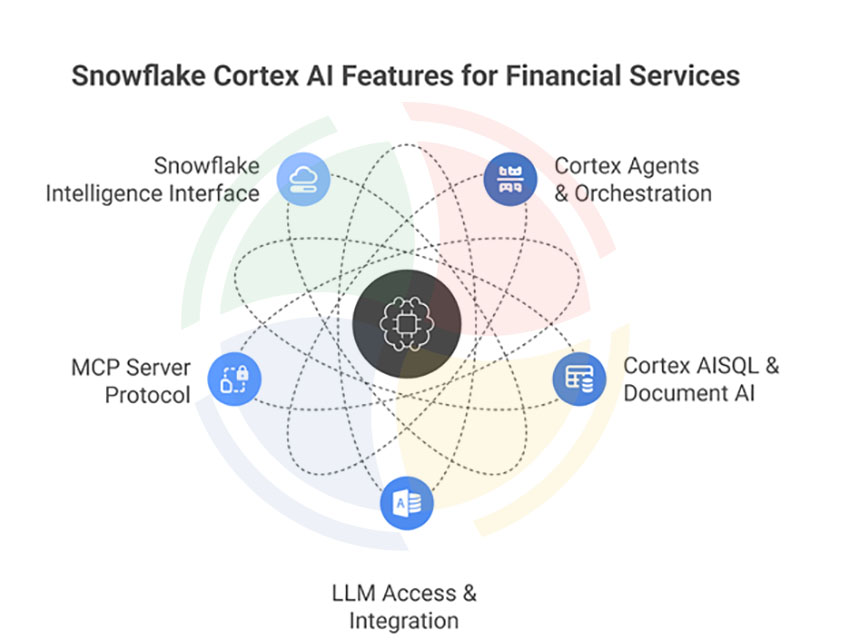
Here are the key features of Snowflake Cortex AI:
1. Cortex Agents & Orchestration
Autonomous agents that plan and execute multi-step workflows with minimal human intervention.
Agents can orchestrate tasks such as research, document analysis, or multi-dataset reasoning.
The Data Science Agent automates data cleaning, feature engineering, and model prototyping.
2. Cortex AISQL & Document AI
AI functions are embedded directly in SQL for transforming unstructured data into structured, actionable insights. This feature can analyze PDFs, transcripts, and reports directly in Snowflake.
3. LLM Access & Integration
This feature bridges Snowflake security and native access to leading LLMs, without external API calls.
OpenAI GPT, Anthropic Claude, Mistral, and Meta Llama all run inside Snowflake’s governed environment.
4. MCP Server Protocol
It is a standardized connectivity layer linking Snowflake to external AI platforms and enterprise systems.
It can connect to 20+ tools like Salesforce Agentforce, UiPath, Workday, and CrewAI.
5. Snowflake Intelligence Interface
Snowflake Intelligence Interface is a conversational analytics layer that lets users query data in natural language.
With this feature, no SQL is required; business teams can ask questions directly.
8 High-Impact Use Cases of Cortex AI in Financial Services
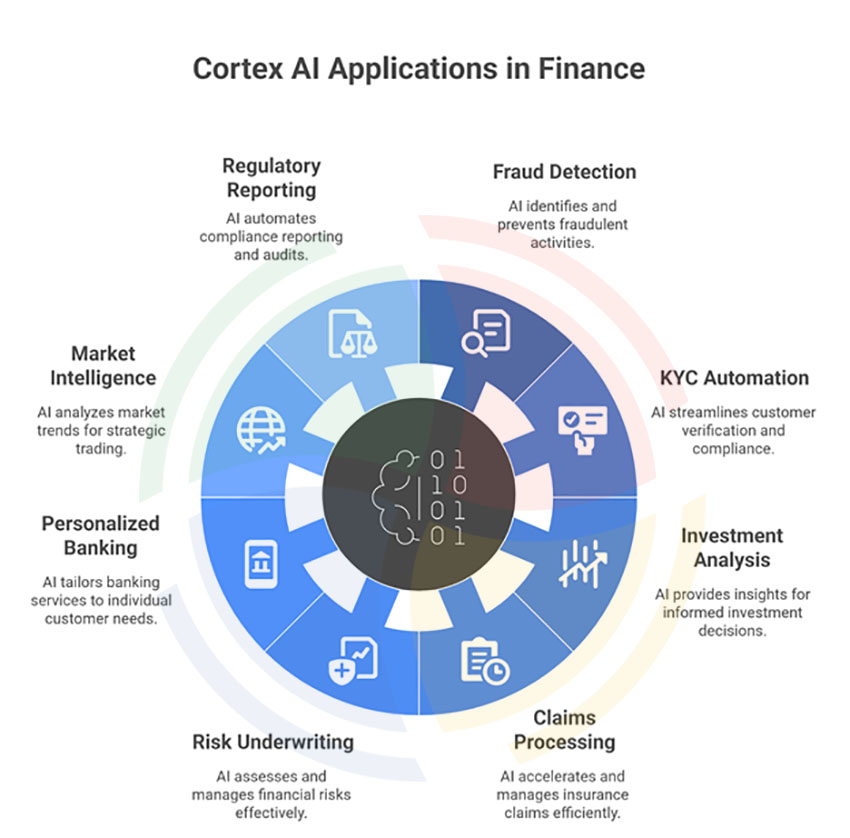
TL;DR: Snowflake Cortex AI’s Financial Use Cases at a Glance
| Use Case | Primary Benefit | Time Savings | Compliance Impact |
| Fraud & AML | Real-time anomaly detection | 50–70% faster reviews | High |
| KYC | Automated onboarding | 40–60% reduction | Very High |
| Quant Research | Faster insights | Hours → minutes | Medium |
| Claims | Faster settlements | Days → hours | Medium |
| Underwriting | Better decisions | 30–40% faster | High |
| Customer 360 | Personalization | Continuous | Medium |
| Market Intelligence | Trading precision | Instant | Low–Medium |
| Regulatory Reporting | Accurate filings | 60–80% automation | Very High |
Below is a deep dive into the eight high-impact, real-world use cases reshaping financial services:
#1: Fraud Detection & Anti-Money Laundering (AML)
Cortex AI enables real-time transaction monitoring by running ML inference directly in Snowflake.
- Detect anomalies across millions of transactions
- Auto-generate SAR reports with grounded evidence
- Use contextual understanding to reduce false positives
- Spot complex laundering patterns that rule-based systems miss
Banks can shrink investigation time from hours to minutes while improving regulatory confidence.
— Data Scientist, Aegis Softtech
#2: Know Your Customer (KYC) & Compliance Automation
KYC doesn’t have to be a document drudgery exercise. Cortex AI handles:
- Automated ID verification and document extraction
- Regulatory workflows for DORA, MiFID II, and more
- Continuous screening against sanctions and PEP lists
- Complete audit trails with lineage and explainability
Firms cut onboarding time while maintaining airtight compliance.
#3: Quantitative Research & Investment Analysis
Portfolio teams get to do more with Cortex AI. It can:
- Analyze earnings calls, analyst notes, and filings in seconds
- Generate investment ideas using datasets like FactSet, MSCI
- Run market sentiment analysis from global news flows
- Speed up backtesting with AI-assisted modeling
Plus, reliable Snowflake consulting accelerates the insight-to-decision pipeline—critical in fast-moving markets.
#4: Insurance Claims Processing & Management
Insurers streamline the entire claims lifecycle:
- Automate FNOL → settlement
- Assess damage from images and reports using LLM + vision models
- Identify fraudulent claims early
- Cut cycle times from days to hours
Policyholders get faster resolutions; insurers reduce leakage.
#5: Risk Underwriting & Credit Decisioning
Underwriters tap into Cortex AI to evaluate risk with far richer context:
- Automated loan application parsing
- Property risk insights from text, images, and structured data
- Enhanced credit scoring with alternative datasets
- Instant risk assessment for quicker approvals
Better data → better decisions → better portfolios.
#6: Customer 360 & Personalized Banking
Cortex AI powers hyper-personalized banking:
- Unified profiles across retail, wealth, and commercial banking
- Next-best-action recommendations
- Product suitability predictions
- Scalable personalized wealth advice
Great for CX, great for retention.
#7: Market Intelligence & Trading Operations
Traders gain an AI-augmented command center:
- Real-time sentiment from AP, Reuters, social feeds
- Automated trade reconciliation
- Predictive volatility analytics
- Algorithmic trading signal generation
Cortex helps convert raw news into tradable insights.
#8: Regulatory Reporting & Audit Automation
Regulation is constant; automation makes it manageable:
- Generate filings for CCAR, Basel III, liquidity reports
- Track data metrics for audits
- Analyze and update policy documents automatically
- Validate compliance across jurisdictions
Firms reduce operational risk while improving reporting accuracy.
Why Financial Services Need Purpose-Built AI Solutions
Financial institutions need AI that understands their world:
- Complex regulations
- Fragmented data
- High-stakes decisioning
- Zero-room-for-error security.
That’s why purpose-built platforms like Snowflake Cortex AI for financial services are becoming essential.
Most firms aren’t struggling with AI ideas, but with AI execution.
Countless proofs of concept never make it to production because the underlying data is scattered across silos. Add the pressure of regulatory expectations, including explainability, audit trails, retention policies, and the fact that generic LLMs simply can’t operate safely or accurately.
Financial data also carries higher privacy, data governance, and lineage requirements. And unlike consumer AI use cases, financial models require domain-specific context. The difference between a market-neutral position and a hedged position isn’t something a generic model “just knows.”
Purpose-built AI solves these gaps by meeting the industry where it operates—in highly governed, compliant, security-first environments built around the financial data lifecycle.
All you have to do is consolidate your data into Snowflake and prepare it for Cortex AI through Snowflake migration, without disrupting trading, risk, or finance operations
Benefits of Cortex AI for Financial Institutions
Here are some of the many benefits of Snowflake Cortex AI for financial institutions:
| Benefit Area | What Cortex AI Delivers |
| Accelerated Time-to-Value | Deploy production-ready AI apps in weeks; eliminate custom infra. Analysts cut research time from hours → seconds using automated insights. |
| Enhanced Regulatory Compliance | Meets EU DORA, ISO 27001/42001, SOC 1/2, PCI DSS. Cortex provides full audit trails, policy controls, and explainability that regulators expect. |
| Cost Optimization | No data movement, no external AI infra. Fully managed services remove DevOps overhead and streamline operations. |
| Enterprise-Wide AI Democratization | Non-technical users—portfolio managers, bankers, underwriters—access self-service AI. Scale across departments without dedicated data science teams. |
| Competitive Differentiation | Offer hyper-personalized client experiences and unlock insights by blending proprietary data with premium sources like FactSet and MSCI. |
Snowflake Cortex AI Pricing for Financial Institutions
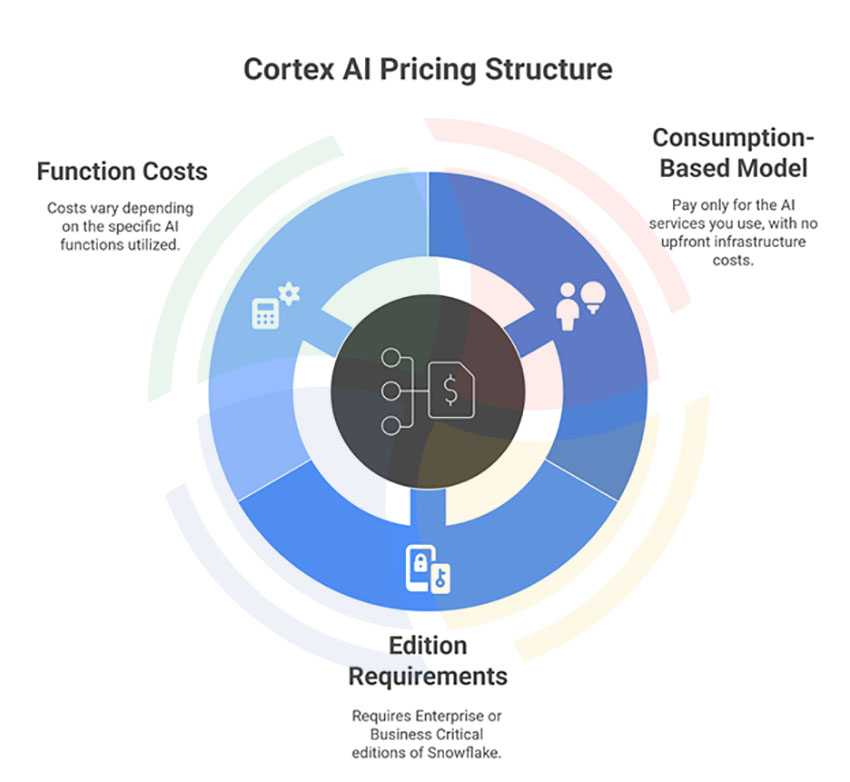
Snowflake Cortex AI uses a consumption-based, credit pricing model. Your costs scale based on compute credits, token usage for AI functions, and which Snowflake edition your compliance posture requires.
Edition & Credit Pricing
Financial institutions typically choose between Enterprise Edition or Business Critical Edition, depending on governance, security, and regulatory needs.
The edition you select sets your baseline credit rate, which influences all Cortex AI costs.
| Edition | Best For | Approx. Credit Price* | Why It Matters |
| Enterprise Edition | Banks, insurers, and wealth management teams running AI + analytics | ~$3.00-$4.65/credit | Ideal balance of cost + query performance (multi-cluster compute, governance, reliability) |
| Business Critical | Highly regulated institutions with strict compliance & data isolation | ~$4.00-$6.20/credit | Required when you need features like Tri-Secret Secure, private connectivity, DORA preparedness |
*Pricing varies by region & contract. See official Snowflake Pricing.
Cortex AI Function & LLM Token Costs
Cortext AI Functions, like SUMMARIZE, COMPLETE, CLASSIFY, or EMBED, are billed using token-based pricing. Both input and output tokens count.
Model selection has the biggest impact on cost.
| Model Size | Typical Workloads | Cost Range (per million tokens) | Notes |
| Small Models | Classification, sentiment, lightweight summarization | Lowest cost tier* | Great starting point for banks to monitor customer feedback or alerts |
| Medium Models | GPT-4.1, Llama3-70B; analysis-heavy tasks | Mid-tier pricing* | Good for regulatory summaries, KYC doc processing |
| Large Models | Claude-4-Opus; complex reasoning | Highest tier* | Use sparingly for risk assessments or narrative generation |
*Snowflake charges based on the underlying model provider; pricing varies.
— Snowflake FinOps Consultant, Aegis Softtech
Sample Cost Scenario
Suppose you analyze 1 million customer feedback entries with a small-model run:
- Token usage minimal → maybe just a few credits.
- At a credit price of ~$3, that could mean $1-$5 in credits. Very manageable.
Contrast this with large-scale document analysis or multimodal AI workflows: costs scale with token count, model size, and output volume, so you must plan carefully.
How To Use Snowflake Cortex AI for Your Financial Organization?
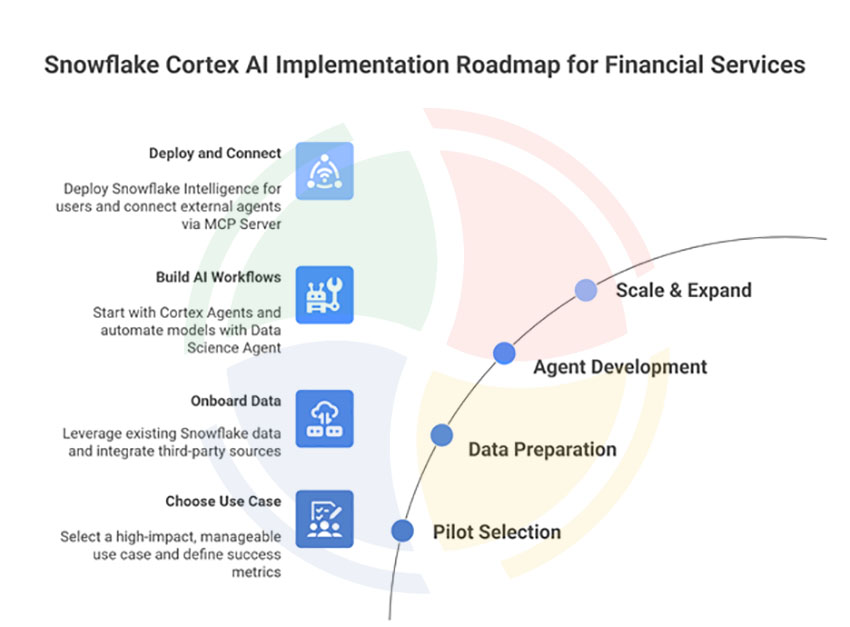
If you’ve already explored what Snowflake Cortex AI has to offer, the next natural question is: How do you actually use it inside a financial organization?
Here’s a phased approach to help you with Snowflake Cortex AI implementation:
Phase 1: Pilot Selection — Start Small, Win Fast
Begin with a focused, high-impact pilot; something that’s big enough to matter but small enough to execute quickly.
Pick a use case that’s:
- High impact (clearly tied to revenue, risk reduction, or productivity)
- Low complexity (limited stakeholders, clear data sources)
- Measurable (you can prove success with simple KPIs)
Some easy use case ideas include
- Fraud detection: Use Cortex Search + embeddings to surface unusual patterns
- Automated research: Use AISQL SUMMARIZE + COMPLETE for quick analyst briefs
- Customer insights: Classify sentiment from call transcripts
Next, define clear success metrics (e.g., reduced investigation time, accuracy improvements) and lock in a 60-90 day pilot timeline so momentum stays high.
— Head of AI Strategy, Aegis Softtech
Phase 2: Data Preparation — Use What You Already Have
You don’t need a data science team to prepare for Cortex AI. Start with the Snowflake tables you already rely on: transactions, market data, CRM logs, and compliance documents.
What to do:
- Identify the 3-5 data sources relevant to your pilot.
- Ensure they’re cleaned enough for AI to “understand” (consistent labels, defined fields).
- Add optional third-party data like FactSet or MSCI if your use case needs external signals.
Cortex Agents perform significantly better when source data is structured and searchable.
Phase 3: Agent Development — Build Your First AI Copilot
You don’t need to design an entire workflow on day one. Start with a single process your team repeats daily, and let a Cortex Agent automate the thinking steps.
Examples:
- Generate KYC summaries from multiple tables + documents
- Auto-classify suspicious transactions and route them to analysts
- Pull market insights + generate a client-ready summary
Then introduce the Data Science Agent for lightweight ML tasks like training a basic anomaly model without writing Python or provisioning compute.
Phase 4: Scale & Expand — Bring AI to the Entire Business
Once your pilot proves value, you expand safely and systematically.
Roll out Snowflake Cortex Intelligence, so non-technical teams can ask natural-language questions like, “Show me high-risk accounts from the last quarter.”
Add new agents for risk, fraud, research, and customer intelligence.
And, connect external automation tools through the MCP Server if you need workflows beyond Snowflake (e.g., ServiceNow, CRM systems).
This is where AI becomes part of daily decision-making, not just a pilot living in a corner.
What’s Next for Cortex AI in Financial Services?
The financial sector is moving fast from scattered AI experiments to truly AI-first operations.
Cortex AI is positioned right at that shift, giving financial institutions a governed, enterprise-ready path to operationalize generative AI without scrambling for new infrastructure.
The next wave is all about smarter automation, deeper personalization, and real-time decision engines built directly inside Snowflake.
We’re already seeing public preview features mature into GA releases, a sign that Cortex AI is accelerating its enterprise footprint.
The addition of Anthropic Claude Opus 4.5 inside Cortex AI raises the ceiling even higher. It will help with richer reasoning, better financial document interpretation, and more reliable agent-driven workflows.
As capabilities evolve, Cortex AI will continue shaping financial services into a landscape where AI is the operating system.
Making Compliant, High-Performance Financial AI Achievable
Snowflake Cortex AI gives financial institutions what they’ve been waiting for: secure, compliant, and scalable AI that runs where the data lives.
But getting Cortex AI right isn’t a one-time deployment. Financial AI maturity grows in phases: pilot, scale, optimization, and continuous compliance. That requires a partner who understands:
- Regulated workflows
- Data lineage expectations
- Operational realities of banking, insurance, and capital markets.
Aegis Softtech brings certified Snowflake development expertise, proven financial-sector delivery, and a long-term engagement model designed to support your AI evolution.
We help institutions build secure data foundations, production-ready Cortex agents, and cost-efficient AI architectures that withstand audits and scale with demand.
FAQs
1. Why do enterprises pair Cortex AI Snowflake to modernize regulated AI workloads?
Cortex AI Snowflake combines governed data operations with secure, efficient model execution. This integration helps Cortex AI Snowflake users accelerate trusted AI deployment across financial processes.
2. Can Cortex AI integrate with existing risk, fraud, or CRM systems?
Yes, Snowflake Cortex AI connects seamlessly to risk, fraud, and CRM systems using standardized data frameworks. This interoperability enables faster model deployment and preserves existing operational workflows.
3. What is the Snowflake Finance Rotation Program?
The Snowflake Finance Rotation Program is a structured development initiative featuring three one-year finance and accounting rotations at Snowflake. It gives early-career professionals hands-on exposure to financial operations, mentoring, and cross-functional finance tasks to build versatile financial acumen.
4. How can finance organizations use a Snowflake LLM?
Snowflake LLM processes structured and unstructured data to automate domain-specific analysis. By reducing manual review effort, it enhances speed and consistency in financial insight delivery.