

At 11:47 PM on a Friday, warehouse manager Tom sent an email that made CEO Lisa’s stomach drop: “We promised Johnson Industries delivery next week, but our system shows we’re 2,000 units short. Finance says we have plenty in stock. Not sure who’s right.”
This wasn’t the first time conflicting data from different systems had caused problems at Lisa’s growing distribution company.
Last month, they’d double-ordered raw materials because purchasing and inventory weren’t synced. The month before, they’d invoiced a customer twice because their accounting software didn’t talk to their order management system.
Lisa realized her company was drowning in disconnected software: QuickBooks for accounting, a separate inventory system, and Excel for everything else. Each solution worked fine individually, but together they created chaos. That’s when she discovered Business Central ERP could replace this patchwork of systems with one integrated platform.
In this blog post, we’ll explore why Business Central (BC) might be the unified solution your growing business needs.
Key Takeaways
- What it is: Business Central is a full ERP, with core CRM capabilities and optional integration with Dynamics 365 Sales.
- Why It Matters: It replaces disconnected accounting, inventory, and spreadsheet-based systems with one reliable source of truth.
- What it Does: It covers finance, supply chain, inventory, sales, projects, and reporting in a single platform.
- How it Grows With You: It scales easily and integrates tightly with familiar Microsoft tools like Excel, Outlook, Teams, and Power BI.
- How to Make it Work: Success depends on expert implementation, where Aegis Softtech focuses on planning, adoption, and measurable results.
Why Businesses Need an ERP System
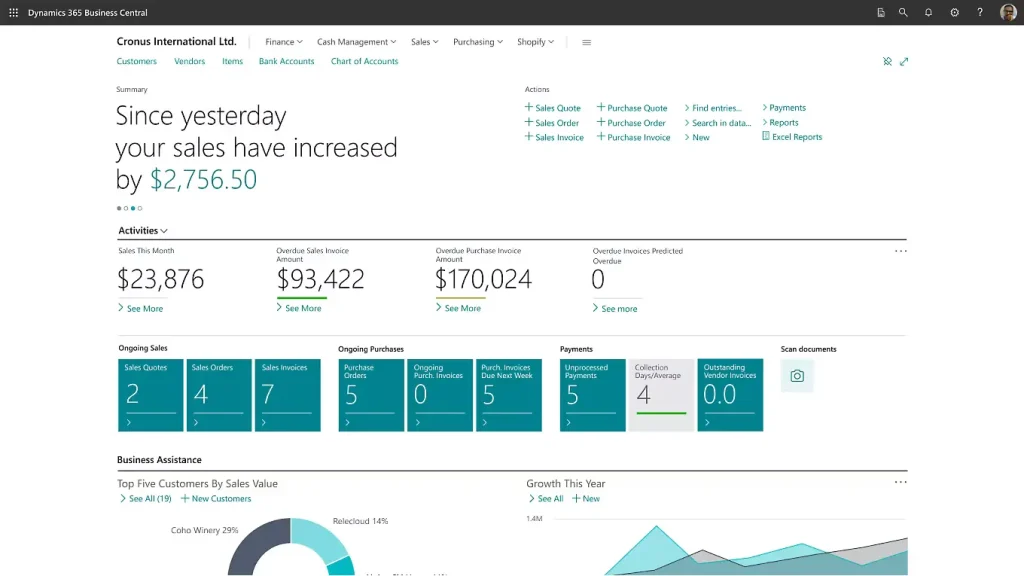
Via Microsoft
Most growing businesses reach a breaking point where their current tools can’t keep up. You know you’ve hit this wall when your team spends more time reconciling data between systems than actually using the insights to make decisions.
The warning signs are unmistakable: spreadsheets that take hours to update, inventory counts that never match between departments, and financial reports that require manual compilation from multiple sources.
The hidden costs of system fragmentation compound quickly in ways most business owners don’t expect. A purchasing manager might spend hours every week reconciling inventory numbers between their accounting software, warehouse management system, and production planning spreadsheets.
Here’s what happens when systems remain disconnected:
- CFOs spend significant portions of the month-end close time gathering data from different systems instead of analyzing results
- Inventory discrepancies create costly stockouts or overstock situations that impact cash flow
- Sales teams lose deals because they can’t quickly access accurate pricing or delivery information during customer calls
- Compliance becomes challenging when data lives in multiple systems with different formats and validation rules
Microsoft Business Central ERP addresses these challenges by replacing fragmented systems with one integrated platform.
When evaluating ERP options, map out your ‘decision lag’. This is the time between needing an answer and actually getting one. If managers wait days for financials or inventory snapshots, the cost of lost agility is often higher than the ERP investment itself.
Core Capabilities of Business Central ERP
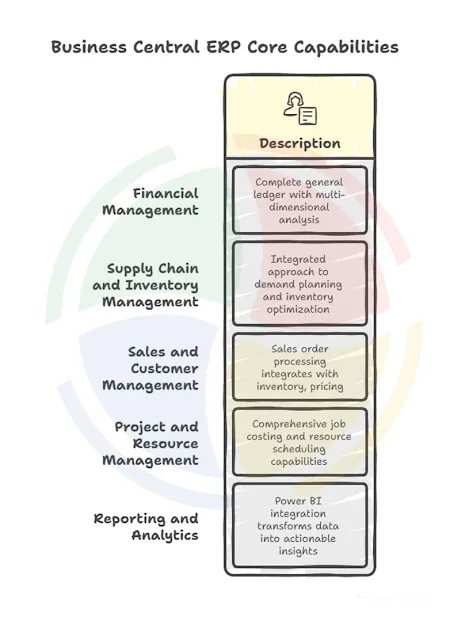
Microsoft Dynamics 365 Business Central ERP offers comprehensive functionality that covers every aspect of your business operations. While most ERP systems excel in one area but struggle in others, BC provides balanced strength across all modules.
Financial Management
Business Central’s financial management system provides a complete general ledger with multi-dimensional analysis. This allows you to track profitability by department, project, or product line in real time.
It also handles complex scenarios without expensive add-ons. Companies can track costs by multiple dimensions simultaneously (something that would require custom development in most other systems).
Financial management features also include:
- Multi-currency support handles international transactions with automatic exchange rate updates
- Cash flow forecasting uses historical data and payment patterns to predict funding needs
- Automated tax calculations work across different jurisdictions for companies expanding geographically
- Consolidation features remove the need for expensive third-party tools when managing multiple legal entities
The system automatically connects financial data to operational activities. When inventory is received, the financial impact appears instantly in cash flow projections and margin analysis. This real-time connectivity means financial teams can see how operational decisions affect profitability immediately.
One overlooked advantage of Business Central ERP is audit readiness. Since every transaction links directly back to its source, audits take hours instead of weeks. This also reduces the risk of missed compliance deadlines.
Supply Chain and Inventory Management
BC’s supply chain management features rival standalone systems that cost significantly more. Its integrated approach to demand planning and inventory optimization helps companies balance service levels with carrying costs.
Consider catch-weight scenarios in food distribution (selling products by weight but purchasing in cases). BC automatically handles unit conversions, lot tracking, and expiration date management without requiring expensive custom development.
Advanced inventory capabilities include:
- Demand forecasting that considers historical patterns and seasonal trends
- Lot and serial tracking with full traceability for quality control and recall management
- Cross-docking capabilities that route products directly from receiving to shipping
- Automated reorder calculations that factor in supplier lead times and minimum order quantities
The vendor collaboration features integrate purchase orders, receipts, and invoices to eliminate duplicate data entry. Companies can significantly reduce purchase order processing time through automated three-way matching between purchase orders, receipts, and invoices.
Distributors using Business Central ERP often see warehouse picking accuracy improve simply because handheld devices connect directly with the ERP. Small changes like this cut mis-shipments and speed up delivery without extra labor.
Sales and Customer Management
Sales order processing integrates completely with inventory, pricing, and financial modules.
When a salesperson creates a quote, the system checks real-time inventory availability across all locations, applies customer-specific pricing rules, and can automatically reserve stock to prevent overselling.
BC excels at handling complex sales scenarios that challenge other ERP systems. Companies with configure-to-order products can manage thousands of possible combinations. The system automatically calculates pricing based on component costs, checks availability, and generates delivery dates based on production capacity.
Here are key sales management capabilities that deliver operational improvements:
- Quote-to-cash workflow eliminates handoffs between sales and operations teams
- Customer-specific pricing engines handle complex scenarios like volume discounts and contract pricing
- Credit management integrates with accounting to automatically manage customer credit limits
- Sales commission tracking calculates commissions based on various criteria and payment terms
Customer insights combine sales history, payment patterns, and service interactions to identify opportunities. BC can identify customers with specific buying patterns or service needs for targeted marketing campaigns.
Project and Resource Management
For service-based businesses or companies handling custom projects, BC’s project management module provides comprehensive job costing and resource scheduling capabilities that typically require specialized software.
The system helps optimize resource utilization and project profitability. Companies can identify underutilized resources and optimize assignments based on skills, availability, and billing rates.
Business Central’s PM capabilities address real challenges that service businesses face:
- Resource scheduling helps optimize utilization and prevent overtime costs
- Time tracking integration with payroll eliminates manual reconciliation processes
- Project profitability analysis identifies which service offerings and clients are most profitable
- Change order management streamlines the billing process for scope changes
The system handles complex billing scenarios, including milestone payments, retainer billing, and time-and-materials with markup. Integration with Microsoft Project provides advanced scheduling capabilities while maintaining financial control.
Reporting and Analytics
Power BI integration transforms your business data into actionable insights through interactive dashboards and automated reports. Unlike bolt-on reporting tools, Business Central’s analytics are embedded in the operational workflow.
The reporting capabilities help companies make better decisions based on real-time data. Companies can identify trends, optimize operations, and respond quickly to changing conditions.
Analytics features provide business value through:
- Real-time KPI monitoring prevents operational issues before they become costly problems
- Automated alerts identify exceptions, errors, or unusual transactions
- Mobile dashboards enable decision-making from anywhere
- Predictive analytics help identify patterns and trends in customer behavior
Business Central learns from data patterns and can suggest optimizations. Companies receive recommendations for inventory management, pricing strategies, and operational improvements based on their specific business data.
Why Businesses Choose Business Central ERP
Microsoft Dynamics 365 Business Central ERP stands out from other ERP solutions because it solves the integration challenges that plague most growing businesses.
While competitors require expensive middleware or custom development, BC works seamlessly with the Microsoft ecosystem that most companies already use.
The integration advantage delivers immediate productivity gains. Companies can access ERP data directly from familiar Microsoft applications, eliminating the need to export reports and copy data manually.
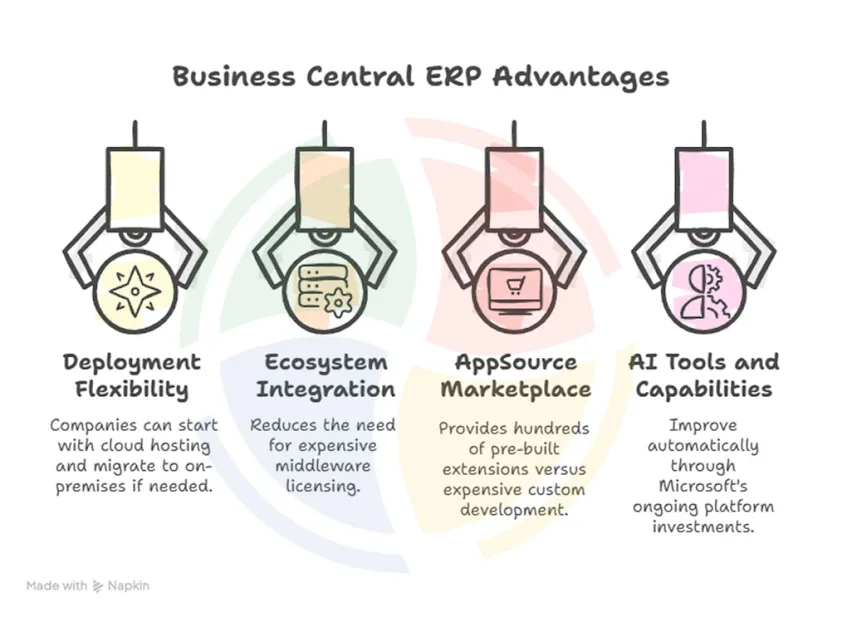
Consider these competitive advantages:
- Deployment flexibility allows companies to start with cloud hosting and migrate to on-premises if needed
- Ecosystem integration reduces the need for expensive middleware licensing
- AppSource marketplace provides hundreds of pre-built extensions versus expensive custom development
- AI tools and capabilities improve automatically through Microsoft’s ongoing platform investments
The total cost of ownership (TCO) is often lower than comparable ERP systems when factoring in integration, maintenance, and upgrade costs over multiple years.
Even if you’re not ready for full ERP deployment, you can pilot Business Central ERP in a single department (like finance or inventory). This lets you prove business value and refine your rollout plan with less risk.
Key Considerations Before Adopting Business Central ERP
Planning your Business Central ERP implementation requires understanding the complexities that can derail projects or cause budget overruns.
The most successful implementations start with realistic expectations and comprehensive planning.
Organizations should budget for the complete transformation, not just software licensing. When you go with Business Central implementation services, it typically includes software licensing, core implementation, training and change management, and contingency for unexpected challenges.
These are the critical planning factors that determine project success:
- License optimization through proper user type assignment and feature selection
- Data migration planning, especially when consolidating systems with inconsistent data structures
- Integration requirements that may exceed initial estimates for older or specialized systems
- Change management investment to ensure successful user adoption
The most common mistake is underestimating the organizational change required for successful ERP adoption.
Technical training is only part of successful implementation; changing business processes and ensuring user adoption requires sustained effort and support.
How Aegis Softtech Helps Businesses Succeed with Business Central ERP
Aegis Softtech’s Business Central Services address both technical and organizational challenges that determine implementation success.
We focus on three critical success factors: realistic planning that accounts for organizational change, comprehensive testing that identifies issues before go-live, and sustained change management support.
Our Business Central consultants offer comprehensive services, including:
- Pre-implementation assessment to identify potential challenges and data quality issues
- Data migration planning and quality improvement to ensure clean, accurate information
- Phased rollout strategies that maintain business continuity while building user confidence
- Industry-specific configuration based on best practices and proven methodologies
What’s more, we measure success by business outcomes and operational improvements. Our goal is to help clients achieve measurable benefits through improved efficiency and better decision-making capabilities.Hear it from a client: “We brought Aegis’ Microsoft BC team on board for monthly support, and they’ve always been hands-on and efficient. They completed our projects on time and truly became an extension of our team. I’d happily work with them again.”
Choose the Right ERP Partner for Long-Term Success
Selecting the Microsoft Dynamics 365 Business Central ERP represents a significant investment in your company’s operational foundation. Success depends on choosing implementation partners who understand both technical requirements and change management challenges.
ERP implementations can either transform operations and enable growth or become costly failures that disrupt business operations. The difference often comes down to proper planning, realistic expectations, and sustained support throughout the adoption process.
FAQs
1. Is Business Central an ERP or CRM?
Business Central is primarily an enterprise resource planning system with basic CRM functionality. It excels at financial management, inventory control, manufacturing, and supply chain operations while including sales tracking and customer management features.
Companies needing advanced marketing automation or complex sales pipeline management often integrate it with Dynamics 365 Sales.
2. What industries benefit most from Business Central ERP?
Manufacturing, wholesale distribution, retail, and professional services typically see strong results from Business Central ERP because they can leverage its inventory management, project costing, and financial reporting capabilities effectively.
Specialized industries benefit from AppSource extensions that add industry-specific functionality.
3. How scalable is Business Central ERP?
Business Central ERP scales from small businesses with several users up to mid-market companies with hundreds of employees across multiple locations. The cloud version automatically adjusts resources during peak periods, while modular licensing allows companies to add functionality as they grow.
4. Is Dynamics 365 and Business Central the same thing?
Microsoft Dynamics 365 Business Central ERP is one component of the broader Dynamics 365 business application suite. Business Central serves as the ERP foundation, while other Dynamics 365 applications include Sales, Marketing, Customer Service, and Field Service.