

You wish to adopt ServiceNow to regulate your customer support efforts. As soon as you begin the platform implementation, the expected costs rise due to the unexpected complexities.
Relatable?
This happens when there’s no proper planning of the implementation scope and no budgeting to cover last-minute extensions and integrations.
Your ServiceNow implementation cost can reach thousands of dollars based on the configuration, customization, integrations, data migration, and rollout strategy
In this guide, you’ll know what factors influence ServiceNow implementation costs and how to plan for realistic budgets. We will also help you build a cost strategy that aligns with enterprise expectations.
Key Takeaways
- ServiceNow implementation cost: ServiceNow implementation cost ranges from $50,000 to $1 million+, depending on licensing, scope, integrations, migration, training, and long-term support.
- Primary cost drivers: Process maturity, CMDB depth, configuration vs customization discipline, regional rollouts, and legacy system quality.
- Implementation services: The largest expense, ranging from $20K for SMB setups to $4.5M+ for global, multi-instance enterprise deployments.
- ITSM cost profile: Typically $20K–$1M+ depending on automation depth, CMDB complexity, integrations, and governance requirements.
- ITSM vs CSM: CSM implementations cost more due to customer-facing workflows, portal customization, deeper integrations, and higher licensing.
- Long-term TCO: Controlled through configuration-first design, strong governance, continuous training, and proactive maintenance.
- Cost Disclaimer: All pricing and cost ranges in this guide are indicative estimates based on industry benchmarks, partner experience, and the information available on community forums.
ServiceNow pricing is quote-based and varies by scope, configuration depth, integrations, and commercial terms.
What Influences the ServiceNow Implementation Cost?
Implementation costs vary based on enterprise size, operational maturity, and architectural complexity. Below, we break down the five major cost pillars to help you understand what drives your spend.
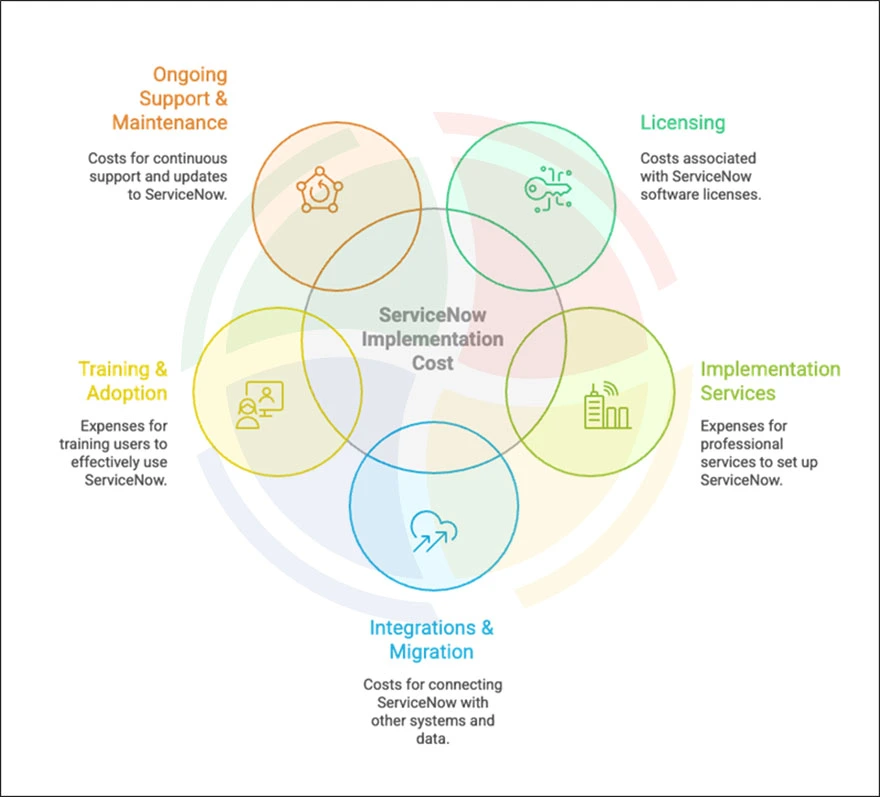
1. Licensing Cost Variations Based on ServiceNow Modules
Licensing is often the first budget anchor. It’s just one part of the overall financial picture, but an important one. Read on to know how.
ServiceNow uses a fully custom, quote-based subscription model influenced by:
- User type (fulfiller vs requester)
- Edition level (Standard, Pro, Enterprise)
- Module suites (ITSM, ITOM, CSM, HRSD, SecOps, etc.)
- Contract tenure (1-3 years, multi-year discounts common)
- Enterprise size and usage volume
- Industry-specific compliance or security requirements
Typical Enterprise Licensing Ranges
| Module/Product | Licensing Approach | Indicative Pricing Range |
| IT Service Management (ITSM) | Per fulfiller user; packaged in tiered editions (Standard, Pro, Enterprise). | ITSM Pro typically ranges between $100-$140 per user per month, depending on scale and features |
| IT Operations Management (ITOM) | Per managed node or Configuration Item (CI), based on the number of servers and devices monitored. | ITOM Visibility is generally priced at $10-$15 per node per month |
| Human Resources Service Delivery (HRSD) | Per total employee count across the organization (not limited to platform users). | Pricing varies by workforce size, usually $20-$45 per employee per year |
| Customer Service Management (CSM) | Per agent, following a fulfiller-style licensing model. | Typically falls in the range of $150-$250 per agent per month |
| Security Operations (SecOps) | Per fulfiller or security analyst, often aligned with incident and response volumes. | Pricing is highly variable and commonly bundled based on operational needs |
| Governance, Risk, and Compliance (GRC) | Per GRC professional or fulfiller, depending on governance scope. | Pricing varies and is frequently bundled to support long-term compliance strategies |
| Software Asset Management (SAM) | Per managed device, covering both client and server assets. | SAM Pro generally ranges between $3-$5 per device per month |
| App Engine | Per application user or based on a custom table and usage requirements. | Custom pricing determined by application complexity, scale, and usage patterns |
*Indicative figures based on industry benchmarks and our customized packages. Final pricing is determined during your custom quotation.
Why Licensing is Only Step One
Your licensing selection influences the broader cost ecosystem, including:
- Number and complexity of integrations
- Workflow and automation depth
- CMDB scope and data modeling
- Training and enablement needs
- Ongoing support and governance maturity
2. Consultation & Implementation Services
ServiceNow implementation services account for the majority of your project spend. A ServiceNow implementation covers architectural design, workflow engineering, and enterprise-wide process transformation.
Baseline Implementation Ranges
| Deployment Type | Estimated Cost (Indicative)* |
| SMB basic setup | $20,000-$50,000 |
| Mid-size foundational builds | $150,000-$450,000 |
| Large enterprise, multi-module | $100,000-$500,000 |
| Global multi-instance rollouts | $1.2M-$4.5M+ |
| Certified consultant rates | $150-$250/hour (U.S. average) |
*Costs depend on technical scope, not organizational size. Estimated ranges reflect typical enterprise implementations observed across ServiceNow consulting partners.
Key Factors that Dictate Implementation Cost
a. Process Maturity
If your processes lack maturity, implementation effort increases quickly. You’ll spend more time redesigning workflows, aligning stakeholders, running extended UAT cycles, and training teams before stabilization.
b. Configuration vs Customization
When you rely heavily on customization, both cost and long-term maintenance effort rise. ServiceNow is designed to be configured; custom code increases build time, technical debt, and upgrade complexity.
c. CMDB Depth
Your CMDB scope has a direct cost impact. A lightweight CMDB is significantly cheaper than one that includes discovery, dependency mapping, normalization, and integrations across multiple data sources.
d. Multi-Team & Multi-Region Rollouts
If your rollout spans multiple teams or regions, costs scale beyond simple user counts. You need to account for regulatory differences, localized SLAs, language support, added integrations, and phased deployment planning.
e. Quality of Legacy Systems
The quality of your existing systems shapes the migration effort. You’ll spend less when migrating from structured tools like Jira or SCCM, and far more when data is fragmented, inconsistent, or built on non-standard workflows.
Implementation Stages
| Stage | Scope | Cost Range (Indicative)* |
| Discovery & Design | Workshops, process mapping, and architecture | 30-160K |
| Configuration & Build | Workflows, forms, portal, CMDB, integrations | $105K-$360K |
| Testing & QA | SIT, UAT, regression | $30K-$120K |
| Deployment | Environment setup, cutover execution | $15K-$64K |
*Cost ranges are indicative and vary by implementation scope, customization level, and governance requirements.
At Aegis Softtech, we help you deliver scalable, configuration-first implementations that reduce rework, upgrade risk, and cost overruns.
3. Integration & Data Migration Costs
ServiceNow rarely operates in isolation—integrations and data pipelines create significant cost variability.
Integration Cost Spectrum
| Integration Type | Examples | Cost Range (Indicative)* |
| Basic | Okta, Azure AD, SSO | A few thousand dollars |
| Moderate | Jira, HRMS, monitoring tools | $10K-$50K |
| Complex Enterprise | ERP, CRM, Finance, Custom APIs | $50K-$100K+ |
*Integration cost ranges are indicative and based on common enterprise ServiceNow integration patterns.
Cost escalates when dealing with custom middleware, non-standard APIs, real-time sync requirements, and large data volumes—areas that typically require experienced ServiceNow development services.
Data Migration Cost Factors
Migration cost depends on:
- Volume of historic or archived data
- Data hygiene and completeness
- Complexity of mapping and normalization
- Number of legacy systems and data sources
- Transformation vs direct import strategy
Typical budgets range from $5K to $100K+. Unclean data is often the single biggest cost driver.
4. Training & User Adoption Costs
While a dependable architecture is crucial for user adoption, the cost of successful ServiceNow programs also depends on user training.
Training Investment Breakdown
| Training Type | Estimated Cost* |
| On-demand modules | ~$500 |
| Instructor-led certifications | $2,000-$2,700 per participant |
| Large-scale user enablement | Custom-built programs |
| CSM training | Typically higher due to omnichannel components |
*Training costs vary by delivery model, participant volume, and certification requirements.
Training differences:
- ITSM (IT Service Management): Backend workflows including incident, request, change, problem, CMDB, and service catalog processes.
- CSM (Customer Service Management): Customer-facing workflows such as case routing, multi-team case management, portals, omnichannel interactions, and entitlement handling.
- ITOM (IT Operations Management): Operational visibility across infrastructure, including discovery, service mapping, event management, and service health monitoring workflows.
- HRSD (Human Resources Service Delivery): Employee service workflows covering HR case management, knowledge articles, lifecycle events, approvals, and role-based access.
- ITAM (IT Asset Management): Asset lifecycle processes spanning procurement, inventory tracking, contract management, compliance, and financial reconciliation.
Proper training reduces long-term operational overhead and improves ROI, thereby managing the total cost of ownership (TCO).
If adoption is poor, you may face low platform utilization, incorrect workflow execution, inconsistent data, higher ticket volumes, and increased reliance on external consultants. Using ServiceNow’s guided self-service features can also improve user adoption across teams.
H3: 5. Ongoing Maintenance & Support Costs
A successful ServiceNow environment requires continuous optimization, upgrades, tuning, and governance.
Maintenance Requirements
Typical recurring work includes:
- Routine platform maintenance
- Biannual release upgrades
- Enhancement backlog execution
- Workflow and catalogue refinements
- Automation expansion
- Performance and health checks
Support Cost Benchmarks
| Support Type | Estimated Cost |
| Minimal annual support | ~$200+ |
| Managed services | $3K-$25K per month |
Average Implementation Cost for ServiceNow ITSM
IT Service Management (ITSM) remains the most common starting point for enterprises adopting ServiceNow. Because ITSM touches core operational workflows—incident, request, change, problem, CMDB, and service catalog—its implementation footprint is inherently broad. We often see teams underestimate how interconnected these workflows become during execution.
Here’s a detailed breakdown to help you understand ITSM implementation cost ranges, licensing considerations, and deployment timelines based on real enterprise scenarios.
1. ITSM Cost Ranges by Company Size
ITSM implementation costs vary by your company size, operational maturity, integration needs, and the depth of automation you plan to build. The ranges below reflect typical patterns across SMB, mid-market, and enterprise rollouts:
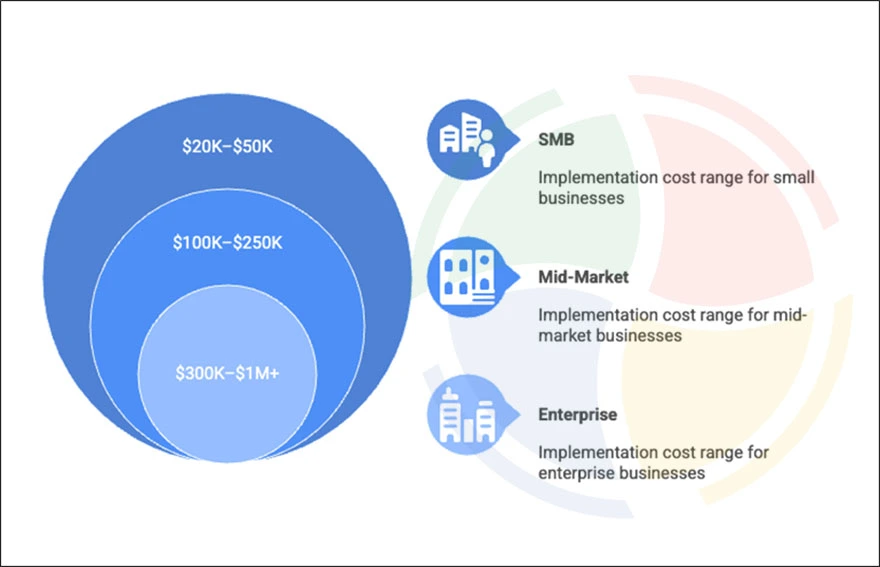
SMB ITSM Implementations ($20K-$50K)
Small-to-medium businesses (SMBs) generally aim for a lean ITSM footprint that stabilizes operations without heavy architectural overhead. Most implementations include:
- Incident Management
- Request Management
- Basic Knowledge Management
- A limited number of catalog items (10-30)
- Light reporting and dashboards
SMBs often operate with simpler processes, minimal integrations, and low user volume, resulting in shorter build cycles and straightforward workflows.
Mid-Market ITSM Implementations ($100K-$250K)
Mid-market organizations need deeper operational control, requiring additional layers of configuration and platform alignment. Typical inclusions are:
- CMDB setup (core CI classes, relationships, lifecycle states)
- Discovery deployments for servers, network devices, and cloud assets
- Monitoring tool integrations (SolarWinds, Dynatrace, Nagios, Datadog)
- SLA frameworks with automated breach calculations
- Custom catalog workflows tied to approval chains and fulfillment logic
- Role-based access governance
CMDB development, automation-heavy catalogs, and 2-4 system integrations create additional build and testing cycles.
Enterprise ITSM Implementations ($300K-$1M+)
For enterprises, ServiceNow ITSM is the foundation for service transformation, cross-functional alignment, and end-to-end automation. Enterprise rollouts typically include:
- Global or regionalized service catalogs
- Automation & orchestration layers (Flow Designer, IntegrationHub, custom scripts)
- Cross-team assignment, routing, and escalation rules
- Structured CMDB with full relationship maps
- CloudOps and DevOps pipeline integrations
- Multi-instance or multi-department environments
- Compliance and audit workflows (SOX, ISO, HIPAA, ITIL v4 practices)
Enterprises require governance councils, multi-phased deployment waves, multi-team alignment, and more complex integration ecosystems—each adding depth to design, testing, and maintenance.
2. ITSM Licensing Cost
ServiceNow licensing for ITSM falls in the $90-$100 per user per month range. When paired with implementation, enterprise total investments usually land here:
- $200K–$500K+ for combined licensing + implementation
- Higher footprints if the environment expands into:
- ITOM (Discovery, Service Mapping, Event Mgmt)
- SecOps
- HRSD
- CSM
Your fulfiller count, automation depth, and integration strategy influence not only licensing fees but also the architectural complexity required during implementation.
3. ITSM Implementation Timeline
Timelines depend on the number of modules, integrations, and regions included. Typical project durations look like this:
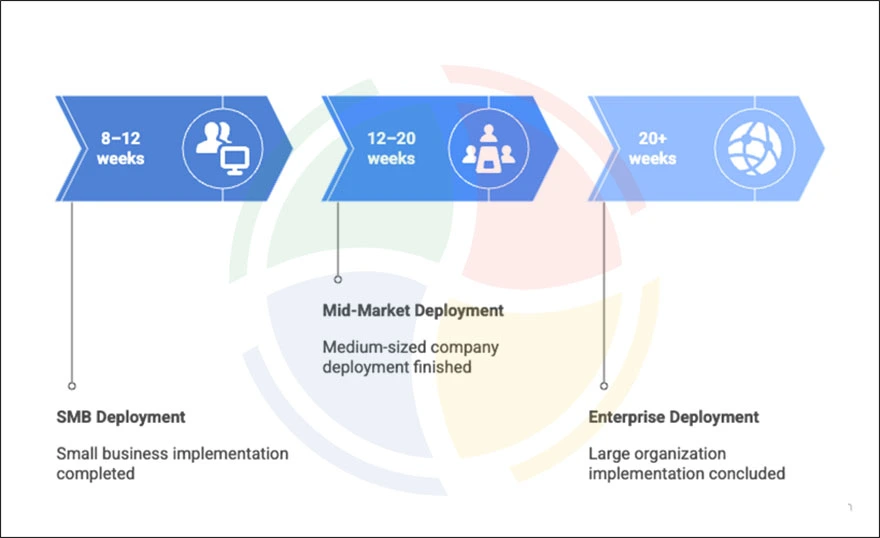
Small ITSM Setups (8-12 weeks)
Best suited for SMBs or single-team operations with minimal workflows.
- Low customization
- Limited data migration
- No advanced automation
Mid-Market ITSM Rollouts (12-20 weeks)
This includes Discovery, CMDB, SLAs, and a moderate number of integrations.
- More UAT cycles
- Integration testing across multiple tools
- Dependency views and CI lifecycle definitions
Enterprise ITSM Deployments (20+ weeks)
Enterprises extend timelines due to higher governance requirements and multi-team dependencies. Timelines increase with:
- Multi-region deployments with localized workflows
- Parallel migrations from legacy ticketing systems
- Data normalization challenges
- Large-scale integration ecosystems (ERP, HRMS, monitoring, cloud platforms)
- Compliance-driven testing cycles
Comparing ITSM vs CSM Implementation Costs
Although ITSM and CSM operate on the same ServiceNow platform, their implementation cost profiles differ substantially due to scope, user base, and architectural complexity.
The table below helps you see why CSM implementations typically require a higher investment than ITSM across multiple dimensions:
| Cost Dimension | ITSM Implementation | CSM Implementation |
| Primary Use Case | Internal IT service delivery for employees | Customer-facing service management across external users |
| Workflow Complexity | Mature, standardized ITIL-based workflows with predictable patterns | Highly variable workflows including case routing, entitlement logic, contract-based SLAs, multi-department resolutions, escalation paths, and omnichannel support |
| Process Standardization | High level of standardization across industries | Low standardization; workflows differ significantly by industry, customer type, and service model |
| Portal & UI Customization | Limited UI customization focused on internal usability | Branded customer portals, role-based dashboards, multi-language support, responsive layouts, and UX optimization |
| Integration Depth | Integrations are typically limited to monitoring, identity, and asset systems | Deep integrations with CRM, ERP, billing platforms, customer interaction channels, and communication systems |
| Licensing Structure | Primarily fulfiller-based licenses for IT agents | Higher licensing due to customer agents, portal users, and multiple engagement channels |
| Data Model Complexity | CMDB-driven asset and service data with clear ownership | Complex customer hierarchies, contract mapping, entitlement models, and SLA structures |
| Security & Access Control | Internal role-based access controls | Fine-grained access controls across customers, partners, and internal teams |
| Testing & QA Effort | Predictable UAT cycles focused on internal teams | Extensive testing across portals, integrations, customer journeys, and edge cases |
| Change Management Impact | Limited to IT teams | Spans support teams, customer experience teams, and external users |
| Overall Implementation Cost | Lower relative cost with predictable scope | Higher cost due to customization, integrations, and customer-facing complexity |
ITSM implementations benefit from well-defined industry patterns and predictable architectures. CSM, by contrast, extends ServiceNow beyond internal operations into customer experience, revenue protection, and brand perception, introducing additional layers of complexity that directly influence cost.
Your CSM budgets must account for UX design, data governance, security modeling, and cross-system orchestration beyond the core build effort.
Additional Costs Above Implementation
Initial implementation is only the entry point. Over the lifecycle of a ServiceNow platform, secondary and often underestimated costs play a much larger role in shaping the total cost of ownership (TCO). These costs compound as your usage expands, new modules are added, and governance expectations increase.
1. Administration & Staffing Costs
A mature ServiceNow environment requires continuous operational ownership. As the platform footprint grows, administration shifts from basic maintenance to active platform engineering and governance.
Common staffing models include:
- In-house ServiceNow administrators: Experienced administrators typically command salaries in the $80K-$150K+ range, depending on certification level, module exposure, and regional market conditions.
- Outsourced or hybrid managed services: Monthly costs generally fall between $3K-$25K, influenced by SLA coverage, ticket volume, and module complexity.
Core administrative responsibilities include:
- Instance and platform health monitoring
- Workflow optimization and tuning
- Service catalog maintenance and expansion
- Integration monitoring and error resolution
- Role and ACL governance
- Release upgrade planning and execution
- Automation and performance refinements
2. Upgrade & Enhancement Costs
ServiceNow releases two major platform upgrades each year, making upgrades a recurring operational investment.
Common upgrade activities include:
- Regression testing across workflows and integrations
- Review of customizations and scripts
- Deprecation and compatibility checks
- Script validation and refactoring
- SIT and UAT cycles across teams
Upgrade cost drivers include:
- Volume of customizations versus configurations
- Number of active modules
- Integration density and complexity
- Strength of governance and documentation
3. Continued Training & User Adoption Costs
ServiceNow enablement does not end after go-live. As teams evolve and platform capabilities expand, ongoing training becomes essential to sustain adoption and ROI.
Recurring training investments typically cover:
- Role-based refreshers for fulfillers and approvers
- Enablement for new workflows and modules
- Onboarding programs for new administrators
- Training updates aligned with major platform releases
Turning ServiceNow Costs into Long-Term Enterprise Value
ServiceNow implementation cost is the outcome of strategic choices around architecture, governance, integrations, and adoption.
As you know by now, the biggest cost drivers are rarely licensing alone. Process maturity, CMDB depth, customization discipline, regional rollout strategy, and operational ownership shape the true cost of a ServiceNow program. We see these factors drive long-term value or create ongoing operational drag.
When you treat ServiceNow as a configurable platform, expect consistent, favorable outcomes. Upon doing so, your budget covers estimations of go-live, customization, governance, and training. This helps you align the implementation scope with measurable business objectives. And, Aegis Softtech helps you make a well-thought-out plan. Our expert guidance through ServiceNow consulting reduces delivery risk and improves long-term results.
FAQs
Q: How much does a ServiceNow contract cost?
ServiceNow contracts are quote-based and start with an annual six-figure range. Enterprise contracts often range from $300,000 to several million dollars per year, depending on modules, user volume, and contract duration.
Q: How much does the ServiceNow portal cost?
The ServiceNow portal itself does not have a standalone license cost, but customization, branding, UX design, and integrations add to implementation expenses. Portal-related work costs between $10,000 and $100,000 based on complexity.
Q: How much does ServiceNow cost per user?
ServiceNow pricing is based on full licenses. ITSM Standard costs around $90-$100 per user per month, while advanced suites like CSM or ITOM range from $100-$200 per user per month.
Q: What is the ServiceNow CSM implementation cost for enterprises?
ServiceNow CSM implementation cost ranges from $150,000 to over $1 million, driven by customer volume, portal complexity, CRM and ERP integrations, and governance. CSM costs are consistently higher than ITSM due to customer-facing UX, entitlement modeling, and multi-channel service delivery.
Q: What is the total planned cost in ServiceNow?
The total planned cost includes licensing, implementation, integrations, training, and ongoing support. For most enterprises, the long-term ServiceNow investment over three to five years is often two to three times the annual licensing cost.