
The launch of ChatGPT in late 2022 changed everything. Within two months, it reached 100 million users, making it the fastest-growing consumer app in history. Suddenly, generative AI wasn’t a fringe research project; it became a boardroom discussion.
So, what is generative AI? At its core, it’s technology that can create new content, such as text, images, audio, code, and even video, by learning patterns from massive datasets.
Write a product description? Done.
Generate photorealistic ad campaigns? Easy.
Draft functional Python code? Also done.
But, how does it do what it does? How can you use it in your business? And, more importantly, is it just a hype or does it deliver real results?
By the end of this guide, you’ll understand not just what generative AI is, but how to strategically implement it in your organization.
Key Takeaways
- Definition: Generative AI creates new content from learned data patterns
- Main goal: Enhance productivity, creativity, and problem-solving at scale
- Key applications: Content creation, code generation, customer service automation
- Critical considerations: Data privacy, bias mitigation, human oversight
- Future trends: Agentic AI represents the next evolution beyond basic content generation
- Implementation readiness: Beginner to Advanced
–> Generative AI Best Practices Checklist
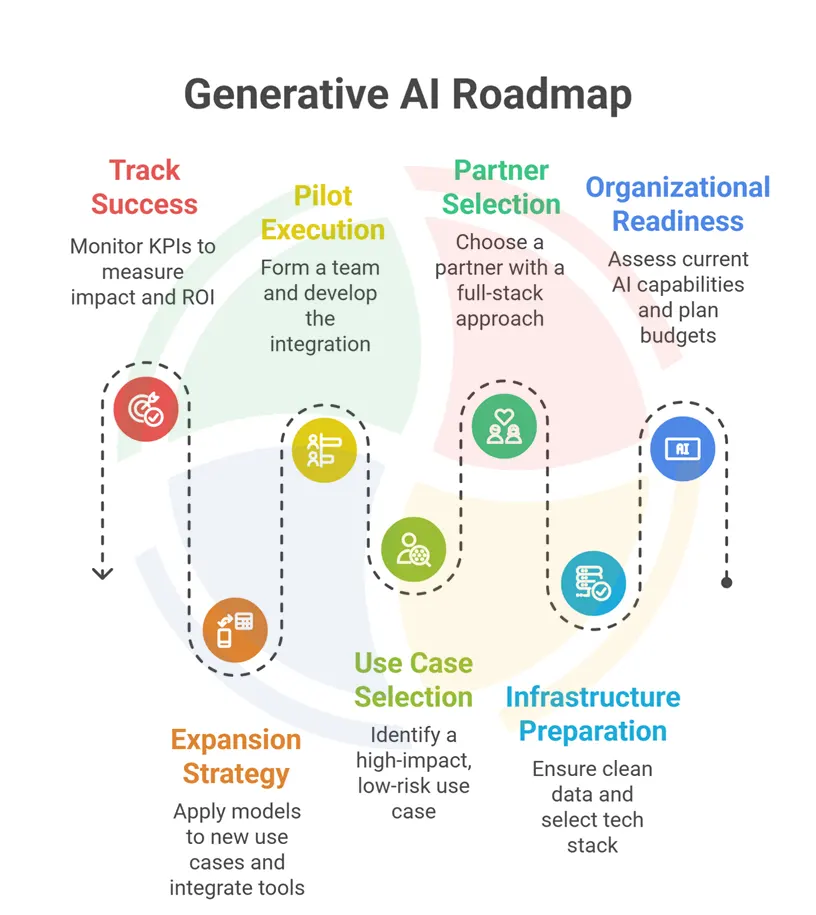
–> Generative AI Implementation Roadmap
What is Generative AI? Beyond the Basics
Not long ago, AI felt like a helpful sidekick. It helped classify emails as spam, recommend movies, or predict stock prices.
Useful? Absolutely.
But creative? Not quite.
That’s where Generative AI (GenAI) came in.
Generative AI refers to AI systems that don’t just analyze, but create. It is powered by deep learning models to generate new data. Instead of simply predicting whether an email is spam, GenAI can actually write the email itself.
Now, the evolution has been fast, almost cinematic. Here’s a snapshot of how GenAI evolved:
| Year | Milestone | Impact |
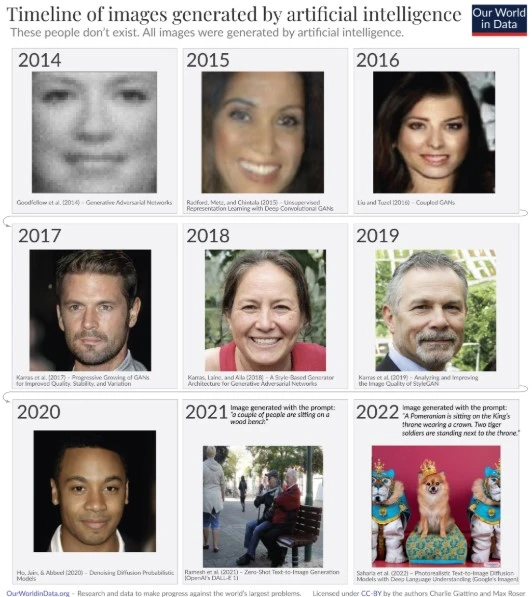
| 2014 | GANs (Goodfellow et al.) | First realistic synthetic images |
| 2017 | Transformers (Vaswani et al.) | Breakthrough in NLP |
| 2018–20 | GPT, BERT, StyleGAN | Human-like text, hyperrealistic images |
| 2021–22 | Diffusion models | State-of-the-art image generation |
| 2023+ | Foundation models (GPT-4, Stable Diffusion) | Multi-modal creativity at scale |
To visualize this journey, imagine the progression of AI-generated images, from pixelated faces in 2014 to lifelike portraits in 2023.
A side-by-side comparison below captures this leap perfectly:
What is the Main Goal of Generative AI?
Unlike popular belief, the primary goal of Generative AI isn’t to replace people; it’s to amplify human capability.
The primary objectives can be grouped into four categories:
- Productivity Enhancement: Automating repetitive tasks so humans can focus on strategy.
- Creative Augmentation: Generating variations or ideas to help teams break creative blocks.
- Problem-Solving Acceleration: Mining complex data for actionable insights and smarter recommendations.
- Process Optimization: Streamlining workflows across disciplines—from marketing campaigns to engineering design.
Ultimately, the mission is simple: extend human potential. Machines take over what they do best, while humans focus on strategy, innovation, and leadership.
And the numbers already prove this shift is more than hype.
- Cost Reduction: Up to 7% increase in global GDP potential (Goldman Sachs)
- Productivity Gains: 1.5 percentage point lift in productivity growth over 10 years
- Time Savings: 82% of healthcare leaders report reduced burnout potential
- Revenue Impact: $200-340B annual value potential in banking alone (McKinsey)
What Kind of Content Does Generative AI Generate?
Generative AI produces diverse outputs, including text, images, audio, video, and even executable code.
Here’s a detailed overview:
| Content Type | Primary Use Case | Examples | Training Data Size |
| Text Generation | Writing, coding, analysis | GPT-4, Claude | 570GB+ text |
| Image Generation | Visual content, design | DALL·E, MidJourney | 400M+ images |
| Code Generation | Software development | GitHub Copilot, CodeT5 | 159GB+ code |
| Audio Generation | Music, voice, sound effects | OpenAI Jukebox, AudioLM | 1.2M+ songs / 60k hours+ |
| Video Generation | Animations, deepfakes, learning | Synthesia, Runway Gen-2 | Millions of clips+ |
The size and diversity of training data directly influence generative AI’s output quality. Larger, varied datasets improve realism, accuracy, and creativity across text, images, audio, and video.
Key GenAI Model Architectures Explained
Generative AI has rapidly reshaped content creation, from text to images. To understand its power, we need to explore the underlying architectures that make it possible:
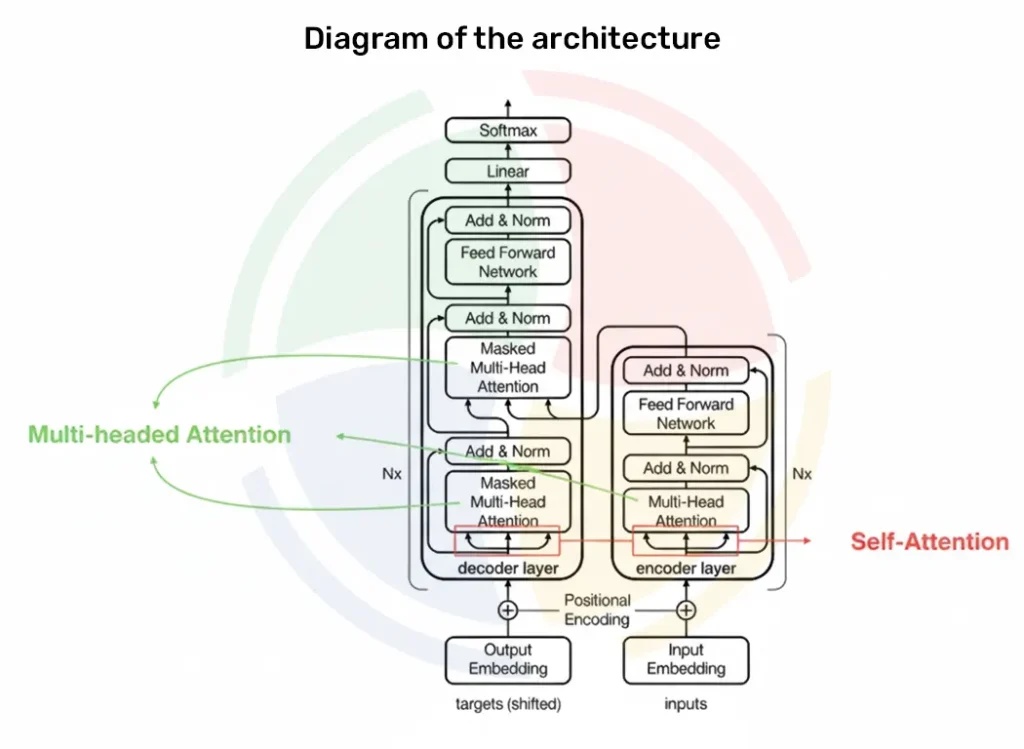
Transformers form the backbone of modern LLMs like GPT, Claude, and Gemini. They use self-attention mechanisms to capture context across long sequences. This makes them adept at language understanding. The encoder-decoder architecture further refines this, processing input efficiently and generating coherent outputs.
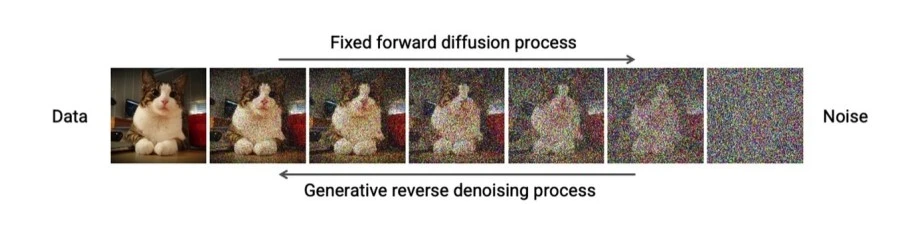
Switching gears, Diffusion Models power image generation in tools like DALL-E and Stable Diffusion. They produce high-fidelity visuals from random patterns by iteratively adding and removing noise.
Generative Adversarial Networks or GANs, such as StyleGAN, adopt a competitive training approach, pitting a generator against a discriminator to improve output realism continuously.
Meanwhile, Variational Autoencoders (VAEs) compress data while enabling variation generation, useful in scenarios needing controlled creativity.
Generative vs. Traditional AI – What Makes The Two Different?
Traditional AI recognizes patterns, while generative AI creates them. Traditional AI focuses on classification, prediction, and analysis.
It answers questions like, “Is this email spam?” or “What’s the probability of churn?”
Generative AI, on the other hand, synthesizes new text, images, music, or code, often indistinguishable from human output. It imagines possibilities.
— AI Solutions Lead, Aegis Softtech
Here’s a detailed comparison of the two:
| Aspect | Traditional AI | Generative AI |
| Primary function | Analyze & classify existing data | Create new, original content |
| Output type | Predictions, insights, decisions | Text, images, code, audio, video |
| Learning approach | Supervised learning with labeled data | Unsupervised/semi-supervised learning |
| Business value | Process optimization, automation | Creative augmentation, content scaling |
| Implementation complexity | Moderate, task-specific | High, requires careful tuning |
Traditional AI answers questions. Generative AI creates solutions. Aegis Softtech helps you bridge that gap with enterprise-grade GenAI services tailored to your business needs.
How Does Generative AI Work? A Technical Deep Dive
Generative AI seems like magic. You type a question, and a coherent, detailed answer appears.
But behind that simple interface is a process of staggering scale and complexity.
Here’s how generate AI works:
Phase 1 – Foundation Model Training
It begins with the model learning to “think.” This phase involves allowing the algorithm to discover the underlying patterns of human language, logic, and creativity on its own.
Key Training Process:
- Data Ingestion:
Massive datasets, including terabytes of text, images, and code from the public internet and private sources, are fed into the neural networks.
- Pattern Recognition:
The algorithm identifies statistical relationships and complex structures within the data. It learns everything from grammar and facts to reasoning and artistic styles.
- Parameter Development:
This process forges billions of parameters, the internal connections within the neural network that encode all the learned patterns. It becomes the model’s core knowledge map.
- Validation:
The model’s predictive accuracy is rigorously tested against held-out data it has never seen to ensure it can generalize its knowledge effectively.
Phase 2 – Model Tuning and Specialization
Raw foundation models require specialization for specific business applications. This involves several approaches:
| Tuning Method | Purpose | Business Application | Resource Requirements |
| Fine-tuning | Task-specific accuracy | Customer service chatbots | High (labeled data needed) |
| RLHF | Human-aligned responses | Content moderation | Medium (human feedback) |
| RAG | External knowledge integration | Enterprise knowledge bases | Low (existing documents) |
| Prompt Engineering | Optimized interactions | Quick deployment | Very Low (crafted prompts) |
Phase 3 – Deployment and Continuous Improvement
Once a model goes live, the work isn’t over. It enters a continuous feedback loop where every interaction becomes a potential data point for improvement. Performance is constantly monitored to detect bias, inaccuracies, or performance drift.
For example, a marketing AI generating ad copy might initially produce generic results.
By analyzing which copy variants lead to the most clicks, the model can be continuously retrained.
It learns what resonates with a specific audience, evolving from generic to hyper-effective over time.
Real-World Applications and Use Cases Across Industries
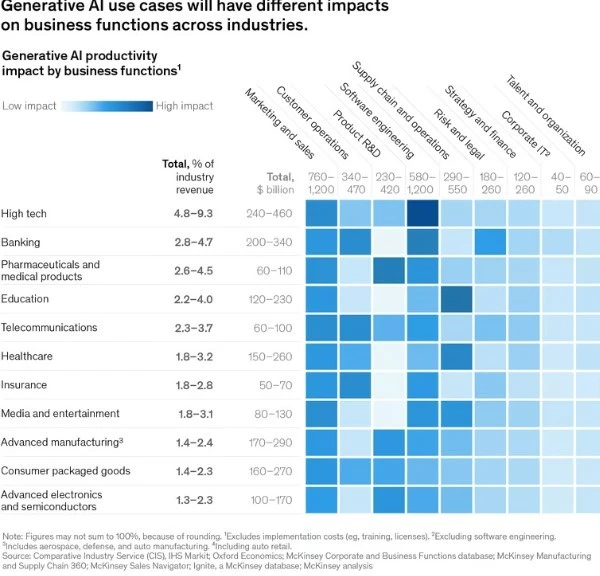
Generative AI’s versatility spans virtually every business sector. Current applications demonstrate both immediate value and transformative potential.
In fact, a report by Salesforce clearly shows that 57% of IT leaders recognize AI as a revolutionary tool.
And, it’s easy to see why:
Marketing and Personalized Experiences
Modern marketing has shifted from mass campaigns to hyper-personalized engagement.
Generative AI in advertising is enabling brands to craft content that adapts in real-time, speaks directly to user needs, and maximizes ROI at unprecedented scale.
Use Cases:
| Use Case | Description |
| Personalized Advertising | AI dynamically generates ad copy and visuals tailored to each audience segment. |
| Dynamic Content Generation | Blogs, product descriptions, videos, and images are created at scale. |
| Brand Voice Consistency | AI ensures content maintains a consistent tone and brand identity. |
| Social Media Automation | Posts, captions, and engagement responses are AI-assisted. |
| Predictive Campaign Analytics | Models forecast ad performance and optimize budget allocation. |
| Customer Journey Personalization | Real-time offer recommendations across email, web, and apps. |
Real-World Examples:
- Radisson Hotels: Boosted ad campaign revenue by 20% with AI-driven personalization.
- WPP: Integrated generative AI into its marketing OS to personalize campaigns at scale.
Business Impact:
Kraft Heinz slashed campaign development timelines from eight weeks to just eight hours by leveraging generative design tools.
When integrated into education, automated grading freed up nearly seven hours per week for teachers, giving them more time to focus on direct instruction and student engagement.
Customer Relationships & Support
Generative AI is revolutionizing customer service by enabling 24/7 automated support, multilingual capabilities, and seamless integration with knowledge bases.
Use Cases:
| Use Case | Description |
| Virtual Agents & Chatbots | AI provides round-the-clock support, answering FAQs and complex queries with contextual awareness. |
| Multilingual Support | Real-time translation enables global businesses to serve diverse customer bases. |
| Sentiment Analysis | Detects emotional intent, tone, and urgency to prioritize escalations. |
| Agent Assist | Offers support agents summarized history, suggested responses, and policy lookups. |
| Knowledge Base Automation | Conversational search allows retrieval of answers from enterprise FAQs, manuals, or policies. |
| Interactive Voice AI | Natural conversation at call centers and drive-thrus with automated resolution. |
Real-World Examples:
- Salesforce: Einstein AI auto-generates customer replies by understanding intent and sourcing answers from knowledge bases.
- Zendesk: AI assists agents by expanding replies as they type, improving response efficiency.
- Uber: Uses AI to summarize user context during support chats, enabling more efficient service.
Business Impact:
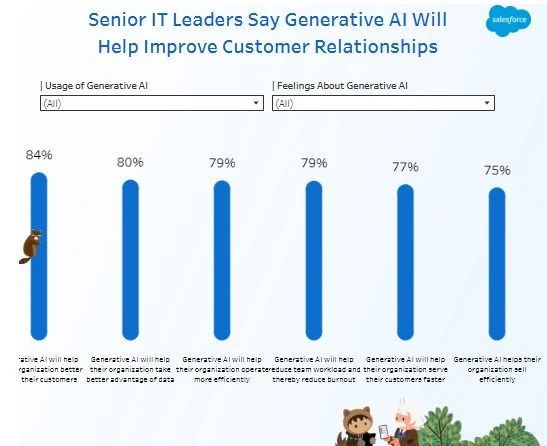
At Amazon, AI-powered demand forecasting helps keep products consistently available, directly boosting customer satisfaction. Meanwhile, DHL uses AI-driven last-mile delivery planning, which not only lowered costs by 10% but also cut CO₂ emissions in half.
Turn every customer interaction into a growth opportunity. Aegis Softtech’s GenAI integration services enable chatbots, multilingual support, and more—all built for scale. Get in Touch With Our Team!
Healthcare and Life Sciences
Healthcare industries have been transformed by generative AI. From diagnostics to drug discovery, Generative AI enables faster, more accurate, and more personalized care.
Use Cases:
| Use Case | Description |
| Drug Discovery | AI predicts new molecules and chemical interactions to accelerate R&D. |
| Personalized Medicine | Tailors treatments based on genetic and lifestyle data. |
| Predictive Patient Analytics | Highlights early risk signs to prevent readmissions. |
| Medical Imaging & Diagnostics | AI analyzes scans for early-stage disease detection. |
| Clinical Documentation | Automates notes, streamlines EHR updates for physicians. |
| Virtual Health Assistants | Guides patients with reminders, triage, and personalized advice. |
Real-World Examples:
- Apollo Hospitals (India): Developed AI-powered breast cancer screening, scaling to 3M+ patients.
- Seattle Children’s Hospital: Uses AI to instantly search 10,000+ pages of pediatric guidelines.
Business Impact:
Zebra Medical Vision applied AI-assisted radiology, significantly improving early disease detection across multiple conditions.
Also, Google DeepMind Health introduced its “Streams” app, which reduced kidney injury risks and, as a result, improved patient outcomes.
Financial Services and Banking:
Financial institutions thrive on precision and speed, but fraud, compliance, and customer demand for real-time services challenge traditional systems.
Generative AI brings new resilience and intelligence into financial ecosystems.
Use Cases:
| Use Case | Description |
| Conversational Banking Agents | Supports account queries, lending, and advisory in natural language. |
| Fraud Detection & Prevention | Identifies suspicious transactions in real-time. |
| Automated Credit Risk Analysis | AI models evaluate loan eligibility faster with more accuracy. |
| Personalized Wealth Management | Hyper-customization of investment advice and portfolio insights. |
| Regulatory Compliance | AI generates audit-ready reports and detects anomalies. |
| Claims & Document Processing | Automates insurance claims and KYC verification workflows. |
Real-World Examples:
- Deutsche Bank: Built “DB Lumina” to cut research report creation from hours to minutes.
- Scotiabank: AI chatbot powers predictive, highly personalized client interactions.
Business Impact:
Procter & Gamble optimized its supply chain with AI, significantly reducing inventory costs.
Meanwhile, Foxconn applied AI-driven quality checks, which not only improved product standards but also strengthened supplier risk management. This highlights how AI is driving efficiency while reinforcing operational resilience across finance.
Software Development and Code Generation
Developers are under constant pressure to deliver cleaner, faster code. Generative AI in software development now acts like a digital co-pilot in assisting, debugging, generating, and documenting at speeds no human team can match.
Use Cases:
| Use Case | Description |
| Automated Code Generation | Suggests functions, classes, and modules based on prompts or incomplete snippets. |
| Bug Detection & Security Scanning | Identifies vulnerabilities and logical errors before deployment. |
| Legacy Code Modernization | Translates outdated codebases into modern languages. |
| Test Case & QA Automation | Automatically generates unit tests and regression testing scenarios. |
| Documentation Creation | Builds API docs, user manuals, and in-line code comments automatically. |
| API & Integration Development | Generates boilerplate integration code for faster system connectivity. |
Real-World Examples:
- Renault Group (Ampere): Uses Gemini Code Assist to boost EV software engineering productivity.
- Commerzbank: Automated code-to-ticket workflows for faster regulatory compliance coding.
- Wayfair: Developers set up environments 55% faster and improved code reliability with AI assistance.
Business Impact:
Siemens set a new benchmark by using AI-powered automation on its production lines, achieving a 99.998% quality rating.
Similarly, Foxconn adopted AI-driven quality control systems, which not only reduced defect rates but also boosted overall customer satisfaction.
Note: The business impact and real-world examples have been curated from Google Cloud.
Innovative Use Cases
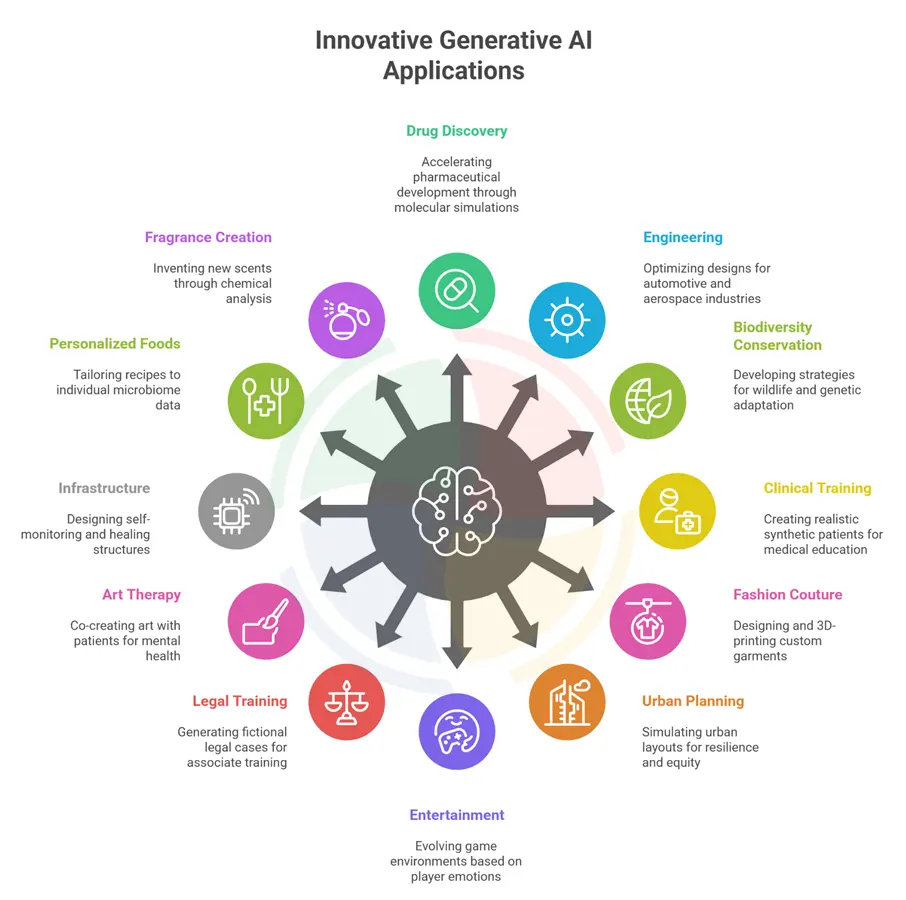
AI is increasingly moving from theoretical promise to practical deployment, with generative AI driving some of the most groundbreaking innovations across sectors:
What Are The Challenges With Generative AI?
Generative AI has exploded into mainstream adoption, powering everything from marketing copy to drug discovery. Yet beneath the hype lies a tangle of challenges that enterprises must grapple with before deploying it at scale:
TL;DR: Key Challenges with Generative AI
| Challenge Area | Core Issues |
| Model Limitations | Hallucinations, bias amplification, shallow context, and inconsistent results |
| Infrastructure Needs | High compute costs, massive data storage, bandwidth, and latency concerns |
| Privacy & Security | Compliance risks, copyright issues, data confidentiality, and system exposure |
| Organizational Risks | Skills gap, change management, integration hurdles, and ROI uncertainty |
Model Limitations
Generative AI often dazzles with fluency, but accuracy is another story. Hallucinations, false or nonsensical outputs, occur in 8-15% of responses, creating risks for business-critical use cases.
— Director of AI, Aegis Softtech
Worse, the models tend to amplify existing biases embedded in training datasets, reflecting them back at scale. Their grasp of nuanced context remains shaky, often missing cultural, legal, or industry-specific subtleties.
To top it off, output quality varies significantly across prompts, which can be frustrating for teams aiming for consistency.
Infrastructure Requirements
Even if the models behave, they require substantial computational muscle. Training requires high-end GPUs or TPUs, and inference at scale is no lighter.
Datasets balloon into terabytes, straining storage and pushing networks to shuttle petabytes of data.
Real-time deployments, like chatbots or fraud detection, only intensify the pressure, requiring sub-second responses without breaking budgets.
Privacy and Security
Generative AI also opens Pandora’s box of compliance and data safety. Organizations must align with GDPR, CCPA, and similar regulations, while also preventing leaks of copyrighted content.
Confidentiality risks are very real: models can regurgitate sensitive training data if mishandled.
And without strict access controls, unauthorized actors could exploit systems to generate malicious or brand-damaging content.
— AI Ops Lead, Aegis Softtech
Organizational Implementation Risks
Finally, the human layer. Deploying generative AI isn’t plug-and-play. Teams face skills gaps in AI literacy, alongside the cultural shift required to embed AI in daily workflows.
Integrating these systems with legacy architectures is rarely a smooth process. And perhaps the toughest challenge of all, quantifying ROI in real-world deployments, remains elusive.
What is a Best Practice When Using Generative AI?
A best practice when using generative AI is to implement a structured framework that prioritizes controlled deployment, human oversight, and solid governance.
It ensures that the technology delivers value while mitigating its inherent risks, such as inaccuracies, biases, and security vulnerabilities.
Plus, our team follows a set of other best practices to deliver cutting-edge generative AI solutions
Our approach is built on a simple, proven framework that ensures value and mitigates risk from day one:
| Best Practice | Our Implementation Approach | Core Benefit |
| Internal First | We pilot all new models on internal helpdesks and documentation teams. | Safely tests real-world use in a controlled environment. |
| Human-in-the-Loop | No critical decision (e.g., code, legal text) is published without expert review. | Guarantees quality and prevents costly “hallucinations.” |
| Clear Labeling | Every AI-generated email, image, or document is tagged with a disclaimer. | Builds unwavering trust and manages user expectations. |
| Data Governance | We classify and anonymize sensitive data before any model interaction. | Ensures regulatory compliance and protects IP. |
Here’s a quick checklist for best practices for various layers across generative AI:
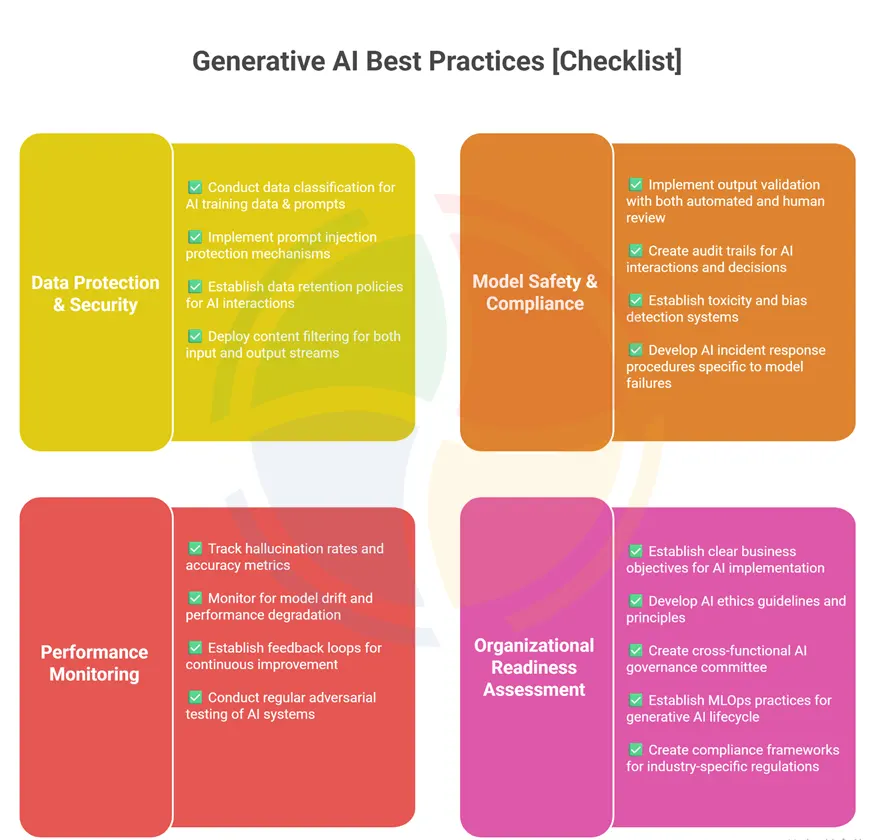
Best practices only matter if you execute them right. Get compliance, governance, and real business value from day one with experts on your side. Our AI Consulting Services!
Getting Started: Your Generative AI Roadmap
Executives are excited. Teams are curious. And everyone wants to “do something” with generative AI before the competition eats their lunch.
The good news? Here’s a roadmap built around phases, priorities, and measurable results.
Let’s break it down.
Phase 1: Foundation Building (Months 1-3)
Before writing a single line of prompt, your organization needs a foundation.
Organizational Assessment
Start with a clear-eyed analysis of where you stand today.
Do you already have machine learning teams, or is AI expertise nonexistent?
Map your data infrastructure, identify gaps in staff skills, and set realistic budgets for tools, training, and hiring.
Most importantly, secure executive buy-in—AI adoption without C-suite sponsorship rarely scales.
Infrastructure Preparation
Generative AI runs on quality data, not magic. That means structured, accessible datasets for training and fine-tuning.
Select cloud platforms and AI toolsets that integrate seamlessly with your existing tech.
Build security frameworks to protect sensitive information, and run compliance checks against industry standards like GDPR or HIPAA.
Partner Selection & Support
Choosing the right partner can save you years of missteps. Look beyond flashy demos.
Evaluate vendors based on technical depth, delivery consistency, and cultural alignment.
Aegis Softtech, for example, offers full-stack AI/ML development, cloud integration, and long-term continuity with a low-attrition team. With transparent pricing and global expertise, it helps enterprises move fast without sacrificing control.
Phase 2: Pilot Implementation (Months 4-6)
Next, test the waters with focused experiments. Pick winners using this matrix to ensure high-impact, low-risk starts:
| Criteria | Weight | Scoring Method | Acceptable Range |
| Business Impact | 40% | Revenue/cost impact ($) | $100K annual value |
| Technical Feasibility | 25% | Complexity assessment (1-5) | Score ≥ 3/5 |
| Risk Level | 20% | Risk assessment (1-5) | Score ≤ 3/5 |
| Resource Requirements | 15% | FTE and budget needs | <20% of total AI budget |
How to Use the Matrix:
- List your top 5-10 candidate use cases (e.g., AI-powered chatbots, automated reporting, personalized marketing).
- Score each use case in the four categories. For example, a chatbot might score “4/5” for feasibility but only “$80K” in annual impact, while automated reporting could score “>$200K” in impact but also carries a higher risk.
- Multiply each score by the weight.
- Add up the weighted scores to get a final priority ranking.
- Choose the top 1-2 use cases that deliver high impact with manageable risk and fit your current resource constraints.
Example:
Fraud detection scores 5 on business impact ($1M potential savings), 4 on feasibility, 3 on risk, and 2 on resources. Weighted, it outperforms a “chatbot” pilot that may be easier but generates less measurable value.
Pilot Execution Plan
Once you’ve selected the pilot use case using the matrix, the next step is creating a structured execution plan.
- Week 1-2: Assemble the team and finalize requirements. Define clear KPIs upfront.
- Week 3-6: Evaluate different models and narrow down the best fit. Don’t over-engineer—good enough is better than perfect.
- Week 7-10: Build integrations with existing workflows, test compatibility, and iron out edge cases.
- Week 11-12: Conduct user acceptance testing with real business users. Collect feedback, measure KPIs, and decide: scale or scrap.
Phase 3: Scale and Optimize (Months 7-12)
When you have a successful pilot, it’s time to expand intelligently.
Expansion Strategy
Apply what worked horizontally across similar departments, deepen capabilities in proven areas, and connect AI tools across functions for compounded value.
Continuous fine-tuning based on live data ensures performance improvements over time.Track Success Metrics and KPIs
Scaling without measurement is guesswork. Here’s how leading organizations track progress:
| Category | Metrics | Target Range | Measurement Frequency |
| Productivity | Task completion time | 30-50% improvement | Weekly |
| Quality | Output accuracy/satisfaction | 90% user approval | Daily |
| Adoption | User engagement rate | 75% active usage | Monthly |
| ROI | Cost savings/revenue impact | 300%+ ROI within 12 months | Quarterly |
Pair hard metrics (ROI, adoption) with soft signals like employee sentiment. If people hate using the tool, adoption will drop (even if the numbers look good).
Cut through the hype and build real-world AI solutions. Our generative AI developers help you move from idea to impact with speed and precision.
What is Agentic AI vs Generative AI? Key Differences
While generative AI aids in content creation, agentic AI facilitates autonomous decision-making. It sets goals, evaluates options, adapts in real time, and executes tasks with minimal human input. This shift is especially relevant for reliability-focused teams, where agentic sre applies autonomous agents to monitor systems, enforce SLOs, remediate incidents, and optimize uptime without constant human intervention.
Generative AI gives you material. Agentic AI gets things done. Understanding this difference will matter most to businesses that bet on AI for long-term value, not just content churn.
| Characteristic | Generative AI | Agentic AI |
| Core function | Creates content based on prompts | Executes multi-step tasks autonomously |
| Autonomy level | Low – requires human direction | High – operates independently toward goals |
| Task complexity | Single, discrete tasks | Complex, chained workflows |
| Decision making | Pattern-based responses | Strategic, goal-oriented choices |
| Key benefit | Content creation acceleration | Process automation and optimization |
| Examples | ChatGPT, DALL-E, Claude | AutoGPT, autonomous agents, RPA systems |
| Business value | Creative augmentation, efficiency | Workflow automation, problem-solving |
Industry Trends & Future Outlook in Generative AI
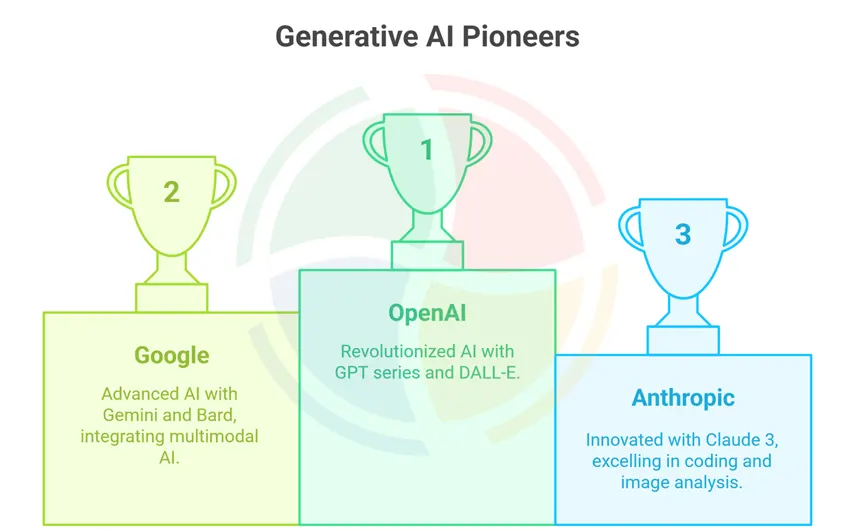
Looking ahead, five macro trends are set to define the next era of generative AI adoption:
| Trend | What It Means | Example |
| AI-as-a-CoPilot | AI agents embedded into daily workflows for employees and customers. | Google Workspace Gemini → reduces credit analysis, HR onboarding, and sales cycles. |
| Industry-Specific LLMs | Domain-tuned models (finance, healthcare, automotive) will outperform general-purpose ones. | Bud Financial (Finance LLM); Med-specific models at Apollo Hospitals. |
| Autonomous Agents & Digital Twins | AI-driven “virtual factories, hospitals, cities” will simulate scenarios and optimize outcomes in real-time. | UPS building a global distribution network twin; Toyota Woven using datacenter-scale AI for mobility. |
| Trust, Compliance & Responsible AI | Regulatory frameworks (EU AI Act, India’s DPDP Act) will make explainable AI + auditable AI non-negotiable. | Bradesco + Google AML AI; Generali Italia’s compliance-ready pipelines. |
| AI + IoT + Edge Convergence | Combining AI with IoT sensors, robotics, and AR for smart factories, grids & cities. | Siemens Industry 4.0; Samsung’s Ballie home robot; Southern California Edison’s “eCO2grid.” |
By 2030:
By 2030, 80% of enterprise workflows will have an AI-agent layer baked in. That means nearly every business process, from customer support to compliance, will have machine-driven copilots running quietly in the background.
The growth curve? Explosive. Generative AI is projected to skyrocket from $25.86B in 2024 to $1,005.07B by 2034, riding a blistering 44.20% CAGR.
And, finally, nations won’t just compete on AI innovation. They will treat AI infrastructure as strategic (similar to telecom or 5G), leading to geo-economic competition in AI-data sovereignty.
Building Real-World Gen AI with Aegis Softtech
The recap is simple: Generative AI learns from patterns and creates new outputs, reshaping industries from healthcare to retail.
But the challenge isn’t understanding what it can do; it’s making it work for your business without drowning in hype or half-baked solutions.
Where Aegis Softtech Steps In:
This is where our team changes the game. Our expert team delivers:
- Custom-fit AI tuned to your workflows and data—not generic, off-the-shelf models.
- Enterprise-grade reliability with compliance, security, and scalability baked in.
- Flexible engagement, whether you need a pilot project, staff augmentation, or a dedicated AI unit.
- Ongoing support that evolves your systems as your business grows.
With us, you move smarter, faster, and cleaner.
FAQs
1. What is the difference between AI and generative AI?
AI analyzes data to make predictions or automate decisions, while generative AI creates new outputs such as text, images, or simulations. This creative capability enables richer content generation and more adaptive problem-solving.
2. What is the most famous generative AI?
ChatGPT is widely recognized as the most famous generative AI due to its advanced language abilities and broad real-world adoption. Its versatility spans writing, analysis, customer support, and general problem-solving tasks.
3. What is the first example of generative AI?
One of the earliest examples of generative AI is the 1950s “Markov text generator,” which produced new sentences based on learned patterns. This foundational concept later evolved into modern neural network–driven models.
4. Which language is used for generative AI?
Python is the most commonly used language for generative AI because it supports major machine learning frameworks like TensorFlow and PyTorch. Its extensive libraries simplify model development, training, and deployment.