

If you’re only testing your code from the outside, you’re flying blind. White box testing dives straight into the core of your code, verifying logic, conditions, paths, and inner mechanics.
It is all about interrogating the code. Every line, every branch, every loop.
And, it’s especially valuable for developers, QA engineers, and security teams who need transparency, control, and precision.
So, if you’re serious about delivering rock-solid, secure software, white box testing is your go-to.
In this blog, we’ll break down what makes white box testing in software testing so essential, where to prioritize it for maximum impact, types, tools, methods, and so much more.
Let’s go.
Key Takeaways
- Definition: White box testing, also known as glass box, clear box, or structural testing, is a code-level testing approach.
- Why It Matters: Early defect detection, better reliability, stronger security, higher coverage, and improved automation
- Types & Levels: Unit, integration, static analysis, mutation testing, white box pentesting, memory/performance testing
- Techniques: Statement, branch, condition/MC‑DC, path (with cyclomatic complexity), loop, data flow, and function/segment coverage
- Challenges:: Time, fragility, tooling limits, required skills, and coverage fallacy
What is White Box Testing in Software Testing?
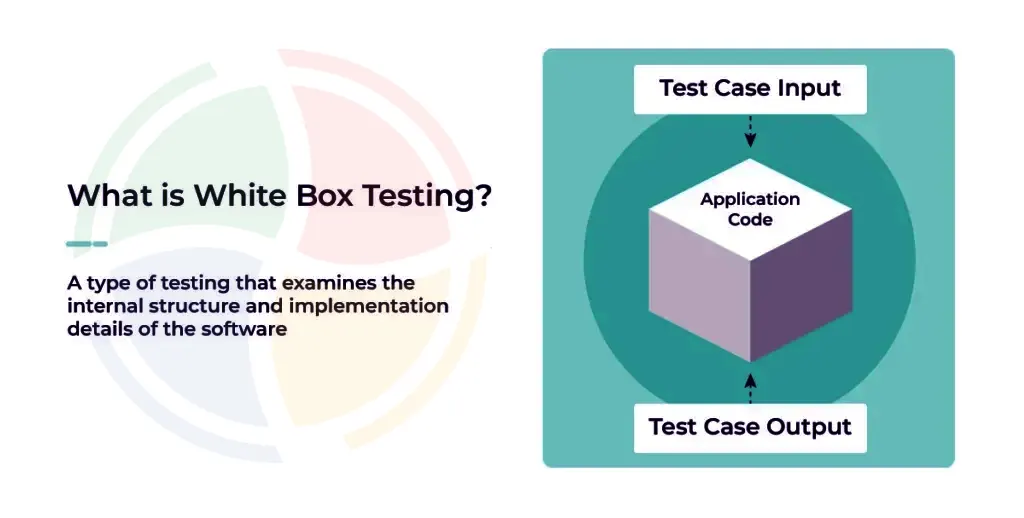
White box testing, also known as glass box, clear box, or structural testing, is a code-level testing approach. It’s where the tester has full visibility into the internal logic and structure of the application.
The primary objective is to inspect internal code paths, control flows, data handling, and logic structures to catch hidden bugs early, especially in conditions and loops where edge cases often live.
✅ When to use it:
White box testing is ideal during unit and integration stages, particularly in critical logic-heavy modules.
For example, authentication, encryption, or transaction processing.
❌ When not to use it:
Avoid using white box testing for exploratory testing, UI validation, or scenarios where the tester shouldn’t (or doesn’t need to) access the source code. For example, end-user acceptance testing or beta testing.
Why Does White‑Box Testing Matter?
White-box testing is a high-leverage strategy that pays off early and often:
- Early defect detection:
Catches logic flaws and boundary errors right at the source code level
- Boosts optimization & reliability:
Helps devs write cleaner, faster, and more maintainable code
- Security hardening:
Exposes vulnerabilities like broken access control or input sanitization issues before attackers do
- Enhances test coverage:
Encourages deeper automation and thorough validation across all possible execution paths
It’s less about “does this feature work?” and more about how safely and efficiently it works under the hood.
Types of White Box Testing in Software Engineering
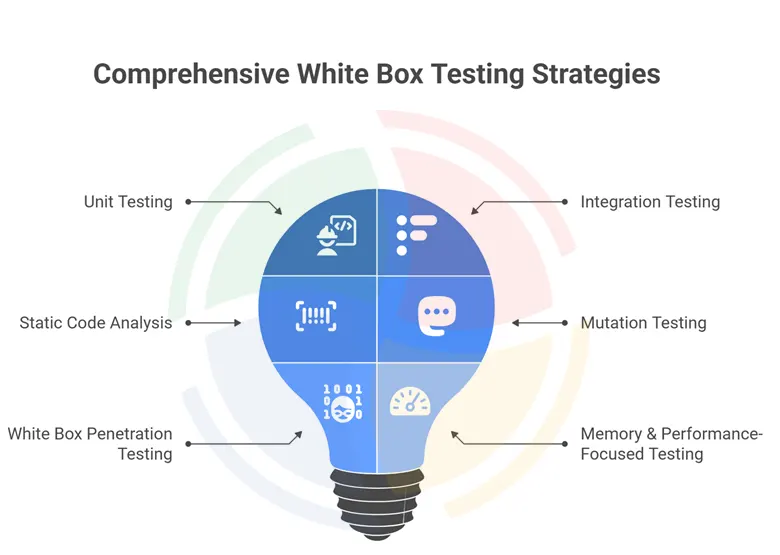
White box testing spans multiple types, starting from unit-level validation to full-scale performance and security inspections. Each layer adds confidence, but more importantly, it shapes code quality early.Let’s understand these various types of white box testing in software engineering in detail:
Unit Testing
Unit testing targets the smallest testable pieces of code, like functions or methods, and validates them in isolation.
Tools like JUnit (for Java) and pytest (for Python) are commonly used to automate these checks.
In a well-structured CI pipeline, these tests run every time a developer commits code. It implies that issues are caught while they’re still cheap and easy to fix.
A developer changes the logic for calculating discounts. Unit tests for the calculate_discount() function immediately flag if the new logic breaks edge cases.
Integration Testing
Once individual units work, the next step is testing how they interact. Integration testing validates the behavior of connected modules, often spanning databases, microservices, or third-party APIs.
White box integration testing isn’t limited to verifying “if the API responds.”It tests whether the logic behind the API functions correctly when dependent components are involved.
A user registration system might pass unit tests, but fail integration if the database schema update wasn’t reflected in the user verification service.
Static Code Analysis
This type doesn’t require code execution. Instead, it scans the codebase to catch issues like insecure patterns, code smells, or deviations from standards.
Tools like SonarQube and Fortify help detect vulnerabilities before runtime, making this a powerful preventive measure, especially in regulated industries like finance and healthcare.
Detecting hardcoded credentials in a backend script long before it ships.
Mutation Testing
Here’s where it gets a bit sci-fi. Mutation testing involves introducing small changes—or “mutants”—to your code and checking whether your existing tests catch them.
The goal is to expose weak tests.
A high mutation score indicates your test suite is genuinely rigorous. A low score means your tests are probably sleeping on the job.
You changed if x Greater Than 5 to if x Less Than 5 in your code. If your tests still pass, they’re not doing their job.
White Box Penetration Testing
Penetration testing is ethical hacking, but with source code access. Security engineers simulate real-world attacks while leveraging full visibility into the app’s structure.
It’s particularly useful in enterprise software, where zero-trust architecture and threat modeling are critical.
Your security team reviews the source code of an internal banking app and discovers a logic flaw in the transaction approval workflow that allows bypassing multi-factor authentication. With full code access, your team can patch the flaw before external pen testers can even find it.
Memory & Performance-Focused Testing
For systems that handle massive datasets or real-time operations, white box testing isn’t complete without analyzing resource consumption.
Memory leaks, inefficient loops, or CPU spikes might pass all functional tests—and still break your app at scale.
Memory and performance testing are vital for AI platforms, IoT systems, or fintech solutions, where performance isn’t a “nice-to-have” but a survival.
An AI recommendation engine crashes during high-load scenarios; white box profiling reveals a memory leak caused by unclosed TensorFlow sessions.
White Box Testing Techniques in Software Engineering

Let’s break down the key white box testing techniques in software engineering that bring real visibility and real confidence to your codebase:
Statement Coverage
Executes every line of code at least once. Ideal for identifying dead or skipped code paths that never run.
- Use When: Starting baseline coverage for any module or class.
- Tools: JaCoCo (Java), Coverage.py (Python), Istanbul (JS).
Branch (Decision) Coverage
Tests each true/false outcome in conditional logic like if, switch, and ternaries.
- Use When: You want to verify that all logic branches behave as expected.
- Tools: Clover, Cobertura, GCC’s gcov.
Condition & Multiple Condition Coverage (MC/DC)
Verifies every condition within a decision, and for MC/DC, that each can independently influence the result.
- Use When: Working on safety-critical software or nested logical expressions.
- Tools: VectorCAST, Testwell CTC++.
Path Coverage & Cyclomatic Complexity
Explores every possible path through your program and calculates its logical complexity.
- Use When: Auditing deeply nested or high-risk code.
- Tools: SonarQube, Lizard, CodeScene.
Loop Coverage
Tests loop behavior across boundaries—zero, single, multiple iterations—including nested and infinite loop risks.
- Use When: Validating loop controls, break conditions, and edge-case data.
- Tools: JUnit (with loop analysis plugins), CodeCover.
Data Flow Testing
Tracks how variables are declared, used, and killed, catching usage errors and initialization gaps.
- Use When: Detecting subtle logic issues related to variable scope and lifecycle.
- Tools: CodeSonar, Understand by SciTools.
Function & Segment Coverage
Confirms all functions are invoked, and optionally, that deeper code segments (like blocks or routines) are tested.
- Use When: Ensuring no part of your application is left out, especially during refactors.
- Tools: NUnit (C#), BullseyeCoverage (C++).
Tools & Frameworks for White Box Testing
When it comes to white box testing, having the right tools and frameworks can dramatically improve code quality and testing efficiency.
| Category | Tools/Frameworks | Notes |
| Unit Testing | JUnit, pytest, NUnit, TestNG | Core for automation |
| Static Analysis | SonarQube, Fortify, ESLint | Security & style enforcement |
| Coverage Analysis | JaCoCo, Istanbul, Coverage.py | Visualize coverage metrics |
| Mutation Testing | PITest (Java), MutPy (Python) | Measure test suite resilience |
| Penetration Testing | OWASP ZAP, Fortify SAST | For white box pentest |
| Memory/Performance Analysis | Valgrind, JProfiler, VisualVM | Resource optimization |
White Box Testing Process
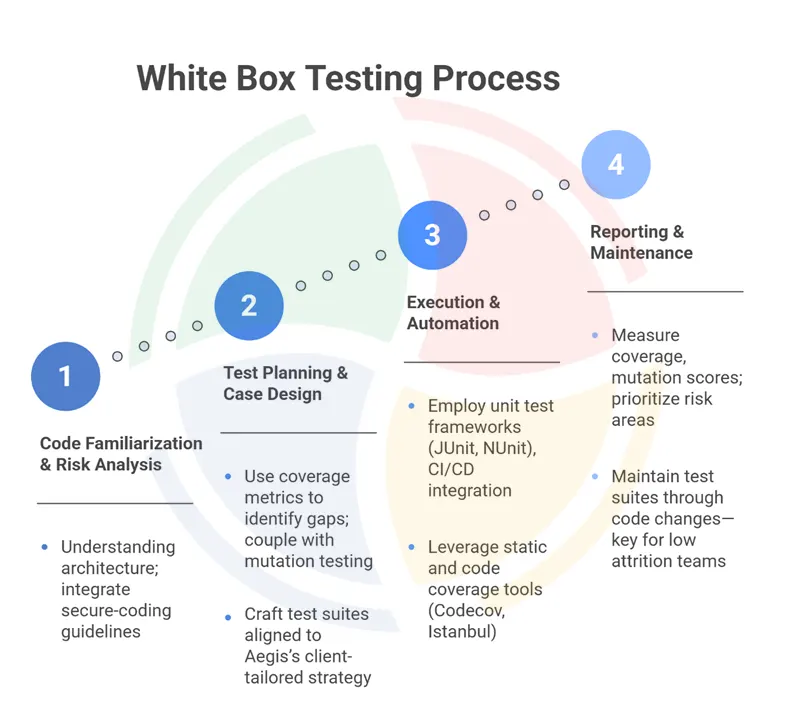
So you’ve got the source code. Now what?
→ Step 1: Code Familiarization & Risk Analysis
Start by reading the code line by line. Understand the architecture, identify complex branches, and evaluate security-critical logic.
→ Step 2: Test Planning & Case Design
Use coverage metrics, such as statements, branches, and conditions, to identify blind spots. Mutation testing strengthens this by introducing small code changes to see if tests catch them.
→ Step 3: Execution & Automation
Run tests using unit test frameworks like JUnit or NUnit. Automate them into CI/CD workflows. Enhance visibility with coverage tools like Codecov or Istanbul.
Every commit becomes a quality checkpoint.
→ Step 4: Reporting & Maintenance
Track mutation scores and risk coverage. Flag weak points.
As your code evolves, so should your tests, especially if you’re building low-attrition teams that depend on clean, documented test suites.
Want a product that scales safely? We can help with reliable software quality assurance testing services custom-planned for your product growth.
Putting It All Together: Sample Workflow
Building a secure, cloud-ready microservice demands a structured white-box testing approach. Here’s a streamlined workflow that delivers quality and reliability:
- Develop Unit Tests:
Start by writing precise unit tests to verify individual code components.
- Integrate Sonar & Coverage:
Use tools like SonarQube to measure code quality and coverage metrics continuously.
- Add Loop and Branch Tests:
Ensure all logical paths are tested, catching hidden edge cases.
- Perform Mutation Testing:
Introduce small code changes to validate that your tests catch faults effectively.
- Execute Load Tests:
Simulate traffic against endpoints to verify performance under stress.
Finally, automate the entire pipeline—code commit triggers testing, load evaluation, and deployment seamlessly. Visualize all results on a dashboard for real-time insights, enabling continuous improvement.
Best Practices for White Box Testing
White box testing thrives when it’s woven seamlessly into your development workflow. Here’s a checklist for you to maximize its impact:
- Start Early: Integrate white box testing during design and embed it in CI/CD pipelines from day one.
- Use Code Coverage & Mutation Dashboards: Track how much code your tests exercise and identify weak spots.
- Continuously Refine Tests: Remove obsolete or flaky tests and expand coverage to address code drift.
- Measure Impact: Monitor defect leakage, cost savings, and security improvements to justify efforts.
- Automate Unit & Integration Tests: Integrate these tests into CI/CD for rapid feedback.
- Pair Testing with Code Reviews: Involve peers to catch gaps early and improve test quality.
- Write Maintainable Tests: Avoid brittle, overly complex tests that break easily.
- Regularly Refactor Tests: Keep tests aligned with evolving requirements through continuous updates.
Following these practices transforms white box testing from a checkbox into a powerful quality enabler.
Common Challenges & How to Overcome Them
White-box testing offers deep insight into your code, but it’s far from flawless.
Understanding common pitfalls and practical ways to overcome them is key to maintaining test effectiveness and software quality.
| Challenge | What It Means | How to Overcome |
| Time & Maintenance Burden | White-box tests require ongoing updates and effort to maintain. | Use risk-based prioritization to test critical code first. Apply incremental coverage analysis to avoid full re-runs. |
| Tester Bias & Overfitting | Same testers can develop blind spots, leading to narrow test focus. | Rotate testers regularly and pair white-box testing with functional (black-box) QA for balanced coverage. |
| Test Fragility During Refactoring | Tests break easily when code internals change, even if behavior remains stable. | Use interface-driven tests and avoid tight coupling to implementation details for more resilient tests. |
| Tooling Limitations | No single tool uncovers all issues; gaps remain. | Combine static analysis, dynamic testing, and mutation testing tools for broader coverage. |
| Requires Code & Language Knowledge | White-box testing demands deep technical expertise, causing knowledge silos. | Build a shared library of testing patterns to spread expertise and standardize practices across teams. |
| Coverage Fallacy | High code coverage doesn’t guarantee test quality or bug detection. | Focus on thoughtful assertions that validate meaningful outcomes, not just lines of code executed. |
White Box vs. Black Box vs. Grey Box Testing
Understanding the differences between white box, black box, and Grey Box testing helps you pick the right strategy.
| Testing Type | Knowledge of Code | Focus Area | When to Use |
| White Box | Full access to code | Internal logic, paths | Security, unit, and code coverage |
| Black Box | No knowledge of code | Functionality, outputs | User acceptance, system testing |
| Grey Box | Partial knowledge of code | Both internal and external | Integration, security, risk-based |
Decision Flow:
- Need to test internal workings? Go White Box.
- Focused purely on user experience and output? Choose Black Box.
- Want a mix of both, often for security or integration? Pick Grey Box.
Each method complements the others—combined, they provide comprehensive coverage that balances code insight with real-world usage.
Maximize test coverage, minimize risk. Plug our QA automation testing services into your QA cycle and deliver zero-defect software with speed.
Power Up Your White Box Testing with Aegis Softtech: Precision, Speed, Security
White box testing is the backbone of reliable, secure enterprise software. But doing it right means smart prioritization.
And, if you want zero-defect, enterprise-grade quality without breaking the bank or deadlines, Aegis Softtech is your go-to partner.
Why choose our testers for white-box testing:
- Precision software testing for flawless, secure software
- ISO/IEC 27001 certified for top-notch security
- Advanced automation testing that cut testing time by up to 30%
- Faster releases with confidence
- Zero-defect delivery, on time and within budget
FAQs
1. What does white box mean in software?
White box in software means evaluating the internal code structure, logic, and flow to find errors, focusing on how the software works internally rather than just its outputs.
2. What are blackbox and whitebox tests?
White box testing in software testing examines internal code, while black box tests focus on inputs and outputs without knowing the code, testing functionality from a user’s perspective.
3. What are the best white box testing methods?
The best white box testing methods include code coverage analysis, path testing, and control flow testing. These are key white box testing techniques in software engineering for thorough validation.
4. What is white box vs static testing?
White box testing involves running code to verify functionality, whereas static testing reviews code without execution, often through inspections or code analysis.