
Generative AI in Real Estate
Impact, Use Cases & Roadmap
Generative AI has become an executive assistant for industries across the board. But in real estate, it’s hitting at exactly the right moment.
For decades, the real estate sector has been a technology laggard. It relied heavily on manual processes, fragmented data, and human-driven workflows that haven’t changed much since the early MLS days.
This year marks a real inflection point for the industry: better models, cleaner data, regulatory clarity, and shrinking margins are pushing brokerages, developers, and property managers to finally modernize.








If you’re exploring generative AI in real estate, this guide will walk you through what actually matters. We'll discuss practical use cases, implementation roadmaps that won’t derail your team, and the real math behind ROI.
And if you’re still in the “just looking” phase? Perfect.
This is the ideal place to understand what’s hype, what’s real, and how to take your next step without committing to anything today.
Key Highlights
Defintion: Generative AI in the real estate market works by creating dynamic content, automating workflows, and analyzing massive datasets in seconds.
Main goal: Help real estate teams work smarter: better listings, faster transactions, sharper investment insights, and stronger tenant experiences.
Key applications: Auto-generated listings, virtual staging, tenant chatbots, property valuation, predictive analytics, document analysis, smart maintenance, and marketing automation.
Critical considerations: Data quality, Fair Housing compliance, human oversight, legacy system integration, and clear KPI tracking.
Free Resources in this Guide:
- GenAI Pitfall Prevention Checklist
- Generative AI Budget Planning Framework for Real Estate
What is Generative AI in Real Estate Market? Why Does It Matter?
Generative AI in real estate is the next big disruptor as an intelligent system that creates new content, designs, and insights.
Unlike traditional, rules-based AI that follows fixed instructions, generative AI learns from massive volumes of text, images, and structured property data to generate:
- Marketing copy
- Virtual tours
- Renovation concepts
- Predictive pricing insights—on demand.
GenAI in real estate works on Large Language Models (LLMs) and foundation models, fine-tuned for the real estate ecosystem. These models can understand zoning data, tenant patterns, or neighborhood sentiment and then create tailored recommendations or visuals.
But why does it all matter? Because this technology is reimagining how real estate companies market properties, manage operations, and engage customers.
From automating listings to generating immersive experiences, generative AI in the real estate market is giving every firm a competitive, scalable edge.
Why Real Estate Professionals Are Adopting Generative AI Now
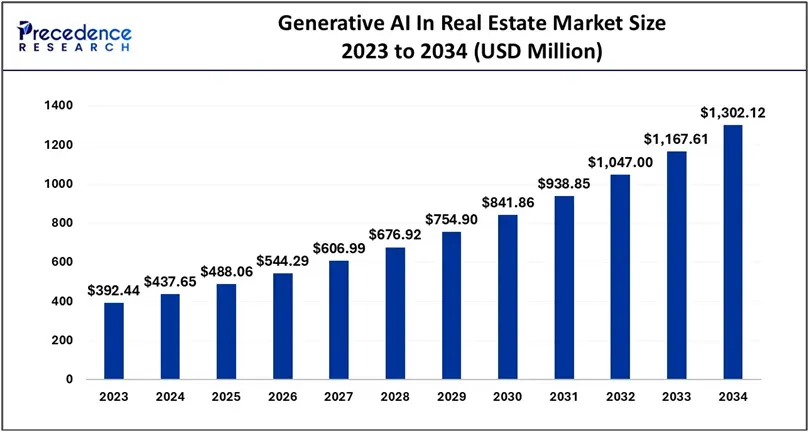
If you’ve noticed the buzz around generative AI in real estate, its momentum is backed by numbers.
The market for GenAI in real estate is valued at $437.65 million in 2024 and is projected to hit $1.3 billion by 2034, growing at an 11.52% CAGR.
Plus, it is proving immeasurably valuable right now as the industry is being squeezed from all sides—labor shortages, rising operational costs, and higher investor expectations (Deloitte).
Post-2020, digital transformation shifted from “nice-to-have” to survival mode.
Meanwhile, the talent landscape is catching up fast: GenAI-related job listings jumped 64% in 2022 and another 58% in 2023.
And early adopters are already cashing in. McKinsey reports 10%+ NOI improvements and dramatic time savings for firms using AI-driven property analysis, marketing, and lease management.
Many teams start with a small, low-risk pilot built with a GenAI development partner, then expand once they’ve proven it can actually move the needle on lead quality or time-to-close.
Pro Tip:
Track your "listing-to-lead" conversion rate weekly. Firms using AI listings see significant lifts when descriptions include neighborhood sentiment scores.
High-Impact Generative AI Use Cases in Real Estate
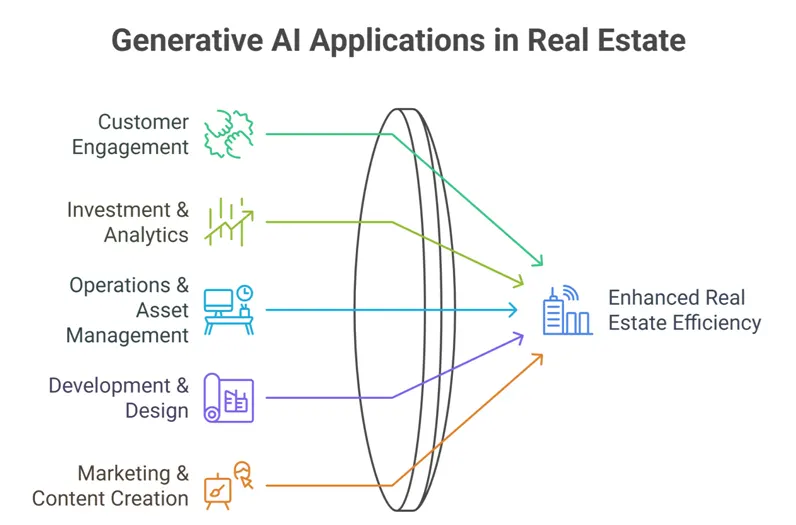
Let’s break down the most high-impact generative AI applications in real estate that are reestablishing the industry’s core functions.
Customer Engagement
One of the most prominent use cases is that AI intervention has led to a new rulebook for how properties are marketed, staged, and sold.
- Auto-generated listings:
NLP algorithms can now generate rich, SEO-optimized property descriptions in seconds, dramatically improving visibility and engagement online.
- Virtual staging:
GenAI tools can transform empty property photos into beautifully furnished rooms—at 97% lower cost than physical staging, with an average turnaround time of 12-48 hours vs. 7-14 days traditionally.
Pro Tip:
Before launching virtual staging, A/B test three furniture styles across identical properties to identify what resonates best with your target demographic.
Sales price premium:
Homes using AI-driven staging see a 1.1% price lift.
- Chatbots & support:
AI-powered virtual assistants manage 24/7 customer service, lead qualification, and tenant engagement.
- Personalized search:
Generative AI refines property discovery by learning from user behavior, preferences, and browsing history to deliver customized property recommendations in real time.
Impact:
Faster listings, higher conversion rates, and more engaging buyer experiences.

Investment & Analytics
Another one of many generative AI applications in real estate is transforming how investors evaluate and grow portfolios.
- Property valuation:
Automated Valuation Models (AVMs) powered by GenAI have drastically improved accuracy. Zillow’s Zestimate now shows a 2.4% median error rate for listed properties.
- Market forecasting:
Predictive analytics use historical and regional data to forecast pricing, demand, and rent trends, helping firms stay ahead.
- Investment opportunity scanning:
GenAI sifts through massive datasets and demographic trends to surface profitable acquisition targets.
- Portfolio optimization:
AI models continuously rebalance assets, risk, and returns across diverse property portfolios.
Impact:
Data-backed decision-making with speed and precision.
Operations & Asset Management
Behind the scenes, generative AI use cases in real estate are cutting costs and streamlining operations.
- Lease/document analysis:
NLP models extract clauses, risks, and obligations, reducing manual review time by 70-80%.
- Fraud detection:
AI flags anomalies and suspicious activities to maintain compliance and reduce risk.
- Back-office automation:
From financial reports to procurement, GenAI automates repetitive administrative tasks.
- Smart property management:
AI predicts maintenance needs, integrates IoT sensor data, and improves tenant matching, enabling 40% faster leasing cycles.
Impact:
Leaner operations, smarter decisions, and elevated tenant experiences.
Development & Design
Generative AI has become a design co-pilot for real estate developers and architects, fusing creativity with data intelligence.
- AI-Driven Floor Plans & Architecture:
Instead of designing in isolation, AI-powered platforms use occupancy data, spatial analytics, etc, to generate floor plans that maximize efficiency and livability.
- Rapid Visualization:
GenAI tools can create multiple design iterations and renderings in hours. These visualizations allow stakeholders to compare options, visualize light, space, and flow.
- Neighborhood Analytics:
Real estate success isn’t just about the building; it’s about the where. Generative AI synthesizes local data (amenities, demographics, commute times) into interactive neighborhood insights.
Impact:
Faster innovation cycles, data-driven precision, and sustainable competitive advantage across the pharma value chain.
Marketing & Content Creation Applications
Perhaps the most popular of generative AI use cases in real estate is marketing. It helps teams eliminate repetitive work and produce more personalized, data-driven campaigns.
- Marketing Campaign Automation:
GenAI tools can now generate ad copy, email campaigns, and social content at scale, while maintaining brand consistency.
- Architectural Design Assistance:
Going beyond creative rendering, AI can overlay foot traffic, daylight exposure, and spatial analytics on preliminary designs.
- Neighborhood & Market Analysis Reports:
Agents and developers can use GenAI to synthesize complex data, such as school ratings to crime rates, to generate client-ready market reports. Add predictive modeling, and you’ve got forward-looking insights on property values and emerging neighborhoods before the competition even notices.
Impact:
Smarter design, hyper-personalized marketing, better advertising, and faster deals powered by generative intelligence in real estate.
Quick Reference: GenAI Use Cases by Real Estate Function
Want a quick overview of how GenAI can transform your real estate operations? Here’s a snapshot of the most impactful use cases by function.
| Use Case | Primary Benefit | Implementation Difficulty | Typical ROI Timeline |
|---|---|---|---|
| Auto-generated Listings | Faster, SEO-optimized property descriptions | Low | 1-3 months |
| Virtual Staging | Lower cost, faster turnaround, higher engagement | Low | 1-2 months |
| AI-Powered Property Valuation | Accurate, data-driven pricing | Medium | 2-4 months |
| Predictive Market Analytics | Proactive investment and portfolio decisions | Medium | 3-6 months |
| Lease/Document Analysis | 70–80% reduction in manual review time | Medium | 2-4 months |
| Fraud Detection | Reduced risk, improved compliance | Medium | 3-6 months |
| Back-Office Automation | Streamlined admin, reduced costs | Low | 1-3 months |
| Smart Property Management | Faster leasing, predictive maintenance | Medium | 3-6 months |
| AI-Driven Floor Plans & Design | Faster, data-backed design iterations | Medium | 3-6 months |
| Rapid Visualization | Instant, cost-effective design renderings | Low | 1-2 months |
| Neighborhood Analytics | Data-driven location insights | Medium | 3-6 months |
| Marketing Campaign Automation | Personalized, scalable campaigns | Low | 1-3 months |
| Architectural Design Assistance | Enhanced creativity and efficiency | Medium | 3-6 months |
| Market Analysis Reports | Client-ready, predictive insights | Medium | 2-4 months |
| Lead Generation & Qualification | Higher conversion, faster response | Low | 1-2 months |

— Head of Generative AI Solutions, Aegis Softtech
How to Implement Generative AI in Your Real Estate Business?
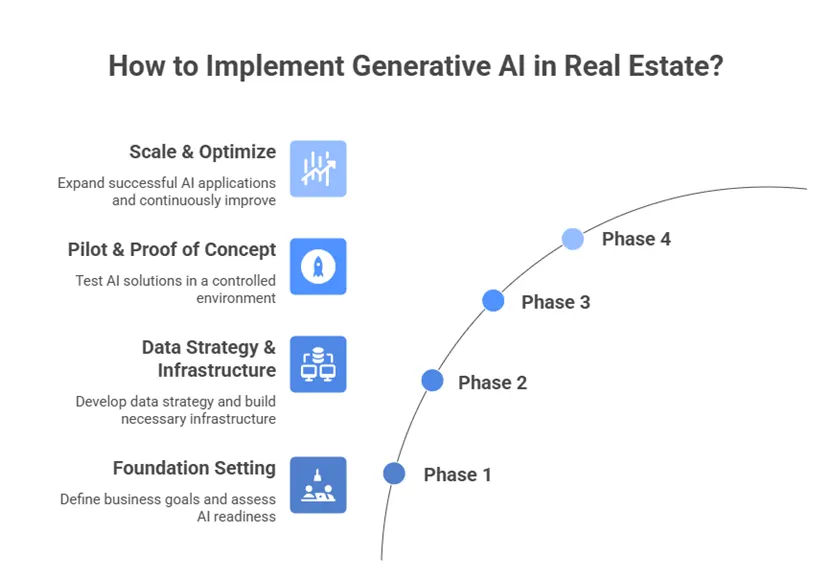
Implementing generative AI in real estate can feel intimidating. There’s data to clean, tools to evaluate, and people to align. But don’t worry; the process doesn’t need to be chaotic.
With a clear, phased roadmap, you can move from concept to execution without losing focus.
The exact path will differ by your company’s size and digital maturity—but the foundation remains universal.
Here's a quick guide:
Phase 1: Foundation Setting (Months 1-2)
Begin by taking a thorough assessment of where you stand.
Assess Current State
Start by evaluating your AI maturity and technical readiness. Audit your data quality, accessibility, and governance policies and identify legacy systems that need modernization.
Align Leadership & Define Vision
Without C-suite buy-in, your GenAI initiative won’t last a quarter. As McKinsey notes, leadership alignment is the first pivotal action in any AI transformation.
Determine where you sit in the real estate value chain—development, operations, or investment—and tie clear business goals to GenAI capabilities.
Challenge legacy hierarchies and rethink how teams collaborate across silos.
Build a Cross-Functional Team
You don’t need a massive hiring spree. Just the right mix of talent. Assemble a nimble team of engineers, designers, domain experts, and data specialists.
Define new roles like prompt engineers or compliance managers, and allocate a budget for training existing staff.

Phase 2: Data Strategy & Infrastructure (Months 2–4)
Think of this phase as moving from “location, location, location” to “data, data, data.”
Develop Proprietary Data Assets:
Identify the proprietary data you already hold. This could be tenant histories, property performance, or market insights. Next, figure out what’s missing.
Use IoT sensors, tenant apps, and building systems to capture new streams.
Establish Data Governance:
Assign data stewards for quality, ethics, and compliance. Select governance frameworks that fit your geography (GDPR, SOC 2, or local regulations).
Build your own data lakehouse to maintain ownership rather than outsourcing control to vendors.
Engineer Prompt Library:
A model is only as good as the prompts driving it.
Create real estate-specific prompt templates for tasks like lease renewal outreach, investment summaries, or marketing descriptions. Then, refine them through testing cycles.
Modernize Your Technology Stack:
Integrate GenAI safely with toxic language filters (for Fair Housing compliance) and guardrails against hallucinations.
Connect property management, CRM, and maintenance systems for full workflow visibility.
Phase 3: Pilot & Proof of Concept (Months 4-7)
This phase is your “test before you invest” moment.
You’re validating how GenAI performs in the real world, where it can deliver quick results, and where it might need fine-tuning before full rollout.
Apply the 2x2 Approach:
A practical framework to begin with is McKinsey’s “2x2” strategy. Use two quick-win use cases and two transformational ones.
Quick wins, like AI-generated property listings or virtual chatbots, show fast ROI and build internal excitement.
And, transformational use cases, such as AI investment copilots or generative design tools for architecture, take longer but create lasting competitive advantage.
The balance ensures you see early success while laying the groundwork for deeper transformation.
Select Implementation Approach:
Choosing the right implementation path depends on your priorities. Public APIs like ChatGPT offer speed; third-party tools deliver industry focus; open-source models give flexibility but need in-house skill; and purpose-built LLMs ensure data privacy with longer timelines.
The right fit depends on your use case complexity, budget, and compliance needs—customizability always trades off with time-to-market.
Define Success Metrics:
Measuring impact early keeps the project grounded.
Define both financial KPIs, such as cost savings, deal velocity, revenue uplift, and non-financial ones like tenant satisfaction, lead conversion, and accuracy improvements.
Iterate Based on Feedback:
Refinement is crucial. Keep humans in the loop for output validation and model feedback. Conduct regular audits to detect bias or drift, and continuously update prompts and models as foundation systems evolve.
The goal is to create a living AI ecosystem that learns and adapts along with your organization.
Phase 4: Scale & Optimize (Months 7-12)
Now it’s time to go from promising pilots to full-scale transformation. This phase requires integrating AI into your company’s DNA. This makes it part of everyday workflows, not a side project.
— Lead of AI Transformation, Aegis Softtech
Expand Across Organization:
Once pilots show value, scale them horizontally. Extend successful tools to marketing, operations, and property management teams.
Create a self-service AI portal so employees can safely use approved tools, while comprehensive training ensures consistent, confident adoption across departments.
Redesign Operating Model:
Restructure how your teams operate. Free agents from repetitive data entry so they can focus on client relationships and deal-making.
Reimagine marketing with AI-powered personalization and analytics. Encourage new hybrid roles—prompt engineers, AI auditors, compliance leads—that bridge human expertise with AI efficiency.
Establish AI Governance & Ethics:
Build your guardrails early. Conduct bias and fairness audits regularly, and make AI decisions transparent and explainable.
Stay compliant with GDPR, SOC 2, and housing regulations. Track performance against baseline metrics and report ROI clearly to stakeholders.
Most importantly, share your wins. Internal success stories build momentum, helping your team see GenAI not as a disruptor but as an accelerator for everything they already do well.

Common Challenges with GenAI in Real Estate (+Solutions)
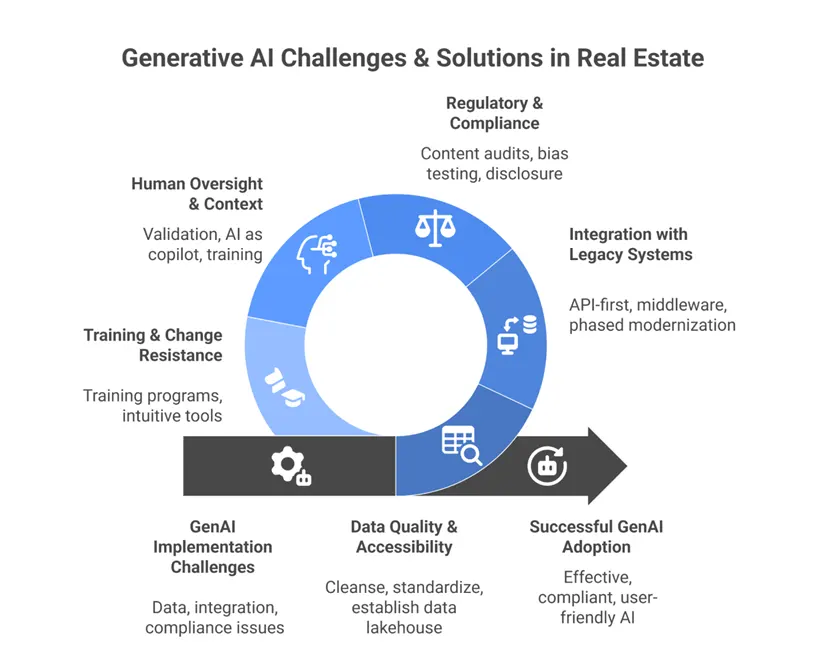
GenAI in real estate sounds like a dream: automated listings, hyper-personalized property recommendations, and virtual staging that sells homes before anyone steps inside.
But getting there? It’s a maze. Between messy data, legacy systems, and the delicate balance between automation and human touch, most firms hit speed bumps fast.
Let’s explore the most common challenges and how forward-thinking teams are solving them:
Data Quality & Accessibility Issues
The biggest obstacle to generative AI in real estate is: garbage in, garbage out.
When data is inconsistent, incomplete, or trapped in silos across MLS databases, broker CRMs, and third-party listing feeds, AI models start hallucinating. Or worse, they start generating unreliable insights.
Due to this, agents get inaccurate property valuations. Renters see listings that don’t exist. Decision-makers lose trust in AI tools.
Solutions:
- Cleanse and standardize data before implementation.
- Establish a single source of truth with a modern data lakehouse.
- Schedule regular data quality audits—AI needs fresh fuel.
- Invest in data infrastructure in parallel with AI tools, not after.
Pro Tip:
Assign one "data owner" per system—CRM, MLS, PMS—who validates completeness and format consistency before any AI pilot even starts.
Integration with Legacy Systems
Most firms rely on outdated technology, and they also struggle to integrate new AI solutions. That’s like trying to plug a Tesla charger into a 1970s gas pump.
That means workflows break. Data remains siloed. AI models can’t connect with CRM or ERP systems, limiting their impact.
Solutions:
- Adopt an API-first integration approach to ensure compatibility.
- Use middleware platforms to bridge old and new systems.
- Modernize in phases—no need for an overnight overhaul.
- Pick AI vendors with proven real estate integrations.
Our generative AI integration experts connect the dots without disrupting daily operations.

Regulatory & Compliance Concerns
Real estate AI sits at the crossroads of privacy, ethics, and law. Think Fair Housing Act compliance, data privacy (GDPR, CCPA), and intellectual property rights for AI-generated visuals or listings.
This results in biased AI recommendations or a privacy slip, which can trigger fines or PR nightmares.
Solutions:
- Run regular audits for discriminatory or biased content.
- Conduct bias testing across AI-generated recommendations.
- Clearly disclose AI-generated material to clients.
- Enforce data privacy compliance such as GDPR, CCPA, and local regulations across all platforms.
- Include legal review for high-stakes outputs.
Also Read: Generative AI in the Legal Industry
Lack of Human Oversight & Context
Generative AI can analyze patterns—but it doesn’t feel the market pulse. It may miss that “wow” factor of a property or make impractical design suggestions.
This can lead to poor client experiences, tone-deaf marketing, and missed revenue opportunities.
Solutions:
- Keep a human in the loop for review and validation.
- Position AI as a copilot, not a replacement.
- Train agents to recognize AI’s limits.
- Let humans handle high-stakes decisions like negotiations.
Insufficient Training & Change Resistance
You can have the best GenAI tool on the planet, but if your team doesn’t know how (or why) to use it, adoption stalls.
This can lead to low utilization, stalled ROI, and “AI fatigue.”
Solutions:
- Build hands-on training programs focused on practical, real-world use.
- Start with AI advocates and let their wins inspire others.
- Prioritize intuitive tools that integrate seamlessly with existing workflows.
- Celebrate early wins to reinforce adoption momentum.
- Ensure executive sponsorship to signal leadership commitment.
— Generative AI Lead, Aegis Softtech
Unclear Success Metrics
Without KPIs, you’re flying blind. Real estate firms often launch pilots without defining what success looks like.
It indicates that teams can’t measure impact or justify investment. Thus, AI ends up shelved.
Solutions:
- Set baseline metrics before rollout.
- Track both financial (lead conversions, cost per sale) and non-financial (agent productivity, client satisfaction) outcomes.
- Maintain a consistent reporting cadence—monthly during pilots, quarterly post-scale.
- Benchmark results against industry standards to validate performance.
Calculating ROI: What Does GenAI Really Cost and Return?
So you’ve bought into the promise of generative AI in the real estate market, but the CFO’s question lingers: “What’s the actual ROI?”
Let’s make that concrete:
| Cost Component | What It Covers | Typical Range (USD) | When It’s Incurred | Optimization Tip | Source / Insight |
|---|---|---|---|---|---|
| License Fees | Subscription to foundation models | $10–$500 per user/month (off-the-shelf) $50K–$300K+ (custom builds) | Monthly / Annual | Start with SaaS models; move to custom once ROI proven | Precedence Research |
| Staff Training | Upskilling brokers, marketers, and operations staff on AI tools and workflows | $500–$2,000 per person | Months 1–3 | Blend internal workshops with vendor-led sessions | Industry Averages |
| Pilot Programs | Proof-of-concept use cases like automated listing creation, virtual staging, or lead scoring | $10K–$500K+ (varies by company size) | Months 3–6 | Begin small; reinvest pilot savings into scale | Deloitte Survey |
| Integration & Upgrades | Connecting AI tools to CRMs, MLS systems, marketing automation, and analytics platforms | $25K–$150K | Months 2–6 | Choose API-friendly tools; avoid costly custom connectors | Market Estimates |
| Governance & Compliance | Data privacy, responsible AI policies, legal vetting | $5K–$50K | Ongoing | Align with NAR data standards and local regulations | Internal Policy Benchmarks |
| Maintenance & Model Updates | Continuous improvement, fine-tuning, and monitoring | $2K-$10K/month | Ongoing | Automate retraining pipelines to reduce cost drift | Operational Benchmarking |
Expected Returns
When done right, the ROI from generative AI in real estate compounds quickly, boosting efficiency, reducing costs, and driving higher revenue.
- Efficiency Gains:
Cut 40-60% of time spent on listings, lease reviews, and document analysis.
- Operational Cost Savings:
Realize 15-20% savings; virtual staging costs drop by up to 97%.
- Revenue Growth:
Expect +10% NOI and up to +1.1% higher sale prices via AI-enhanced virtual tours.
- Faster Leasing:
Reduce vacancies with 40% quicker leasing cycles through AI-driven marketing personalization.
Typical Payback Period:
- Quick wins: 3-6 months
- Enterprise transformation: 12-18 months
Also Read: Generative AI in Software Development
Success Stories of Generative AI Applications in Real Estate?
Companies leading the charge with generative AI in real estate are already seeing real, measurable ROI. Here are a few examples showing how AI’s not just transforming operations; it’s redefining them.
JLL – Occupancy Insights
Global real estate powerhouse JLL uses a proprietary AI platform to analyze occupancy data across massive portfolios. The system identifies space utilization patterns, energy inefficiencies, and optimization opportunities for corporate clients, especially at Fortune 500 scale.
The result is smarter space design, lower operational costs, and real-time visibility into how offices actually function.
Zillow – Zestimate
Zillow’s Zestimate is a neural network in action. By blending property photos, listing details, and local trends, Zillow’s AI engine achieves a 2.4% median error rate for on-market homes.
That means your $500,000 home estimate is, on average, within $12,000 of its true value. It’s precision at consumer scale, and a major trust builder in digital real estate.
Lessons Learned:
- Start small: Prep your data, launch one pilot, then scale.
- Document everything: Failures and pivots hold as much value as wins.
- Measure relentlessly: Track ROI to validate success and secure future investment.
The Future of AI in Real Estate: What's Next?
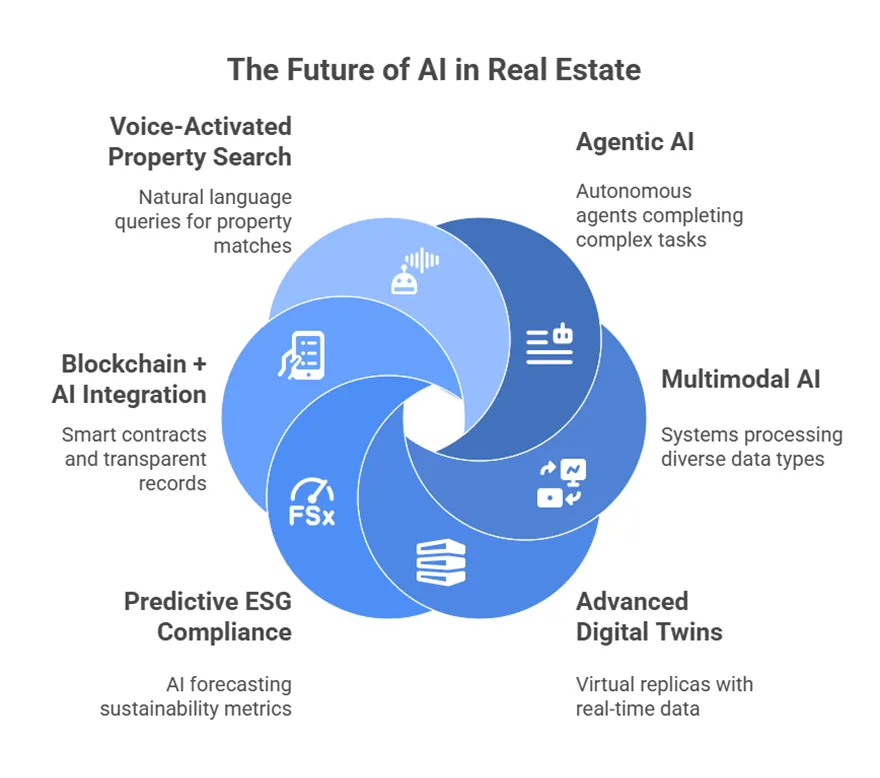
As the industry matures past basic automation, the next wave of AI will feel less like a tool and more like a partner that works alongside you.
Here’s where the industry is heading (and it’s a big leap forward):
Agentic AI
AI agents will independently handle multi-step tasks: running comps, scheduling tours, drafting documents, and coordinating inspections.
Multimodal AI
These systems will analyze photos, videos, floor plans, live sensor data, and text together to deliver richer insights, smarter recommendations, and more accurate property valuations.
Advanced Digital Twins
Buildings will have live virtual replicas connected to IoT sensors, predicting maintenance needs, monitoring energy usage, and optimizing building operations automatically.
Predictive ESG Compliance
AI will forecast environmental performance, upcoming regulations, carbon impact, and sustainability scoring.
Blockchain + AI Integration
Smart contracts, automated verification, tamper-proof records, and AI-driven fraud detection will make buying and selling smoother and more transparent.
Voice-Activated Property Search
Buyers will simply speak their intent, and voice bots will deliver precise matches instantly.
Your Launchpad for the AI-Driven Real Estate Future
The difference between ROI and wasted effort with piloting genAI in real estate almost always comes down to execution. The firms seeing real gains are the ones working with teams who understand both the tech and the industry realities.
If you want predictable outcomes, you need a partner who brings:
- Experience with complex AI builds
- Real estate domain knowledge
- Full-stack engineering strength across AI/ML, cloud, and integration
- Stable teams with low attrition
Aegis Softtech checks those boxes. We design, build, and integrate GenAI solutions that plug directly into your existing systems and deliver wins fast (without derailing your team).
So, i you want a clear, grounded path to your first GenAI win, our experts can map your next 90 days and build a pilot that actually ships.
Frequently Asked Questions
Predictive AI analyzes historical trends to forecast pricing or demand, while generative AI in real estate creates new content such as descriptions, insights, or scenario-based planning. Together, they help professionals make faster decisions and elevate client-facing experiences.
No, generative AI in real estate market workflows automates repetitive tasks. However, it cannot replace the negotiation skills, local expertise, and emotional intelligence that agents provide. Instead, it enhances productivity so agents can focus on higher-value client service.
Valuations powered by generative AI applications in real estate integrate MLS history, geospatial data, renovation permits, and micro-market trends, often reaching accuracy ranges within 3–8% of appraised value. Accuracy improves further when agents validate anomalies that AI cannot interpret, such as unique finishes or off-market comparables.
The best platform depends on whether you need marketing automation, valuation insights, or broader generative AI use cases in real estate, like deal analysis or portfolio optimization. Consider scalability, data security, and integration capabilities when comparing vendors.