
Organizations across industries are racing to integrate artificial intelligence into their products and operations.
But the question keeping CTOs, product leaders, and procurement teams up at night remains the same: how much does AI software development actually cost?
Simple prototypes and MVPs fall on the lower end, while enterprise-grade solutions requiring custom model training, multi-system integration, and regulatory compliance push costs significantly higher. Let’s break down AI software development cost across different project types, the estimation methods that work, and reveal the ongoing expenses most teams overlook.
Key Takeaways
- Chatbot costs: Rule-based bots run $3,000 to $15,000, while LLM-powered systems reach $50,000 to $150,000+.
- Custom model development: Pre-trained integrations start at $20,000, while training from scratch exceeds $100,000 to $500,000.
- Agentic AI systems: Simple agents cost $15,000 to $40,000, enterprise multi-agent platforms reach $100,000 to $200,000+.
- Infrastructure reality: Cloud GPU costs range from $0.66/hr (specialized providers) to $6.98/hr (Azure) for identical hardware.
- Hidden ongoing costs: Budget 15-25% of initial development annually for maintenance, retraining, and scaling.
- Build vs. buy trade-off: Off-the-shelf solutions cost $99 to $1,500/month but limit differentiation; custom builds cost more upfront but reduce long-term per-unit costs at scale.
Cost Disclaimer: The cost figures mentioned in this article are indicative estimates based on industry benchmarks, publicly available information, and our experience delivering AI-driven software development solutions. Actual costs may vary depending on project scope, usage, customization, and the pricing models of specific AI providers.
What is Included in AI Software Development Cost?
The global AI market will reach $244 billion in 2025 and is projected to exceed $800 billion by 2030. Moreover, AI projects carry more phases than traditional software. Each phase has distinct cost drivers that stack up fast when under-scoped.
Problem Definition and Feasibility Analysis
This discovery phase answers critical questions before code gets written:
- Is the data available and accessible?
- What accuracy threshold makes business sense?
- Which systems need integration?
- What compliance requirements apply?
Typical cost: $5,000 to $25,000
Skipping this phase is how $50,000 projects become $150,000 projects.
Data Collection, Labeling, and Preprocessing
AI learns from data, and bad data produces bad AI. The cost of AI software development rises significantly when data preparation is underestimated.
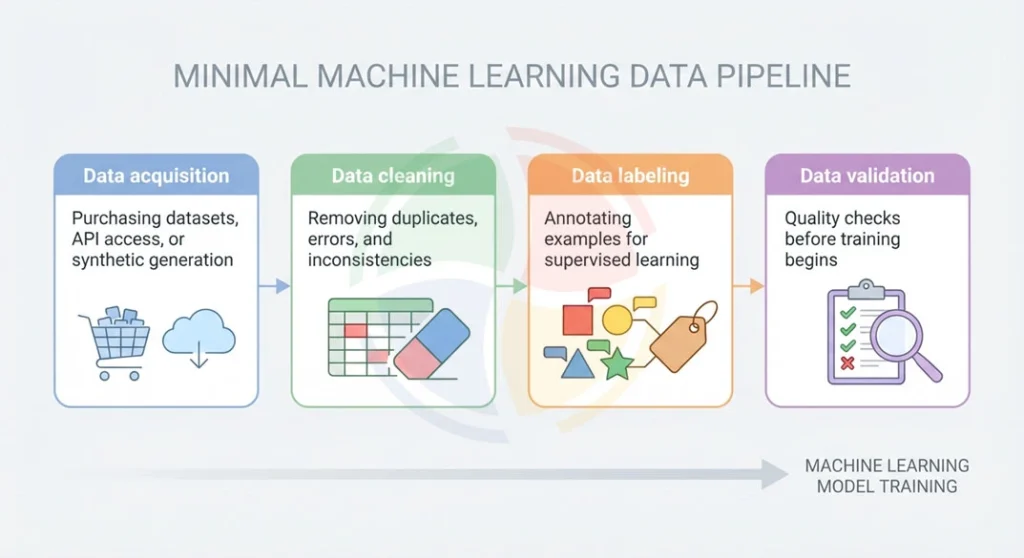
This phase includes:
- Data acquisition: Purchasing datasets, API access, or synthetic generation
- Data cleaning: Removing duplicates, errors, and inconsistencies
- Data labeling: Annotating examples for supervised learning
- Data validation: Quality checks before training begins
Typical cost: $10,000 to $100,000+ depending on volume and complexity
Organizations with clean, existing data pipelines save 30-50% on this phase.
Model Development and Training
The core AI model development cost includes:
- Algorithm selection and architecture design
- Training runs and hyperparameter tuning
- Performance evaluation against benchmarks
- Iteration until accuracy targets are met
Cost driver: GPU compute. A single training run on a medium model costs $500 to $5,000 in cloud compute. Complex generative AI models require dozens of runs.
Application and API Development
Wrapping the model into usable software:
- User interfaces (web, mobile, voice)
- API endpoints for integration
- Authentication and security layers
- Error handling and fallback logic
Deployment, Monitoring, and Maintenance
Production readiness requires:
- Infrastructure provisioning
- CI/CD pipeline configuration
- Performance monitoring dashboards
- Alerting and incident response setup
Key Factors Influencing AI Development Cost
Six variables create the biggest swings in AI software development cost.
1. Quality and Volume of Data
Clean, labeled data accelerates everything. Messy data adds weeks of engineering time.
Example: A fraud detection project with organized transaction logs costs 40% less than one requiring data extraction from legacy systems.
2. Complexity of AI Models
| Model Type | Cost Range | Accuracy Potential |
| Rule-based logic | $5,000-$20,000 | Low (rigid) |
| Classical ML | $30,000-$100,000 | Medium |
| Deep learning | $100,000-$300,000 | High |
| Custom LLM fine-tuning | $150,000-$500,000+ | Very high |
3. Infrastructure and Cloud Usage
GPU cloud pricing varies 3-5x across providers:
| GPU | AWS | Azure | Specialized Providers |
| NVIDIA A100 | $4.09/hr | $3.40/hr | $0.66-$1.50/hr |
| NVIDIA H100 | $3.90/hr | $6.98/hr | $1.49-$2.50/hr |
Sources: CUDO Compute, GMI Cloud
AWS cut H100 pricing by up to 45% in June 2025. Specialized providers like Lambda, CoreWeave, and RunPod consistently undercut hyperscalers by 50-70%.
4. Integration Requirements
Every connected system adds to the cost of AI software development:
| Integration Type | Cost Range |
| Standard CRM (Salesforce, HubSpot) | $2,000-$5,000 |
| ERP connection | $10,000-$25,000 |
| Custom workflow automation | $5,000-$30,000 |
| Legacy system connectors | $15,000-$50,000 |
5. Security, Compliance, and Governance
Regulated industries pay a premium:
- HIPAA (healthcare): $15,000-$30,000 implementation
- SOC 2 certification: $10,000-$25,000
- GDPR compliance: $10,000-$20,000
- Ongoing monitoring: $500-$2,000/month
6. Build Location and Team Structure
Hourly rates vary significantly by region:
| Location | AI Engineer Rate |
| United States | $150-$300/hr |
| Western Europe | $100-$200/hr |
| Eastern Europe | $50-$100/hr |
| South Asia | $30-$60/hr |
Cost of AI Software Development by Use Case
Different AI applications carry distinct cost profiles. Understanding these breakdowns helps teams avoid budget surprises.
AI Chatbot Development Cost
The AI chatbot market will reach $27 billion by 2030. AI chatbot development cost depends entirely on the intelligence level.
Rule-Based Chatbots
- Cost: $3,000-$15,000
- Timeline: 2-4 weeks
- How they work: If-then logic, decision trees, keyword matching
- Handles: FAQ responses, appointment booking, simple lead capture
- Breaks when: Users ask anything outside the script
- Best for: Small businesses seeking quick automation wins without AI complexity
Conversational AI Chatbots
- Cost: $20,000-$60,000
- Timeline: 2-3 months
- How they work: NLP for intent recognition and entity extraction
- Handles: Customer support, sales qualification, context-aware responses
- Requires: Training data, ongoing model updates
- Best for: Mid-market companies with established support workflows
LLM-Powered Chatbots
- Cost: $50,000-$150,000+
- Timeline: 3-6 months
- How they work: Large language models (GPT, Claude, Llama 4) with custom prompting or fine-tuning
- Handles: Complex queries, multi-turn conversations, dynamic content generation
- Ongoing costs: $5000-$5,000/month in API usage
AI Model Development Cost
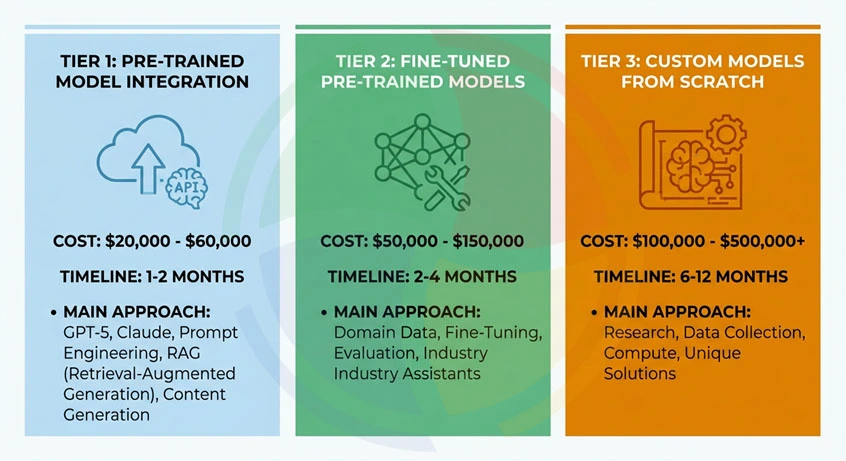
AI model development cost varies dramatically based on how much you build vs. buy.
Tier 1: Pre-trained Model Integration
- Cost: $20,000-$60,000
- Timeline: 1-2 months
- Approach: Call GPT-5, Claude, or similar via API
- Work involved: Prompt engineering, RAG pipeline setup, application wrapper
- Best for: Content generation, summarization, Q&A systems
Lowest upfront cost, but API fees accumulate. High-traffic applications can spend $2,000-$10,000 monthly on inference.
Tier 2: Fine-tuned Pre-trained Models
- Cost: $50,000-$150,000
- Timeline: 2-4 months
- Approach: Customize foundation models with domain-specific data
- Work involved: Training data preparation, fine-tuning runs, evaluation loops
- Best for: Industry-specific assistants, specialized classification, custom recommendations
Balances customization with reasonable cost. Requires quality training data (minimum 1,000-10,000 examples for most use cases).
Tier 3: Custom Models from Scratch
- Cost: $100,000-$500,000+
- Timeline: 6-12 months
- Approach: Design and train proprietary architectures
- Work involved: Research, extensive data collection, significant computing investment
- Best for: Unique competitive advantages, proprietary data assets, novel problem domains
Only justified when pre-trained alternatives cannot achieve the required performance or when IP ownership matters strategically.
Agentic AI Development Cost
Agentic AI development cost reflects a newer, more complex category. These systems plan autonomously, execute multi-step tasks, and coordinate across tools and databases.
Simple AI Agents
- Cost: $15,000-$40,000
- Timeline: 1-2 months
- Capabilities: Single-task AI automation, basic tool integration, scripted workflows
- Examples: Email triage bots, scheduling assistants, document processors
Multi-Agent Systems
- Cost: $50,000-$100,000
- Timeline: 2-4 months
- Capabilities: Multiple agents coordinating on complex tasks, cross-system orchestration
- Examples: Customer service routing with escalation, research assistants with multiple data sources
Enterprise Autonomous Systems
- Cost: $100,000-$200,000+
- Timeline: 4-8 months
- Capabilities: Long-term memory, compliance logging, real-time decision loops, human-in-the-loop oversight
- Examples: Automated underwriting, supply chain optimization, autonomous security operations
AI Development Cost Estimation Methods
Four approaches help teams build realistic AI development cost estimation models.
1. Time-and-Materials Estimation
Development teams charge based on actual hours worked at agreed rates. The final cost depends on time spent rather than fixed deliverables.
This approach works best for exploratory projects with evolving requirements, R&D phases where scope is genuinely unknown, and proof-of-concept work before committing to full builds. The flexibility comes with risk: scope creep can spiral costs without strong project management.
2. Feature-Based Costing
Break the project into discrete, estimable components. Price each feature separately, then sum for the total budget.
This method suits well-defined projects with clear deliverables. It enables informed trade-off decisions when budget constraints force prioritization. The risk lies in underestimating integration complexity between features and missing cross-cutting concerns like security and performance.
Example breakdown for an AI chatbot:
| Feature | Estimated Cost |
| Conversation design | $5,000 |
| NLP/LLM integration | $15,000 |
| CRM connection | $8,000 |
| Analytics dashboard | $10,000 |
| Deployment and testing | $7,000 |
| Total | $45,000 |
Add 15-20% contingency for integration complexity and scope adjustments.
3. Model-Centric Costing
Estimate based on the AI model as the primary cost driver. Calculate data requirements, training compute, and model complexity before adding application development.
Doing this forces a realistic assessment of data preparation needs and accounts for iterative training cycles. It works best when custom model training drives the project rather than API integration.
Multiply expected iterations (usually 3-10 for production-ready models) to get realistic compute budgets.
4. Infrastructure-Led Estimation
Start from compute and infrastructure requirements, then layer development costs on top. Work backward from production needs.
This method suits teams with existing AI platforms and clear inference volume projections. It captures ongoing operational costs from the start and forces realistic production planning.
Cost Comparison: Custom AI vs. Off-the-Shelf AI Solutions
Here’s a quick comparison of custom vs. off-the-shelf AI solutions.
| Factor | Custom Development | Off-the-Shelf Solutions |
| Initial cost | $50,000-$500,000+ | $99-$1,500/month |
| Time to deploy | 3-12 months | Days to weeks |
| Customization | Fully tailored | Limited configuration |
| Competitive advantage | High differentiation | Same as competitors |
| Ongoing costs | 15-25% annually | Subscription + usage fees |
| Data ownership | Full control | May share with vendor |
| Accuracy potential | Optimized for your data | Generic performance |
| Scalability | Designed to your specs | Vendor-imposed limits |
Infrastructure and Compute Cost Considerations
Infrastructure often surprises teams focused on development labor. For complex projects, compute can match or exceed engineering costs.
Training vs. Inference Costs
| Cost Type | What It Covers | Typical Range |
| Training | GPU hours during development | $500-$50,000+ per project |
| Inference | Production API calls | $500-$10,000/month ongoing |
Training is a one-time (or periodic) cost. Inference scales with usage and never stops.
Cloud vs. On-Premises Infrastructure
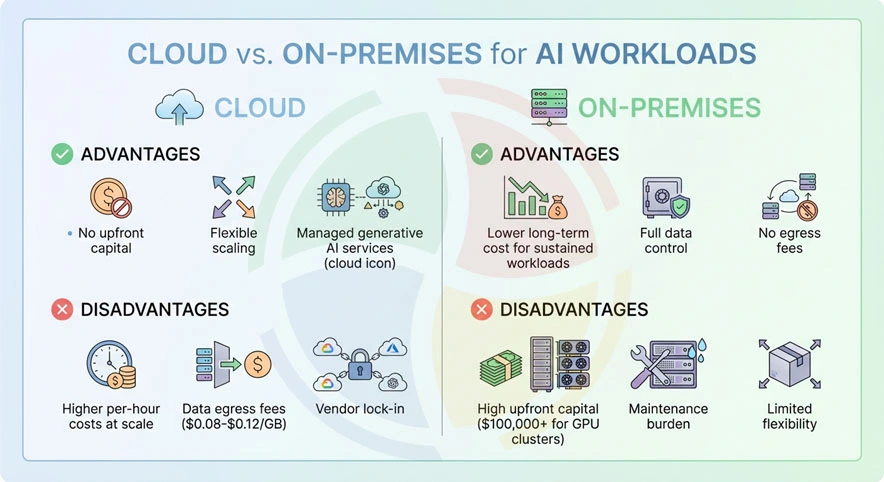
Cloud advantages:
- No upfront capital
- Flexible scaling
- Managed generative AI services
Cloud disadvantages:
- Higher per-hour costs at scale
- Data egress fees ($0.08-$0.12/GB)
- Vendor lock-in
On-premises advantages:
- Lower long-term cost for sustained workloads
- Full data control
- No egress fees
On-premises disadvantages:
- High upfront capital ($100,000+ for GPU clusters)
- Maintenance burden
- Limited flexibility
GPU/TPU Pricing by Provider
Specialized GPU providers consistently beat hyperscaler pricing:
| Provider Type | H100 Cost/Hour | Best For |
| AWS, Azure, GCP | $3.90-$6.98 | Enterprise integration, compliance |
| Lambda Labs | $2.49-$3.29 | Training workloads |
| CoreWeave | $2.21-$2.49 | High-volume inference |
| RunPod | $1.99-$2.39 | Development, prototyping |
| Thunder Compute | $0.66 (A100) | Budget-conscious startups |
AI Integration and Deployment Costs
Getting AI into production adds layers of cost beyond model development.
API Integration
| Integration Target | Cost Range | Timeline |
| Standard SaaS (Salesforce, HubSpot, Zendesk) | $2,000-$8,000 | 1-2 weeks |
| ERP systems (SAP, Oracle, NetSuite) | $10,000-$30,000 | 3-6 weeks |
| Custom internal systems | $5,000-$25,000 | 2-6 weeks |
| Legacy mainframe connectors | $20,00- $50,000+ | 6-12 weeks |
CI/CD for AI Models
MLOps infrastructure enables reliable model updates:
- Basic pipeline setup: $10,000-$20,000
- Enterprise MLOps platform: $30,000-$50,000
- Ongoing tooling costs: $500-$2,000/month
Key components: model versioning, automated testing, staged rollouts, and rollback capabilities.
Observability and Monitoring
Production AI needs visibility into:
- Prediction accuracy over time
- Latency and throughput metrics
- Error rates and failure patterns
- Data drift indicators
Monthly cost: $500-$2,000 for monitoring infrastructure
Security and Access Control
Non-negotiable for production systems:
- Role-based access control (RBAC)
- API authentication and rate limiting
- Encrypted data storage
- Audit logging for compliance
Implementation cost: $5,000-$15,000
Ongoing cost: $500-$1,500/month
Ongoing Costs After AI Goes Live
AI software development costs do not end at launch because production systems require continuous investment.
Model Retraining
Why it matters: Data patterns shift. Models degrade without updates.
Frequency: Quarterly to annually, depending on data volatility
Cost: 10-20% of the initial AI model development cost per cycle
Data Drift Monitoring
Why it matters: Detects when production data diverges from training data
Tools: Evidently AI, WhyLabs, Arize, custom dashboards
Cost: $200-$1,000/month
Infrastructure Scaling
Successful AI products attract more usage. Plan for:
- 2x usage: typically manageable with minor adjustments
- 5x usage: may require architecture changes
- 10x usage: likely needs significant infrastructure investment
Support and Optimization
Ongoing engineering requirements:
- Bug fixes and edge case handling
- Performance tuning
- Feature enhancements
- Security patches
Annual budget: 15-25% of initial development cost
How Aegis Softtech Helps Estimate and Optimize AI Development Costs
Aegis Softtech partners with organizations to ensure clarity throughout AI development cost estimation and reduce total project spend. Our AI developers evaluate data readiness, integration complexity, and model requirements before budgets get locked. Realistic projections replace optimistic assumptions.
Additionally, our Adaptive AI Development Services involve reduction through incremental releases:
- MVP validation before scaling investment
- Feature prioritization based on business impact
- Budget gates between phases
- Course correction opportunities built in
FAQs
1. Is training a custom AI model always more expensive than using pre-trained models?
Upfront, yes. Custom training costs 3-10x more than fine-tuning or API integration. But the calculation changes at scale. Pre-trained model API fees accumulate monthly. For high-volume applications processing millions of requests, custom models often achieve a lower total cost of ownership within 12-18 months.
2. Can AI development costs be reduced without affecting accuracy or performance?
Absolutely. Effective strategies include using open-source frameworks, starting with pre-trained models, optimizing data pipelines, and selecting right-sized infrastructure. Teams commonly cut AI software development costs by 30-50% through architecture decisions alone.
3. How does regulatory compliance affect AI development budgets?
Compliance adds $10,000 to $50,000 in implementation costs, depending on requirements. HIPAA, SOC 2, and GDPR each demand specific controls, documentation, and audit capabilities. Ongoing compliance monitoring adds $500 to $2,000 monthly. Projects in regulated industries should budget 15-25% more than comparable unregulated projects.
4. Are open-source AI tools truly “free” when used in production systems?
No. Open-source eliminates licensing fees but introduces infrastructure, security, and maintenance costs. Organizations must provision compute, implement security controls, and maintain systems without vendor support.
For deployments under 100,000 monthly requests, managed commercial alternatives often cost less than properly securing and maintaining open-source deployments.