
Rapid release cycles, microservices, increasing quality expectations, and sprawling cloud architectures characterize modern software delivery.
QA teams are often stretched, especially when tasked with delivering digital-first applications or mobile platforms. Retaining specialized skills is hard.
But what’s harder is maintaining high coverage across functional, performance, security, and automation tests.
Outsourcing QA testing helps align quality outcomes with your business goals and avoid release blockages, freeing your internal teams to focus on core product innovation. It shifts your software delivery from a cost play to a strategic enabler of velocity and risk management.
Our guide to software testing outsourcing explains what it entails, the models available, benefits, services typically outsourced, and best practices for a successful release. You will also understand the importance of having a trusted offshore software testing partner.
Let’s get started!
Key Takeaways
- Software testing outsourcing is a strategic engagement of a third-party provider to establish a reliable testing engine integrated with your delivery processes. Access specialized skills, tools, and governance without scaling in-house.
- Project-Based: One-time or short-term needs
- Dedicated QA Teams: Ongoing product support
- Managed QA: End-to-end ownership
- Onshore/Offshore/Hybrid: Balance cost and collaboration
- Reduce costs and operational overhead
- Speed up releases
- Leverage expert testing capabilities
- Catch edge-case defects with unbiased validation
- Functional testing
- Test automation
- Performance and load testing
- Security testing
- Continuous QA support
- Define clear KPIs and SLAs
- Involve QA early in the lifecycle
- Establish strong governance
- Treat QA partners as part of your engineering team
What is Software Testing Outsourcing?
Software testing outsourcing is the simple practice of engaging a third-party provider to execute quality assurance (QA) activities that you might otherwise perform in-house. You do not offload tactical tasks; rather, you benefit by establishing a reliable testing engine that integrates with your delivery processes.
QA outsourcing services are a part of a structured quality strategy with defined roles, SLAs, governance models, and performance metrics. Outsourcing arrangements function as extensions of your internal teams, offering you access to specialized skills and methodologies that are otherwise hard to cultivate internally.
Since there is no one-size-fits-all, you can choose from a list of outsourcing models.
Types of Outsourcing Models
The four core software outsourcing models include project-based testing, dedicated QA team, managed QA services, and onshore/offshore/hybrid models.
The model you choose should align with your internal workflow, whether you prefer a dedicated team for long-term stability or a project-based approach for a specific release.
Selecting a model that mirrors your business agility ensures that external expertise feels like a natural extension of your core team.
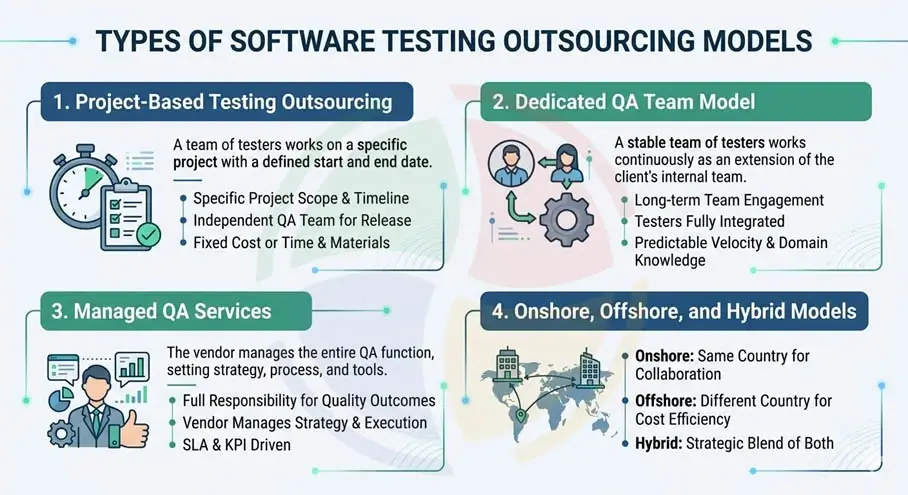
The core models offered by any leading software testing services company are:
Project-Based Testing Outsourcing
The project-based model is suitable for finite initiatives, such as major upgrades, standalone modules, or product launches. It works best when you need testing support for a defined scope and timeline.
It includes predictable engagement outcomes against the agreed test plan, without long-term commitment.
Ideal for organizations that:
- Require QA support for time-bound initiatives such as compliance deadlines or releases
- Want independent validation before production rollout
- Experience short-term testing spikes
- Need fast onboarding without changes to internal QA structures
Dedicated QA Team Model
In a dedicated QA model, an extended team of professionals works exclusively on your product. It fosters deeper ownership and context as the onboarded team becomes familiar with your codebase and quality expectations.
Ideal for organizations that:
- Maintain continuous development cycles with frequent releases
- Want stable QA capacity
- Require testers who develop deep domain or product understanding
- Need a predictable velocity
Managed QA Services
The provider is completely responsible for quality outcomes via an agreed governance framework, KPIs, service levels, and tools. It elevates QA beyond execution to include strategy, reporting, optimization, and automation frameworks of testing processes.
Ideal for organizations that:
- Want accountability for quality outcomes
- Need standardized testing processes, KPIs, tooling, and governance
- Aim to reduce internal QA management and coordination overhead
- Operate multiple products or distributed engineering teams
Onshore, Offshore, and Hybrid Models
Outsourcing is also categorized by location. Each has implications for collaboration, time-zone overlap, access to talent, and cost.
Onshore services are in the same country, offering easier communication and cultural alignment.
Ideal for organizations that:
- Need real-time collaboration with business and product teams
- Operate in regulated environments requiring close stakeholder interaction
Offshore services are in a different country, delivering cost efficiencies and access to broader talent pools.
Ideal for organizations that:
- Need scalable QA capacity across automation, regression, and mobile testing
- Require extended testing hours or round-the-clock execution
Hybrid services blend local oversight with offshore scale.
Ideal for organizations that:
- Need strategic oversight locally with scalable execution offshore
- Balance cost efficiency with governance and communication
Benefits of Outsourcing Software Testing
Beyond the obvious cost savings, outsourcing offers access to a global talent pool with skills in the latest diagnostic methodologies and tools. Your internal developers can thus focus on feature innovation, leaving external experts to handle the rigorous code quality validation.
Implementing high-tier enterprise software testing services through a trusted partner significantly accelerates your release cycles. Ultimately, you achieve a balance between rapid market entry and uncompromising reliability.
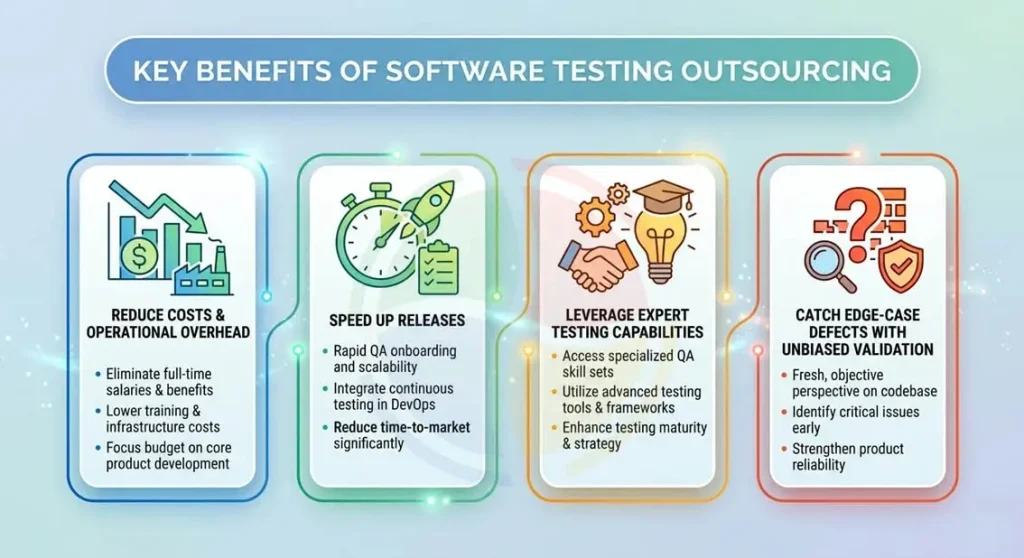
Access to Specialized Expertise and Tools
Outsourcing partners bring deep experience with diverse test types, including functional, performance, load, automation, and security. They also offer multiple toolchains that your internal teams may not own.
Leverage their specialized QA testing skills to accelerate test maturity and reduce reliance on upskilling internal staff alone.
Cost Efficiency
Digital testing outsourcing reduces overall QA cost, while offering you access to global talent and proven testing frameworks. Inviting external talent can significantly reduce operational costs, especially when compared to maintaining a full internal team with equivalent capabilities.
Faster Time-to-Market
It augments your capacity to meet delivery timelines, improving overall customer satisfaction. QA vendors embedded in DevOps workflows can support automated regression suites and continuous testing, enabling more frequent releases without compromising the quality.
Unbiased Perspective
Your internal teams may miss defects due to codebase familiarity. External testers, however, bring fresh viewpoints and broader testing experience to uncover edge-case issues.
Scalability and Flexibility
Fluctuating project demands benefit the most from outsourcing, since it enables unprecedented scaling up or down of testing resources. Align capacity with delivery demands without the burden of recruiting and ramp-up delays.
Software Testing & QA Services You Can Outsource
The scope of outsourcing managed QA services has expanded to include highly specialized domains. You can offload complex environments that require niche expertise or expensive infrastructure to maintain.
A prime example is the shift toward cloud testing services, where your external partner manages performance and scalability validation across diverse virtual environments. Similarly, in outsourcing, certain services are best handled by outside experts.
Most often, outsourced services in QA cover:
Manual Functional Testing
Despite growing automation in security testing, manual testing remains crucial for validating real-world user flows and business logic that automated scripts cannot reliably capture. External teams bring structured exploratory testing techniques that expose integration issues and usability gaps early in the release cycle.
Test Automation Engineering
Test automation is no longer an option, especially if you’re eyeing success. Building and maintaining effective automation frameworks requires polished skill sets. Outsourcing qa test automation services helps select the right tools and design scalable frameworks aligned with your CI/CD pipelines.
Performance and Load Testing
Modern applications must maintain performance reliability under unpredictable demand, product launches, enterprise-scale usage, and seasonal traffic spikes. The right partner will conduct performance and load testing using specialized tools. They simulate real-world conditions to identify blockages before they reach production.
Security and Compliance Testing
Increasing regulatory scrutiny has shifted security and compliance testing from a periodic activity to a continuous requirement. External QA providers offer expertise in executing vulnerability assessments and penetration testing aligned with your industry standards—SOC 2, ISO, HIPAA, and PCI-DSS.
CI/CD and Continuous Testing Support
CI/CD continuous testing services ensure quality is directly embedded into the delivery pipelines. Seasoned professionals integrate automated tests and monitor CI/CD workflows for continuous validation with every code change.
Best Practices for Successful Software Testing Outsourcing
Clear communication and shared performance metrics form the foundation of a successful partnership. Establishing a transparent feedback loop and adopting best practices from the outset is what makes outsourcing software testing your A-game.
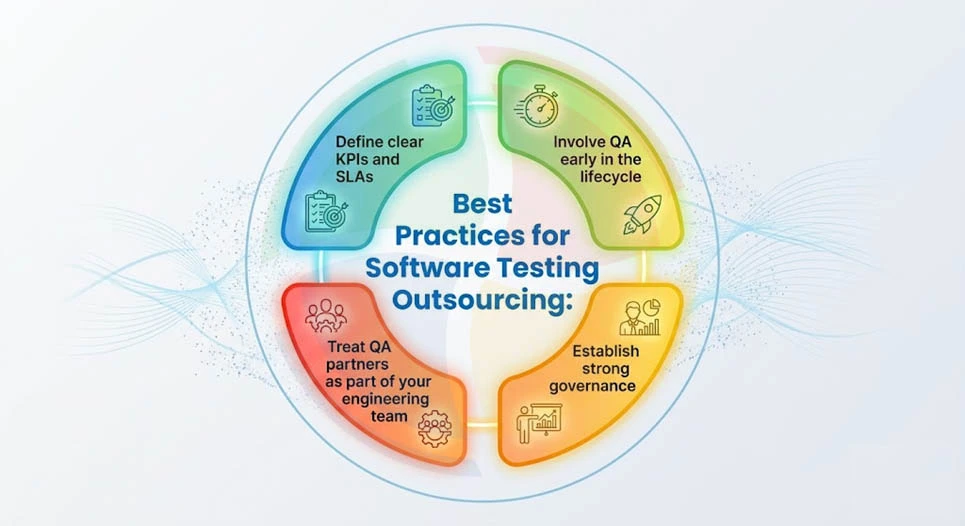
Here’s a list of the key best practices to follow:
Define Clear Quality KPIs and SLAs
Start by defining outcomes and quality metrics, such as defect escape rate, cycle time, test coverage, and critical path validation. Embed these metrics into your service level agreements. Clear measures reduce ambiguity and align expectations.
Embed QA Early in the SDLC
Integrate quality from design through deployment by practicing shift-left testing. Collaboration between architects and developers from the outset aligns tests with acceptance and requirements criteria.
Establish Strong Test Governance
A governance framework with risk escalations and regular checkpoints ensures visibility and accountability. The stronger the governance, the better it fosters prioritization and remediation strategies.
Treat QA Partners as Engineering Stakeholders
Involve testing partners in planning, retrospectives, architecture discussions, and sprint reviews to instill and nurture a sense of shared outcomes ownership.
Drive Growth with Aegis Softtech as Your QA Outsourcing Partner
Outsourcing is not limited to offloading tasks. It is a responsibility of finding a partner who values the integrity of your product.
And for that, you must collaborate with a QA team that owns outcomes.
At Aegis Softtech, our process of software quality checks and assurance works as a strategic engine for our clients. We blend deep domain knowledge with a flexible QA approach, ensuring resilience for your software.
Whether you are launching a niche eCommerce platform or navigating complex enterprise migrations, we refine your software development lifecycle. Our team of testers offers technical oversight crucial to turning quality into a competitive advantage.
We’ve spent around two decades helping organizations transition from fragmented testing processes to high-output QA machines.
We intend to do the same for you by aligning our specialized software and automation testing frameworks with your unique business goals.
FAQs
Q1. What are the 7 stages of testing?
The seven stages of the software testing life cycle typically include requirement analysis, test planning, case development, environment setup, execution, cycle closure, and maintenance.
Q2. Is outsourcing QA cost-effective for enterprises?
Yes, outsourcing QA is often considered a more cost-effective path for enterprises. It significantly reduces overhead, including salaries, hiring expenses, benefits, and infrastructure. Enterprises can still access specialized skills and advanced tools instantly, leading to faster releases and high-quality software.
Q3. When should enterprises avoid QA outsourcing?
Enterprises should avoid QA outsourcing if they think the risk to security and control of product quality outweighs the potential cost savings. It is also ill-advised for mission-critical systems or when dealing with highly sensitive data.
Q4. What is QA outsourcing?
QA (Quality Assurance) outsourcing is the practice of hiring a specialized third-party to ensure software testing and quality validation. Businesses can access expertise and advanced tools without the effort and cost of building an in-house team. These external providers offer a myriad of services, including performance, functional, usability, and security testing.
Q5. What testing services are best to outsource?
Testing services requiring specialized skills or extensive device/platform coverage are best outsourced. The most common ones are performance, automation, security, mobile, localization, and API testing services.