
Still thinking your traditional data center can handle modern AI workloads?
As you scale real-time applications, train larger models, and move massive datasets, legacy systems hit limits on high-density compute, parallel processing, and ultra-low latency.
This raises the key question: what is an AI data center, and why does it matter for enterprise AI adoption?
An AI data center is a purpose-built facility designed to train, deploy, and manage AI and machine learning workloads at scale. Unlike traditional data centers, these facilities use GPU/TPU clusters, high-speed networks, advanced cooling, and AI-driven operations to deliver reliable, high-performance compute.
In this guide, you’ll learn how AI data centers work, why they matter, and what it takes to design one that supports AI-driven transformation.
Key Takeaways
- Concept of an AI-Data Center: High-density GPU environments require advanced data center maintenance best practices to manage extreme heat, constant utilization, and tightly linked cooling-power systems.
- Core best practices: Adopt predictive maintenance, enforce preventive routines, validate redundancy, and use condition-based monitoring to prevent failures before they impact uptime.
- Specialized infrastructure needs: Maintain liquid cooling systems, ensure stable power distribution, and optimize high-bandwidth network performance for AI workloads.
- Operational priorities: Centralize DCIM–CMMS visibility, strengthen physical and cyber security, upskill teams, maintain spare inventory, and optimize energy efficiency.
- Outcome & value: Integrated maintenance, KPI tracking, and AI-driven automation improve uptime, reduce MTTR, and future-proof AI data center operations.
Why AI Data Centers Matter
AI is no longer confined to research labs; it powers your customer interactions, drives internal workflows, fuels analytics, and supports strategic business decisions. But behind every AI capability lies a foundational infrastructure challenge—one that traditional data centers were never designed to support.
1. AI Models are Growing at an Unprecedented Pace
As you adopt generative AI, foundation models, or large-scale neural networks, the demands on your infrastructure grow dramatically.
You need:
- More compute nodes to handle expanding workloads
- Higher GPU density for parallel processing
- Faster interconnects to move data efficiently between nodes
- Specialized accelerators for optimized AI computations
- Larger distributed storage to manage massive datasets
Modern AI workloads require facilities specifically designed to handle high compute intensity and rapid data movement—something traditional data centers struggle with.
At Aegis Softtech, we regularly help enterprises navigate these limitations as they outgrow traditional infrastructure and prepare for AI-ready environments.
2. Enterprise AI Adoption Is Outpacing Legacy Infrastructure
Your current data center may handle virtualization, transactional databases, and general-purpose workloads, but AI is fundamentally different.
It demands:
- Near-instant data throughput for real-time processing
- Massive parallelism across GPU clusters
- High-bandwidth, low-latency networking
- Power-dense racks to support intense compute
- Advanced thermal management to prevent performance throttling
Without an AI-ready infrastructure, you face longer training cycles, increased costs, and slower deployment times.
3. Real-World AI Use Cases Require High-Performance Compute
The AI applications shaping modern enterprises rely on continuous, reliable compute power and include:
- Natural Language Processing (NLP) for chatbots, summarization, and sentiment analysis
- Computer vision for quality inspection, security, and autonomous systems
- Fraud analytics for real-time transaction monitoring
- Autonomous systems and robotics
- Recommendation engines for personalized experiences
- Predictive maintenance in manufacturing or IT operations
All these applications rely on uninterrupted compute and fast data flow—capabilities that traditional data centers are not optimized to provide.
Core Components of an AI Data Center
AI data centers are purpose-built facilities designed to handle the unique demands of modern AI workloads.
Unlike traditional data centers, they combine high-performance computers, advanced networking, scalable storage, precision cooling, and intelligent operations management. Each component plays a critical role in ensuring efficiency, reliability, and scalability.
Here’s a closer look at the core elements you need to understand:
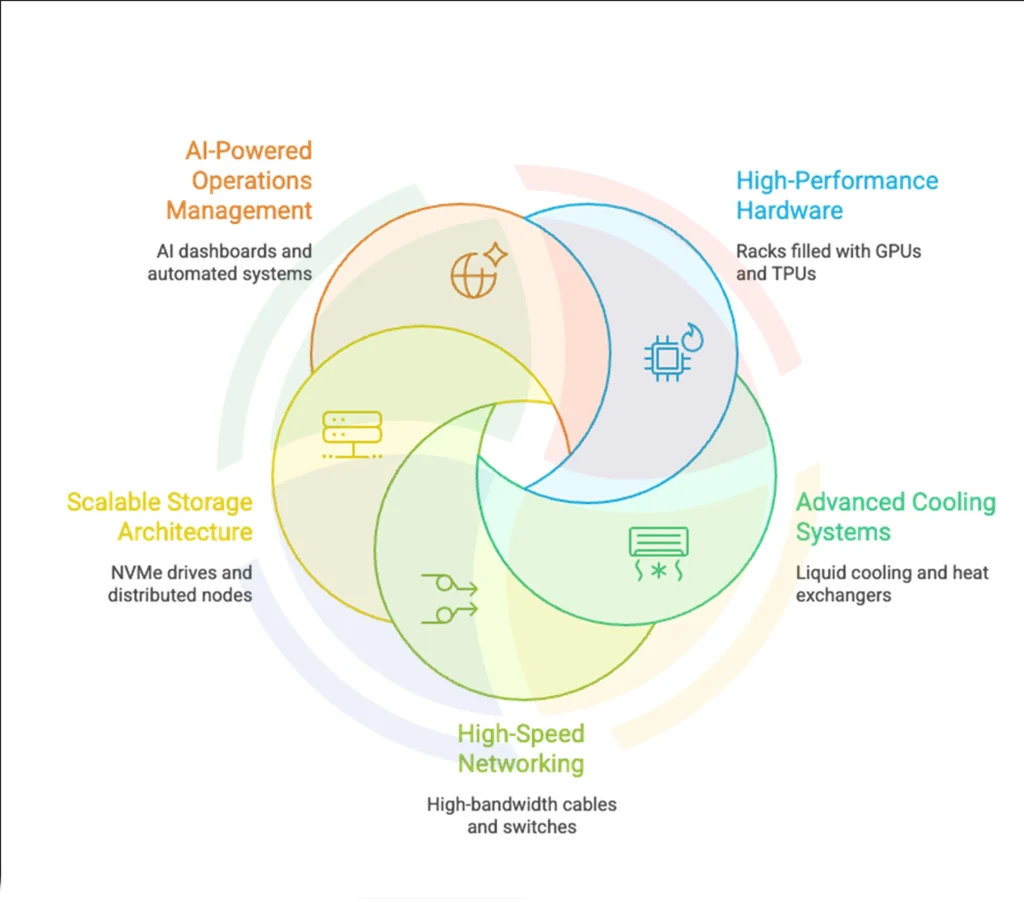
1. High-Performance Hardware
At the heart of every AI data center is computing power. This is where your AI models are trained and executed, and selecting the right hardware directly impacts performance and ROI.
- GPUs (Graphics Processing Units): Designed for massive parallelism, GPUs excel at handling the multi-thousand parallel operations required for deep learning.
- TPUs (Tensor Processing Units): Specialized for AI workloads, TPUs accelerate matrix-heavy operations with lower latency, improving both speed and energy efficiency.
- Custom Accelerators: Solutions like NVIDIA Grace Hopper or AWS Trainium optimize specific AI workloads, reducing bottlenecks in large-scale model training.
For teams newer to AI infrastructure, understanding the foundational concepts of generative AI provides helpful context on why GPU- and accelerator-based architectures are essential for modern AI workloads.
2. Advanced Cooling Systems
High-density compute hardware generates 3–5x more heat than standard racks. Without proper thermal management, performance throttles and hardware lifespan are shortened. Advanced cooling systems are critical to maintain efficiency:
- Direct-to-Chip Liquid Cooling: Circulates liquid directly to hot components for precise heat management.
- Rear-Door Heat Exchangers: Efficiently dissipate heat at the rack level, reducing energy spent on traditional air conditioning.
- Immersion Cooling Tanks: Submerge components in dielectric fluid to achieve uniform, high-performance cooling.
- Hybrid Air-Liquid Systems: Combine airflow with targeted liquid cooling to optimize both energy efficiency and performance.
The goal is to maintain optimal performance while minimizing energy consumption, which also supports sustainability objectives.
3. High-Speed Networking
AI workloads depend heavily on fast, reliable data movement between nodes. Slow or congested networks create bottlenecks that delay model training and inference. AI data centers employ:
- InfiniBand HDR/NDR: Ultra-low latency, high-bandwidth communication between clusters.
- 400–800 Gbps Ethernet: Scalable, high-throughput connectivity.
- RDMA (Remote Direct Memory Access) protocols: Enable direct memory transfers without CPU overhead, minimizing latency.
These solutions ensure your AI clusters scale seamlessly, keeping GPUs and accelerators fully utilized while maintaining consistent performance.
4. Scalable Storage Architecture
Data powers every AI model, and training requires fast, reliable access to massive datasets across multiple nodes. AI data centers use high-performance, scalable storage to minimize latency, maximize throughput, and keep GPUs and TPUs fully utilized. AI data centers incorporate:
- NVMe storage: Provides extreme throughput and reduced latency.
- Object storage: Enables efficient management of unstructured data.
- Distributed file systems (e.g., Lustre, Ceph): Allow thousands of nodes to access datasets concurrently.
The architecture ensures that your models never wait for data, maximizing GPU utilization and accelerating training and inference cycles.
5. AI-Powered Operations Management
AI data centers leverage AI-powered operations management to run more efficiently. Intelligent systems optimize workload scheduling, predict maintenance needs, detect anomalies, and manage energy use, ensuring high performance, reliability, and minimal manual intervention. They include:
- Dynamic Workload Scheduling: Automatically allocates tasks to the best available resources, reducing idle time.
- Predictive Maintenance: Uses AI to anticipate failures before they impact operations.
- Energy Optimization: Monitors power and cooling systems to minimize consumption without compromising performance.
- Anomaly Detection & Automated Failover: Identifies issues in real time and takes corrective action, reducing downtime.
By automating these processes, you reduce operational friction, increase uptime, and create self-optimizing, future-ready infrastructure.
What is the Purpose of an AI Data Center in Modern Infrastructure
AI Data Center is the backbone that enables your AI initiatives to scale, perform reliably, and deliver business impact. They are purpose-built to support the full lifecycle of AI workloads, from model training to deployment and continuous optimization, while maintaining energy efficiency and controlling operational costs.
To understand their value, let’s look at the key ways AI data centers drive performance, efficiency, and business outcomes:
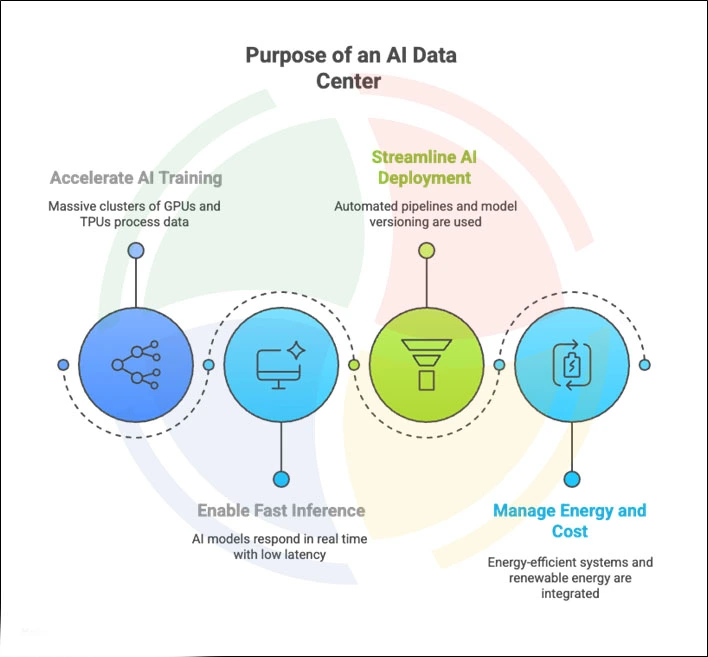
1. Accelerate AI Training
Training large-scale AI models is compute-intensive, often requiring thousands of cores working in parallel. To handle this, AI data centers provide:
- Thousands of parallel compute cores: Ensuring distributed workloads complete efficiently.
- Distributed memory architectures: Allowing large datasets to be accessed simultaneously by multiple nodes.
- Ultra-fast interconnects: Enabling rapid communication between GPUs, TPUs, and accelerators.
2. Enable Fast, Reliable Inference
Once your AI models are trained, they need to respond instantly in real-world applications. AI data centers support low-latency, scalable inference by providing:
- Low-latency inference: Ensuring real-time responsiveness for critical applications.
- Scalable APIs: Allowing multiple applications or services to access AI models simultaneously.
- Edge integration: Bringing AI closer to the data source for faster decision-making.
- Hybrid cloud deployments: Enabling seamless workload distribution across on-premise and cloud environments.
These capabilities enable industry-specific AI applications that depend on real-time responsiveness, consistent performance, and scalable deployment across enterprise environments.
3. Streamline AI Deployment and MLOps
Managing AI models at scale requires more than compute power; it requires robust operational support. To operationalize these capabilities, many enterprises partner with us for Gen AI development services to build and deploy production-ready models at scale.
AI data centers provide the backbone for efficient MLOps practices, including:
- Model versioning: Keeping track of multiple iterations to maintain reproducibility and compliance.
- CI/CD for ML (MLOps): Automating model deployment pipelines for faster rollouts.
- Automated scaling: Dynamically allocating resources based on demand.
- Model monitoring: Ensuring performance consistency and detecting drifts or anomalies.
4. Manage Energy and Cost Effectively
AI workloads are notoriously energy-intensive. AI data centers integrate intelligent energy and cost management systems to help you achieve efficiency and sustainability:
- Cooling efficiency: Advanced liquid or immersion cooling reduces energy use while maintaining performance.
- Power density optimization: Ensures that high-performance racks are utilized efficiently.
- Renewable energy integration: Leverages sustainable power sources to minimize environmental impact.
- AI-driven power distribution: Allocates electricity dynamically to optimize consumption.
Key Differences Between Traditional and AI Data Centers
Traditional data centers have supported general IT needs for decades, but AI workloads introduce demands that conventional facilities were never engineered to meet.
Comparing the two highlights why purpose-built AI data centers are critical for modern enterprises:
| Dimension | Traditional Data Center | AI Data Center |
| Purpose | General computing & storage | High-performance AI workloads |
| Processing Units | CPUs | GPUs, TPUs, accelerators |
| Networking | 40–100 Gbps Ethernet | 400–800 Gbps Ethernet / InfiniBand |
| Cooling | Air cooling | Liquid, immersion, hybrid cooling |
| Power Density | 5–10 kW per rack | 40–100+ kW per rack |
| Storage | SAN/NAS | NVMe, distributed file systems |
| Scalability | Moderate | High-density, modular, cluster-based |
Best Practices for Designing an AI Data Center
If you’re evaluating what is the best way to design an AI data center, start by adopting proven principles that ensure your facility is scalable, efficient, and future-ready.
AI workloads are compute- and data-intensive, so thoughtful planning across hardware, power, cooling, and operations is critical to avoid bottlenecks and maximize ROI.
Given the complexity of high-density compute, power planning, and cooling architecture, enterprises often rely on AI consulting services to model AI workloads, validate design assumptions, and avoid costly infrastructure missteps.
1. Plan for High GPU Density
The foundation of any AI data center is its compute capability. To handle large-scale models efficiently, you should:
- Evaluate workload profiles: Understand the compute and memory requirements of your AI applications.
- Design power and cooling for peak loads: Ensure infrastructure supports maximum GPU utilization without throttling.
- Optimize rack layouts for airflow: Maintain thermal efficiency and prolong hardware lifespan.
- Use modular GPU expansion: Allow incremental growth as AI workloads evolve, without disrupting existing clusters.
2. Build Efficient Power and Cooling Architecture
High-density AI hardware produces substantial heat and demands significant power. To maintain performance while controlling costs:
- Adopt liquid cooling early: Direct-to-chip or immersion cooling improves thermal efficiency.
- Integrate heat-reuse systems: Capture and redirect waste heat for building or process heating.
- Ensure redundant power distribution units (PDUs): Minimize downtime from power disruptions.
- Automate energy monitoring: Track consumption and optimize energy allocation in real time.
3. Balance Smart Workload Orchestration
Efficient utilization of compute resources is just as important as having high-density hardware. AI data centers should implement:
- AI-driven orchestration tools: Intelligently allocate tasks across nodes and clusters.
- Distributed training: Ensure large models are trained effectively across multiple GPUs or nodes.
- Reduced idle GPU time: Maximize compute efficiency and lower operational costs.
- Optimized cluster utilization: Dynamically balance workloads for peak performance.
4. Design for Scalability and Modularity
AI workloads evolve quickly, and your infrastructure must expand seamlessly within the facility itself. Scalability here focuses on physical and architectural flexibility:
- Prefabricated modules: Allow faster deployment of new compute clusters.
- Modular power and cooling blocks: Expand capacity as AI demand increases.
- Scalable network fabrics: Support higher bandwidth and more nodes without performance loss.
5. Integrate Hybrid and Multi-Cloud Flexibly
Beyond physical expansion, AI workloads often require distributed computing across multiple environments. Hybrid and multi-cloud integration ensures your AI infrastructure is flexible, elastic, and globally connected:
- Enable burst compute: handle peak workloads without over-provisioning on-premises resources.
- Support distributed training: leverage multiple environments for faster model development.
- Facilitate edge inference: bring AI closer to end users for real-time decision-making.
- Grow with your business: hybrid design ensures your infrastructure scales alongside AI initiatives.
At Aegis Softtech, we can help you assess readiness, optimize architecture, balance cost and performance, and implement MLOps.
Industry Leaders Investing in AI Data Centers
World’s biggest tech companies are already building the next generation of data centers to power massive machine learning workloads. Their investments provide real-world models of how purpose-built AI infrastructure can drive both performance and sustainability.
Here’s how some of the top players are architecting their AI compute future:
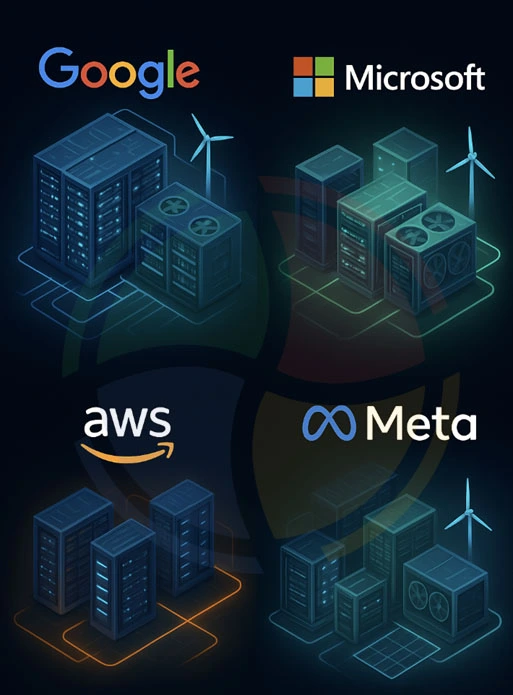
- Google: Committed major CapEx to build liquid-cooled TPU superclusters, and is expanding its AI data center footprint with renewable energy–powered facilities.
- Microsoft: Investing billions in high-density AI hubs (such as its new European cluster) to support OpenAI workloads and enterprise-scale generative AI.
- Amazon (AWS): Combining its own Trainium and Inferentia chips with advanced cooling architectures to host large-scale training and inference workloads.
- Meta: Scaling up with AI-optimized fabrics and hyperscale clusters, and increasingly leaning into sustainable power sources like renewable energy, to power its AI ambitions.
Challenges and the Future of AI Data Centers
While AI data centers unlock unprecedented performance and efficiency, they also come with unique challenges that require careful planning. Addressing these hurdles early ensures your infrastructure is reliable, cost-effective, and scalable.
Current Challenges:
- Escalating Power & Cooling Demands: Dense AI racks can consume 4–10x more power than traditional servers. Efficient energy management and advanced cooling solutions are no longer optional—they’re essential for sustained performance.
- Rising Infrastructure Costs: High-end GPUs, specialized accelerators, liquid cooling systems, and high-bandwidth networking create significant upfront investments. Strategic budgeting and phased deployment can help balance costs with operational efficiency.
- Sustainability Pressure: Enterprises are increasingly expected to reduce emissions and maximize energy efficiency. Integrating renewable energy sources and intelligent power distribution is critical to meet these expectations.
- Talent Gaps: Managing AI-centric infrastructure requires engineers skilled in high-density compute, advanced cooling, and AI operations. Investing in training or partnerships can mitigate this challenge.
The Future of AI Data Centers
- Edge AI Data Centers: Smaller, localized facilities bring compute closer to users for ultra-low-latency inference, enabling real-time AI services at the edge.
- Widespread Liquid Cooling Adoption: As power densities continue to rise, liquid and immersion cooling will become the standard to maintain performance and efficiency.
- Autonomous, AI-Managed Data Centers: Self-optimizing clusters that monitor workloads, predict failures, and manage energy autonomously are emerging as the next frontier.
- Compact, High-Efficiency AI Modules: Micro-AI data centers will empower smaller organizations to deploy advanced AI without investing in massive facilities, democratizing access to high-performance AI infrastructure.
Transform Your AI Strategy with the Right Infrastructure
To fully leverage AI for enterprise growth, you need a data center built to handle high-density compute, ultra-low latency, and massive parallel processing. Purpose-built AI infrastructure—featuring GPU/TPU clusters, advanced cooling, high-speed networking, and AI-driven operations ensures your models train faster, deliver real-time inference, and scale efficiently.
With Aegis Softtech, you gain a trusted partner to design, optimize, and manage AI-ready facilities. Our AI developers help you:
- Deploy high-performance GPU clusters for peak efficiency
- Implement advanced cooling and energy optimization systems
- Monitor infrastructure health with AI-powered operations
- Integrate seamlessly with hybrid and multi-cloud environments
FAQs
Q1: What is the difference between a data center and an AI data center?
A traditional data center supports general computing, storage, and standard workloads. An AI data center is purpose-built for high-performance AI tasks, using GPUs, TPUs, advanced networking, and AI-driven management to handle massive parallel processing efficiently.
Q2: Who is building AI data centers?
Tech giants like Google, Microsoft, Amazon, and Meta, along with specialized providers like CoreWeave, are investing in AI data centers. They focus on high-density, energy-efficient facilities to accelerate AI model training, inference, and deployment at scale.
Q3: How big are AI data centers?
Sizes range from hyperscale facilities with hundreds of thousands of GPUs to compact modular setups for enterprises. The focus is on GPU density, compute throughput, and energy efficiency rather than just physical space.
Q4: Can smaller organizations benefit from AI data centers?
Yes. Micro-modular designs and hybrid cloud options allow mid-sized businesses to deploy cost-effective AI infrastructure without massive capital investment.