

Did you know that over 70% of companies are already using generative AI in at least one part of their business?
That’s right, what was once experimental is now becoming central to how generative AI in industries reshapes daily operations. Companies are using it to automate work, design new products, and deliver better customer experiences.
However, with great power comes great responsibility; the same technology that fuels innovation also introduces risks around compliance, ethics, and operational complexity.
In this blog, we’ll explore how generative AI is being adopted across industries, where the biggest investments are happening, and what you need to prepare for if you want to scale it smartly and safely.
By the end, you’ll have a clearer roadmap for using gen AI to drive measurable, sustainable business value.
Key Takeaways
- Generative AI in industries is accelerating automation, creativity, and decision-making across sectors—healthcare, finance, retail, law, manufacturing, logistics, and more.
- Key applications: Product design, diagnostics, fraud detection, compliance automation, content generation, and personalized customer experiences.
- Overall business impact: Faster workflows, reduced costs, better accuracy, and innovation pathways through generative AI use cases in industries.
- Risks involved: Data bias, compliance gaps, compute costs, IP concerns, and legacy integration challenges.
- Gen AI adoption: Requires a structured, multi-phase framework that ensures safe scalability and efficient impact.
What Sets Generative AI Apart?
Unlike traditional AI, which relies on predefined rules or historical data patterns, generative AI can create entirely new content, ranging from text and images to code, designs, and simulations. This leap is powered by advanced model architectures such as:
- Transformers: Enabling large language models (LLMs) with human-like reasoning
- Diffusion models: Powering realistic images, videos, and molecular structures
- Foundation models: Enabling cross-domain intelligence and multimodal understanding
The combination of creativity and intelligence gives generative AI a strategic edge in industries:
- Automating knowledge-intensive tasks
- Generating new designs, ideas, or solutions instantly
- Helping teams accelerate workflows, reduce errors, and improve decisions
If you are navigating rapid digital transformation, gen AI can be an innovation catalyst and a competitive differentiator capable of transforming entire value chains.
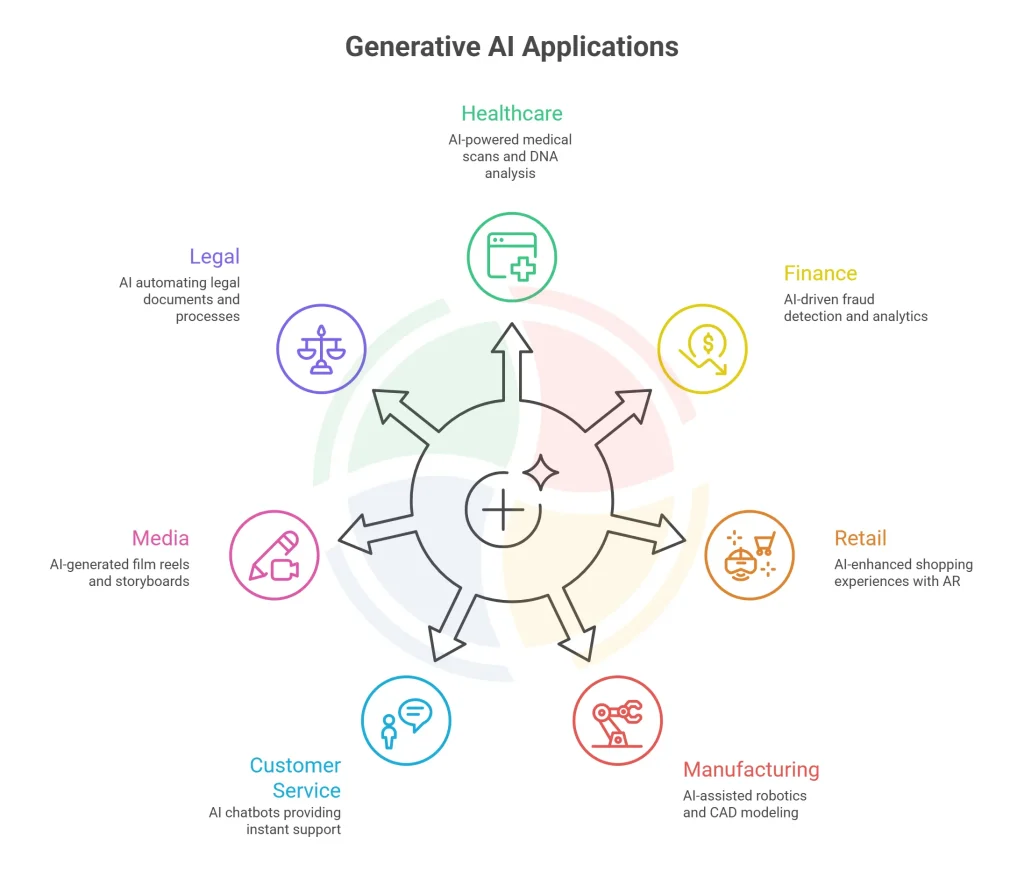
Generative AI Applications in Industries
By exploring generative AI use cases in industries, you can identify high-value opportunities that accelerate R&D cycles, automate complex decision workflows, and drive efficiency.
Below is a comprehensive, industry-by-industry breakdown with business impact to help you understand the potential impact and operational readiness:
Healthcare & Pharmaceuticals
Generative AI is becoming an essential driver of modernization across the healthcare and pharma industry. The value chain covers everything from clinical and operational to research-focused.
Key Applications:
- Drug Discovery & Molecular Engineering: Simulates protein folding, generates molecular candidates, predicts toxicity, and pharmacokinetics.
- Diagnostics & Clinical Decision Support: Automates radiology reports, curates patient summaries, predicts risk scores, and generates personalized treatment plans.
- Operational & Administrative Automation: AI-driven EHR documentation, coding and claims processing, and patient scheduling optimization.
Business Impact:
| Area | Traditional Approach | GenAI-Enabled Approach | Business Impact |
| Drug Discovery | Multi-year trials | AI-generated molecules in minutes | Reduction in early R&D timelines |
| Diagnostics | Manual interpretation | Automated multimodal scan + text analysis | Increased accuracy, reduced burnout |
| Administration | Labor-heavy tasks | Automated documentation | Millions saved in labor costs |
Finance & Banking
Drive your finance function forward by boosting insights, safeguarding assets, and streamlining customer experiences—powered by next-generation digital tools.
Key Applications:
- Fraud & Risk Management: Generates synthetic fraud scenarios, detects behavioral anomalies, and improves credit risk profiling.
- Personalized Financial Advisory: Provides real-time portfolio summaries, conversational wealth management, and proactive risk alerts.
- Regulatory Compliance: Automates compliance reports, AML/KYC summarization, and audit trail generation.
Business Impact:
| Area | Traditional Process | With GenAI | Value |
| Fraud | Reactive alerts | Real-time generative risk modeling | Lower false positives |
| Compliance | Manual reporting | Auto-generated regulatory summaries | Faster audit cycles |
Manufacturing & Supply Chain
Manufacturers are using modern tech to reinvent product design, production, and operational intelligence.
Key Applications:
- Predictive Maintenance: Creates AI-generated maintenance schedules, predicts failures, and flags anomalies in real time.
- Generative Product Design: Automates CAD model creation, lightweight structure design, and multi-objective optimization.
- Supply Chain Forecasting: Generates demand simulations, scores supplier risk, and optimizes routing.
Business Impact:
| Use Case | Benefit | Impact |
| Generative Design | Faster prototyping | Reduction in design cycles |
| Predictive Maintenance | Less downtime | Millions saved annually |
| Inventory Optimization | Balanced supply-demand | Reduced stock-outs |
Retail & E-Commerce
Take your retail brand to new growth heights by increasing personalization, streamlining operations, and accelerating content velocity. All of this is possible with Gen AI at your disposal.
Key Applications:
- AI-driven product recommendations: Suggest items based on behavior, preferences, and purchase patterns.
- Virtual try-ons and AR styling: Let shoppers preview clothing, accessories, or cosmetics digitally.
- Automated ad copy and product descriptions: Produces on-brand, high-volume creative content instantly.
- Conversational shopping assistants: Guides customers with queries, sizing help, and purchase support.
Business Impact:
| Area | GenAI Capability | Impact |
| Personalization | Behavior-based recommendations | Higher conversions |
| Content Creation | Automated creatives | Faster campaign rollouts |
| Customer Experience (Cx) | AI shopping assistants | Higher retention |
Legal Industry
Legal firms are now streamlining document-heavy processes, improving research capabilities, and supporting data-driven decision-making.
Key Applications:
- Contract Drafting & Review: AI-assisted drafting, clause suggestions, and automated compliance checks.
- Legal Research: Fast case law retrieval, precedent analysis, and summarization of judgments.
- Litigation Support: Evidence analysis, case prediction, and risk assessment.
- Regulatory Compliance: Automated compliance monitoring, reporting, and alerts.
- Client Advisory: AI-generated insights for strategy, risk, and legal guidance
Business Impact:
| Area | Generative AI Role | Impact |
| Document Management | Contract drafting & review | Faster contract preparation, fewer errors, improved compliance |
| Research & Analysis | Legal research & precedent summarization | Reduced research time, better-informed legal strategies |
| Risk & Litigation | Litigation support & predictive modeling | Proactive risk mitigation, improved case outcomes |
| Compliance | Automated monitoring & reporting | Reduced regulatory violations, timely alerts |
| Client Services | AI-generated insights | More personalized advisory, faster response times |
Media & Entertainment
Generative AI is opening new avenues for producing stories, visuals, and experiences. It has enabled the media industry to identify new creative opportunities and new oversight requirements.
Key Applications:
- Scriptwriting augmentation: Assists writers with ideas, dialogues, and plot development.
- Scene previsualization: Creates quick visual concepts to guide production planning.
- Automated VFX and rotoscoping: Speeds up labor-intensive visual effects tasks.
- Personalized content generation: Tailors media experiences to individual viewer preferences.
- Audio synthesis and voice cloning: Produces realistic voices and sound elements for creative use.
Business Impact:
| Area | Generative AI Role | Impact |
| Content Creation | Scriptwriting augmentation & personalized content generation | Faster creative cycles, tailored audience experiences |
| Production Efficiency | Scene previsualization & automated VFX/rotoscoping | Reduced labor hours, lower production costs |
| Audio & Voice | Audio synthesis and voice cloning | Realistic sound design, faster audio production |
Software Development
With generative AI, the entire software development lifecycle (SDLC) becomes faster. The overall productivity has been enhanced, errors reduced, and teams enabled with high-quality coding shipment, faster than ever.
Key Applications:
- AI Code Copilots: Automated code suggestions, boilerplate generation, instant debugging guidance.
- Automated Testing: Auto-generated test cases, intelligent test coverage analysis, faster QA cycles.
- Intelligent Refactoring: Code cleanup, architectural recommendations, performance optimization proposals.
- DevOps Automation: CI/CD pipeline scripts, deployment automation, environment configuration.
- Auto-Generated Documentation: Real-time document generation, code summaries, API documentation drafts, and architecture notes.
Business Impact:
| Area | Traditional Process | With GenAI | Impact |
| Coding | Manual writing & debugging | AI-assisted code generation | Faster development |
| Testing | Time-intensive QA | Auto-generated test coverage | Fewer bugs, faster releases |
| Documentation | Often outdated | Real-time auto-documentation | Improved developer clarity |
| DevOps | Script-heavy workflows | Automated pipelines | Shorter deployment cycles |
Human Resources (HR)
Across HR functions, advanced systems are driving more efficient hiring, smarter workforce decisions, and tailored growth opportunities.
Key Applications:
- Job descriptions: AI crafts role descriptions aligned to required skills.
- Resume screening: Automates candidate filtering with built-in bias controls.
- Match scoring: Evaluates candidates against role needs using AI-driven scoring.
- Learning pathways: Builds personalized development journeys for employees.
- Sentiment insights: Analyzes employee feedback to surface workplace patterns.
- Policy drafting: Generates clear, consistent policies and employee handbooks.
Business Impact:
| HR Function | GenAI Application | Impact |
| Hiring | Resume + JD generation | Faster hiring cycles |
| L&D | Personalized upskilling paths | Higher workforce readiness |
| Engagement | Sentiment summarization | Improved retention |
Insurance
When it comes to managing document-heavy processes in the insurance sector, Gen AI is a boon for the insurers.
Key Applications:
- Automated Claims Summaries: Instant claim insights, structured case notes, faster approvals.
- Risk Profile Generation: Data-driven risk scoring, applicant assessments, coverage suitability.
- Synthetic Risk Modeling: Scenario simulations, loss projections, market condition testing.
- Policy Generation & Document Drafting: Auto-created policy drafts, coverage summaries, compliance-ready documents.
- Fraud Pattern Simulation: Suspicious behavior detection, anomaly patterns, early fraud alerts.
- Personalized Coverage Recommendations: Tailored policy suggestions, premium optimization, customer-fit options
Business Impact:
| Area | Challenge | Impact |
| Claims | Manual review | Automated triage |
| Underwriting | Limited data models | AI-driven risk simulations |
| Service | High query load | 24/7 AI support |
Education & EdTech
Like every other industry adapting modern AI tech, the academic system is also reaping its share of benefits. From personalized instruction and automated tasks to quicker access to high-quality educational content, Gen AI is bringing a crucial change in the field.
Key Applications:
- Intelligent Tutoring Systems: Concept explanations, step-by-step guidance, interactive practice.
- Personalized Learning Paths: Adaptive lessons, skill-level adjustments, tailored study plans.
- Course and Exam Content Generation: Auto-created quizzes, lesson summaries, curriculum materials.
- Automated Grading: Rubric-based scoring, instant feedback, plagiarism detection.
- Student Progress Analytics: Performance insights, early warning indicators, engagement tracking.
- Real-Time Doubt Support: Instant answers, conversational problem-solving, 24/7 learning help.
Business Impact:
| Area | Traditional Process | With GenAI | Impact |
| Learning | One-size-fits-all | Adaptive, personalized guidance | Better student outcomes |
| Content Creation | Manual material development | Instant AI-generated content | Significant time savings |
| Tutoring | Limited availability | Always-on AI learning assistants | Higher accessibility |
| Assessment | Manual grading | Automated scoring & feedback | Faster, consistent evaluations |
Customer Service
By streamlining workflows and improving information accuracy, advanced AI solutions are helping your businesses delight customers at every interaction.
Key Applications:
- Conversational AI Agents: Natural dialogues, guided troubleshooting, automated query handling
- Real-Time Sentiment Detection: Emotion analysis, priority escalation, service quality insights
- AI-Generated Resolution Scripts: Tailored responses, step-by-step fixes, context-aware suggestions
- Knowledge-Base Auto-Generation: Dynamic FAQs, support article drafts, and continuous content updates
- Multilingual Support: Seamless translation, localized interactions, global service coverage
Business Impact:
| Area | Generative AI Role | Impact |
| Customer Support | Conversational AI agents & multilingual support | Faster query resolution, global coverage, and improved satisfaction |
| Issue Resolution | AI-generated resolution scripts | Consistent, context-aware solutions, reduced errors |
| Knowledge Management | Knowledge-base auto-generation | Continuously updated support content, lower workload for agents |
| Service Quality | Real-time sentiment detection | Proactive issue handling, higher customer retention |
Hospitality & Travel
You can improve guest experiences and manage operations across hotels, airlines, and travel platforms through intelligent solutions designed for the modern travel industry.
Key Applications:
- Hyper-Personalized Itinerary Planning: Custom trip ideas, activity matching, preference-based recommendations.
- Dynamic Pricing Automation: Market-aligned pricing, demand-based adjustments, revenue optimization.
- AI Concierge Systems: Instant assistance, booking support, in-stay guidance.
- Guest Sentiment Modeling: Experience monitoring, service alerts, loyalty insights.
- Automated Menu, Ad, and Content Creation: Fast creative variations, localized offers, targeted promotions.
Business Impact:
| Area | GenAI Role | Impact |
| Guest Experience | Personalized plans | Higher loyalty |
| Operations | Automated scheduling | Cost efficiency |
| Marketing | AI-generated offers | Increased bookings |
Logistics & Transportation
As industries embrace advanced technologies, logistics and transportation are adapting too. More strategic planning, quicker operations, and dependable networks are becoming the new standard.
Key Applications:
- Route Optimization with AI-Generated Alternatives: Fuel-efficient paths, time-saving routes, and congestion avoidance.
- Predictive Fleet Maintenance: Early issue detection, service scheduling, and extended fleet lifespan.
- Shipment Risk Forecasting: Delay prediction, risk scoring, proactive mitigation.
- Automated Logistics Documentation: Auto-filled forms, compliance summaries, shipment notes.
- Warehouse Optimization via AI Simulations: Layout improvements, workflow sequencing, throughput enhancement.
Business Impact:
| Use Case | Benefit | Impact |
| Route Optimization | Lower fuel use and shorter delivery time | Reduced costs, faster deliveries, and improved customer satisfaction |
| Predictive Fleet Health | Fewer breakdowns and cost control | Increased fleet reliability, minimized downtime, and extended vehicle lifespan |
| Warehouse Simulation | Higher throughput and smoother operations | Enhanced warehouse efficiency, optimized workflow, and quicker order fulfillment |
Blueprint for Responsible and Strategic GenAI Adoption
To unlock meaningful and lasting value from generative AI, you need to approach adoption as a structured, multi-stage program rather than a collection of isolated pilots. The blueprint below outlines the core pillars for implementing Gen AI responsibly, efficiently, and at an enterprise scale.
It also reflects how we, at Aegis Softtech, support you in building secure, production-ready Gen AI systems that align with your business and compliance goals.
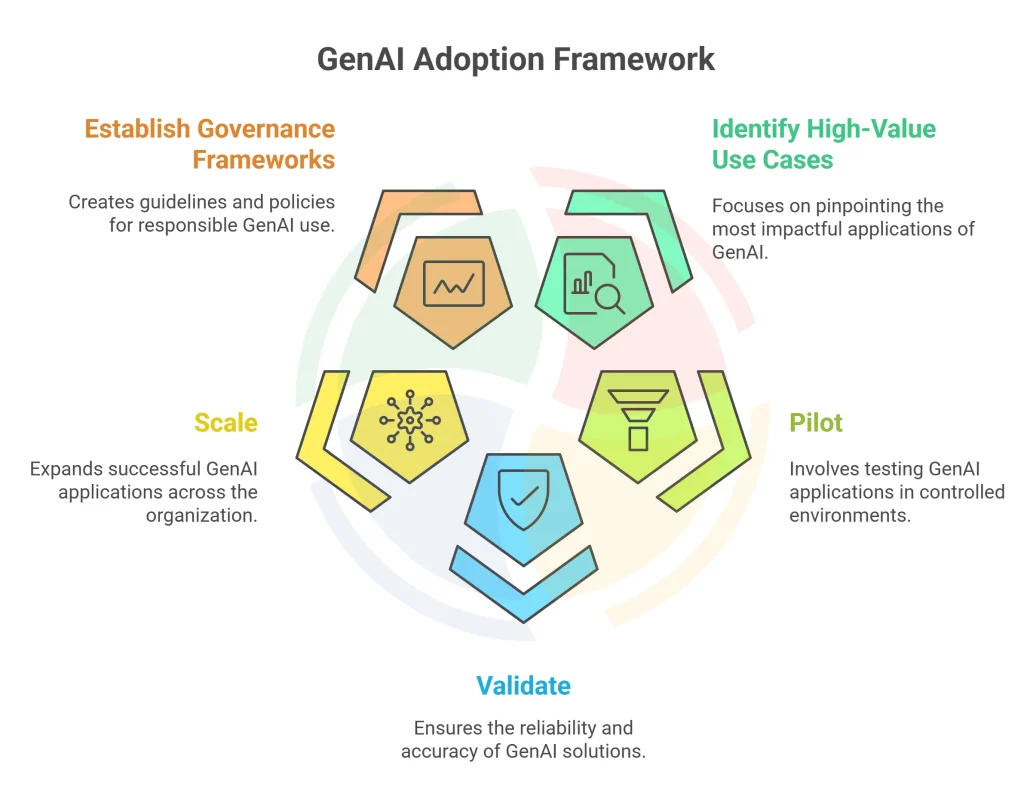
1. Identify High-Value Use Cases
Your adoption journey begins with identifying opportunities where Gen AI can deliver measurable impact. Our team helps you to assess operational bottlenecks, check data readiness, estimate ROI, and prioritize low-risk, high-impact pilots.
A careful selection process helps you accelerate value realization and reduce early-stage complexity.
2. Pilot, Validate, Scale
Before committing large resources, we run controlled pilots to test your assumptions.
By gathering user and performance feedback, refining workflows, and validating outputs, we confirm if the selected model is robust enough for your scalability needs. Once the results align, we expand solutions into production with lower risk and a smoother scale-up.
3. Establish Governance Frameworks
Responsible GenAI on your end requires strong guardrails. Based on your industry governance standards, we define clear ethics guidelines, bias monitoring, human-in-the-loop oversight, and audit-ready documentation.
These are the backbone of a trustworthy system—helping you maintain safety, transparency, and compliance across regulated and non-regulated environments.
4. Foster Cross-Functional Collaboration
Successful generative AI integration into your business depends on its alignment with existing systems— IT, data engineering, security, compliance, and business teams.
We support you in this collaborative planning, shared KPIs, and unified roadmaps to reduce adoption blockers and strengthen organizational buy-in. This synergy of GenAI strategy across systems makes it an operational reality.
5. Measure ROI and Model Impact
Continuous evaluation is essential for long-term success. During post-implementation monitoring and support, we track cost savings, efficiency improvements, accuracy gains, and risk reduction. It brings you a clear picture of whether GenAI is delivering on its promise. With these insights, we can together refine future iterations and maintain sustained performance over time.
Our generative AI services involve designing and implementing effective solutions for your industry-specific requirements.
Challenges and Risks of Generative AI in Regulated Industries
As you accelerate Gen AI adoption, the excitement is matched by a set of practical and strategic hurdles. These challenges highlight why disciplined planning, strong governance, and scalable infrastructure are essential for long-term success.
The significant limitations include:
- Data Quality and Bias: Incomplete, inconsistent, or biased datasets can lead to inaccurate, unsafe, or discriminatory outputs.
- Infrastructure & Compute Costs: Training and running your large models demand high-performance GPUs, scalable storage, and advanced cooling—investments that grow substantially as usage scales.
- Model Transparency: Many Gen AI systems operate as black boxes, making it difficult for your regulated industries to justify decisions, meet compliance standards, or ensure fairness.
- Integration with Legacy Systems: Your legacy enterprise architectures are often incompatible with modern AI workloads, slowing deployments and increasing the cost of modernization.
- Intellectual Property Risks: Determining ownership of AI-generated content remains ambiguous, creating legal uncertainties for your organization using generated text, images, or code.
- Regulatory & Ethical Limitations: Your sensitive domains, such as patient data, financial transactions, media rights, and personal identifiers, are subject to strict regulations that limit how Gen AI can be deployed.
- Workforce Readiness: Employees often require new skills to manage AI tools, validate outputs, and integrate Gen AI into existing workflows.
Engineering Scalable Generative AI Infrastructure with Aegis Softtech
To unlock the full potential of generative AI, you need infrastructure built to scale.
High-density GPU compute, advanced cooling, predictive monitoring, and robust orchestration give you the edge in productivity, reliability, and competitiveness.
With Aegis Softtech, you get access to decades of engineering expertise to design, optimize, and scale infrastructure that mitigates the risks of generative AI in regulated industries.
- Our team of AI developers helps you:
- Optimize GPU clusters for peak performance
- Manage thermal systems efficiently
- Monitor infrastructure health with predictive analytics
- Integrate fully with DCIM/CMMS systems
Every solution is engineered for agility, security, and sustainability—helping your initiatives deliver measurable operational impact.
Take the first step toward building scalable, secure, and high-performing generative AI infrastructure for your business.
FAQs
1. How can businesses identify high-impact generative AI use cases for their industry?
Evaluate operational bottlenecks, assess data quality and availability, consider regulatory constraints, and prioritize use cases with high ROI and low risk.
2. Which industry has much influence of AI?
The tech, healthcare, finance, and manufacturing sectors have the strongest influence on AI development, as they generate high-value data and invest heavily in advanced automation. Their needs often shape AI innovation, standards, and industry-wide adoption.
3. Which industry is not likely to be affected by generative AI?
Industries with minimal digital processes or highly manual, craft-based work, such as small-scale artisanal manufacturing or traditional local trades, may see limited impact in the near term. However, most sectors will experience indirect effects as AI-enabled tools become more widespread.
4. How can small and mid-sized enterprises (SMEs) leverage generative AI effectively?
Start with SaaS-based Gen AI tools, focus on automation and high-impact use cases, and use pay-as-you-go infrastructure to control costs.