
Data is the new oil. But not all oil flows the same way.
Some data is predictable, structured, and flows like a pipeline—names, orders, transactions. Other data is messy and fast-moving—social interactions, sensor logs, real-time updates.
To manage this ever-diversifying data flood, you need database systems that match the shape and velocity of your data.
And most QA teams rely on two foundational data storage technologies: SQL and NoSQL databases.
One is built on decades of relational theory and rigid structure. The other thrives on flexibility and scalability.
This blog explores what these two database models really mean beyond the surface-level buzz.
We’ll unpack the critical differences that influence application behaviour, and illustrate how each fits into real-world systems. Additionally, we’ll examine which is best for your organization, or if you should take a hybrid approach instead.
Let’s get started!
Key Takeaways
A relational database that stores structured data in predefined tables (rows and columns). SQL databases enforce ACID properties to ensure reliable, consistent transactions and strong data integrity.
What is a NoSQL Database?A non-relational database designed for flexible, schema-less data storage. NoSQL systems support models like document, key-value, column-family, and graph, and are optimized for scalability and high-performance workloads.
When to Use SQL DatabaseUse SQL when your application relies on structured data, well-defined relationships, and strong transactional consistency. It’s ideal for financial systems, ERP platforms, inventory management, and other transactional applications.
When to Use NoSQL DatabaseUse NoSQL when dealing with large volumes of semi-structured or unstructured data, rapidly evolving schemas, or distributed systems requiring high scalability and low-latency performance.
When to Use BothMany modern architectures combine SQL and NoSQL. SQL handles core transactional systems requiring consistency, while NoSQL supports high-speed analytics, caching, and large-scale distributed workloads.
What Are SQL and NoSQL Databases?
Every application, from payment systems to social media platforms, relies on structured or unstructured data. How that data is stored, queried, and scaled often determines the performance and resilience of the entire system.
For this, we have two core database models: SQL and NoSQL.
Each one is built for a different kind of workload. Knowing which model to use and when can define the success of your entire architecture.
SQL Databases (Relational)
SQL databases, short for Structured Query Language, are relational databases that store data in predefined tables consisting of rows and columns.
Each row represents a record, and each column defines a data attribute.
Think of it like a well-organized spreadsheet.
These databases enforce ACID properties (Atomicity, Consistency, Isolation, Durability), ensuring reliable transactions and data integrity even at scale.
Relational databases excel in scenarios where data relationships are well-defined, and consistency is critical.
They’re the backbone of enterprise systems. They power OLTP (Online Transaction Processing) applications such as financial systems, HR platforms, and inventory management solutions.
Some of the popular relational databases include MySQL, PostgreSQL, Oracle, and SQL Server. All are widely adopted for their maturity, standardized syntax, and extensive ecosystem support.
NoSQL Databases (Non-Relational)
NoSQL databases, short for “Not Only SQL,” depart from rigid tabular structures. Instead, they offer a schema-less or dynamic data model that adapts to the needs of semi-structured or unstructured data.
NoSQL systems come in four primary types:
- Document-based (e.g., MongoDB)
- Key-value (e.g., Redis)
- Column-family (e.g., Apache Cassandra)
- Graph-based (e.g., Neo4j)
These databases are engineered for horizontal scalability, often distributed across multiple nodes to support high-velocity, high-volume workloads.
They prioritize flexibility, performance, and availability, making them ideal for real-time analytics, big data applications, IoT platforms, and personalized content delivery.
Unlike SQL databases, NoSQL systems often embrace eventual consistency over strong consistency. This trade-off prioritizes speed and fault tolerance over immediate accuracy, especially valuable in globally distributed architectures.
Difference Between SQL and NoSQL Databases
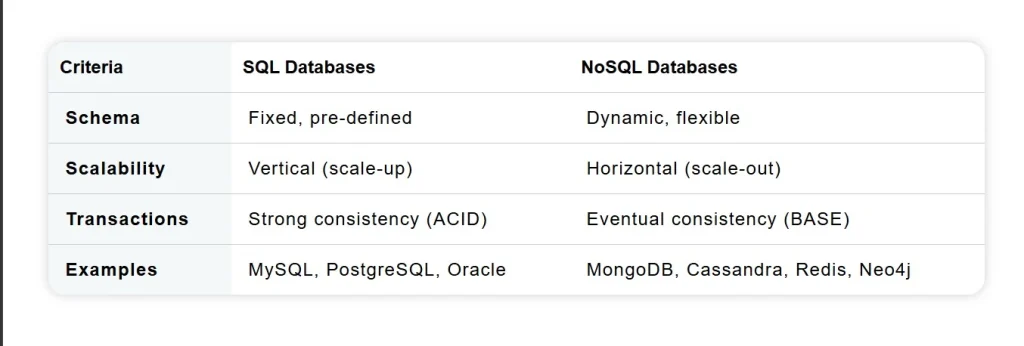
At a glance, the difference between SQL and NoSQL databases lies in how they structure data and scale under load. But under the hood, it’s also about trade-offs between consistency, speed, and flexibility.
Here’s a quick comparison across key criteria:
Performance and Consistency Trade-offs
SQL databases prioritize strong consistency, making them ideal for use cases where transactional integrity matters.
Think banking apps, ERP systems, or order processing. However, this often comes at the cost of performance under massive scale or distributed architectures.
In contrast, NoSQL databases trade strict consistency for performance and availability. These systems distribute data across multiple nodes and relax consistency rules to improve performance.
This allows them to handle massive volumes of reads and writes with low latency. Ideal for real-time analytics, social feeds, and sensor data ingestion.
Developer Speed and Data Variety
Another major difference is how they support development workflows. SQL databases require predefined schemas, which enforce structure but can slow down iterations when data models evolve.
NoSQL databases, with their schema-less design, allow developers to move faster, especially when working with diverse or evolving datasets. Like JSON APIs, event logs, or multimedia content.
When to Use SQL and NoSQL Databases
Choosing between SQL and NoSQL depends on your data structure, scalability needs, and application goals. Here’s how to make an informed choice–or combine both.
When to Use SQL Databases
- Structured Data & Clear Relationships:
If your application relies on well-defined schemas and relationships like users, orders, and inventory, SQL databases provide robust modeling via tables and joins.
- Enterprise Systems:
Ideal for financial systems, ERP platforms, CRM tools, and applications where business rules and referential integrity must be enforced.
- Strong Consistency Requirements:
When every transaction must be reliable and atomic (e.g., bank transfers, inventory deductions), SQL’s ACID compliance guarantees data correctness.
When to Use NoSQL Databases
- Big Data & Real-Time Analytics:
NoSQL databases are optimized for ingesting large volumes of unstructured or semi-structured data at high speed, with low latency.
- Flexible or Evolving Schemas:
In agile environments where data structures change often, NoSQL’s dynamic schemas reduce friction and accelerate development cycles.
- High-Throughput, Distributed Systems:
Perfect for use cases like IoT telemetry, personalization engines, social media feeds, or mobile backends. Any scenario that demands high availability and elastic scaling.
When to Use Both (Polyglot Persistence)
- Blending Strengths:
Modern systems often use SQL for core business logic and transactional consistency, while layering NoSQL for fast analytics, caching, or content delivery.
- Examples in Action:
Netflix uses Cassandra for streaming metadata and MySQL for billing. Uber combines PostgreSQL with Riak and Redis to manage geospatial data and real-time requests.
- Cloud-Native Database Options:
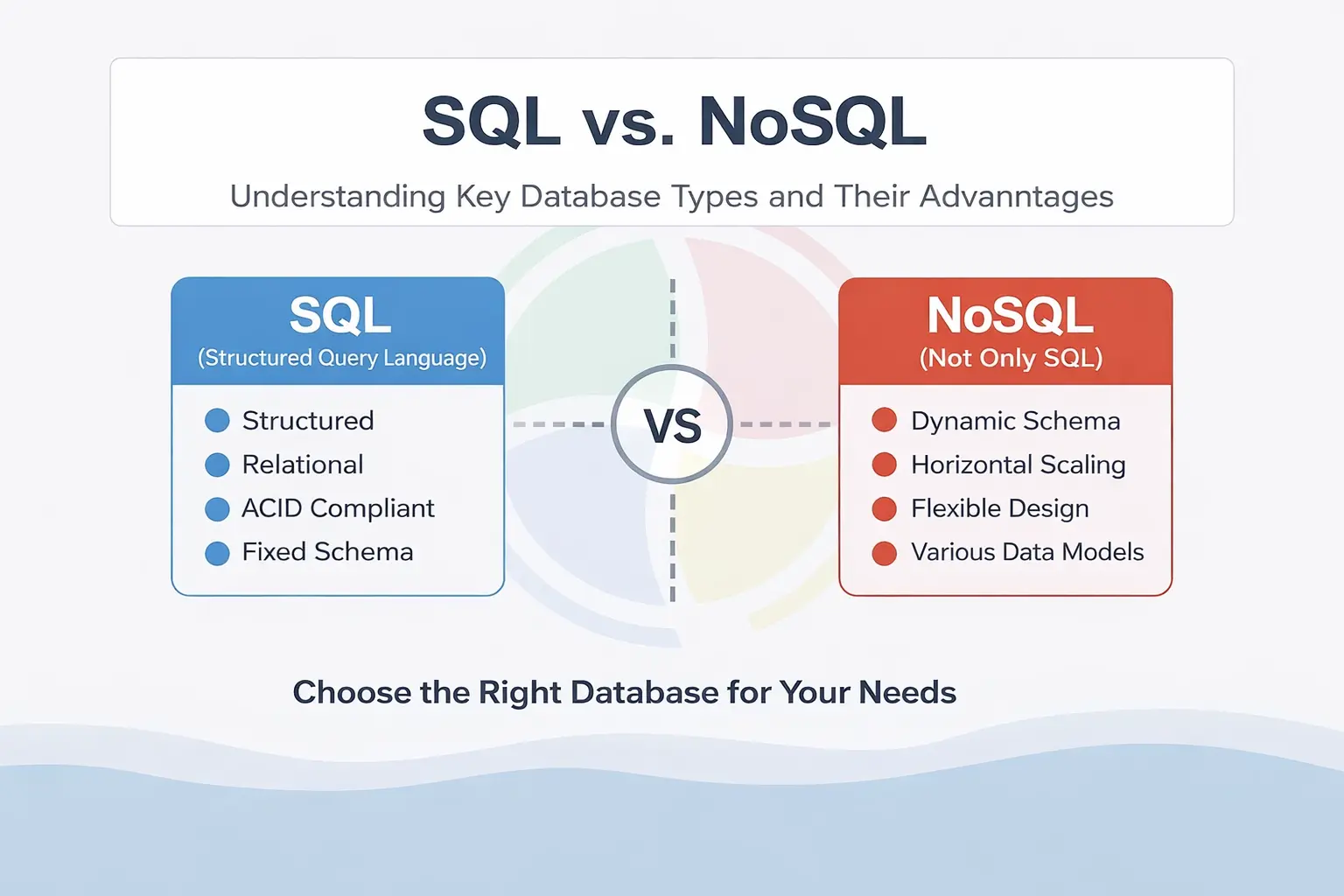
Platforms like Azure Cosmos DB, AWS DynamoDB, and Amazon Aurora support both paradigms. They offer SQL-like querying with NoSQL scalability, enabling hybrid models by design. SQL and NoSQL databases are source systems from which data is extracted and fed into your data warehouses.
Real-World Examples of SQL and NoSQL Databases
Theoretical differences are helpful, but nothing beats real-world context. Let’s look at some of the most widely used SQL and NoSQL databases in production today, along with the use cases they serve best.
Popular SQL Databases
- MySQL
A widely adopted open-source relational database known for simplicity, speed, and community support.
Use Case: E-commerce platforms like Kroger for managing structured transactional data such as product details, inventory, orders, payments, and user profiles, ensuring ACID compliance and data consistency.
- PostgreSQL
A powerful object-relational database with advanced indexing, full-text search, and standards compliance (ACID, ANSI SQL).
Use Case: Geospatial apps, analytics platforms, and fintech systems that require extensibility and complex queries.
- Oracle Database
An enterprise-grade RDBMS designed for high performance, scalability, and security, complete with features like in-memory processing and multi-tenant architecture.
Use Case: Mission-critical systems in banking, telecommunications, and ERP solutions where uptime and data integrity are non-negotiable.
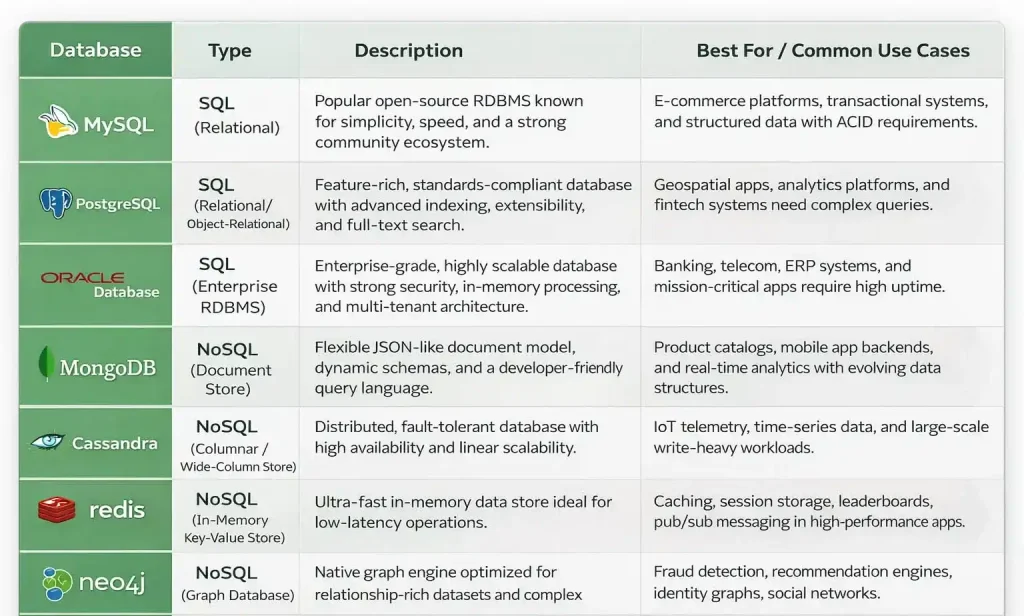
Leading NoSQL Databases
- MongoDB
A document-oriented NoSQL database optimized for JSON-like documents and flexible data structures.
Use Case: Product catalogs, real-time data analytics, and mobile app backends with rapidly changing data models.
- Cassandra
A highly available, distributed columnar store built for fault tolerance and horizontal scalability.
Use Case: IoT telemetry, time-series data, and large-scale write-heavy applications like Netflix’s viewing histories, where downtime isn’t an option.
- Redis
An in-memory key-value store used for blazing-fast data access, session storage, and caching layers.
Use Case: Real-time leaderboards, caching user sessions, and pub/sub messaging queues in high-speed web applications, such as Uber’s driver locations.
- Neo4j
A graph database engineered to model and query complex relationships across large datasets.
Use Case: Fraud detection, recommendation engines, and social networks where connections matter more than individual records.
Pros and Cons of SQL and NoSQL Databases
No technology is universally better—only better suited. Understanding the practical trade-offs between SQL and NoSQL databases helps align your data strategy with application needs.
| Aspect | SQL | NoSQL |
| Maturity | ✅ Decades of stability and proven models | ❌ Still evolving, with newer ecosystem support |
| Flexibility | ❌ Rigid schemas require upfront planning | ✅ Schema-free—ideal for agile development |
| Tooling | ✅ Strong IDEs, ORM libraries, and admin tools | 🟡 Varies across platforms and maturity levels |
| Learning Curve | ✅ Standardized SQL syntax across engines | ❌ Learning differs by DB type (e.g., MongoDB vs Cassandra) |
A Balanced Perspective
- SQL excels in structured environments where data integrity, complex queries, and transactional safety are mission-critical.
- NoSQL leads in flexibility and speed, especially in high-volume, rapidly evolving, distributed systems.
But most real-world applications don’t live at the extremes. In many cases, the right choice isn’t SQL vs NoSQL, it’s how to leverage both responsibly within your tech stack.
SQL and NoSQL Databases in 2026: Key Trends to Watch
The database landscape has been undergoing an accelerated evolution in recent years. What was once a binary choice between SQL and NoSQL has now matured into a dynamic ecosystem.
An ecosystem is typically defined by convergence, specialization, and the need to serve AI-driven, real-time, and global-scale workloads.
Four trends stand out:
- Continued Hybrid Architectures
Hybrid and multi-model databases, such as Azure Cosmos DB and CockroachDB, persist as standard databases, blending SQL ACID guarantees with NoSQL scalability for diverse workloads in IoT and e-commerce. Predictions emphasize polyglot persistence evolving into data mesh architectures, treating data as domain-specific products.
- JSON and SQL Enhancements
SQL engines such as PostgreSQL and SQL Server continue advancing SQL/JSON standards with native parsing, indexing, and hybrid queries, reducing ETL needs and bridging relational-NoSQL gaps for semi-structured data.
- Vector Databases for AI
Vector databases like Pinecone and Weaviate solidify as AI backbones, enabling RAG, semantic search, and LLMs with hybrid capabilities; Gartner forecasts over 40% of AI apps relying on vector search by 2026.
- Serverless and Distributed Growth
Serverless platforms like FaunaDB and Snowflake scale automatically with global replication, supporting agentic AI and zero-copy integration; cloud-native SQL and lakehouse formats like Iceberg drive enterprise adoption
Choosing the Right Database Strategy: SQL, NoSQL, or Both?
Choosing the wrong database won’t just slow down your app. It could actually bottleneck your entire business.
Relational databases like SQL offer structure, reliability, and transactional control. These are ideal for financial systems, ERP suites, and enterprise data integrity.
NoSQL steps in where flexibility, speed, and scale matter most. Think user personalization, real-time analytics, or IoT data streams.
But here’s the real edge: you don’t have to choose one over the other as the source system for your data warehouse. Modern architecture thrives on polyglot persistence–SQL for stability, NoSQL for scale. Giants like Netflix, Uber, and Amazon don’t choose between the two databases. They use both strategically.
As cloud-native platforms like Azure Cosmos DB, AWS Aurora, and DynamoDB blur the lines further, the question shifts from “Which database?” to “How do we design for agility, growth, and AI readiness?”
Want to architect a future-proof, hybrid-ready data stack for your data warehouse?
Aegis Softtech helps enterprises build scalable, real-time, and intelligent database strategies, grounded in business logic, optimized for performance.
With reliable data warehouse consulting services, we help you make the right choice for successful data storage and management.
FAQs
What are the 4 types of NoSQL databases?
Document, key-value, column-family, and graph databases; each purpose-built for different data access patterns.
Is MongoDB a SQL or NoSQL database?
MongoDB is a NoSQL database. It uses a flexible, document-oriented model ideal for unstructured or semi-structured data.
Is PostgreSQL a SQL or NoSQL database?
PostgreSQL is a SQL database. It is a relational database with advanced querying, though it supports JSON and key-value pairs.
Which is faster, SQL or MongoDB?
Depends on workload. SQL is faster for relational queries and joins; MongoDB scales better for large, dynamic datasets with frequent writes.