
You have been running analytics on a traditional data infrastructure. It used to work smoothly for the first few years of your business, but it no longer does.
That’s how data storage and management take a toll on any organization.
With a single conventional data warehouse, your retail orders are manageable, and inventory moves predictably until your business grows.
More stores, more customers, more products. Now your data volume is touching the roof, and there’s no way to manage it all. A cloud data warehouse can change this for you.
Instead of managing fixed infrastructure, your organization can store and analyze large volumes of data on scalable cloud platforms that scale with your business needs.In this guide, we’ll explain “what is a cloud data warehouse?”, how it works, and how you can choose the right platform for your data strategy.
Key Takeaways
- Definition of a cloud data warehouse: A managed, cloud-hosted platform for storing and analyzing large volumes of structured and semi-structured data, without the overhead of on-premise hardware.
- Key advantage: Elastic scalability, pay-as-you-go pricing, zero hardware maintenance, and native integration with modern analytics and AI tools.
- Top platforms: Snowflake, Google BigQuery, Amazon Redshift, Azure Synapse Analytics, SAP Datasphere, Databricks, etc.; each serves different use cases and ecosystems.
- Cloud vs on-premise: Cloud wins on agility, scalability, and lower upfront cost. On-premise wins on control, compliance certainty, and predictable performance for stable workloads.
- Choosing the right platform: Depends on your existing cloud ecosystem, workload type, compliance requirements, team skillset, and total cost of ownership goals.
What is a Cloud Data Warehouse?
A cloud data warehouse is a managed, cloud-based service that centralizes large volumes of structured and semi-structured data for analytics, business intelligence, and reporting.
Unlike a traditional data warehouse that runs on hardware you own and manage, a cloud data warehouse runs on infrastructure provided and maintained by a vendor such as AWS, Google Cloud, Microsoft Azure, or Snowflake.
You do not buy servers. You do not manage patches. You do not plan capacity months in advance. You connect your data sources, load your data, and start querying.
Typical Characteristics of Cloud Data Warehouse Platforms
- Managed infrastructure: The vendor handles hardware provisioning, software updates, backups, and availability. Your team focuses on data, not operations.
- Elastic compute and storage: Resources scale up or down based on workload demand, often automatically and without downtime.
- Pay-as-you-go pricing: Most platforms charge based on storage consumed and compute used, replacing large CapEx with flexible OpEx.
- SQL-based access: Cloud data warehouses support standard SQL, making them accessible to analysts and engineers without specialized training.
- Built-in integrations: Native connectors to BI tools like Tableau, Power BI, and Looker, as well as ETL/ELT platforms like Fivetran and dbt, reduce integration friction.
- High concurrency: Designed to support many simultaneous users and workloads without performance degradation.
Benefits of Cloud Data Warehouses for Analytics Teams
Cloud data warehouses remove the barriers that traditionally slowed analytics delivery. Provisioning a new environment takes minutes instead of months.
Storage is virtually unlimited. Compute scales to handle end-of-quarter reporting spikes without any manual intervention.
Because the vendor manages the underlying infrastructure, analytics teams spend more time building insights and less time managing systems.
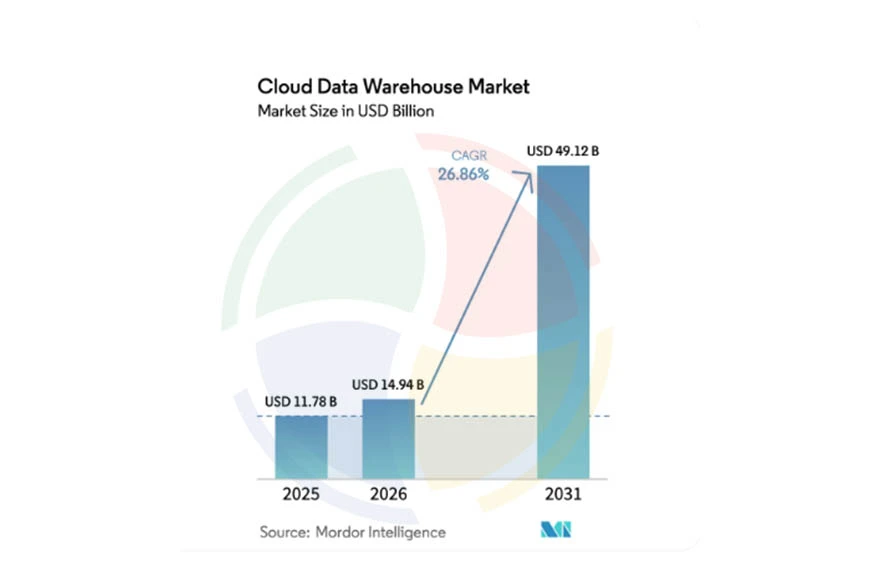
According to Mordor Intelligence , the cloud data warehouse market is projected to grow from $6.67 billion in 2024 to $11.22 billion by 2029, at a CAGR of 10.97%.
Cloud Data Warehouse Architecture
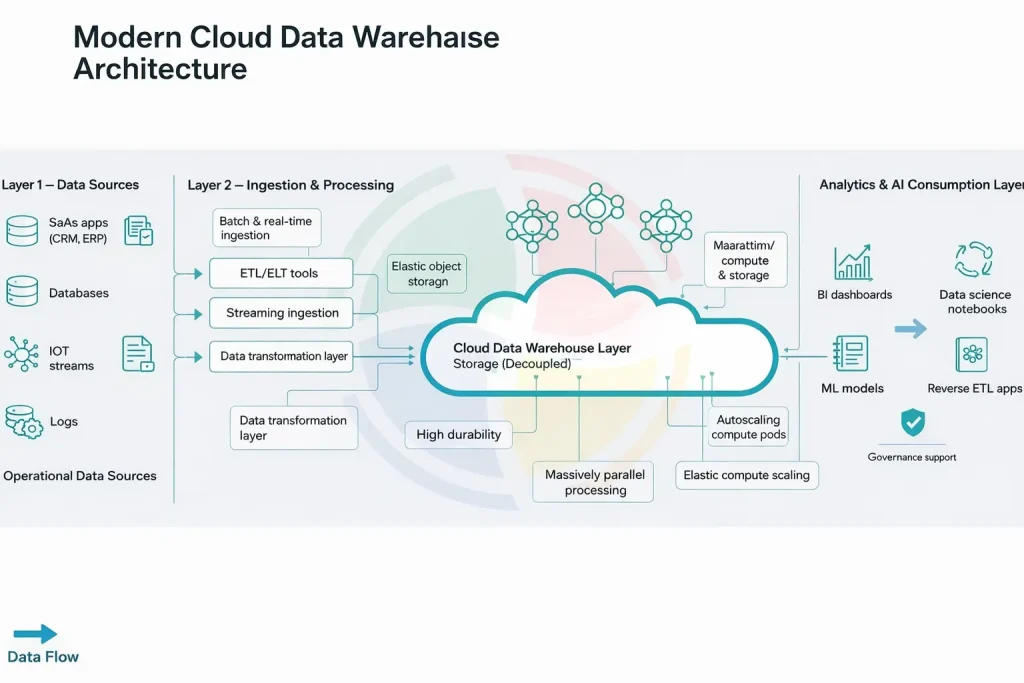
Understanding how a cloud data warehouse is architected helps you evaluate platforms more effectively and design deployments that match your workload needs.
Core Components and Design Principles
Modern cloud data warehouse architecture is built around a few foundational principles.
Separation of Compute and Storage: It is the most significant architectural shift from traditional systems. In on-premise warehouses, compute and storage are tightly coupled, meaning you scale both together even if you only need more of one. Cloud data warehouses decouple them, allowing you to scale compute independently for heavy query workloads and store data cost-effectively without paying for idle compute.
Massively Parallel Processing (MPP): MPP distributes query execution across many nodes simultaneously. Instead of one server grinding through a billion-row table, dozens or hundreds of compute nodes each handle a slice of the work. This is what enables sub-second query performance at petabyte scale.
Elasticity and Auto-scaling: This allows the platform to spin up additional compute resources during peak demand and scale them back down when workloads subside. It is managed automatically on serverless platforms like BigQuery or manually configured on cluster-based platforms, such as Amazon Redshift.
Redundancy and High Availability: These traits are built in at the infrastructure level. Data is replicated across multiple availability zones and regions, so hardware failures do not result in data loss or service outages.
Multi-Cloud and Hybrid Architectures
Not every organization runs on a single cloud provider. Many enterprises operate across AWS, Azure, and Google Cloud simultaneously, and some maintain on-premise systems alongside cloud environments. Cloud data warehouses address this in different ways.
Snowflake runs natively on all three major cloud providers and allows data sharing across them. Azure Synapse integrates tightly with Microsoft’s hybrid infrastructure tools. SAP Datasphere supports hybrid deployments where on-premise SAP data connects seamlessly to cloud analytics.
Hybrid architectures are common in highly regulated industries where certain data must remain on-premises for compliance reasons, while less sensitive workloads are processed in the cloud.
How Data Warehouses and Data Lakes Interact
A cloud data warehouse and a data lake serve different but complementary roles. A data lake stores raw, unprocessed data in its native format, including unstructured data like logs, images, and documents. A data warehouse stores structured, processed data optimized for querying and reporting.
In modern architectures, data flows from source systems into a data lake, gets transformed via an ELT pipeline, and lands in the data warehouse for analytics. Some platforms, like Databricks with Delta Lake and BigQuery with its external table support, blur the line between the two through a lakehouse model.
Security, Compliance, and Governance
Cloud data warehouse vendors invest heavily in security capabilities that most enterprises cannot replicate on their own. Standard features include encryption at rest and in transit, role-based access controls, multi-factor authentication, network isolation via VPCs, and detailed audit logging.
For compliance, leading platforms hold certifications including SOC 2 Type II, ISO 27001, HIPAA, and GDPR readiness. That said, compliance in the cloud follows a shared responsibility model: the vendor secures the infrastructure, and you are responsible for securing your data, access policies, and configurations.
DWH data governance tools like column-level security, dynamic data masking, and row-level access policies are now standard across major platforms, enabling organizations to control who sees what data without duplicating datasets.
Cloud Data Warehouse Platform Comparison
| Platform | Storage and Compute Architecture | Best For | Strengths | Limitations |
| Snowflake | Decoupled compute and storage | Mid to large enterprises needing elasticity | Multi-cloud, zero copy sharing, Snowpark for Python/ML | Can get costly with high concurrency |
| SAP Datasphere | Tight SAP integration; hybrid-ready | Enterprises using SAP ERP (S/4HANA) | Compliance-focused, native SAP ecosystem, hybrid flexibility | Less agile for non-SAP workflows |
| Google BigQuery | Serverless, fully managed | Real-time analytics and large data sets | Auto-scaling, high performance, built-in ML with BQML | Cost optimization requires careful planning |
| Amazon Redshift | Cluster-based with RA3 flexibility | AWS-native analytics environments | Mature, Redshift Spectrum, good for semi-structured data | Not truly serverless, performance tuning needed |
| Azure Synapse Analytics | Integrated DW and Spark and pipelines | Microsoft ecosystem and BI-focused teams | Tight Power BI integration, hybrid analytics | Complex pricing, learning curve |
| IBM Db2 Warehouse on Cloud | Container-based cloud deployment | Regulated industries and legacy IBM users | ACID-compliant, strong security, deep analytics | Less popular among modern startups |
| Databricks (Lakehouse) | Lakehouse via Delta Lake | ML-heavy organizations and real-time streaming needs | Unified AI/BI workloads, auto-scaling, Apache Spark-native | UI less intuitive for pure BI workloads |
| Firebolt | Decoupled compute and storage | Real-time dashboards and low-latency apps | Sub-second query performance, great for embedded analytics | Smaller ecosystem, less mature tooling |
| Oracle Autonomous DW | Autonomous, self-driving DB | Oracle-heavy enterprises and finance verticals | Self-tuning, ML capabilities, multi-model support | Premium pricing, vendor lock-in |
Choosing a cloud data warehouse platform affects how your analytics teams work, how much you spend, and how quickly you can move as your data needs evolve.
Here is what to look for and how the leading platforms stack up:
What Makes a Solution Best-in-Class?
The right platform depends on your specific context, but the strongest solutions share a few qualities. They separate compute from storage cleanly. They scale without manual tuning. They integrate with the tools your teams already use. They offer transparent, predictable pricing. And they have a proven track record with organizations at your scale and in your industry.
Snowflake Cloud Data Warehouse
Snowflake as a cloud data warehouse is widely regarded as the benchmark cloud platform in 2026. It was purpose-built for the cloud, meaning it does not carry the architectural debt of systems originally designed for on-premise deployment.
Snowflake’s defining characteristic is its complete separation of compute and storage. You can run multiple independent compute clusters, called virtual warehouses, against the same data simultaneously. This means your data science team, your BI analysts, and your operational reporting jobs never compete for resources.
Key features include zero-copy cloning for instant environment duplication, Snowflake Marketplace for third-party data sharing, native support for Python and Java via Snowpark, and Cortex AI for running large language model workloads directly within the platform. Snowflake runs on AWS, Azure, and Google Cloud, making it a genuinely multi-cloud option.
The main caution with Snowflake is cost management. Its consumption-based pricing is flexible but can escalate quickly with inefficient queries or high-concurrency workloads. Organizations need to implement resource monitors and query optimization practices to keep spending predictable.
SAP Cloud Data Warehouse
SAP’s cloud data warehousing offering, now branded as SAP Datasphere, is designed for enterprises that run their core operations on SAP products like S/4HANA. Its key differentiator is not raw query performance but rather the depth of its integration with the SAP ecosystem.
SAP Datasphere provides a unified environment where business users can access SAP transactional data alongside external sources without complex ETL pipelines. It includes a business semantic layer that preserves SAP data models and business logic, meaning finance and operations teams see data in terms they recognize rather than raw database tables.
From a compliance perspective, SAP Datasphere supports data residency requirements and integrates with SAP’s broader governance and security framework. For industries with complex regulatory environments and deep SAP investments, this is a significant advantage.
Compared to the on-premise SAP BW/4HANA, SAP Datasphere offers faster deployment, lower infrastructure overhead, and more flexible scaling. Organizations migrating from BW/4HANA can preserve their existing data models while gaining cloud agility.
The limitation is scope. SAP Datasphere is optimized for SAP-centric workflows. For organizations with diverse, non-SAP data environments, other platforms typically offer greater flexibility and a broader integration ecosystem.
Comparing Cloud vs. On-Premise Data Warehouses
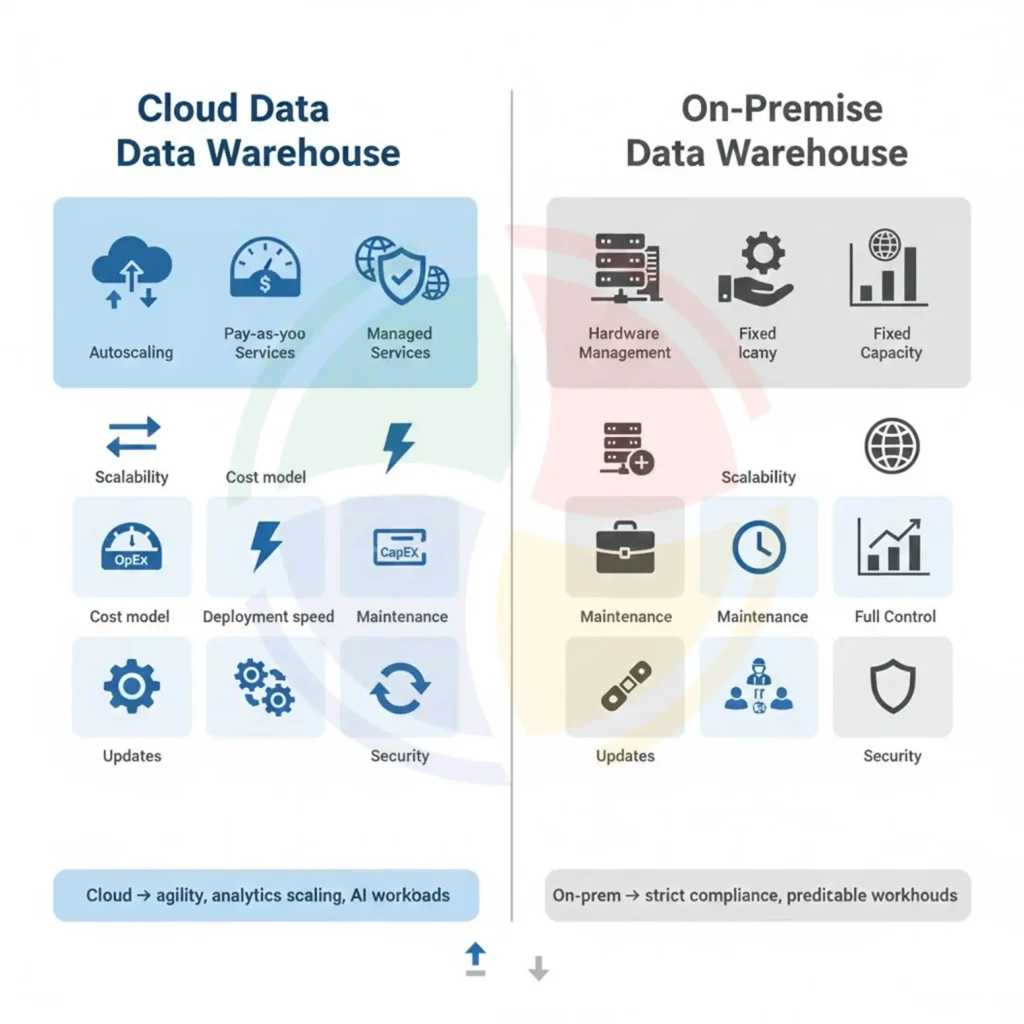
The shift toward cloud data warehouses is well underway, but on-premise systems still make sense for specific organizations and workloads.
Here is an honest comparison across the factors that matter most:
Scalability
Cloud data warehouses scale on demand. Adding compute or storage takes minutes and requires no hardware procurement. On-premise systems are limited by the physical hardware installed in your data center. Scaling requires purchasing new servers, provisioning racks, and waiting through procurement cycles that can take weeks or months.
Cost Structure
Cloud operates on an OpEx model. You pay for what you use, with no large upfront investment. This lowers the barrier to entry and makes costs predictable for variable workloads.
On-premise requires significant CapEx upfront for hardware, software licenses, and data center infrastructure. However, for stable, predictable workloads that run at consistent capacity, the long-term total cost of ownership can favor on-premise once the initial investment is amortized.
Performance
On-premise systems deliver consistent, low-latency performance for local workloads because data and compute reside in the same physical environment. Cloud performance is excellent for distributed and parallel workloads, but it depends on network connectivity. Latency-sensitive applications that run entirely within a single data center may still favor on-premise deployments.
Security and Compliance
A common misconception is that on-premise is inherently more secure than cloud. In practice, cloud vendors invest in security capabilities that most enterprise IT teams cannot match. It includes dedicated security engineering teams, continuous penetration testing, and compliance certifications across dozens of regulatory frameworks.
The real advantage of on-premise is control: you know exactly where your data is, who touched it, and how it is secured. For industries with strict data residency requirements or classified data, that certainty can outweigh the operational benefits of the cloud.
Updates and Maintenance
Cloud platforms update automatically. Features improve, security patches deploy, and performance optimizations roll out without any action from your team. On-premise requires your IT staff to plan, test, and execute upgrades, which consumes time and introduces risk.
Migration Strategy and Considerations
Moving from on-premise to a cloud data warehouse is not a lift-and-shift operation. Data models may need redesign. ETL pipelines require re-engineering. Query performance tuning differs between platforms. A phased data warehouse migration approach, starting with lower-risk analytical workloads before moving mission-critical systems, reduces disruption and gives teams time to build cloud expertise before full cutover.
Key Advantages and Limitations of Cloud-Based Data Warehouse Platforms
While cloud data warehouses deliver impressive scalability and flexibility, they also introduce a new set of operational and strategic trade-offs.
The following breakdown highlights the most significant advantages and potential limitations businesses should consider:
| Aspect | Pros | Cons |
| Elasticity | Instantly scalable compute and storage resources based on demand | May require autoscaling configuration and monitoring |
| Total Cost of Ownership (TCO) | Pay-as-you-go pricing reduces upfront CapEx; optimized OpEx | Costs can rise unexpectedly with inefficient queries or high concurrency |
| Resource Pooling | Multi-tenancy and shared resources improve efficiency | Shared environments may raise concerns for sensitive data |
| Ease of Management | No hardware to maintain; automated backups, patching, and scaling | Less granular control compared to on-prem systems |
| Continuous Updates | Platforms improve regularly with zero downtime or user intervention | Feature changes may require regular team training or adaptation |
| Vendor Lock-In | — | Proprietary APIs and storage formats make migration difficult |
| Data Privacy & Regulations | — | Compliance challenges with regional laws (e.g., GDPR, HIPAA) |
| Egress Fees | — | High costs when moving data out of the cloud to other environments |
Setup the Right Cloud Data Warehouse with Aegis Softtech
A cloud data warehouse is the foundation on which your organization’s data analytics, business intelligence, and AI capabilities are built. Choosing the wrong platform means higher costs, slower insights, and a harder migration path later. Choosing the right one means your data teams can focus on building value instead of managing systems.
Your existing cloud ecosystem matters. If your organization runs primarily on AWS, Redshift offers deep native integrations that reduce complexity. If you are a Microsoft shop, Azure Synapse and its tight Power BI integration are a natural fit. If you need true multi-cloud flexibility, Snowflake is purpose-built for that.
At Aegis Softtech, we work with enterprises navigating data warehouse decisions, from platform evaluation to implementation and beyond.
If you are assessing your options or planning a migration, our team with end-to-end data warehouse consulting supports to find the right fit. For your architecture, compliance needs, and budget.
FAQs
1. What are examples of cloud data warehouses?
The most widely used cloud data warehouses include Snowflake, Google BigQuery, Amazon Redshift, Microsoft Azure Synapse Analytics, SAP Datasphere, IBM Db2 Warehouse on Cloud, Databricks, Firebolt, and Oracle Autonomous Data Warehouse. Each serves different use cases, ecosystems, and scale requirements.
2. Is AWS a cloud data warehouse?
AWS is a cloud platform, not a data warehouse itself. AWS offers Amazon Redshift as its primary cloud data warehouse service. Redshift is a cluster-based, fully managed data warehouse built for large-scale analytics workloads and integrates deeply with other AWS services like S3, Glue, and SageMaker.
3. What are the three types of cloud data storage?
The three main types of cloud data storage are object storage (such as Amazon S3 or Google Cloud Storage, used for unstructured data and data lakes), block storage (used for databases and applications requiring low-latency access), and file storage (used for shared file systems and traditional file-based workloads). Cloud data warehouses typically use object storage as their underlying storage layer.
4. Which is the best cloud data warehouse?
There is no single best cloud data warehouse for every organization. Snowflake is widely regarded as the most flexible and enterprise-ready option in 2025. Google BigQuery excels for serverless, large-scale analytics. Amazon Redshift suits AWS-native environments. Azure Synapse fits Microsoft-centric teams. The best choice depends on your cloud ecosystem, workload type, compliance needs, and budget.